
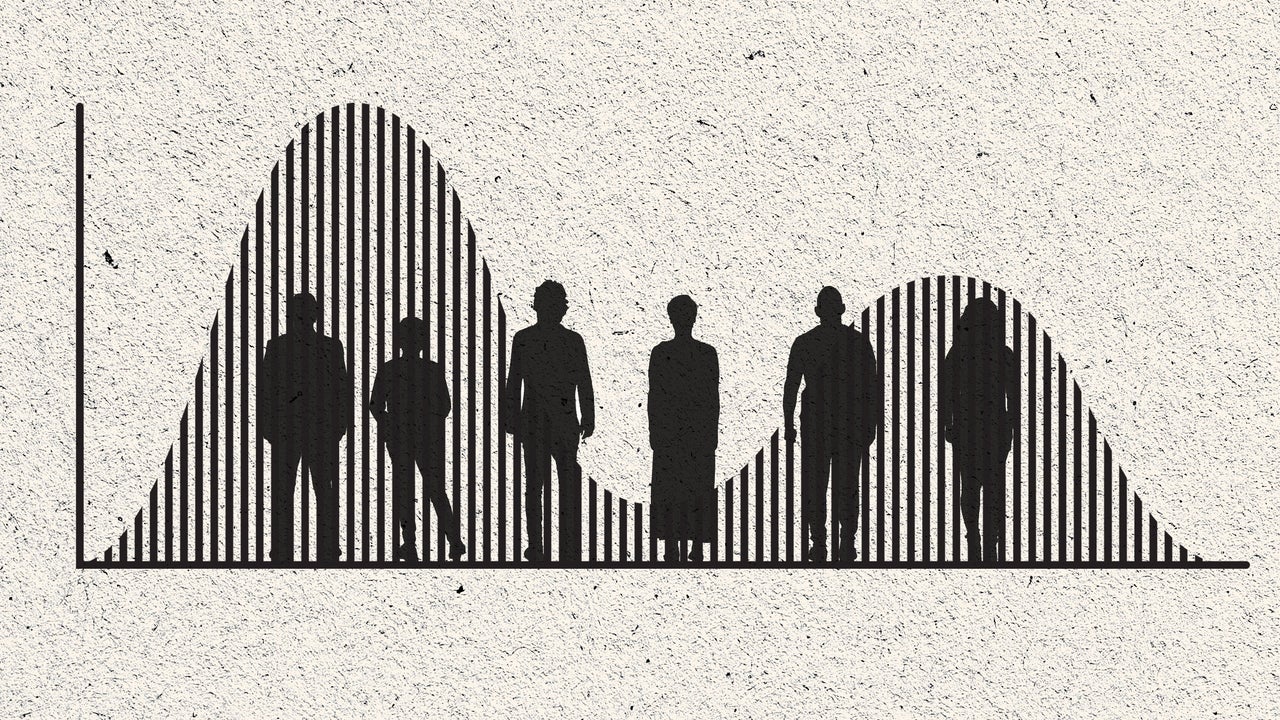
I grew up believing one thing: Don’t be average.
Looking back now, as an older, slightly fatter man, there’s something wonderfully ironic about that particular piece of advice. While every person in authority was telling me not to become average, the systems around me were teaching me exactly how to become it.
School teaches us there was one right answer. Business teaches us there’s a right process. Algorithms tell us there’s a right format. Most industries have their own best practices, and society at large constantly reminds us that fitting in is safer than standing out.
{“blockType”:”mv-promo-block”,”data”:{“imageDesktopUrl”:”https://images.fastcompany.com/image/upload/f_webp,q_auto,c_fit/wp-cms-2/2026/06/JamesMartinPromoLogo_1280x720.png”,”imageMobileUrl”:”https://images.fastcompany.com/image/upload/f_webp,q_auto,c_fit/wp-cms-2/2026/06/JamesMartinPromoLogo.png”,”eyebrow”:””,”headline”:”u003Cemu003EMade By Jamesu003C/emu003E”,”dek”:”Want to build a recognizable reputation in your industry? Head to James Martin’s website, sign up for his newsletter, and stay informed about his upcoming events, workshops, and more. For information, go to themadebyjames.com.”,”subhed”:””,”description”:””,”ctaText”:”Learn More”,”ctaUrl”:”http://themadebyjames.com”,”theme”:{“bg”:”#000000″,”text”:”#ffffff”,”eyebrow”:”#9aa2aa”,”subhed”:”#ffffff”,”buttonBg”:”#3b3f46″,”buttonHoverBg”:”#3b3f46″,”buttonText”:”#ffffff”},”imageDesktopId”:91563943,”imageMobileId”:91563950,”shareable”:false,”slug”:””,”wpCssClasses”:””}}
None of these proven systems are bad. In fact, they’re incredibly useful. They help us educate millions of little people, build reliable businesses, and make sense of an increasingly complicated world.
But when you start stacking them on top of one another, year after year, decade after decade… something intriguing happens. They all pull us in the exact same direction:
- Toward what’s proven
- Toward what’s predictable
- Toward what’s familiar
- Toward the flipping middle
We hear a lot these days about falling test scores, declining creativity, and a lack of ambition. I’m not convinced that’s the whole story. I think we’re living inside an ecosystem of invisible forces that constantly reward the safest path. Millions of perfectly sensible decisions, made by perfectly sensible people, combine to suck us toward the same ideas until we all end up in the exact same place… the fookin’ middle.
I call this: the gravity of average.
Whether we realize it or not, we’ve been caught in its invisible pull since the day we were born … damn it.
Here are the five layers of gravity conspiring against us all, and why you need to fight them with everything you’ve got to protect your individual magic.
1. Educational gravity
Our first experience of this gravity starts in the classroom.
School has an incredibly difficult job: educating millions of children fairly and consistently, often with limited resources and enormous expectations. The only way to make that possible is to rely on standardized curricula, rigid grading schemes, and easily measured outcomes.
From a very young age, we learn to optimize for what gets rewarded … the gold stars, the praise from teachers, the good-old pats on the back. Before long, we’re no longer just learning the subject, we’re learning how to succeed within the system.
The educational environment doesn’t intentionally produce average people. Far from it. But when success is measured in the exact same way for everyone, it’s only natural that millions of children begin chasing the exact same things. The more people optimize for the identical outcome, the more they will eventually look alike… it’s the logical outcome of a predictable system.
2. Economic gravity
Businesses only exist if they survive, and to do that, they have to make rational decisions. If a pricing model has worked before, why change it? If a marketing strategy has proven successful, why reinvent it? If a competitor is growing using a particular approach, it’s only natural to copy it.
None of these are bad decisions.
Economist Harold Hotelling described this exact phenomenon in what became known as Hotelling’s Law. When businesses compete for the same customers, they naturally drift toward one another rather than away. Differentiation feels risky, while similarity feels sensible.
Over time, this way of thinking compounds. What starts as “best practice” gradually becomes the default way of doing business. When an entire industry chases the identical measures of success (revenue, profit, or market share), even the most original business ideas eventually drift toward the average when they optimize for the same thing.
3. Social gravity
As humans, we’ve always worried about belonging. For most of human history, being accepted by the group dramatically increased our chances of not becoming dead.
That instinct is still hardwired into us. One of my favourite psychology experiments that backs this up comes from Solomon Asch. Participants were invited into a room to complete what they thought was a simple test about the length of a few lines. What they didn’t know was that everyone else in the room was an actor hired to be in on the experiment.
The answers were obvious, but one by one, the actors deliberately gave the wrong answer. Faced with an entire room disagreeing with them, many participants ignored what they could clearly see and went along with the crowd instead. Around 75% of people conformed at least once, even though the group was clearly wrong.
Nobody has to tell us to fit in. We just learn which parts of ourselves earn acceptance and which parts are safer left hidden.
4. Algorithmic gravity
Welcome to the newest kid on the block. Algorithms don’t care about “silly” things like originality … all they give a poop about is retention.
The easiest way to predict what will keep your attention is to look at what has already worked. Successful ideas become recommendations. Recommendations become trends. Trends become the templates that every influencer and their dog starts copying. Before long, thousands of people are creating different versions of the exact same thing because that’s what the system keeps serving up.
Social media isn’t in the business of finding the next brilliant idea. It’s in the business of keeping us scrolling, and scrolling, and scrolling. And the easiest way to do that is by feeding us a slightly repackaged version of the average … the baseline of everything the system has already gobbled up before.
5. Professional gravity
Every profession develops its own “playbook.” Designers have processes, marketers have foolproof plans, and consultants have their frameworks. Most of these defaults exist because someone, at some point, solved a real problem for a real person … hurrah.
The danger happens when best practice subtly becomes the only practice. The longer an approach survives unquestioned, the more it feels like common sense. Before long, entire industries are repeating formulas that worked 30 years ago, even though the world has completely evolved around them. The comfort zone is a very dangerous place. Nothing grows there, as they say.
The optimization trap
What I’ve realized about these five forces is that they all share the exact same mischievous mechanism. Every system must decide what success looks like and, once it does, the rest of us naturally optimize for it.
- School rewards grades.
- Business rewards revenue.
- Algorithms reward engagement.
- Society rewards acceptance.
- Professions reward best practice.
None of the above are bad … but when millions of people chase the exact same measures of success, gravity takes over. Human beings are remarkably good at adapting to their environment. The more we align ourselves with the same definition of success, the more we begin to resemble one another.
And today, more people than ever are finding themselves in the middle.
For most of history, becoming competent at something took years of deliberate practice. Today, technology can get almost anyone to “good enough” in a matter of minutes.
Technology is closing the gap from below, while optimization is closing the gap from above. People who once struggled to produce competent work can now create something perfectly passable with better tools. At the same time, many of the people who were once exceptional are handing more of their thinking over to those same tools. In the pursuit of speed they often sacrifice the originality and personality that made them stand out in the first place.
One force lifts people into the middle. The other pulls people back towards it.
Now, there is absolutely nothing wrong with being average. Millions of people build fulfilling careers, do meaningful work, and live brilliant lives without ever trying to stand out.
But commercially, today, average is becoming a far riskier place to build a future.
To riff on something Rory Sutherland once said: when you become logical, you become predictable. And when you become predictable, you become replaceable.
That doesn’t mean you should reject logic or stop using new technology. It simply means those things are no longer enough. They help you meet the standard, yes, but they’ll never make you the obvious choice.
I’ve come to believe that opportunity doesn’t flow toward the middle. It flows toward recognizable differences that people trust.
The gravity of average never disappears.
You simply decide whether to drift with it … or spend your time pushing against it.
Maybe that’s what Mr. Hotelling was trying to tell us all along.
Test the edges.
{“blockType”:”mv-promo-block”,”data”:{“imageDesktopUrl”:”https://images.fastcompany.com/image/upload/f_webp,q_auto,c_fit/wp-cms-2/2026/06/JamesMartinPromoLogo_1280x720.png”,”imageMobileUrl”:”https://images.fastcompany.com/image/upload/f_webp,q_auto,c_fit/wp-cms-2/2026/06/JamesMartinPromoLogo.png”,”eyebrow”:””,”headline”:”u003Cemu003EMade By Jamesu003C/emu003E”,”dek”:”Want to build a recognizable reputation in your industry? Head to James Martin’s website, sign up for his newsletter, and stay informed about his upcoming events, workshops, and more. For information, go to themadebyjames.com.”,”subhed”:””,”description”:””,”ctaText”:”Learn More”,”ctaUrl”:”http://themadebyjames.com”,”theme”:{“bg”:”#000000″,”text”:”#ffffff”,”eyebrow”:”#9aa2aa”,”subhed”:”#ffffff”,”buttonBg”:”#3b3f46″,”buttonHoverBg”:”#3b3f46″,”buttonText”:”#ffffff”},”imageDesktopId”:91563943,”imageMobileId”:91563950,”shareable”:false,”slug”:””,”wpCssClasses”:””}}
Source link