
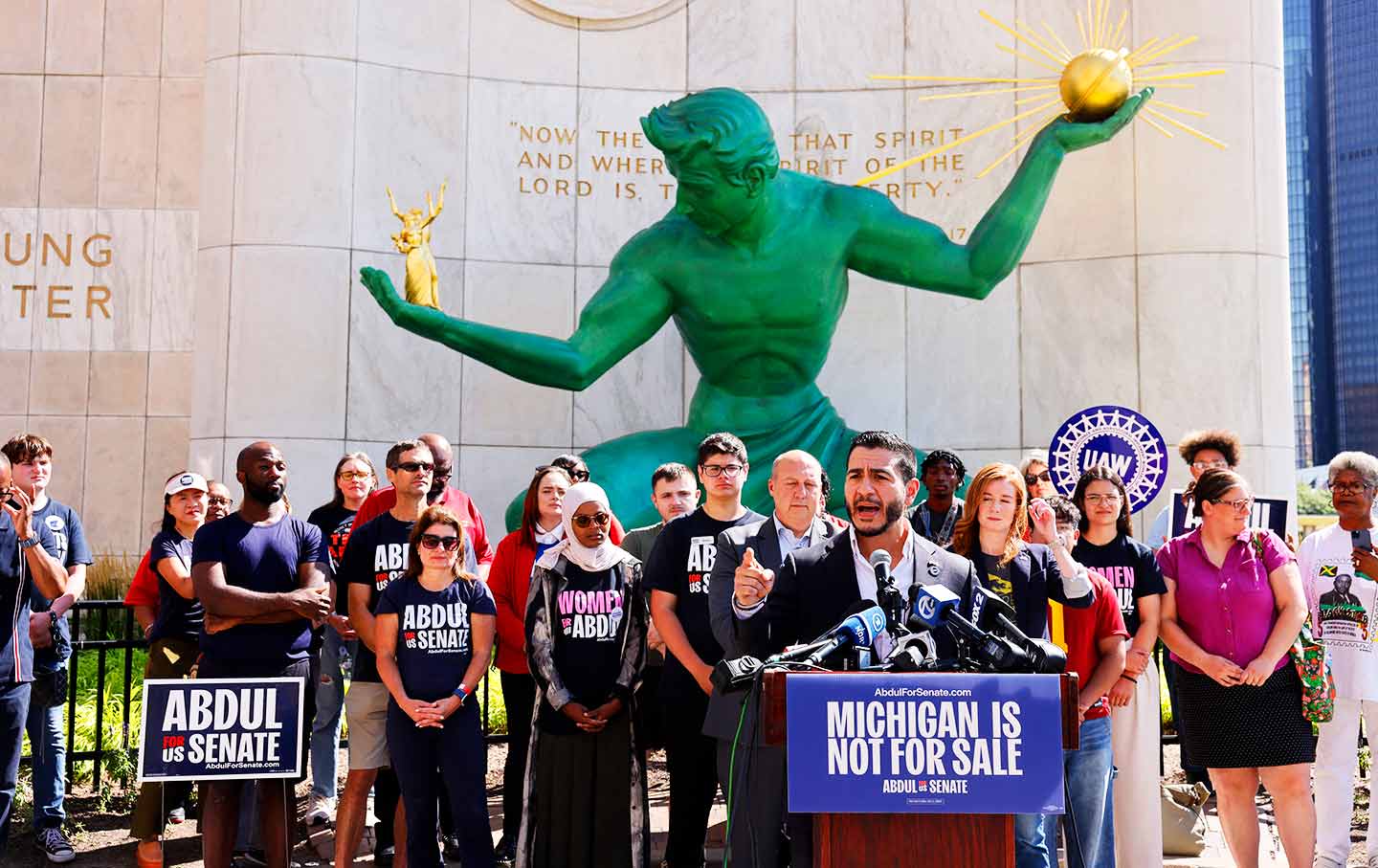
The progressive Senate candidate has won over students with his politics—and, in at least one case, his protein intake.
Parker Ward remembers every detail about his first time meeting Abdul El-Sayed. It was October 3, 2025, and El-Sayed was holding a town hall for Central Michigan University students, cohosted by the school’s College Democrats chapter, of which Ward is president. In the basement of a local Unitarian church, about 30 people showed up—half students, half Mount Pleasant community members.
“I loved listening to him, and I thought everything he was saying was awesome,” Ward recalls. El-Sayed spent his time answering the audience’s questions—discussing how people could connect across political divides, how AI policies affect students, and what community safety in the face of gun violence looks like. But as Ward was sitting there, listening intently to El-Sayed’s policy platform, he couldn’t help but notice something.
“I was like, ‘Oh my God, this dude is jacked,’” Ward remembers thinking to himself. After El-Sayed posed with the CMU College Democrats members for a picture following the event, Ward turned to him, shook his hand, and asked him the question that was at the top of his mind: “Abdul, how much protein do you eat in a day?”
“I don’t think he was expecting it, he just closed his eyes and laughed,” Ward recalls. El-Sayed gave him an answer: 180 to 182 grams of protein per day. It was, perhaps, the moment that Ward knew he was going to vote for El-Sayed.
“This dude is locked in,” Ward said. “I have to vote for him. I’m sold. That’s our next senator.”
Just over a year later, on October 9, more than a thousand students and local community members filled an auditorium at CMU to see El-Sayed speak. Where only a few dozen people had shown up to see the candidate a year before, now, the crowd was so big that some people had to be turned away at the door.
Current Issue

College campuses and young voters have always been a focal point of El-Sayed’s campaign. In 2025, El-Sayed held student town halls all around the state, visiting campuses from Wayne State University in Detroit to Northern Michigan University in the upper peninsula.
“It was really critical for us as we were building our campaign to go and listen to young people first, to engage them on the issues that are the most important in their lives,” El-Sayed told The Nation in January. “I see young people as being a foundational engine of this movement. And so it only made sense to start reaching out to them.”
That philosophy has paid off. In the August primary, El-Sayed won young voters by large margins, and led in major counties where the younger vote is concentrated. And come Election Day, a strong turnout from the youth voter bloc will be necessary for El-Sayed to beat Republican candidate Mike Rogers.
Over the course of a year, El-Sayed’s team has built up a network of campus fellows who run Students for Abdul chapters across college campuses in Michigan. To date, the campaign has 25 fellows, spread across 12 college campuses. Day to day, they handle voter outreach on campuses, create content promoting El-Sayed for social media, organize events, and inform the campaign of the priorities on their campuses.
“The goal with the program is record youth turnout,” said Milo Slevin, one of two campus campaign managers for the El-Sayed campaign. “Abdul has this unique and powerful ability to speak to students: to the issues that young people care about, to the values they want to see reflected in their government.”
Those youth voter outreach efforts are aided by the relationships that the El-Sayed campaign has fostered with College Democrats chapters across the state, where many of them work alongside local Students for Abdul chapters, organizing their own tabling efforts and registering new voters. The events have ramped up, too. In the lead-up to Election Day, El-Sayed has continued to visit colleges across the state, drawing massive crowds that bring together students and local community members in college towns.
Slevin said that the campaign has directed its attention primarily to eight campuses across the state, with 19 of the 25 fellows working on one of those campuses. Their target schools, which include larger state schools like the University of Michigan and Michigan State University, tend to be residential campuses as opposed to commuter colleges. With residential campuses, students are usually on campus around the clock, allowing for more outreach opportunities. Oftentimes, they already have existing political student organizations on campus, like College Democrats.
Stella Camerlengo, the president of Michigan College Democrats, which is considered a caucus of the Michigan Democratic Party, said that the chapters of College Democrats across the state were focused on “reaching as many people as we can, as quickly as possible.” Camerlengo said that members often coordinated visits to dorms, where they talked to students face-to-face about issues that matter to them, like the affordability crisis and stopping costly wars abroad. Then, they connect those issues back to El-Sayed’s campaign.
At Michigan State, where one of the largest College Democrats chapters is located, chapter president Aastha Singh said that she talked weekly with a staffer from El-Sayed’s campaign, and that the Students for Abdul chapter had become like a subcommittee of her organization.
While constitutional rules prevented Michigan College Democrats from endorsing El-Sayed before the primary, some chapters of College Democrats were so excited about him that they endorsed him independently.
At Central Michigan, prior to the primary, Ward said the majority of his chapter had either Mallory McMorrow or El-Sayed ranked first or second—supporters for Representative Haley Stevens, the moderate Democrat who eventually lost to El-Sayed, were nearly nonexistent. On July 5, when McMorrow, a Michigan state senator, dropped out of the race, the Central Michigan College Democrats immediately announced their endorsement of El-Sayed.
“The endorsement was a long time coming,” Ward said. “When McMorrow dropped out, we said, ‘Well, we don’t have anyone that would vote for an endorsement for Representative Stevens, so we’re going to go forward and endorse Abdul.”
A similar scene played out at Northern Michigan University, where the chapter bylaws require a unanimous vote for a primary endorsement. Before the endorsement, many members in the Northern Michigan chapter were already door knocking for El-Sayed. Shortly before the election, on July 23, they endorsed El-Sayed in a unanimous vote.
Summer Morrison, who leads the College Democrats chapter at Northern Michigan, said that El-Sayed embodied the ideals that young people at Northern Michigan were looking for, especially when it came to affordable healthcare.
“We have one big hospital here in the Upper Penninsula.… overall, our health system is run very thin,” Morrison said. On October 15, El-Sayed rallied at Northern Michigan with Representative Alexandria Ocasio-Cortez. It was a cold, rainy day, Morrison recalled, but hundreds of students and community members waited in the rain for a chance to see El-Sayed.
Hannah Hashem, who runs College Democrats at Detroit’s Wayne State University, said that the El-Sayed campaign reached out to her chapter in March to discuss an endorsement. When Hashem was 11, her father was deported under the first Trump administration. She has not seen her father, who was sent to the Middle East, in over a decade. A candidate like El-Sayed, then, who not only spoke about abolishing ICE, but vocally recognized Israel’s actions as a genocide, meant a lot to Hashem.
Hashem, who is Lebanese and Egyptian, also considers the El-Sayed campaign an opportunity to bring communities together. “Maybe we’ll get to have a senator who’s Muslim and a senator who’s Jewish.… I think that’s something that Michigan really needs, and something I’m really excited for,” Hashem said, referring to Senator Elissa Slotkin, who is Jewish.
While El-Sayed’s campaign fellows and the College Democrats are focusing most of their efforts on in-person organizing, they have also had fun making content for social media, where Singh says they have been able to reach many other young people.
Over the summer, Singh and Camerlengo attended a creator event where they were able to make content with El-Sayed. She came in ready with an idea, and gave El-Sayed the rundown. When it came time to film, he suggested they move to a spot in the room with better lighting.
Popular
“swipe left below to view more authors”Swipe →
“People love seeing candidates engaged with young people where young people spend their time,” Singh said. “It helps people understand and see these candidates in a different way.”
At Central Michigan, Ward said that even a rumor about El-Sayed can draw crowds. During a student activity fair, word somehow spread that El-Sayed would be visiting—even though it wasn’t true, as Ward was quick to tell the student press. So, the students took whatever else they could get instead—El-Sayed stickers, pins, even campaign literature. The table was nearly empty by the end of the activity fair.
“Anything that has Abdul on it or says Abdul’s name,” draws student interest, Ward said.
Before he took the stage at Mount Pleasant on October 9, El-Sayed made the time to speak to the people who had been turned away at the door. In the crowd, Ward, who got a chance to address the crowd that evening, saw professors, students, friends—even members of Central Michigan’s College Republicans. They didn’t disrupt the event, Ward said, and even laughed and clapped along at times.
Afterwards, El-Sayed came backstage and shook hands with all of the students who had worked the event. It was a small, but meaningful moment to Ward.
“When you’re a college student and you feel dejected and powerless to do anything in politics…it is empowering to realize that you can elect a fundamentally good person to office who will have a lot of power over how things work,” Ward said. “And I think that’s what a lot of young people are seeing.”
More from The Nation
In this week’s Elie v. U.S, our justice correspondent challenges Democrats’ lack of a plan if Trump steals the midterms. Plus: the most racist, and honest, AI add ever.

The president is leaning into the politics of toxic parenting.
The calamitous history of America’s wars of choice.