
Close Menu
    Facebook X (Twitter) Instagram
    TRENDING :
    • DoorDash stock reacts on report that it wants to buy Instacart
    • Catawba County Football Coach Arrested: What We Know
    • What Trump’s Cruel Policies Against Immigrants Say About Who’s Next
    • This is how marketers can win in the age of AI
    • Poughkeepsie-Area Week 8 High School Football Schedule Released
    • Trump’s Attack on Ilhan Omar Is Just the Beginning
    • The lesson of the Theranos film for today? Before you buy the AI claim, ask to see everything
    • Grimsley Holds Off Reagan as West Forsyth Jumps Page in Top 10
    Populist Bulletin
    • Home
    • US Politics
    • World Politics
    • Economy
    • Business
    • Headline News
    Populist Bulletin
    Home»Business»This gadget uses AI to listen to plants and translate what they say
    Business 3 Mins Read

    This gadget uses AI to listen to plants and translate what they say

    Business 3 Mins Read
    Share Facebook Twitter Pinterest LinkedIn Tumblr Telegram Email Copy Link
    Follow Us
    Google News Flipboard
    Share
    Facebook Twitter LinkedIn Pinterest Email


    If plants could talk, they might be able to help us better understand environmental conditions. A new sensor was designed to do just that by using AI to listen to and translate plant-speak into data humans can understand.

    Bud, from Electric Plant Co., is a lightweight, low-cost handheld sensor that attaches to plants through two probes. It detects and interprets the electric signals that plants naturally produce. Two stainless steel screws hold the sensor in place, and it can be affixed to botanicals whose stem is at least an inch thick. When used on trees, it’s sensitive enough reach into the cambium layer, which divides the bark from the wood.

    [Image: Electric Plant Co.]

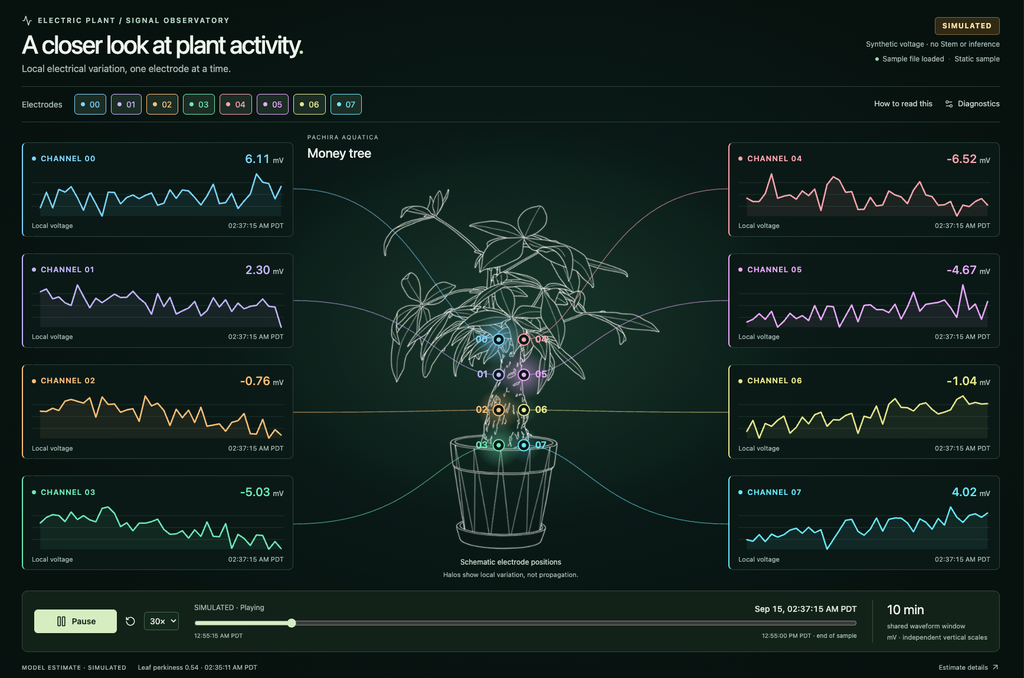
    Like all living things, plants produce electricity, and the company says by tracking and decoding the electric signals that plants give off in response to environmental stimuli, the sensor can gather data about conditions such as hydration and stress. “I actually think of this as kind of a dongle,” Electric Plant’s cofounder and CEO, Justin Mast, tells Fast Company.

    “The plant itself is the sophisticated technology,” Mast says. “Plants and trees have millions of little microreceptors that are processing information about the world around it and then they’re coordinating a lot of their physical responses through electrochemical signals, and so that’s what we’re tapping into and listening to.”

    Other companies, too, are working to translate plant needs into plain language. One of them, Vivent Biosignals, a Switzerland-based plant intelligence company that also uses AI, announced it surpassed more than 2 million monitored plant days in July. The founder of a U.K. startup called Smarty Plants, which makes sensors for houseplants that go in the soil, pitched his product on an episode of a BBC business reality show that aired last month.
    [Image: Electric Plant Co.]

    Electric Plant emerged from stealth with $11.2 million in seed funding on Tuesday. Its artificial intelligence model, called Bombadil, is trained on more than 4 million hours of electrical signals from more than 1,400 plants across 100 species, ranging from tomatoes, coleus, and common garden plants to sequoias, apple trees, almond trees, and oaks.

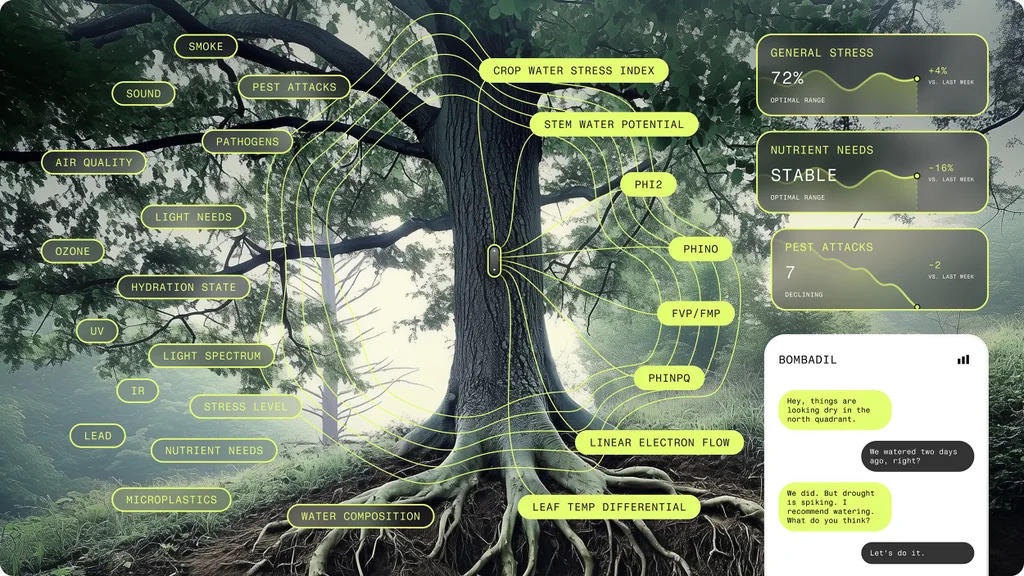
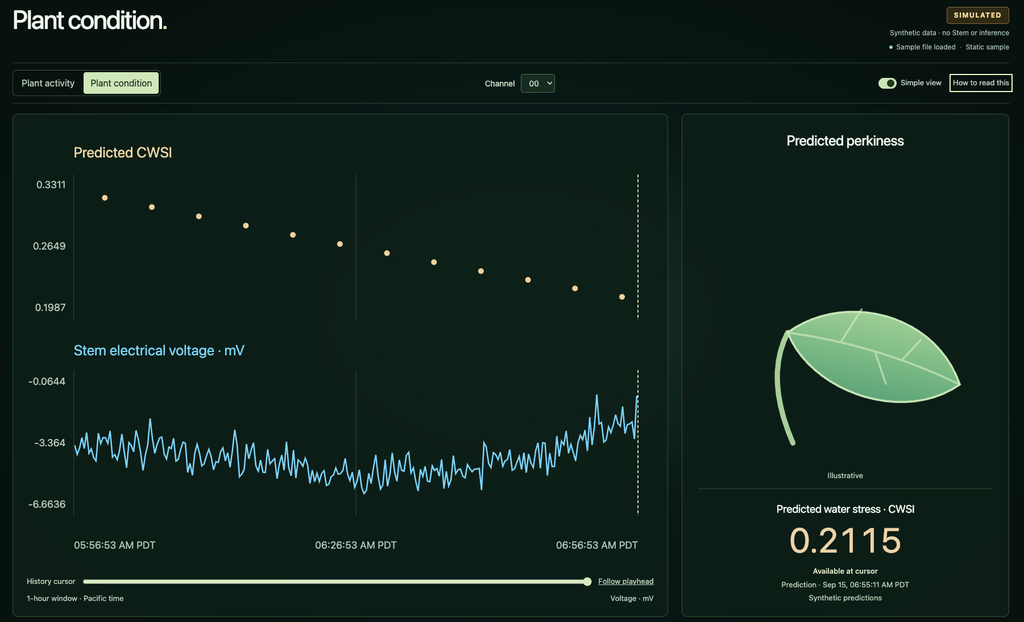
    The model estimates seven physiological stress markers from a plant’s electrical signals, like the operating efficiency of photosystem or the temperature differential between leaves and air, and turns those into insights about plant conditions. In a world that’s getting warmer and with prices for things like fertilizer on the rise, the technology offers the possibility of more efficient planting with a higher success rate.

    Mast, who also founded the direct-to-consumer houseplant delivery service Bloomscape, says while working there he learned firsthand how hard it is to tell people what plants need at any given time. That depends on factors like how much sunlight a plant gets, what part of the world you’re in, how big the plant is, and whether it’s near a radiator.
    [Image: Electric Plant Co.]

    “It’s so contextual,” he says, and that also goes for forestry and agriculture.

    “There you have people who are way more skilled, but it’s actually really hard to scale that kind of attention and that kind of understanding [of] what plants need and want,” Mast says. Changing conditions like watering schedules or nutrients can take weeks or months to show up visually, but with its system, Electric Plant promises faster knowledge that unlocks operational possibilities.

    “Fundamentally, it’s just about getting access to the inside language that’s flowing through plants and trees so that we can better understand the experience of the world and how to better care for them,” Mast says.


    Source link

    Share. Facebook Twitter Pinterest LinkedIn Tumblr Email

    Related Posts

    DoorDash stock reacts on report that it wants to buy Instacart

    October 27, 2026

    This is how marketers can win in the age of AI

    October 27, 2026

    The lesson of the Theranos film for today? Before you buy the AI claim, ask to see everything

    October 27, 2026
    Top News
    Business 6 Mins Read

    The AI IPO wave is about to test Wall Street’s appetite

    Business 6 Mins Read

    The AI IPO rush is here. With OpenAI’s announcement late Monday that it had confidentially…

    American Democracy Has Been Killed

    August 21, 2026

    The $62 billion aid machine just broke

    November 4, 2025

    Iowa Colony Pioneers Face Angleton Wildcats

    September 29, 2026
    Top Trending
    Business 2 Mins Read

    DoorDash stock reacts on report that it wants to buy Instacart

    Business 2 Mins Read

    A big change up could be coming to the food delivery sector.…

    World Politics 1 Min Read

    Catawba County Football Coach Arrested: What We Know

    World Politics 1 Min Read

    A high school football coach in Catawba County, North Carolina, has been…

    US Politics 9 Mins Read

    What Trump’s Cruel Policies Against Immigrants Say About Who’s Next

    US Politics 9 Mins Read

    Society / October 27, 2026 The plight of immigrants under this administration…

    Categories
    • Business
    • Economy
    • Headline News
    • Top News
    • US Politics
    • World Politics
    About us

    The Populist Bulletin was founded with a fervent commitment to inform, inspire, empower and spark meaningful conversations about the economy, business, politics, government accountability, globalization, and the preservation of American cultural heritage.

    We are devoted to delivering straightforward, unfiltered, compelling, relatable stories that resonate with the majority of the American public, while boldly challenging false mainstream narratives that seem to only serve entrenched elitists, and foreign interests.

    Top Picks

    DoorDash stock reacts on report that it wants to buy Instacart

    October 27, 2026

    Catawba County Football Coach Arrested: What We Know

    October 27, 2026

    What Trump’s Cruel Policies Against Immigrants Say About Who’s Next

    October 27, 2026
    Categories
    • Business
    • Economy
    • Headline News
    • Top News
    • US Politics
    • World Politics
    Copyright © 2025 Populist Bulletin. All Rights Reserved.

    Type above and press Enter to search. Press Esc to cancel.