
The Supreme Court put the final nail in the coffin this summer. Now we have to raise democracy from the dead.
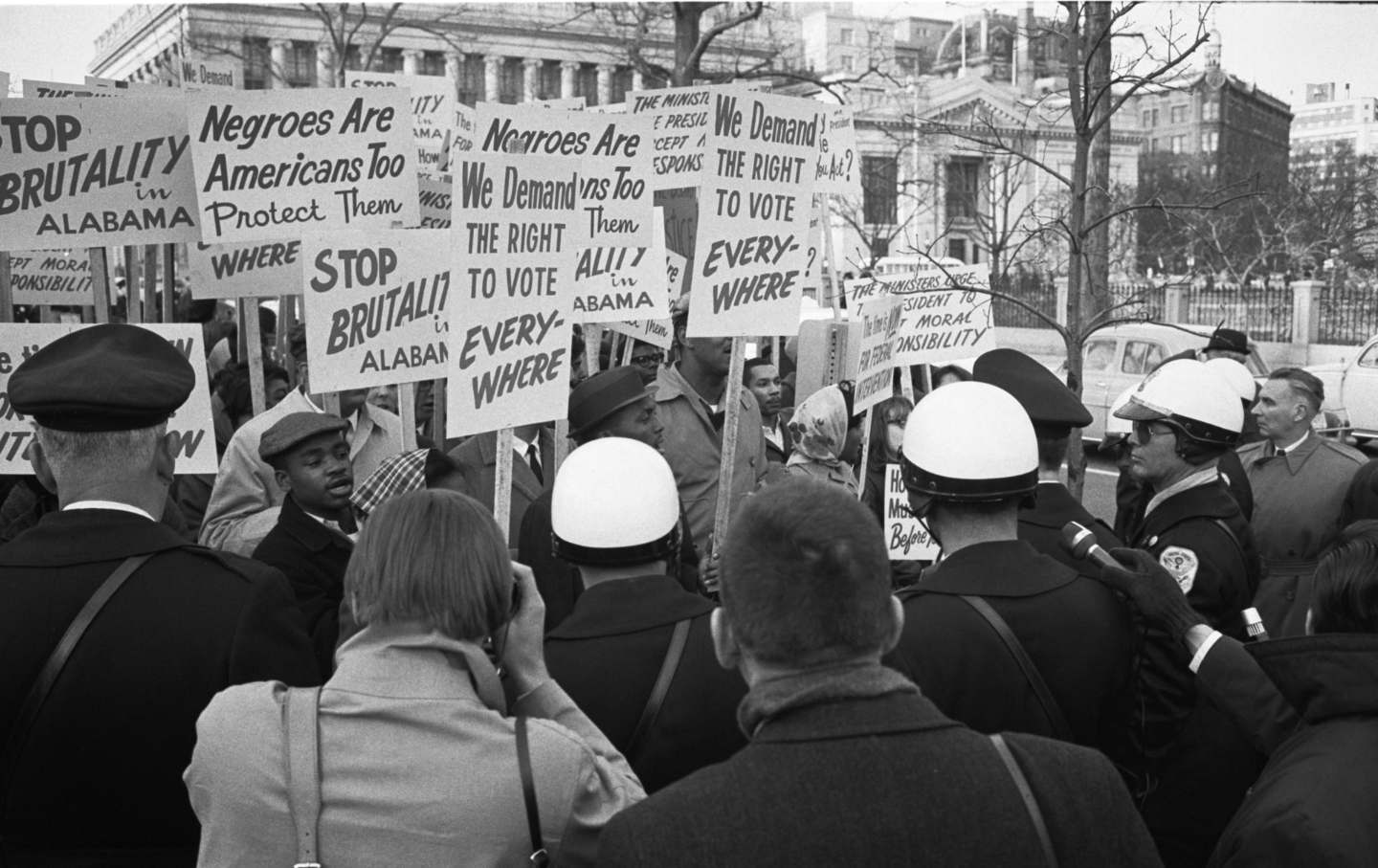
Demonstrators protest outside the White House, on March 12, 1965.
(Warren K Leffler / PhotoQuest / Getty Images)
I can afford no sentimentality about America. For hundreds of years, a majority of my fellow Americans preferred to see me in bondage, tilling the fields, mercilessly beaten, and regarded as much less than human. For a hundred years more, a majority preferred me as their indentured servant, but not as their political equal. And until only recently, a majority preferred to see me jailed, sickly, and alone for the crime of loving another man. Yet the view from down here, where my rights are negotiated out of my sight, and where my perceived wrongs are met with state-sanctioned brutality, lends itself to remarkable clarity about the health of our democracy.
Here is the truth: The grand experiment in democratic self-government that a band of revolutionary soon-to-be Americans launched 250 years ago has been taken out back, shot, and left for dead. This moment is the culmination of intentional efforts to trade democracy for plutocracy precisely when democracy might permanently place the levers of power in the hands of those of us down here—those of us who, because of our distance from the white straight male paradigm, have always been restrained from capturing the power of democracy. The culprits of our demise drape themselves in American flags and symbols while performing Judas’s function at the last supper of our democracy. History is not surprised; its sense of humor is irony, after all.
What’s more, our unwillingness to see this democratic downfall as such doubles our danger. It would be risky enough to live under an undemocratic regime and know it, but it is nearly fatal to live under one while behaving as though a single future election, timely death, or minor repair is all that is needed to restore some former glory.
Many Americans want, indeed, need this not to be true. They need to tell their children that American democracy is strong. And by that they mean not only effective but safe from people like me. They need to be able to say that we have not failed to preserve for ourselves and our progeny that which was entrusted to us by previous generations.
But my children cannot afford for me to tell them this lie. I cannot leave them unprepared for the reconstruction effort that lies ahead if I wish for them to pass to their children anything that looks, feels, or sounds like a democracy.
Perhaps we can ease our grip on the fiction if we start with easily digestible bites. We should at least be able to agree that an essential characteristic of a democracy is that the people choose their leader. Yet twice already in this century more Americans have voted for the opponent of the man placing his hand on the Bible. When the keys of government are handed over to the non-winner in other countries, especially countries run by people who look like me, the American government rightfully calls it a coup. We should not call it anything less when it occurs here.
Current Issue
It doesn’t matter that the mechanism for the coup is embedded in our founding document—a document that created fractional humanity for Black people and required amending to give political rights to half our species. There is no sound claim that the first elections of Presidents George W. Bush and Donald Trump reflect a healthy democracy. But the men who designed the Electoral College preferred the sound of democracy in each other’s voices more than the practice of it with everyone in these United States.
We have mostly tolerated the antidemocratic nature of the Electoral College because, until fairly recently, its outcomes have more or less matched the choice of a majority of voters. Prior to the 2000 election, the mismatch between the two had not occurred in over 100 years. Now not only has it happened twice in the first quarter of this century but it is even more likely to occur after the 2030 census reallocates House seats.
How many more times must we give the nuclear codes to someone who has not garnered the support of a majority of the electorate before we are willing to accept that, when it comes to the quintessential democratic possibility to choose who will lead us, American democracy is failing? When democracy fails, it severs the bridge that I depend on to build a future where I can exist.
It is this reality that makes the Supreme Court’s recent, final demolition of the Voting Rights Act particularly pernicious.
The cost to get the act passed in the first place—to sufficiently prick the consciousness of a majority of Americans to grant me political equality—was high. It was not enough to demand that my grandmother read, knowing that she had been forbidden to learn; to embarrass my mother with guessing games; or to threaten my sister’s life for the thought of casting the ballot. No, it took burying my lynched brothers James Chaney, Andrew Goodman, and Michael Schwerner in Mississippi; surviving one beating after another at the registrar’s office; and broadcasting my splattered blood on the Edmund Pettus Bridge into American living rooms. And even that was not enough to make permanent that which had been bought at such a price. I was required to prove the payment sufficient by convincing Congress to reauthorize the act. And I did, over and over and over again.
Throughout this time, though, the Supreme Court had the act in its sights.
In its first significant attack on the Voting Rights Act, the 1980 case Mobile v. Bolden, the Supreme Court claimed that the American majority could not have possibly meant to bar discrimination against me without proof that discrimination was in the heart of the actor, not just his actions. In response, I convinced Congress to correct the Supreme Court’s error by amending the Voting Rights Act to make clear that it mattered not at all whether state legislators meant to discriminate, but only whether they did so in fact.
For a moment, we, all of us, were willing to find out what this democracy could be if we all had a voice. But sometimes, young Department of Justice lawyers who were never comfortable with the majority’s choice grow up and get black robes. And then they use those robes to take from the majority even the option to remedy past and persistent harms.
Now, with the court’s ruling in Louisiana v. Callais, the same corrective efforts that a few months ago demanded only that I persuade a majority of Congress require me to persuade a majority of Americans to amend our Constitution—a supermajoritarian act.
A purported democracy where a majority cannot decide to repair the harms it historically perpetuated is no democracy at all.
To make matters worse, the Supreme Court claims that it had no other choice. Chief Justice Roberts, along with Justices Alito, Thomas, Gorsuch, Coney Barrett, and Kavanaugh, ruled that the 14th Amendment does not allow any use of race as a corrective to historical and persistent harms. This requires a remarkable interpretation of history.
One must believe that, while 360,000 Union soldiers were killed on our soil to end my dehumanization and to grant me political equality, their deaths, which made the 14th Amendment possible, simultaneously nullified future reparative efforts. Only people more dedicated to something other than democracy could so contort history to arrive at that result.
And lest you be led to believe that the harm that flows from the stripping of my political rights is limited to those of us down here, let me make the picture clearer. To arrive at their conclusion in Louisiana v. Callais that state legislatures cannot be stopped from drawing my political power out of existence, the Court boldly embraced a claim that it had only begrudgingly permitted years before: that anything that can be justified by pursuit of political power may be done no matter who it harms.
Merely seven years ago, in Rucho v. Common Cause, Roberts lamented that even though the pursuit of maximum political power through gerrymandering is “unjust” and “incompatible with democratic principles,” there was nothing for judges to do about it—because there aren’t objective ways to decide when gerrymandering has gone too far. Four of his colleagues thought him wrong even about that. In Callais, the court said the quiet part out loud, declaring that the pursuit of maximum political power through gerrymandering is a legitimate goal. Legitimate in what way, one must ask. Surely not in any way that empowers us to choose our leaders instead of them choosing us.
In this so-called democracy, none of the compromises I’ve made with the American majority are respected. In the 1980s and ’90s, I danced under the nearest disco ball by night. During the day, I sat vigil by my brother’s bedside at a hospital where no one wanted to touch his body or breathe the same air. As he lay there, a disease thought to be driven more by my bedroom than biology ravaged his body. I buried my lover, my dance partners, my friends, and some of the only family I had day after day after day until being gay became synonymous with grief. I finally convinced our government to seek treatments and, God willing, someday, a cure. The hundreds of millions of dollars that followed stemmed the tide of an epidemic, brought us closer to a cure than ever, and expanded prevention efforts all over the world.
But what does all that matter when one man sitting at 1600 Pennsylvania Avenue can decide that, regardless of how a majority of us wish to use our collective coffers, he alone can ensure that the money not be spent? This particular antidemocratic reality is playing out all over the bodies of those of us down here. With the snap of his fingers, there goes the money to find out why my sisters are dying more than others who bear children as they bring life into the world. With another snap, there are suddenly no more dollars to understand why my brother’s cells are sickle-shaped or his prostate more inviting to cancer. Convincing the American majority to give a damn about me, about us down here, proves worthless when democracy fails, when the majority no longer controls the purse strings.
Perhaps I should be grateful that we ever did, as some of the most important questions a country can ask were never asked of us. Right now, my brothers and sisters are back in the Middle East fighting a war that nearly no one wants to fight. How can we be at war, an action expressly reserved for a majority to decide, when we were never asked? When a military commander orders our children to the front lines without our consent, whatever we might call it, we do not call it a democracy. We also do not call it a democracy when the only crime one needs to commit to draw the wrath of the entire Department of Justice is to be disliked by a single man, and nothing more.
Despite the evidence, some persist in asking me to believe that the American democratic experiment remains alive and well. That I am mistaken. That it cannot be so bad. But what kind of democracy do we have where a majority of Americans cannot elect the president, decide who will represent them in the halls of Congress, choose to correct historical and persistent harms, rely on the courts to impose criminal or civil sanctions on presidential overreach. or stop the president from taking us to war, using the Department of Justice as his sword against personal enemies, and ending congressionally authorized, hard-fought-for programs with the snap of his finger? The cry from down here is this: The American democratic experiment is dead.
Popular
“swipe left below to view more authors”Swipe →
We told ourselves that the blood of over 600,000 Americans shed during the Civil War proved a moral truth: that we are bound up together and must find a way to live together, rather than insist that only some of us have a claim to the idea of America. We were wrong–or perhaps we learned different lessons. Some of us learned only that what they could not take by force they might instead take through fear, subterfuge, and the machinery of misinformation.
Yet, enraged as I may be, I cannot afford despair. You can’t tell the children there’s no hope. By this, I do not mean we should lie to them. They cannot afford to be told that the world is made of rainbows when it is a vicious storm. But I do mean to tell them that storms, like sunshine, are not permanent fixtures. Honest hope requires humility.
Thankfully, those of us down here are practiced at this dance.
When my ancestors were brought ashore in Savannah, Georgia, shackled at their hands and feet, setting foot on what we today call the United States of America, they toiled by day but whispered into their children’s ears at night about the freedom that would one day come. They buried the tiniest flickering flame of hope for a better future deep inside themselves and planted it in their children. Those children, shackled from the day of their birth until the day of their death, carried that flame and passed it to their children. Those children too never knew a day of freedom. And so it was for 10 generations. Birth and death in bondage, but a flicker of hope passed down, ultimately to me. So, for those of us down here, the source of the light for that shining city on a hill is the one buried and passed down, not one that requires me to ignore what our eyes can so plainly see.
Let us pause, then, if only for a moment, amid the shock and awe, the jostling from one crisis to another, to acknowledge that this is happening. This is not a call to surrender or cease the resistance. Rather, it is a call to become responsible to future generations of Americans, all of them, whether their ancestors today are tearing the house down or struggling to hold it together. That responsibility demands an honest reckoning with the past and a bold imagining of the future. Nothing today is as it must be.
The men who signed the Declaration of Independence knew that 250 years ago. The delegates at the Constitutional Convention knew that. The people many of those men enslaved knew that. The abolitionists knew that. The suffragettes knew that. The students who staged sit-in protests knew that. The queers at Stonewall knew that. And for a brief luminous moment, those of us who filled the streets after the murder of George Floyd knew that too.
Let us not forget now, for we can least afford to forget at this dark moment that everything can be different from what it is today. We can live in a democracy again, a better one than the one that has passed away.
More from The Nation
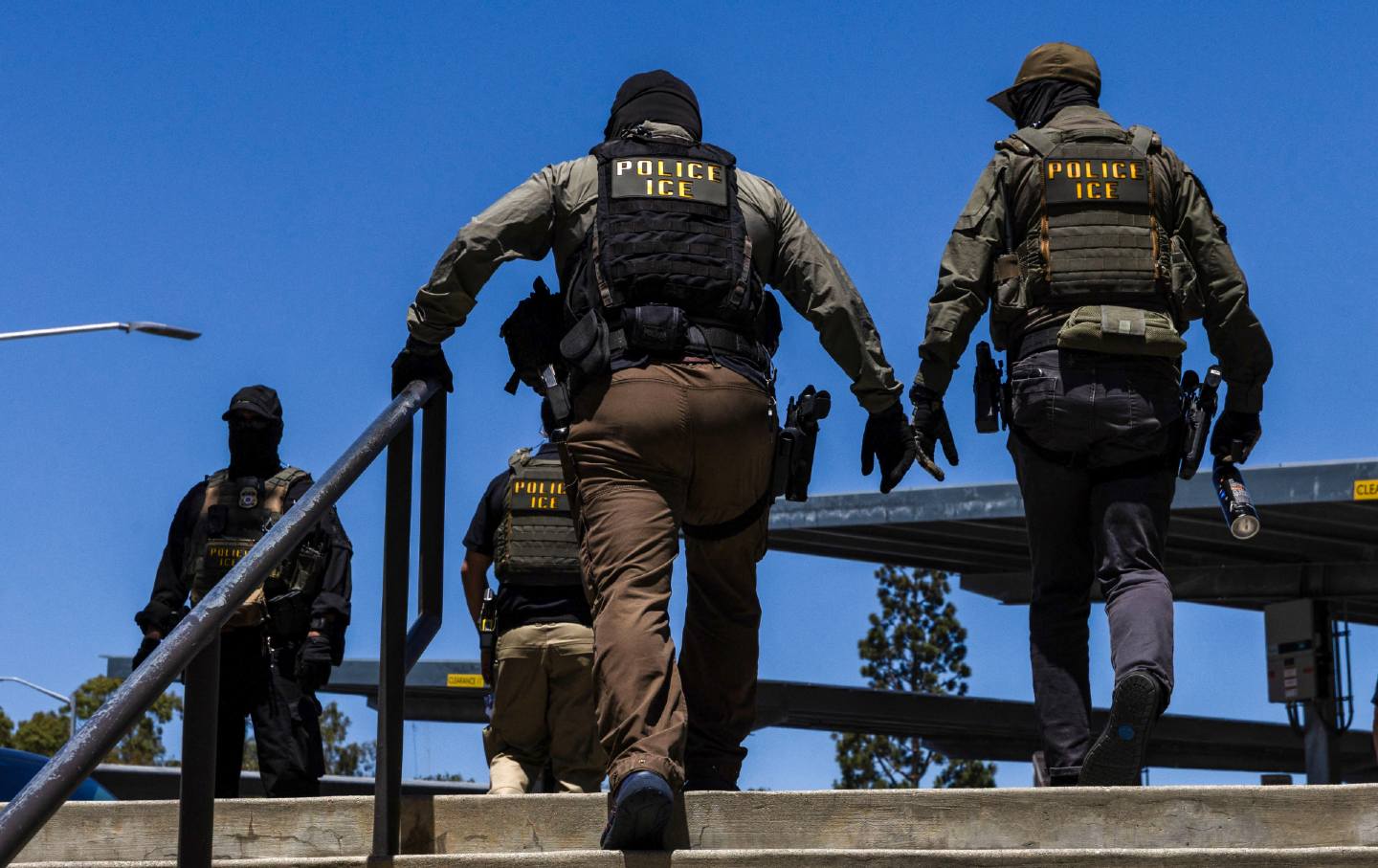
It turns out that people don’t actually want a gestapo force rounding up immigrants all over America.
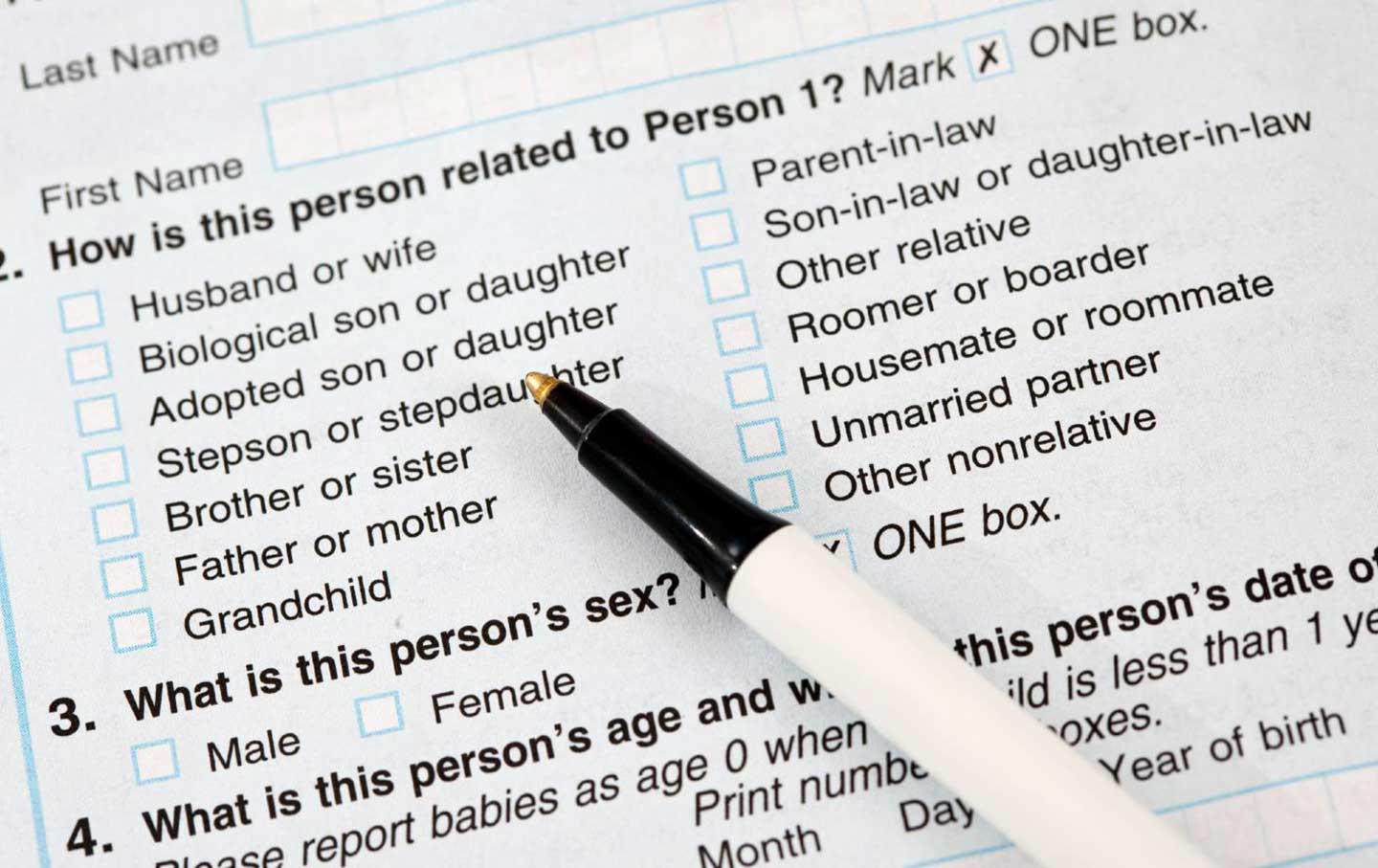
From adding a citizenship question to not tracking race and ethnicity, the administration wants to minimize Black and brown political power.
“You have to talk about these issues like a human being, and not like an MSNBC host on TV.”
A privately operated ICE detention facility where enforcement, profit, and human dignity collide—echoes of concentration camps.