
Jon Wiener: From The Nation magazine, this is Start Making Sense. I’m Jon Wiener. Later in the show: John Nichols on how the Democrats can still win Maine, after replacing Graham Platner with a new candidate. But first, Jamie Raskin on politics – that’s coming up, in a minute.
[BREAK]
Now it’s time to talk politics with Jamie Raskin, the congressman from Maryland who’s the ranking Democrat on the House Judiciary Committee. He was the lead impeachment manager in Trump’s second impeachment trial, and he served on the select committee to investigate the January 6th attack on the Capitol. His book about January 6th, titled Unthinkable: Trauma, Truth and the Trials of American Democracy, was a number one best seller. His articles have appeared in The New York Times, The Wall Street Journal, and The Washington Post, and he’s a featured author in the new issue of The Nation magazine. Jamie Raskin, welcome back.
Jamie Raskin: I’m delighted to be with you guys.
JW: We’re still thinking about the Supreme Court and their rulings last week that made the president so much more powerful, especially their destruction of independent agencies led by professionals and experts. I know you consider this a really significant move on their part. Please explain why.
JR: Well, the administrative agency infrastructure has created the possibility for meaningful regulation in the environment, in the interests of water purity and the interests of clean air, labor, in the interests of union organizing, collective bargaining, you name it. But now the Supreme Court with a sledgehammer has essentially said the president of the United States is now in direct, unilateral personal control of every federal agency and commission, including the Nuclear Regulatory Commission, the Federal Election Commission, the Securities and Exchange Commission, the Food and Drug Administration. In other words, there’s no such thing as the blend of quasi-judicial, quasi-executive, quasi-legislative powers which the Supreme Court had recognized for decades. And so now we’re going to get Donald Trump basically setting the clean air levels and the clean water levels, we’re gonna get Donald Trump overseeing the National Labor Relations Board and deciding what people can do to organize and what they can’t do and so on. What this means is we’re going to have to take the Congress back for this, along with a million other reasons, but we’re gonna have to take Congress back. And with the Congress is going to have to be far more specific and definite and concentrated and dense in our legislation of regulatory standards. So, for now, for example, we’re not going to be able to say that the EPA can set the proper levels for clean air and clean water and particulate admission. We’re going to have to do that ourselves. And so, the legislative process is going to have to be far more specific in trying to legislate. And then we have the additional task of trying to get the executive, certainly with Trump still in charge, to faithfully execute the laws. But that is the job of the president.
JW: The big picture here after last week, of course, is that it’s clear we have a 6 to 3 right wing majority, as you say in your article in The Nation magazine, “committed to corporate power and white supremacy.” A lot of our friends say it’s time for Congress to expand the court. I wonder if you agree with that.
JR: Well, I’m not averse to that question, and I’ll embark upon it in a moment. But I want to say that there are certain things which will have vast, nearly unanimous support in the country. For example, the Supreme Court is i the only Supreme Court in the land — we’ve got 50 state supreme courts — that doesn’t have a binding ethics code. So, we need a binding ethics code, so you don’t get Alito and Thomas engaged in partisan activity or collecting millions of dollars-worth of goods and services from billionaire sugar daddies. So, in Congress, we have a $50 gift ban. Theoretically, that applies to the executive branch. Obviously, Donald Trump blew that off a long time ago as he’s making billions of dollars in totally unprecedented get rich quick schemes. But the $50 gift ban that we have in Congress should definitely apply to the US Supreme Court and to the federal judiciary. There’s no doubt in my mind, and I can’t see any argument against that. These guys make, I don’t know, $300,000 a year, whatever. They can pay for their own damn vacation. They don’t need to be flown all over the world by the Federalist Society or Harlan Crow or anybody else. They can buy their own plane tickets. So those are basic things we can do.
Now, the fundamental problem is that the Republicans have stacked and packed and gerrymandered the Roberts Court. When Justice Scalia died, President Obama in February of 2016 nominated Merrick Garland to fill his seat. And Mitch McConnell said, “no, we’re not going to have hearings, any hearings, we’re not going to have a vote in the committee. We’re not going to vote on the floor.” And they held it open for 11 months, more, actually, it ended up being more than a year that it was held open for. But he said 11 months was too close to the next election. “We want to let the people decide.” Of course, the people had decided in electing President Obama to one of those genuine four-year constitutional terms, but they just blew it off.
But then when Ruth Bader Ginsburg died in September of 2020, two months before the presidential election between Biden and Trump, the press said, “well, you’re not going to go ahead and try to do a process in eight weeks. I mean, early voting has started in a bunch of states.” No. Mitch McConnell laughed it off and said, “no, that was just a rule for the Democrats, of course.” And then they barreled through Amy Coney Barrett’s nomination. She was confirmed for the court, I believe it was 7 or 8 days before the presidential election actually took place.
So, we’ve got two essentially stolen U.S. Supreme Court seats giving them this 6 to 3 mega majority. It should be those two seats, if they’d gone to Democrats, as they should have to Democratic presidents to appoint that, that would be a 5 to 4 majority in the other direction.
So, are we open to rebalancing the Supreme Court to try to counteract the stacking and packing and ethics crisis on the court and legitimacy crisis on the court? Yeah, you’re damn right we’re open to that.
I mean, we have 13 federal circuits in America. We only have nine justices. So, four federal circuits are left out on the best of days. But in fact, and no offense to all you New Yorkers out there, but five of the justices come from the New York metropolitan area. It’s like one justice for each borough of New York City. Meantime, you’ve got huge, thousands and thousands of square miles in the country where nobody has been named to the Supreme Court. And it used to be that there was one justice for each circuit. That’s where circuit riding came from. The justice would meet with the other justices on oral arguments and decisions, but they would go back, and they would conduct federal judicial work in their circuit.
Well, again, four circuits at least today, a majority of the circuits are just completely left out of that and have somebody else who nominally they can look to. So, I would say we – that that should open our discussion about where we need to go. Of course, having packed the court, our MAGA colleagues now want to freeze the number of justices at nine and put it in the Constitution. They actually want to strip this power away from the US Congress, which has, I think, 7 or 8 different times, change the number of justices on the court. So, there could be a showdown coming in a few years on that. Obviously, with Donald Trump still in office, that’s a hopeless prospect.
JW: In The Nation magazine, you call on Congress and voters to restore the balance of power among the three branches by restoring congressional power and one key step, small step, but a significant one is your challenge to the settlement of the lawsuit Trump filed against the IRS because his tax returns were made public by an IRS contractor. This is the deal. Just to remind our listeners, that created the $1.8 billion slush fund for the January 6th rioters, paid for by the taxpayers, and the agreement that the IRS would not audit Trump, his family, or his businesses. Right now, the money for the slush fund seems to be frozen and disavowed by the Department of Justice. But the tax audit immunity for Trump and his family remains in effect. There are several challenges to this underway in federal court. The big one is 35 former federal judges are arguing that the entire settlement is premised on deception and was a fraud on the court. But you think we need more. We need action by Congress. We need a discharge petition. Please explain what that means.
JR: The discharge petition is a way to get a bill out of committee when the majority is blocking it. We’ve used it multiple times, most famously recently over the Epstein files, where we had all the Democrats and a handful of Republicans join us in discharging the Epstein Files Transparency Act, which we got passed, but we’ve been able to do it a number of other times now, including on a very good piece of labor legislation. But right now I put it in and I think within 48 hours now we already have 99 signatures. It’s just a logistical issue of getting everybody down to the clerk’s desk to sign up for it. I believe we will get every single Democrat on it. Every Democrat wants to block this massive rip off of the taxpayers, a $1.776 billion political slush fund, going first to Donald Trump in settlement of his utterly bogus claims against the United States, and then from Trump to the Proud Boys, the Oath Keepers, the convicted criminals who smashed the faces of our police officers in order to storm the Congress and try to assassinate Nancy Pelosi and Vice President Pence in order to overturn the presidential election. That’s what all of this is about.
The 14th Amendment specifically bans the use of any federal dollars for the purposes of paying for insurrection. After the Civil War, they said, “no, you cannot appropriate any money to pay back any of the costs of insurrection.”
Well, guess what? That applies to January 6th just as well. And it is Congress which has to appropriate money, not Donald Trump and not Todd Blanche. They don’t get to appropriate the taxpayers’ money. And it is the courts which decide cases and controversies, not five people that they’re going to appoint to hear the cases referred to them by Donald Trump, of his friends who want to be a MAGA millionaire, which is what you know, it’s like a game for these people. They gave $1.25 million to Michael Flynn, Trump’s disgraced former national security adviser. $1.25 million, which I guess is the going rate to Carter Page, $5 million they gave to the family of an insurrectionist who died when the police repelled the attack on the House of Representatives.
And that’s a tragedy that that happened, that Donald Trump incited them to conduct mob violence against the government. But two different federal investigations absolved the police of any wrongdoing, saying that they had acted totally in accordance with the law and reasonably and responsibly in repelling the attack. So, the bottom line is that, sure, Donald Trump wants a political slush fund to sling all of this money about, but the people are against it. Todd Blanche himself has said it’s not moving forward. Of course, a car at a red light is not moving forward, and the light changes and he goes forward, and Trump keeps saying he wants to do it, and he wants to give these millions of dollars away to these people.
So, we need to pass it into law, that money cannot be used for these purposes under the auspices of the anti-weaponization fund, or under the auspices of any fund they might make up for these same purposes. And then the other thing, Jon, that you correctly point out is it’s not just this fund, they also dealt to Trump and his family and his businesses, a lifelong pardon for criminal civil tax investigation or prosecution for any crimes they’ve committed up until now. Not having anything to do with the bogus claims he even brought before there was a third-party contractor who leaked information about some people’s taxes. That guy’s in jail now. And lots of other people have sued to try to get civil compensation for it, the courts have rejected it. The Department of Justice has fought it successfully. But in Trump’s case, they say, oh no, we’ll settle that for $1.8 billion.
JW: I think we may have time for one more quick question before we let you go. Election protection in the midterms. Seems pretty clear Trump is going to try to disrupt prevent Democrat Democratic voting. How confident are you that we are prepared for protecting the midterm elections?
JR: It’s not that he’s going to try to do that. He is trying to do it. They’ve been trying to do it for months and months. They’ve been trying to shut down polling places in Texas. They’ve been trying to throw people off the rolls in Georgia if they haven’t voted before. You’ve seen this whole post office gambit where they’re trying to get the post office to not deliver mail-in ballots and so on that we won a good victory in the Supreme Court. It shouldn’t have been five-four, it should have been nine-zero saying, of course, it’s up to the states to decide whether or not to take mail in ballots and they can receive them even if they arrive the day after the election or two days after, because the mails have been slow or what have you. Donald Trump has voted by mail like a number of members of his cabinet, and there’s nothing strange or unusual about it. What they don’t like about it is the fact that it opens up the possibility for a lot more people to vote.
And so, in each of these cases, I think we are prepared to fight back. We’ve got great lawyers like Marc Elias out there, like Norm Eisenhower out there. We’ve got great groups that are fighting the ACLU, the NAACP, Legal Defense Fund, MALDEF. They are on the case. And remember, it’s not up to Donald Trump. The president has no role in the conduct of an election. It’s up to the states. And Congress has supplementary jurisdictional power. If we want to legislate in a particular way, that’s what the Voting Rights Act was about. And of course, the Voting Rights Act, which was implemented through the 14th Amendment and the 15th Amendment, as well as that power over elections, has been completely gutted by the Supreme Court. Now, one more reason that we need to take very seriously the crisis of justice we have because of the corruption of the Supreme Court, concealing and masking and defending the corruption of the presidency.
JW: Jamie Raskin, he’s the ranking Democrat on the House Judiciary Committee and a featured author in the new issue of The Nation magazine. You can read his piece “We Must Restore Congress as the Predominant Branch of Government” @thenation.com. Jamie Raskin, thanks for all your work, and thanks for talking with us today.
JR: It’s been great to be with you.
[BREAK]
Jon Wiener: Now, for this week’s political update, we turn to John Nichols. Of course he’s executive editor of The Nation and a frequent commentator on MS NOW. John welcome back.
John Nichols: It’s good to be with you, Jon. What a pleasure.
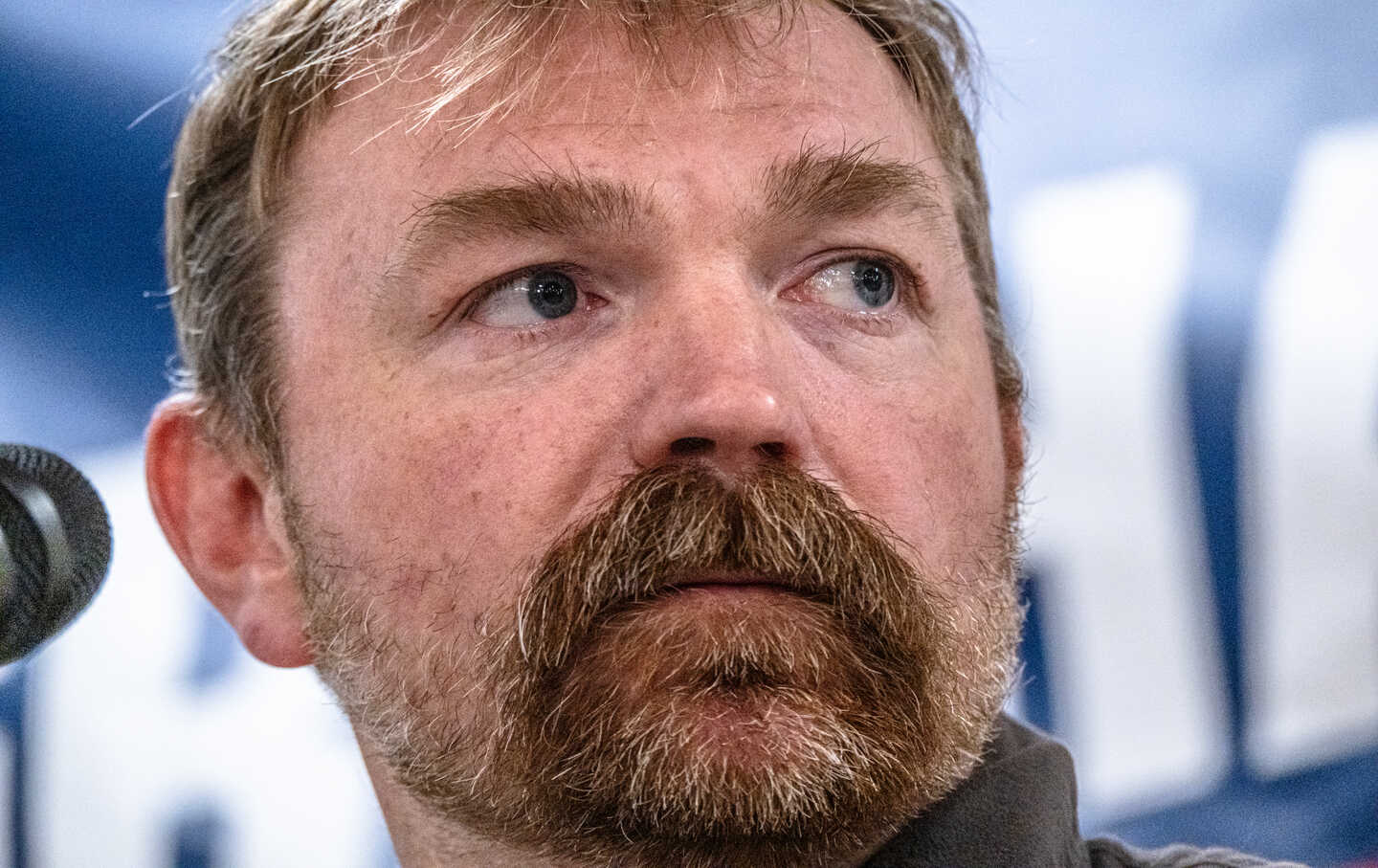
JW: We’ve been tracking the Democratic candidates for the Senate – just to review, we need to hold two seats and flip three or four to win the majority. Four months out from the midterms, we’ve got a big problem in Maine, one of the states we have to flip. We are assuming that by the time listeners hear this podcast, Graham Platner will have withdrawn as the Democratic candidate there after having been accused of sexual assault by a woman he previously dated. Our assumption is that the Maine Democratic Party will pick a new candidate in the next few days. The deadline is July 27th, but as we saw with Kamala Harris in the summer of 2024, replacing a candidate at this point is not easy. I wonder, what’s your comment?
JN: No, it’s not easy, but it is necessary. The revelations about Graham Plattner are very serious. And, I think we should all pause and recognize that that initially there were serious questions and challenges as regards his candidacy. And he argued that he had been through a lot as a veteran who had suffered from PTSD and other things. But the bottom line is that this candidacy has come to a point now where I think everybody has to recognize that it is not tenable. It has got to a point now where it’s an emergency for the Democrats and they have to replace a candidate, but they also have to do so in a way that, that recognizes what voters, what people have been through here with this candidacy.
JW: It’s not going to be easy. But let’s remember, Kamala Harris did win Maine by seven points in 2024. And in The New York Times poll last week, the Democratic candidate for governor leads by 15 points, 55 to 40. And Susan Collins approval rating with Maine voters is negative. The most recent Morning Consult tracking poll found 51% disapprove of her. Only 42% approve. So a new Democratic candidate has a pretty good chance to defeat her. Or am I being too hopeful, as usual?
JN: I don’t know if you’re being too hopeful, John, but I think you do have to acknowledge some political realities. We live in an era where people often find themselves voting for someone that they don’t really like. Sometimes that’s rooted in partisanship, sometimes that is rooted in the circumstance of the election. Sometimes it’s rooted in not liking the other candidate even more than the one you vote for. You need a candidate who can win the trust of Mainers. Is this somebody who knows Maine? And is it somebody who can speak to the fundamental issues that were raised–have been raised already in the fight against Collins, and take them forward? I’m really sorry that they can’t have a primary or that they can’t have even a caucus system in the very narrow window they have.
JW: Well, elsewhere in the Senate races, four of our candidates for flipping Republican seats are ahead right now and running more than ten points ahead of where Kamala Harris ended up two years ago. That’s Sherrod Brown in Ohio, Roy Cooper in North Carolina, Josh Turek in Iowa, Mary Petlola in Alaska. And then there’s the surprising James Talarico in Texas, tied and on the hold side, were in great shape in Georgia with Jon Ossoff. That leaves Michigan. Michigan is another worry right now for the Democrats – a lot going on in Michigan. This is a state, of course Trump won narrowly in 2024. Democratic Senator Gary Peters is stepping down. We had big news over the weekend. One of the three Democratic candidates in their primary withdrew from the race. So, we have it down to two. Representative Haley Stevens, the moderate supported by the party establishment, and Dr. Abdul El-Sayed, a progressive former public health official endorsed by Bernie, AOC and the auto workers, of course, in Michigan, the auto workers are a powerful force. He supports Medicare for all, abolishing ICE – polls show El-Sayed ahead in the primary in running even in the November midterm. But some of our friends are worrying that while a Bernie-AOC type candidate can win easily in a deep blue district of New York City for a statewide candidate in Michigan, the Democrats need a moderate. What do you think?
JN: I don’t necessarily think that’s true. I think that what you need is a candidate who’s in touch with Michigan and who can speak to Michigan about specific issues. Look, one of the things to understand is the term moderate or progressive or whatever phrase you want to throw on here often, you know, ends up muddling a lot of complex issues, right? Clearly Abdul El-Sayed meets a lot of the progressive standards, right? He checks the boxes. But it’s not like those issues that he’s talking about are unpopular, right? I mean, Medicare for all or some sort of universal commitment that health care is treated as a right, not a privilege. Those are very good on that, right? Taxing the rich people really like taxing the rich you know, getting education, making it affordable for people, addressing housing challenges. These are popular notions. And so to simply dismiss Abdul El-Sayed because he is popular with progressives, doesn’t get to the heart of the matter — which is, are the issues he’s talking about in touch with Michigan?
I think that UAW endorsement is a big deal, and I’ll tell you why. The UAW still has really active locals all over Michigan, in Detroit some, but also in Flint and in Pontiac and in other communities across that state, small cities, even some semi-rural areas where the UAW’s presence is sometimes historic, it’s been there for a long time. And what they’re saying is as an institution, they believe their members you know, can hear what, what Abdul El-Sayed is saying and that it makes sense to them. That’s a pretty good poll, by the way. Doesn’t sort out every issue and you can certainly debate it. But the fact of the matter is that I have covered Michigan politics for a long time and a lot of different ways. And I would always say getting the UAW endorsement is a big deal. He’s got it against a candidate who wanted it right. And it’s important to remember that Representative Stevens, his opponent certainly would have liked to have had the UAW there.
So this is I think that it’s incumbent upon Abdul El-Sayed to deliver the message, right? You know, his job is to say that he’s electable and here’s why. And if he does it, I think his chances in the primary become, are quite strong, although that’s going to be – Jon, that’s going to be one of the most intense and, and potentially really rough primaries of, of the summer. I think there’s very little doubt that there’s going to be incredible levels of spending there.
JW: Yeah. And we don’t want it to get too antagonistic because assuming El-Sayed wins, as the polls now suggest, he will, he is still going to need the candidates – the voters for his opponent to support him in November.
JN: Oh, without a doubt. And I mean, this is an important thing to understand. Unifying a party is a big deal. We were just talking about Maine, right? And in Maine, when they’re looking at people to potentially replace Graham Platner as the nominee, a lot of the attention is focused on a couple of candidates who just ran for governor and ran very viable campaigns for governor. Troy Jackson, Shenna Bellows, these are folks who’ve had electoral history in Maine — and who had gone to the voters. They’re in touch with them. They’re also quite progressive. And so, I think that’s the way to look at it is, do you have people who can speak to the state and who can then take these issues that you and I may think are really big deal issues, really important issues and put them in a language that the great mass of voters in a swing state are willing to embrace. I don’t think ruling out progressives makes sense. I do think that recognizing the complexities of different states. That’s what’s vital to this.
JW: Yeah. I also want to talk about campaign finance. In the wake of the Supreme Court ruling last week that political parties could spend unlimited amounts in coordination with candidates. Now we’re getting into the weeds here of campaign finance, a miserable topic that is crucial to campaigns. Previously, there have been strict limits on what’s called coordinated spending between the candidate and the party and independent donors. But there have never been any limits on what’s called independent spending, rich people can spend whatever they want to support whoever they want. Many experts say this Supreme Court decision, permitting coordination between the parties and the candidates in spending is going to be a big boost for Republicans. I’m not so sure of that. And I wonder what you think. It doesn’t actually create more money for Republican campaigns. The Republicans have whatever they have, they’re going to spend whatever they want to anyway. There are no limits on campaign spending. So how important really, is this coordination? I only know of one area where it really matters, which is that the fees for TV ads are a lot cheaper for candidates, have been, a lot cheaper for candidates than for independent others, including the party. So now there’s going to be a lot more TV time sold to candidates, but that’s true of both parties. So we’re going to get a saturation of TV ads. That won’t necessarily elect Republicans. And TV ad spending isn’t really a very good way to win voters anyway. Or am I missing something here?
JN: I think you’re you’re summing things up in some some good ways, but I do think perhaps there’s a little more to this story. Here’s the bottom line that really concerns me about that decision. The ability of political parties to now take in unlimited amounts of money and to effectively, you know, spend it on behalf of a particular candidates, that knocks down a lot of the barriers that we have historically thought are vital in our politics. And this is a big deal, because now candidates — not that they didn’t have a good sense of what independent expenditures were, who was behind him and what was going on there — But now that becomes much more clear. And I think the influence of big money is increased.
And this is the problem, Jon: let’s look at the AI industry, which is pouring money into campaigns this year, big companies, and they’re pointed in on different sides of particular races. They’re not always in the same place. But let’s imagine that some AI companies pour money into the Republican Party, and some AI companies pour money into the Democratic Party. But neither of them really want the level of regulation that you or I might want. Have they dumbed down the process? Have they undermined the process to such an extent that we end up without the level of AI regulation and oversight that we need. And imagine the companies that get, as an example or the wealthy individuals, who give to both parties. Why do wealthy individuals, billionaires and political action committees, stuff like that, why do they give to both parties? It isn’t because of some sort of civic engagement, right? They give to both parties because they would prefer that both parties usually don’t address the issue they’re concerned about, that they don’t get as engaged with it as they should be. And I think this runs the risk of blurring the fight between the two parties because they both become so reliant on these masses of money and that if you, by chance, were to go against some of these sources of money, then it would all flow over to the other party. The candidates would know that. Then you’re in a in a bad place politically. Bottom line is this is a bad decision. It’s a dangerous decision. And it is one that even if Democrats can hold their own in this, that progressives should be very concerned about, because ultimately, it’s a case where issues are taken off the table. I mean, do you really think the health insurance lobbies and the drug company lobbies are going to be encouraging the Democratic Party to take up Medicare for all, right?
JW: Yeah.
JN: And that’s, that’s where the problem comes in. So, I do think we are still where we have been. And that is where we need a constitutional amendment to assert genuine fundamental campaign finance rules in this country. And the interesting thing about it is as we talked about these other issues that’s super popular. You’re not talking about a winning issue. That’s a winning issue. But this court ruling makes it harder for us to get there, so I’m genuinely concerned about it. I think it’s a dangerous ruling that has a potential to, frankly, undermine a lot of progressive goals.
JW: Last thing I want to talk about is Trump and crypto, Trump’s personal crypto. The Trump Coin was the subject of a big exposé in The New York Times the other day, the so-called Trump Coin. At this point, it’s essentially worthless. It lost 97% of its value. But a lot of people did buy in at the high prices, and Trump made a small fortune or a big fortune on this. Almost a million people, The New York Times found, bought the Trump crypto, and they lost a total of $3.8 billion. John, I’m hoping you were not one of the suckers and that you did not buy into Trump’s crypto coin.
JN: No, I did not. I have been, I’m just not a crypto investor. Bottom line is this: I think what we’re seeing here is a really unsettling reminder of just how far the rules, the regulations have have been obliterated here. The New York Times just did an expose, a series of articles– other publications have been involved in this as well–on Trump’s massive enrichment since he became president of the United States. Historically, that would have been, I think a deal killer, right? That that would have been a point at which we’re talking about impeachment or other issues. Instead, these are important subjects which we deal with briefly and then move on to the next thing. I think at some point we’ve got to pause and look at what has happened with the White House, with what has happened with our politics in general. And I do believe that there is potential that corruption, that these questions of what – how people in positions of power in this case Trump but also, look, people in Congress as well enrich themselves. And I think there is a great constituency out there for campaigns that say, “look, this has got to end. You ought to enter office, enter political office, you know, with whatever wealth you’ve got, you ought to leave with something pretty similar.” If you leave massively enriched, if you get billions and billions of dollars more than what you came in with, or even millions, that’s a that’s a flaw in the system. It isn’t how it was supposed to operate. For all their flaws, I don’t think the founders established this system to say, “hey, here’s a lot of ways to get rich. Here’s one of them: become President of the United States.”
JW: “Trump’s financial corruption should be a campaign issue” – John Nichols – read him @thenation.com. John, thanks for talking with us today.
JN: I’m honored to be with you. Good to talk with you, brother.