
M, the mother of two young children living in Tucson, Arizona, works full-time but has been relying on about $700 a month in food stamps to make sure her children are fed ever since they were born. Keeping access to the benefit requires recertifying her income and eligibility every six months, so last August she got her paperwork ready for the renewal process. She sent her documents every way possibly except for by fax—online, through e-mail, through the mail, and in person at an office—to make sure her family stayed enrolled.
But then M—The Nation is referring to her by an initial to protect her from a past abusive partner—received a letter from the Arizona Department of Economic Security saying she hadn’t included some of the required documents, even though she had sent in what was typically sufficient: her pay stubs, her rental agreement, the rates for her children’s childcare. “I was quite surprised,” she said.
In March, she tried again, reapplying for food stamps. This time, after she turned in the paperwork, the state requested documentation from a job “that I’ve never heard of,” but that the state claimed she is doing on top of her actual job, which put her income above the eligibility threshold. When M went to a state office to report that she doesn’t work for that company, she was told to file an identity-theft report.
So she took time off work to not only submit paperwork to the Social Security office but to file both a police and an FBI report. Despite sending in what she was told was necessary to fix the problem, she hasn’t received a response from the state. When she calls for an update, she can’t get through to anyone. “There’s not a lot of employees that can assist you,” she said. The people working at the offices tell her she to just keep calling. “I feel like it’s very disorganized.”
In the meantime, her family hasn’t gotten any support through the food stamp program, leaving her trying to make ends meet on her income of $18 an hour. It “has been really, really hard, because I have to manage my whole life around my paycheck,” she said. She’s cut down on her own meals to give her kids more to eat. She feels constantly torn between getting them healthy food and the cheaper food she can buy more of. “They’re very smart and they have noticed. They’re like, ‘You know mom, we used to get strawberries and blueberries and raspberries,’” she said. She often tells them “no” when they request food items at the grocery store. “It’s hard as a parent because you do want to give them everything but it’s also like, OK. those five dollars are going to be toward diapers or gas or rent.”
For the first time in her life, M. has sought out food banks. The options there are limited, she said, and she’s lucky to get any vegetables. She takes her children to activities at her library because they also give the children a snack.
“I wouldn’t be going through all of this if I didn’t really need it,” she said of food stamps. “We really need to keep that food on our tables.”
M is one of millions of Americans who have lost food stamps since last summer. Republicans passed HR1 last July, or the One Big Beautiful Bill, entirely along party lines, enacting the largest cut to food stamps, also known as the Supplement Nutrition Assistance Program, in history. The legislation reduced SNAP by about $187 billion over the following decade.
The bill achieved that cut through a number of changes. It tightened the program’s existing work requirement by applying it to people up to age 65 and to parents with children 14 and older. It also narrowed exemptions for veterans, homeless people, and former foster youth, and barred undocumented immigrants. Starting next year, states will have to cover 75 percent of the program’s administrative costs, instead of the 50 percent they have been covering. If states are found to have high payment-error rates—meaning they underpaid or overpaid too many recipients—they’ll have to chip in even more to cover the actual SNAP benefits, too.
Since the bill was enacted, more than 4 million people have fallen off of SNAP’s rolls, a 10 percent decline. That includes more than 800,000 children—and that is only from the 13 states with available data. While the number of people enrolled in SNAP had been declining before HR1 went into effect last July, the trend has “accelerated significantly in the months after that,” said Joseph Llobrera, senior director of research for the food assistance team at the Center on Budget and Policy Priorities.
The reductions have occurred in every state across the country, and participation has dropped by 10 percent or more in 21 states. But some have seen even more significant drops. Arizona is so far the worst: Half of all people who had been enrolled are now going without food stamps.
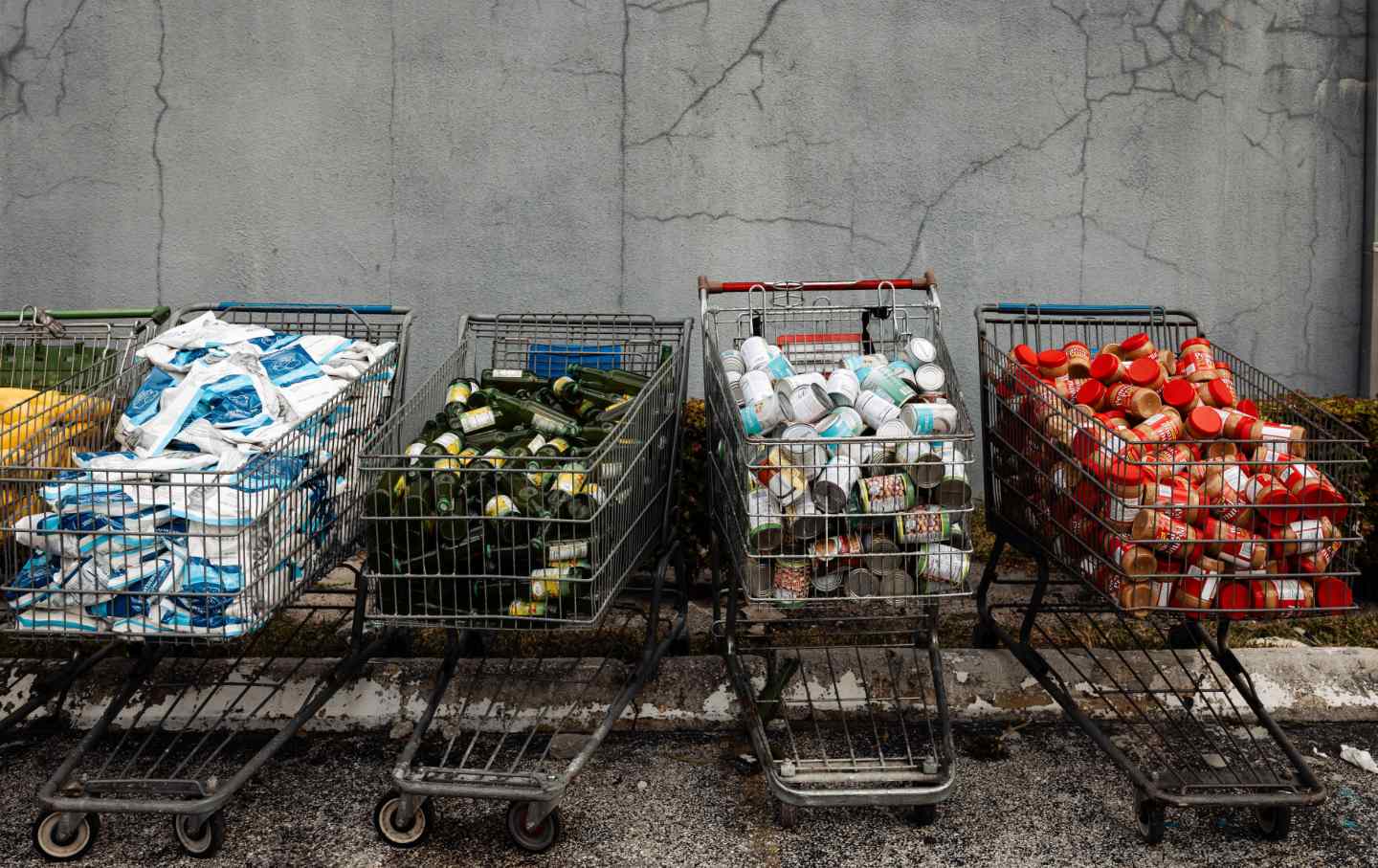
As SNAP participation has sunk dramatically, Arizonans are increasingly turning to food banks. According to data collected by the Arizona Food Bank Network, the number of people visiting food banks shot up from about 670,000 in January to over 840,000 by April.
When we spoke in mid-June, Beth Fiorenza, executive director of Phoenix food bank NourishPHX, said it was experiencing about a 10 to 12 percent increase. Typically, the food bank expects to see about 150 to 175 people a day; now it’s getting more than 200 every day. “It gets higher, higher, higher every week, every month,” she said. “We’re seeing a lot of new people that have never had to visit a pantry.” In late May, almost 40 percent of those who visited were brand new.
So far, the food bank has been able to keep portions the same even as more people visit. But the federal government hasn’t made that easy. Last year it reduced the food that it delivered to food banks, and NourishPHX suddenly and without warning lost a federal grant it had used to buy fresh milk and eggs at the same time that HR1 went into effect.
The people Fiorenza serves at the food bank have given her a variety of reasons why they no longer have food stamps. Some can’t work or volunteer for enough hours each week to meet the work requirement. “We see a lot of people with medical issues, especially seniors, who just aren’t able to work or volunteer,” she said. Some just can’t seem to get re-enrolled even though they’re eligible. For others, it’s not worth wading through so much red tape. “These are families with children, seniors, who have a lot of other things going on in their life,” she said. “That’s just one more extra burden that they have to meet, and some of them I think have given up.”
It’s not yet known exactly what states are doing that is causing such dramatic drops in enrollment. But it is clear that they have been given a very short timeline before they will be penalized with higher costs. Come October 2027, those with payment error rates greater than 6 percent in this current fiscal year and last will have to pay 5, 10, or 15 percent of benefit costs in their state, depending on how high the rate is, on top of the extra administrative costs they all face. According to the Department of Agriculture’s recent data, 41 states are above the error-rate threshold.
That’s kicked off a scramble to get the error rate down at any cost. Republicans’ legislation imposed no penalty for eligible people getting kicked off SNAP or not enrolling at all, only for states getting the payments wrong. So states may be instituting more barriers, such as additional paperwork or processes, that keep people from participating at all. They may also be devoting additional scrutiny to every document applicants provide. “What we’re hearing is that states are asking for much more documentation of household circumstances, so that creates barriers for the household,” Llobrera said. “Not all of that is necessary for actually doing the benefit calculation, but I think states feel like they need to do everything they can to drive down those payment error rates.”
HR1 already added more administrative burdens to the program, requiring states to verify immigration status and compliance with the work requirement. They have received no extra funding to increase administrative staffing, and many agencies, including Arizona’s, were already understaffed. Last summer, Arizona cut department staff by 5 percent. “It creates this mountain of paperwork that state agencies have to act on,” Llobrera said. Staff simply may not be able to review all of it in time. That can sometimes mean that, even when someone has submitted everything required of them, their case gets closed before someone even reviews their application.
That’s what happened to Janae Wall in Phoenix. The single mother of five children under the age of 13 wasn’t able to recertify to keep receiving food stamps during the government shutdown in November that cut off access nationwide. She reapplied in March, sending in everything she knew she would need to prove her eligibility. Usually, she would get a notification if she had missed anything and she could upload it to her account without an issue. But by the time she received a notice that the state wanted more documentation from her, her case had already been closed. “I’m like, ‘You didn’t ask me for anything,’” she said.
Wall is certain that she’s eligible; the system told her as much as she was applying. She makes $21 an hour at her full-time job in behavioral health, but it’s not enough for her family to make it through the month. “It’s very hard. The food prices are very high,” she said. She was counting on getting a couple hundred dollars a month in food stamps. Without it, “it is very stressful,” she said. Wall prioritizes paying rent and then buys food with whatever is left over. She often postpones other bills, like water and electric, risking shutoffs. She’s been relying heavily on food banks, which help but have varying quality and quantities. One time her box was mostly jalepeños. She used to cook homemade meals most days; now they’re eating “a lot of quick meals,” she said, like noodles or cereal. Her kids have noticed: They ask her, “Why don’t we have a bunch of food in the house like we used to?” she said.
“For me, it’s very hard to get food, and I am slaving at work,” she said.
Department of Agriculture Secretary Brooke Rollins has claimed that SNAP participation is dropping because Americans are better off. “We have moved 4.3 million Americans off of the food stamp program,” she told Fox News in late April. “A lot of it is just a better economy.” Citing wage growth, she said, “people don’t need food stamps.”
It is true that, typically, SNAP participation tends to vary based on the health of the economy. But economic indicators don’t show the signs of improvement necessary to explain big reductions. While the unemployment rate is at a relatively low 4.3 percent, it hasn’t decreased over the past year. Inflation has recently risen, including an increase in food prices, and has wiped out all wage gains since the start of Trump’s second term. “The economic conditions haven’t improved to the extent that would explain that rapid drop,” Llobrera said. In Arizona, unemployment has actually risen.
Popular
“swipe left below to view more authors”Swipe →
Rollins has also claimed that the reduction in food stamp participation is due to cutting down on fraud. Citing the millions who are no longer on the program, she said, “A lot of that is fraud, a lot of it is people taking the program that shouldn’t have been.”
But that is not nearly as significant a problem as she makes it out to be. Nationally, the payment error rate was just under 11 percent, including almost 2 percent of payments that were actually underpayments. Many of these are mistakes on either an applicant’s or the state’s behalf, not intentional attempts to siphon benefits; the USDA’s most recent estimate is that just 1.6 percent of benefits are actually trafficked. In 2023, the most recent data, just 41,476 participants were disqualified due to fraud out of 42 million total.
The last time the country saw a drop in SNAP caseloads of this magnitude was when Congress passed major program cuts in 1996 as part of President Bill Clinton’s welfare reform efforts, including adding the work requirement, strict new time limits on benefits, a ban for new immigrants, and a reduction in benefit amounts. Back then, the rolls shrunk by over 9 percent in six months. “The last time we’ve had a drop this rapid it was also because of big cuts to the program, so I think we’re seeing that now,” Llobrera said.
Advocates have been urging Congress to give states more time to adjust to the new SNAP requirements. But when Senate Agriculture Committee Chair John Boozman released text of the Farm Bill on June 23, which governs SNAP, it didn’t include any delay in their implementation.
When states find out how much more of the cost they’ll shoulder next October, those with high burdens will have to make difficult choices, such as raising revenue or slashing spending, to cover them. They might reduce eligibility and shut more people out. Some may stop participating in SNAP entirely: In a recent survey of state agencies, 11 percent said that was a potential risk.
That is the “worst-case scenario,” Llobrera said. Since the beginning of the modern food stamp program, access didn’t matter where people lived—every American could enroll. “We fear that we may run into a situation where it really depends on the state’s fiscal situation and whatever the prevailing political winds are in that state whether they continue to participate,” he said. There could be “a scenario where SNAP withers away and only remains robust in select states.”
“We are still in the early stages of what’s to come,” he added.
More from The Nation

Artificial had a roster of premier talent and a topical subject—but it no longer fit in with Jeff Bezos’s financial ambitions.
Greenspan enthusiastically promoted the deregulation that characterized the era of high neoliberalism.

A case for reimagining plantations—the engines of centuries of oppression—as laboratories for economic justice.
The Labor Notes conference brought together workers fighting for a better world amidst the threats of AI, attacks on federal workers, and ICE’s terror campaign.

The tech mogul will leverage the initial public offering of SpaceX into more sociopathic wealth-hoarding.