
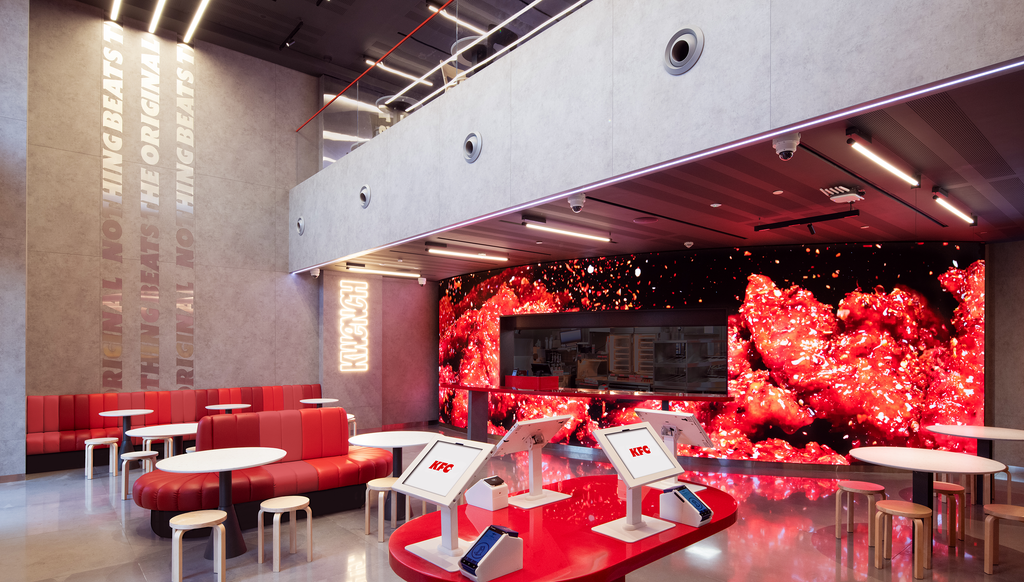
On a busy street in Dubai, there’s a building that’s impossible to miss. Its bright red facade glows with electric white lights. Three giant archways offer passersby a glimpse of a two-story screen playing constant editorial-style videos. Inside, a stark, almost brutalist construction is offset by two-tone red furniture and a neon wall mural.
It’s not a club or a luxury store—it’s a KFC.
We’re in the middle of a modern chicken war, and KFC wants to reclaim its icon status. Chicken—more specifically, the chicken tender—is undeniably having a moment, even as the rest of the fast-casual food space continues to languish in a post-pandemic, cost-of-living-induced slump. Rising stars like Raising Cane’s, Dave’s Hot Chicken, and Hangry Joe’s Hot Chicken & Wings are doing major sales and social media numbers by wooing young consumers with their signature sauces and chunky pickles. Meanwhile, legacy chicken purveyor KFC has faded into the background.
Now, KFC is ready to throw its drumstick back into the ring. After testing new chicken concepts, beverages, and brand approaches for the past several years, KFC is undertaking a major transformation to reclaim chicken supremacy—including, starting on October 31, testing out what it calls a restaurant concept of the future.
Catherine Tan-Gillespie, a KFC veteran who has been with the brand since 2015, took over as president of KFC U.S. in April 2025. Upon stepping into the role, she noted: “It was so obvious that there’s this huge latent love for the brand. We’re an American icon.” At the same time, it was equally clear that while people still hold fond memories of the chain, the challenge lies in keeping it current. In 2025, Raising Cane’s bumped it out of the top three U.S. chicken restaurants by sales, a list still led by Chick-fil-A and Popeyes.
The market share loss, Tan-Gillespie recalls, “was the catalyst for, ‘Okay, we’ve got to do something urgently around making KFC more relevant, more easy, and more distinctive.’”
KFC’s comeback includes a refreshed menu, an entirely new brand platform, and an advertising campaign that brings back Colonel Sanders. The brand’s latest move, though, is perhaps its most ambitious yet. Through a collaboration with the global agency JKR, KFC is reimagining the design of its restaurants from the ground up.
The state of play: A primer on the 2026 chicken wars
If you were online in the late 2010s, you probably remember the chicken sandwich showdown that saw industry giants Popeyes and Chick-fil-A duking it out for fans’ favor. In 2026, though, the chicken war playing field looks quite a bit different—in large part due to an influx of hot new contenders.
Over the past several years, chicken has become a boon for the fast-casual space. According to a report from the market research company Circana, total restaurant traffic for all quick-service restaurant (QSR) brands for the year ending in September 2026 was down 4% from 2019, while chicken spots were up 20%. Per the food-and-beverage trend tracker Datassential, chicken was the strongest-performing segment across all QSR and fast-casual restaurants in 2025, growing total units by 4.6% and sales by 4% across 28 brands.
This supercharged boost has been spearheaded by underdogs like Hangry Joe’s, which was Datassential’s fastest-growing chain in America in 2024 by unit count; Raising Cane’s, which has been on a months-long store-opening tear; and Dave’s Hot Chicken, which Datassential notes expanded its store count by over 34% in 2025 and its sales by nearly 45%.
As new chicken restaurants begin to carve out their own market share, legacy players like Popeyes and KFC are scrambling to pick up the slack. In an interview with MarketWatch, Mark Kalinowski, CEO of Kalinowski Equity Research, noted that in 1999, KFC’s U.S. market share stood at 39.7% of the limited-service chicken segment. By 2025, Chick-fil-A was far and away the leader, with around 45% market share. Popeyes had 11.5%, Raising Cane’s had 11%, and KFC had just 10%.
From around early 2024 to mid-2025, KFC saw a sales slump that added up to seven straight quarters of falling U.S. same-store sales. That figure finally ticked into the green in the third quarter of 2025 and has remained positive since, including a 2% gain in the second quarter of 2026, which ended in June.
It’s looking like KFC’s comeback is finally gaining a bit of headway—and the brand has a plan to keep it going.
Phase one of the chicken turnaround
KFC’s turnaround plan was in the works for years before it started showing up in the numbers. On the product side, KFC has invested in figuring out how to elevate its menu from a nostalgic memory into something more modern and craveable.
In 2024, it launched Saucy, an Orlando-based concept restaurant focused around chicken tenders and sauces. The eye-wateringly neon pink restaurant—designed to appeal to younger generations—tested out 11 new sauce flavors, including cayenne barbecue, chimichurri ranch, and sweet teriyaki.
Since the first Saucy location opened, the spin-off has scaled to 16 additional restaurants. KFC describes them as a “learning lab” to figure out what today’s guest wants from the brand, and several of its custom sauces have become part of KFC’s “global sauce pantry.”
Christophe Poirier, KFC’s chief concept officer, says Saucy’s success has resulted in several key takeaways: “One, you can explore—the world is ready. Second, if you stick to what is expected, that’s the highway to the graveyard of brands. And third, new generations of consumers are very much mavericks in the ways they experience brands.”
Clearly, the test worked: This June, KFC announced a next-generation global menu featuring a lineup of over 20 sauces and new “Dunked” tenders, wings, and sandwiches, all of which come “drenched in sauce.” It also debuted “Kwench,” a beverage platform boasting drinks like boba refreshers, iced coffees, and “Krunch Shakes” as an obvious play to capitalize on Gen Z’s “little treat” drink culture. (McDonald’s, Starbucks, and Taco Bell are just a few other chains that are currently fine-tuning their beverage offerings for younger consumers.)
As KFC modernizes its menu, it has simultaneously used nostalgia to get fans back into stores. In August 2025, the brand announced the return of its cult-favorite potato wedges and hot and spicy wings, tweeting simply: “HERE, DAMN.” The post has more than 80 million views and nearly 500,000 likes. A press release called reviving these items part of KFC’s fight “back to icon status.”
While KFC declined to share specific numbers on the launch’s success with Fast Company, the brand noted that “we went on to see the first of four consecutive quarters of same-store sales growth after seven consecutive quarters of negative same-store sales growth, so we’re encouraged by that progress.”
Into the “Bucketverse”
If the essence of KFC’s new menu is “nostalgia meets modern,” its refreshed brand approach is something similar. This April, the brand reinvested in its marketing with a campaign called “Finger Lickin’ Machine.” The 90-second spot—which accompanied the launch of KFC’s $7, $9, and $11 Box Feast meals—shows Colonel Sanders busting a move in a boardroom meeting as the gloomy executives surrounding him complain about the brand’s low prices.
The campaign is clearly intended to emphasize KFC’s renewed focus on value amid the ongoing consumer spending slowdown, but it serves the dual purpose of recentering KFC’s advertising around its most iconic brand asset, Colonel Sanders. The character is now reimagined as less of a wise old man and more of an athletic, swaggering, chicken purveyor for the people.
“It’s about making sure that we remain distinctively KFC: We have a feisty edge, an entrepreneurial edge,” Tan-Gillespie says. “The colonel was the ultimate showman, and the bucket is also super important.”
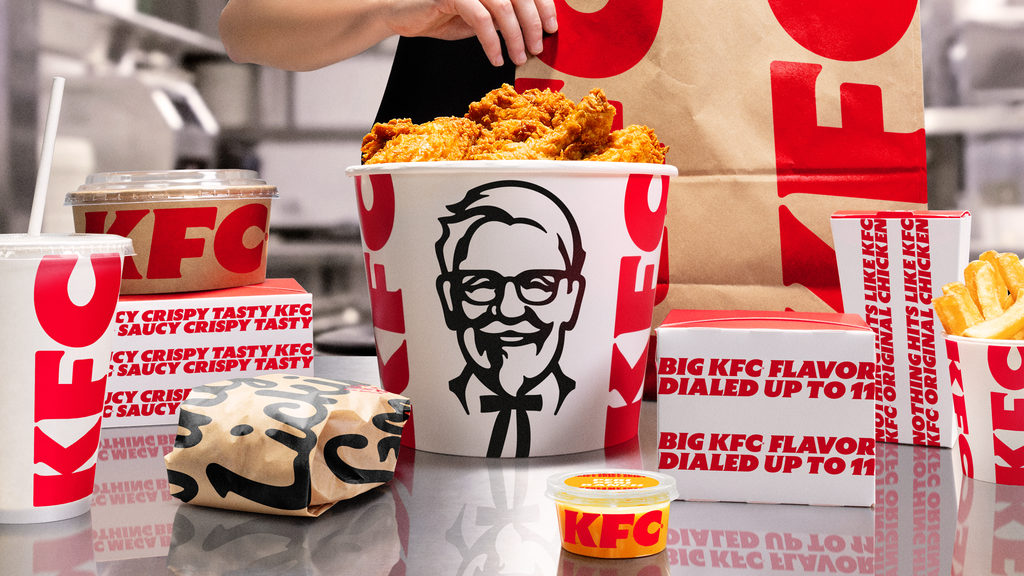
That bucket—the iconic red-and-white striped vessel—became the centerpiece of KFC’s recent rebrand, which was designed by JKR and unveiled in June. The new look includes an updated logo, typography, packaging, and app design. Threaded through it all is the image of the bucket, which has been reimagined as a frame to hold food photography, illustration, and campaign messaging. It’s a system that will give KFC much more flexibility in how it shows up on social media, in marketing, and in the stores themselves.
“Now it’s much more kinetic; it’s also much more immersive,” Poirier says. “This is why we call it the ‘Bucketverse.’”
With a revamped menu, an updated marketing plan, and a global brand refresh, KFC was ready for the most ambitious part of its comeback plan: building the chicken restaurant of the future.
The fast-food restaurant of the future
At the same time that JKR was crafting KFC’s rebrand, the agency was thinking about how it would show up in KFC’s restaurants. It was tasked with designing a modular restaurant concept that epitomized the next chapter of the brand, which could also be broken down into smaller parts and applied to existing and future stores. Dubbed project “Muse,” the first concept store opened on October 31 in Dubai, and two others are currently underway in Seoul and the U.K. Eventually, insights from the concept stores could find their way into KFC’s global fleet of 34,000 locations (and counting).
Sam Smith, an executive business director at JKR, describes Muse as “the best physical expression of the brand we’ve created for KFC.” While conceptualizing the space, JKR didn’t look at other chicken restaurants—or even other restaurants, period. Instead, Smith’s team decided that the best way to imagine a chicken restaurant of the future was to take inspiration from outside the fast-food category.
“How do you connect with people in the real physical world when so much is digital now?” she says. “How could we really use our restaurant spaces, which are the heart of the brand, to create this? We looked everywhere—from hospitality to fashion, entertainment, technology, and luxury.”
KFC says that Dubai, in the United Arab Emirates, was chosen as the flagship Muse site because it’s “one of the world’s most demanding, cosmopolitan, and hospitality-centric markets—a place where guests already expect world-class design and experience.” That combination made Dubai ideal to try out an experimental format that might not immediately land elsewhere.
Indeed, the first Muse location looks more like a modern art museum or sneaker shop-turned-nightclub than your childhood KFC. The restaurant is two stories tall with a stark red exterior, three tall archways, and a giant, illuminated outline of a bucket. Through its glass windows, a massive screen is visible even from the outside of the space. Smith calls this screen the “chicken theater.” Rather than displaying promotional material, which is the typical fare for QSR advertising, the chicken theater is constantly cycling through imagery of KFC dishes displayed like “a fashion shoot.”
“The content whets your appetite at different times of day with different product ranges,” she adds. “At lunchtime, it’s obviously focusing on lunch. Then it changes to more snacks, and you get fed with more beverage information during the afternoon. And then it dials up again for the evening.”
The actual vibe of the restaurant shifts depending on the time of day, too. In the morning and afternoon, the music is kept mellow and the lighting is soft, but as night approaches, the lights come up, the music builds, and the on-screen content gets more intense.
In an era when other quick-service restaurants are rethinking their stores after overemphasizing a design centered on mobile orders and takeout, JKR decided to throw out any notion of what a fast-food restaurant should look like and invent a new one. When it comes to service, the flow of Muse was designed from the ground up.
Muse can accommodate a range of different diners—from those who want to pick up an order to groups who might want to have a traditional restaurant experience. “We’re not following any of the traditional QSR design codes,” Smith says. “We’re definitely not designing furniture-first because, obviously, there are multiple routes: You could be in a drive-through, you could go in person, you can order online, all of these things.”
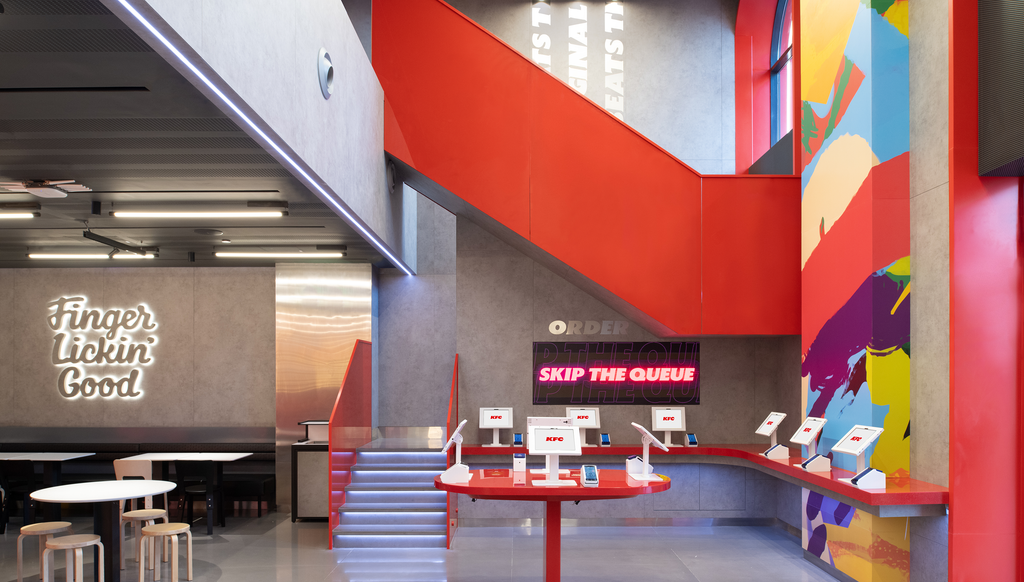
When visitors first enter the Muse location, they place their order at a kiosk zone (the kiosks have been custom-designed for this new store), which is overseen by an employee who can answer any questions. From there, they can head to a pickup zone to grab their food, or opt to have their food delivered directly to their table. In the seating area, different setups—like sections for solo diners versus groups—are set apart with their own materials and colors. The zone receiving table service is called the “Crave Circle.” Smith says that as you move through the restaurant, from the kiosk to your seat, it should feel like a journey with multiple touchpoints.
The finished restaurant is meant to represent what Smith calls KFC’s transition from a QSR to a QXR—“quality experience retail.” KFC’s vision of the future fast-food restaurant turns grabbing a chicken sandwich into a literal production, complete with lights, screens, and mood-setting.
“Kentucky-fried comeback”
Obviously, not every KFC location can be a Muse. (The cost of two-story bucket screens for 34,000 stores alone boggles the mind.) But all of the details that went into Muse are intended to stand on their own—so that in the future, global franchisees will be able to pick and choose which elements could elevate their own locations.
“We designed it holistically so it could work in any site, any place, any format,” Smith says. “They have stores that work in malls, the drive-throughs, the flagships, the tiny versions that appear in transport hubs, the delivery-only locations. Across the globe, there are lots of different formats and they’re also very, very different in terms of the square footage they take. So, we wanted a design that really focused on disrupting the category a bit.”
Other locations might choose to implement specific elements, such as Muse’s ever-changing lighting, audio, and content platform; its “Crave Circle” design; or its lobby kiosk and host system.
In the U.S., KFC is currently testing another concept location called “Open House,” which is similar to Muse but on a slightly smaller scale and tailored to an American audience. It features a mezzanine level, beverage bar, and merch station, as well as long, family-style tables for in-house service. Like KFC’s new brand and marketing, it’s a novel approach mixed with a blast from the past.
“Dining, I think, has been overlooked in the last few years,” Tan-Gillespie says. “If you go to a restaurant, you expect to be waited on. One of the premises of Open House is that it’s a fast-casual experience without the fast-casual price tag—so we’ve got table service.”
Right now, Tan-Gillespie says that Open House is a testing ground: It will have to prove out, through its own sales results, which of its strategies are working and which need improvement. Eventually, though, the goal is to begin applying learnings from Open House (and globally from Muse) and rolling them out on a broader scale.
“This is an invitation for all of America, whatever generation you belong to, to try KFC again,” Tan-Gillespie says. “We like to say it’s the ‘Kentucky-fried comeback’ made real in one restaurant.”