
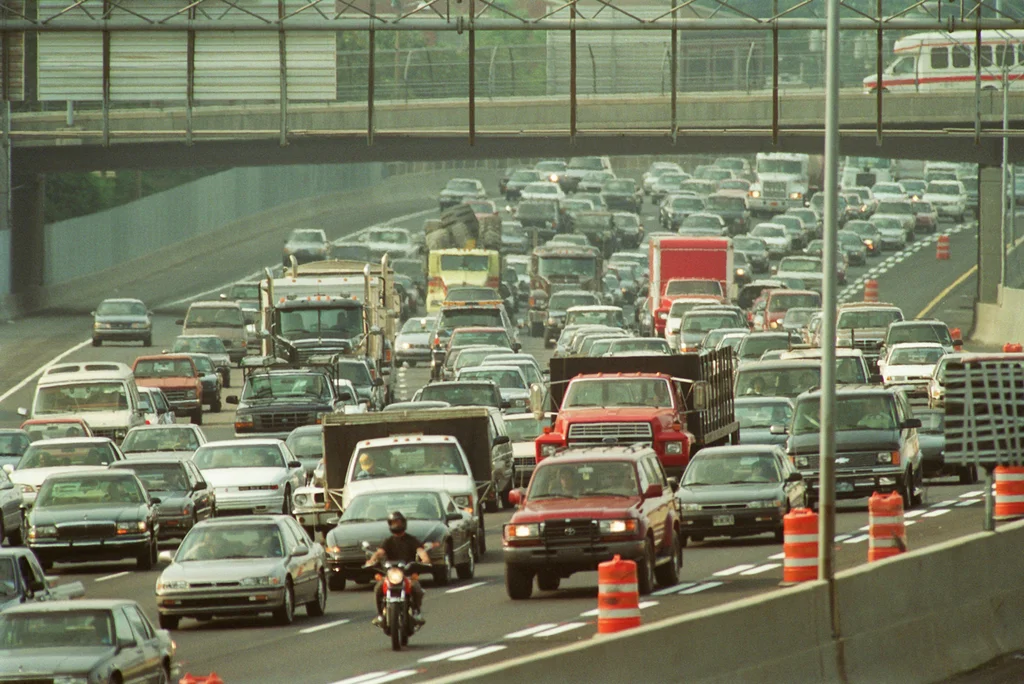
It’s 1996. You just moved to a suburb of Atlanta, to a roomy house on a quiet street. Every morning at dawn, you kiss your family goodbye, and then hop in your car to drive 35 miles to your office in the city. It takes more than an hour to get there.
You have plenty of company on the road at that hour, as you’re one of the more than 600,000 people who moved to the northern outskirts of Atlanta over the last six years. Between the traffic and constant construction, the swelling suburbs are starting to show their fault lines.
Its rapid growth during the 1990s makes Atlanta the quintessential story of suburban growth gone awry, though it is far from alone. Between 1950 and 1990, the share of Americans who lived in suburbs jumped from 23% to 46%. Decades of post-World War II expansion had transformed the American landscape from one built around small-scale neighborhood development and center city density to tabula rasa growth on the edge. Families moved to cul-de-sac subdivisions spread across car-dependent exurbs. These places were not so much cities as they were lily pads of domesticity, linked together by steadily growing interstate highways.
For many Americans, a suburban lifestyle was an outward signal of success: big house, good schools, safe streets. But that wasn’t the case for everyone. In the 1990s, at the peak of suburban sprawl, a small but vocal group of detractors began to take shape. Comprising progressive urban planners, designers, architects, and policymakers, this group coalesced around the idea that there should be an alternative way to live—one that embraced the charms of small town centers, the convenience of walkable neighborhoods, and the diversity of mixed-use and mixed-income districts.
These people would come to be known as the New Urbanists.
In 1996, the New Urbanists wrote a 27-point charter that laid out its core principles for better city planning. At a gathering in Charleston, South Carolina, a line of 262 people ceremoniously walked up onto a stage and signed their names to the charter, legitimizing once-fringe ideas as a new kind of rule book for neighborhood design and city building. Signatories included architects, urban planners, transportation engineers, and government officials, from unknown environmental activists all the way up to the U.S. secretary of Housing and Urban Development.
Over the past 30 years, the charter and its principles of planning and design have gone on to radically change the face of cities and communities across the U.S. and around the world. New Urbanism has grown into a nonprofit organization, the Congress for the New Urbanism, and a movement that’s changed the way cities are planned and built, upending rigid zoning laws, eliminating parking minimums, and bringing walkability back into the hearts of communities.
The objectives of New Urbanism still resonate today, and have been gathering new currency in the face of worsening housing affordability and growing disappointment with mainstream urban design priorities. The abundance movement, inspired by Ezra Klein and Derek Thompson’s book Abundance, calls for a proactive approach to economic and social development that can affect everything from the supply of housing to renewable energy access. Similarly, a recent push by Stripe’s cofounder, Patrick Collison, and the libertarian economist Tyler Cowen aims to spur the creation of “new aesthetics” that can change the course of cities and the architecture within them. Post-Great Recession, post-COVID-19 pandemic, there is an evident hunger for change.
Anyone now arguing for reimagining cities can take lessons from how New Urbanism emerged and rose to prominence. Three decades after the historic charter signing, Fast Company spoke with the people who were most involved in creating the New Urbanism movement—all still alive, all still working—about how such an unlikely crusade took hold. In a rare retrospective, they look back on how their movement took shape, and the legacies of sprawl that New Urbanism is still fighting today.
Roots of a design movement
The New Urbanism didn’t appear out of nowhere. Its roots grew out of a mix of disillusionment and optimism that started taking shape in the 1970s. At that time, a small group of young planners and architects were starting to feel fed up with the built environment. They believed that many of the social and environmental issues cities faced were the result of development patterns that prioritized economic returns over the experiences of the people who lived there.
With highways expanding to reach new subdivisions and new subdivisions arising alongside new stretches of highway, the traditional logic of urbanization was being supplanted by a perverse pattern of growth for the sake of growth. How people lived in these places, what they did there, and why they’d even want to be there were seemingly irrelevant. The environmental costs of populating these areas and keeping them going were afterthoughts at best.
A group of young designers believed development needed a more comprehensive, interdisciplinary, and thoughtful approach, and they set out to show how it could work. They included the Miami-based urban planners Andrés Duany and Elizabeth Plater-Zyberk, the Los Angeles-based architects Elizabeth Moule and Stefanos Polyzoides, and a regional planner in California named Peter Calthorpe. Now all in their 70s and 80s, their paths began crossing after coming out of various architecture and design programs in the 1970s and working as architects and planners across the country.
“We began practicing when the collapse of suburbia became evident. The promise of suburbia, which was plenty of green, plenty of parking, highways that really work, was betrayed,” says Duany, cofounder Duany Plater-Zyberk and Company (now DPZ CoDesign). “You didn’t get nature. You got a whole bunch of traffic congestion in commuting, and all the great parking fields were miserable places. So there was a feeling of betrayal in the air and we were able to perceive it.”
After studying under the influential architectural scholar Vincent Scully, Duany and Plater-Zyberk graduated from Yale University in 1974 and moved to Miami where they co-founded the architecture firm Arquitectonica, and then, in 1980, Duany Plater-Zyberk and Company, a firm focused on counteracting suburban sprawl.
Calthorpe had also studied at Yale but left in the mid-’70s before graduating to work under the California architect Sim Van der Ryn, who in 1975 was appointed state architect by California Governor Jerry Brown. During Brown’s administration, Calthorpe worked on a new plan for downtown Sacramento built around a burgeoning light rail system, an early example of transit-oriented development, which would become Calthorpe’s specialty.
Meanwhile, Moule and Polyzoides had started an architecture firm in Southern California centered around bringing traditional architectural approaches to housing beyond the typical single family home, designing courtyard homes and clusters of housing that would, decades later, become known as “missing middle” housing.
“All of us were working on parallel paths from the mid-’70s on,” Calthorpe says.
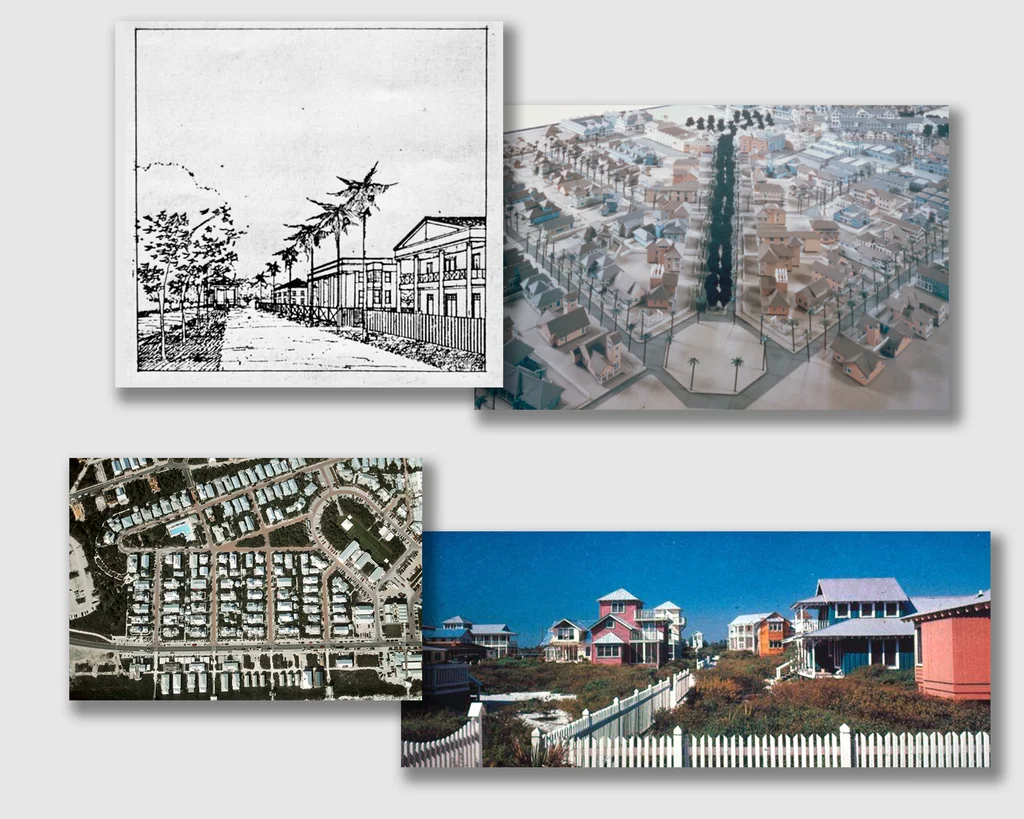
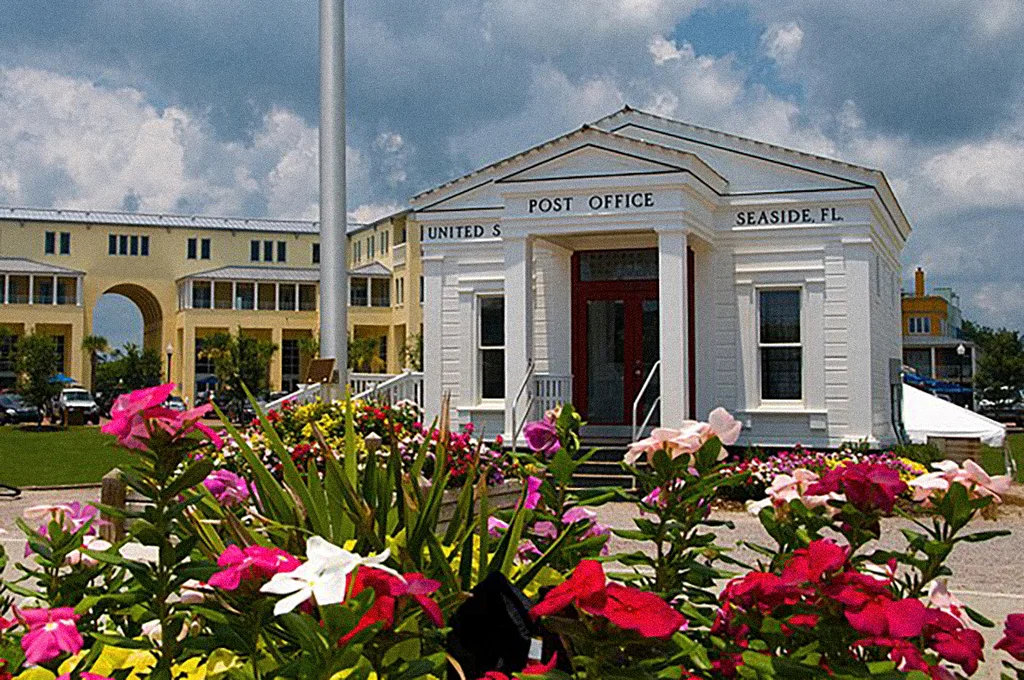
Those paths began to intersect in the 1980s as the designers’ alternative takes on urban and suburban development garnered more attention. An early standout was Seaside, a Florida gulf coast resort town planned by Duany and Plater-Zyberk and founded in 1981. The pastel-toned walkable village-like development, later made famous as the set of the 1998 film The Truman Show, is considered the first New Urbanist community.
“We were architects who were networking. There was a lot of travel to give lectures in the world of architecture about the latest things people were working on. And we realized there were people around the country that were heading in the same direction,” says Plater-Zyberk.
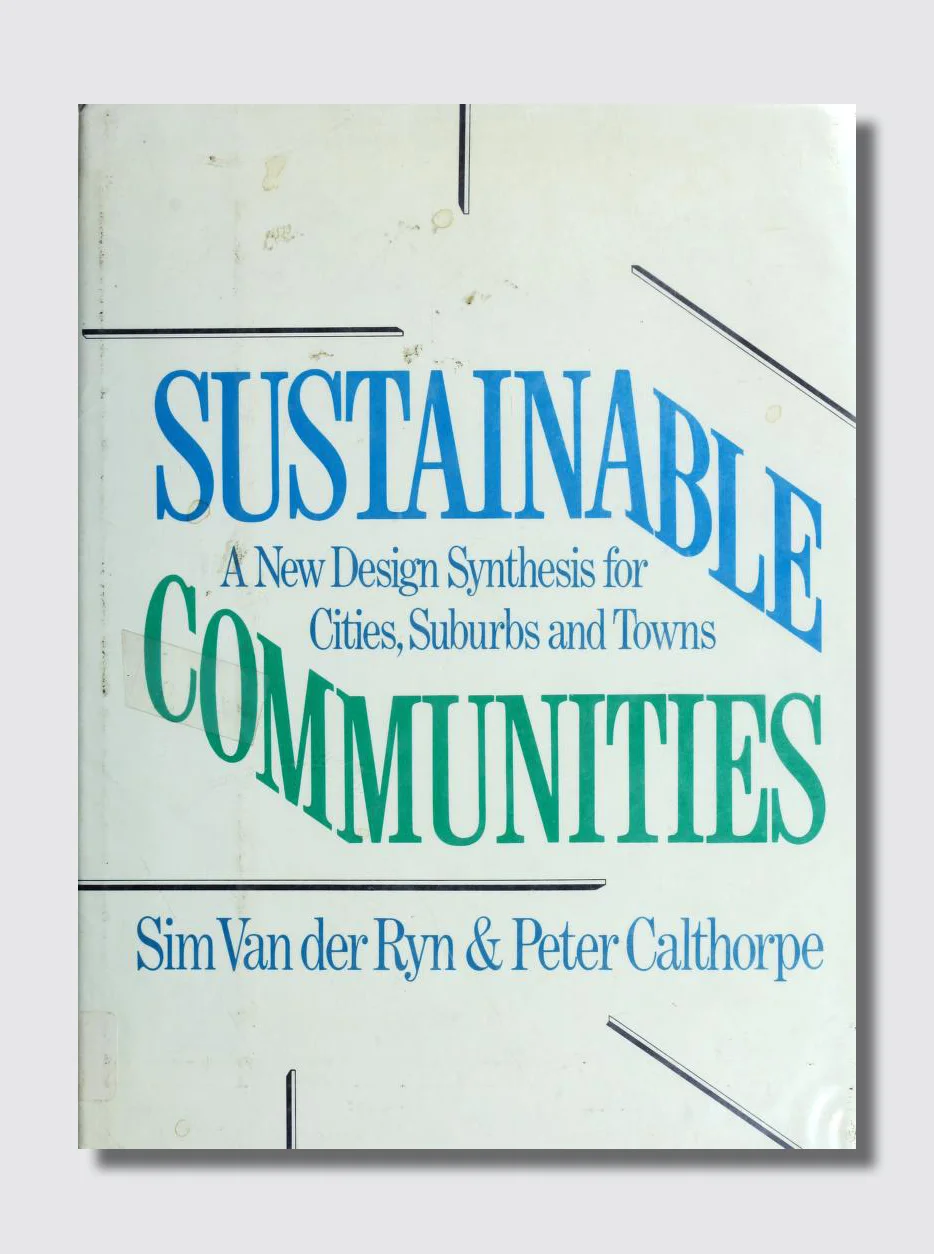
In 1986, Calthorpe and Van der Ryn published a book called Sustainable Communities, which outlined emerging elements in the planning and urban design fields that were changing the shape of cities. It included several case studies of places that were designed to reduce resource consumption and lessen reliance on cars, as well as a focus on utopian-leaning new town development. Later, Calthorpe was teaching a course on transit-oriented development at UC Berkeley with architect and urban designer Dan Solomon, who would later become one of the founders of New Urbanism, and they invited Duany to participate in a symposium on new forms of suburban development.
Slowly, the individual and varied work of these practitioners would intermingle. “We were working on different sides of the same coin,” Calthorpe says.
The founders coalesce
By the beginning of the 1990s, the future founders of the New Urbanism movement joined forces. Their first real meeting was around a plate of pasta.
During Calthorpe’s time working under California Governor Jerry Brown, the state had enacted new energy efficiency and building standards, and created a statewide organization called the Local Government Commission to spread best building practices out to all the jurisdictions across the state. Run by Judy Corbett, a pioneer in sustainable development, the commission’s role was interpreted broadly. Around 1990, Corbett saw an opportunity to tie energy efficiency to larger neighborhood planning, land use, and transportation issues.
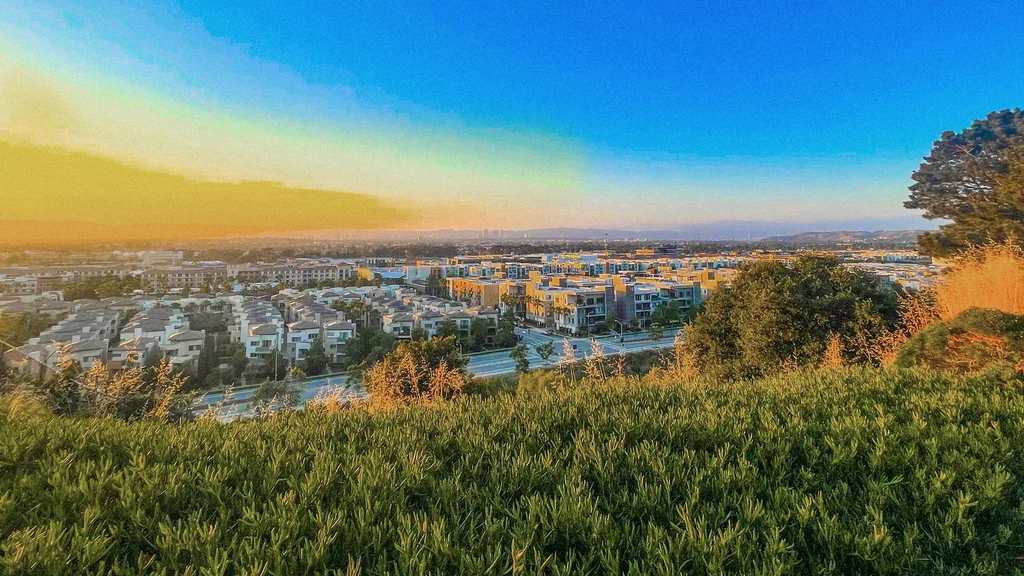
“Judy called me up and said, ‘I want to get some design principles that are clear and firm, but something I can pass around to elected officials throughout the state of California,’” Calthorpe recalls. Duany and Plater-Zyberk were in California working alongside Moule and Polyzoides on the Los Angeles redevelopment project Playa Vista, so Corbett and Calthorpe organized a meeting. They saw the chance to use California’s push for energy efficient buildings as an opening to get more people thinking about ways growth and development should change. “We all met in Judy’s kitchen in Davis, California, and had a pasta dinner and talked about shaping some kind of movement,” Calthorpe says.
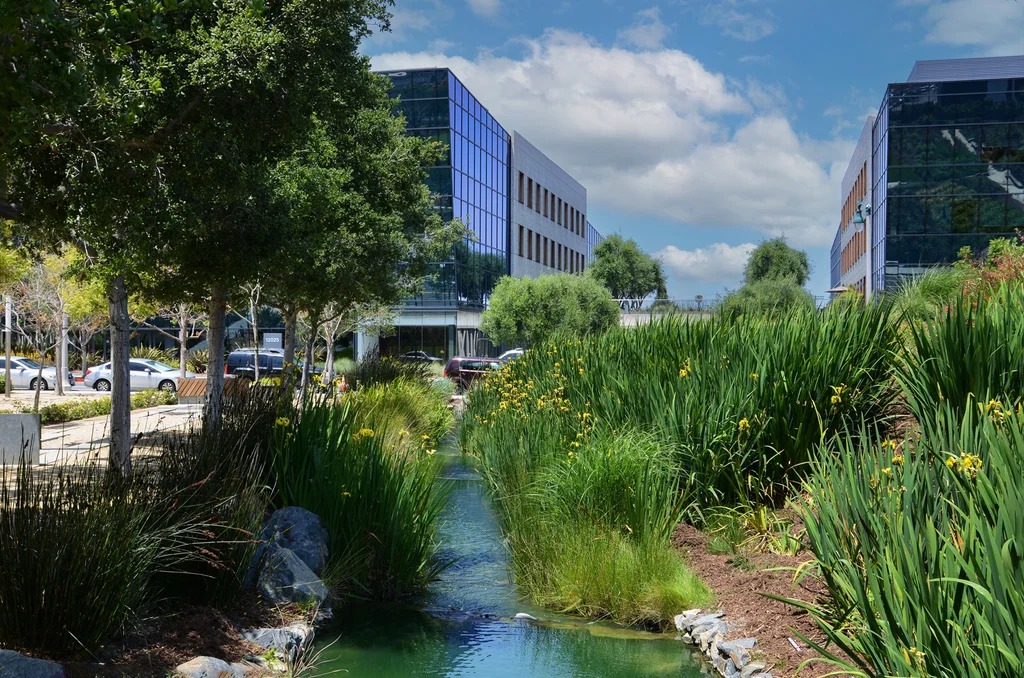
“I don’t know that we thought so much as being a rebellion as much as feeling like we were profound outsiders and the forces in front of us that were creating the cities that we live in were remarkable,” Moule adds.
This led to Corbett organizing a Local Government Commission-led conference at Yosemite National Park’s historic Ahwahnee Hotel in 1991, bringing together architects, planners, transportation engineers, government officials, and policymakers from across California. Calthorpe, Duany, Plater-Zyberk, Moule, and Polyzoides helped drive the discussion.
Moule recalls that during the meeting they created a rudimentary series of principles called the Ahwahnee Principles that helped define their thinking at different scales, from the building block to the street, neighborhood, district, and region. The tenets called for planning “complete and integrated communities,” with a variety of activities, housing types, and jobs, and designs that conserve resources and minimize waste.
“We knew that if we put a little bit more meat on the bones and fleshed them out a little bit more, and then gathered people together to see what they thought about it, then we might be able to get somewhere,” Moule says.
The group agreed that the Ahwahnee Principles should be considered a starting point for a large-scale rethinking of the developer-led, piecemeal urban development patterns of the previous decades. “We were talking about it and saying, you know, these principles are right but they’re not going to get us there. We need more detail. We need to be more specific,” Plater-Zyberk says. “It was one of the things that pushed us to make our own group that was urban design oriented, with greater detail or depth than planning and much more specific goals.”
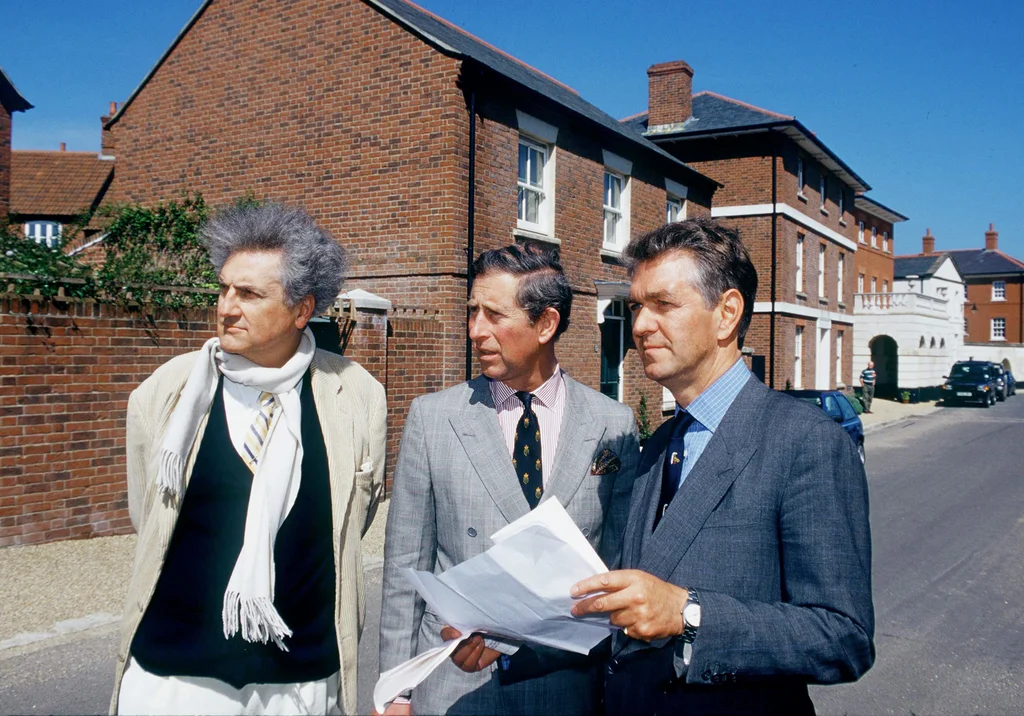
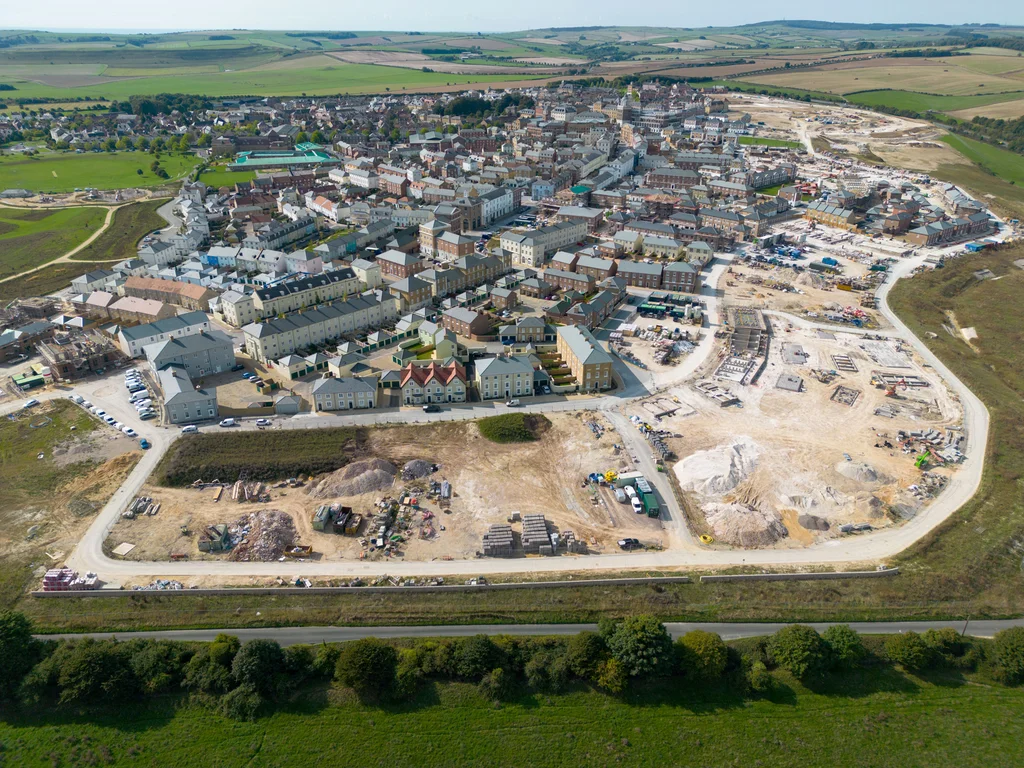
Around this time, Duany was having discussions with architect Léon Krier. A harsh critic of modernism, Krier was the future master planner behind the New Urbanist town of Poundbury, England, initiated in the late 1980s by then-Prince Charles. Krier, who died in 2025 at 79, impressed on Duany how modernist architects had had such a deep influence on 20th century architecture and urban planning through a formal organization called the Congrès Internationaux d’Architecture Moderne (CIAM), founded in 1928. He suggested the anti-sprawl movement needed its own formal organization.
“I was aware of just a few colleagues that were on the same page. And we basically called them,” Duany says.
Calthorpe says Duany proposed a group that would “repeal and replace” CIAM. “They had congresses and they issued a charter. So we thought, well, we’re going to do exactly the same thing. We can just cut and paste, take out the bad shit and put in the good,” Calthorpe says.
New Urbanism’s first congresses
Around 1992, Duany, Plater-Zyberk, Moule, Polyzoides, and Calthorpe all gathered in New York, along with a planner named Peter Katz, who was working on a book about new approaches to urban planning and design (The New Urbanism: Toward an Architecture of Community, published in 1994). The six discussed the overlapping intentions of their design and planning work, and what it would look like to bring a more interdisciplinary approach to creating a more livable urban environment.
“We started with nothing, just fumes,” says Polyzoides, cofounder of Moule & Polyzoides Architects and Urbanists, and now dean of architecture at the University of Notre Dame. “There was so much to learn. There was so much to unveil, really, because the subject is so deep.”
From their work, they knew that reimagining the built environment would be a complicated undertaking. Interrelated forces shape the world as we know it, from land use planning to neighborhood design to traffic engineering to natural resource consumption. Making wholesale change hinged on understanding and reforming how all those interrelated pieces fit together. They walked away from the meeting with a plan to break everything down to three scales: the regional, the neighborhood, and the building. They also came up with a name for themselves: New Urbanists.
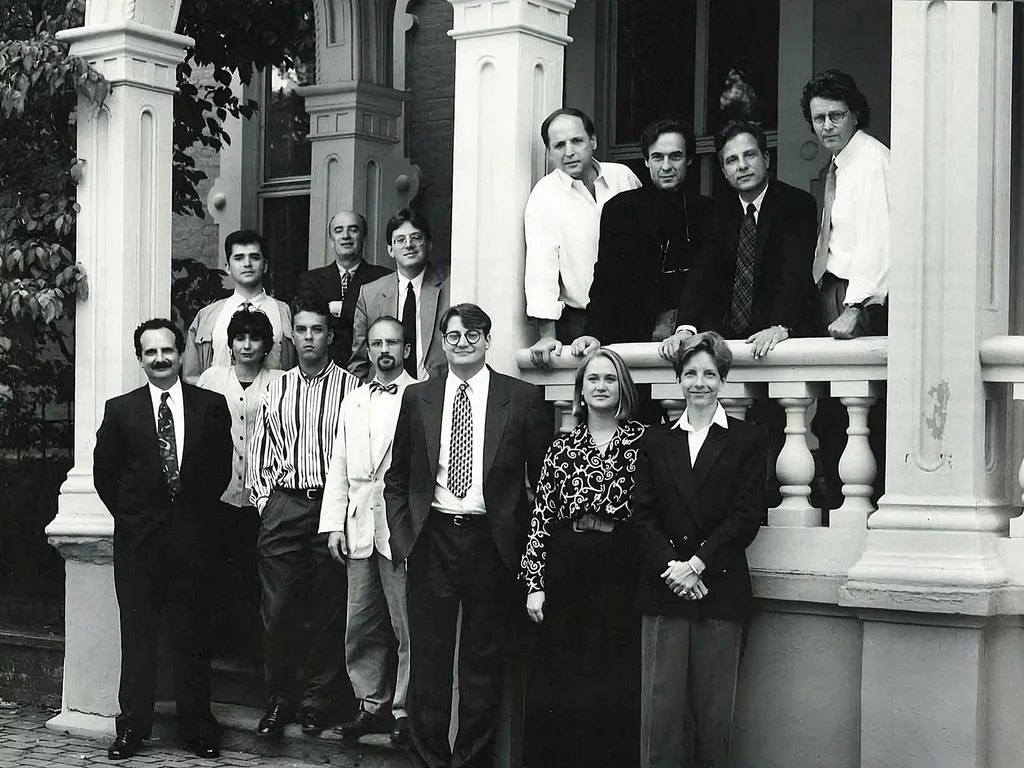
Following the model of CIAM, they decided to hold a series of congresses, or concept-focused meetings where the group could collectively debate exactly how each scale of citymaking should be redirected. With the Congress for the New Urbanism formally established, Duany and Plater-Zyberk led the organization of the first congress in 1993, focused on the neighborhood level and set inside a columned meeting hall in Alexandria, Virginia, called the Lyceum. Each of the founders invited people to participate.
“It was really coming out of our Rolodexes. That I even said Rolodex probably gives you an idea of the time frame,” Moule says. “Instead of it being sort of a board meeting, we decided to make it a larger call to arms.”
About 200 people were invited, including planners, landscape architects, traffic engineers, civic activists, and developers. People made presentations about their experience and projects. “It started out as a very diversely disciplined group who were all working on the same kinds of issues,” Plater-Zyberk says.
The next congress, held in 1994, was organized by Moule and Polyzoides at the Biltmore Hotel in downtown Los Angeles, and focused on the building block and the street. “That was quite provocative at the time, largely because Los Angeles was known for being the home of the automobile and the home of suburban sprawl,” Moule says. “It was sort of a stick-it-in-your-eye kind of conference.”
Calthorpe and Solomon organized the third congress in San Francisco in 1995, focused on the regional level, with an emphasis on their work planning transit-oriented development projects. The founders cast an even wider net for attendees, inviting participants from groups like AARP, the Urban Land Institute, the Trust for Public Land, and the NRDC, as well as heads of departments of transportation, mayors, and government officials. “Unlike CIAM, which was only architects, we really wanted to bring in every last person that we thought had some kind of say in how the urban environment was created and made, so it was pretty diverse group,” Moule says. “It might have had 1,500 people. So there was momentum.”
Organized like conventional conferences, these three congresses had the typical hallmarks of presentations, panels, post-meeting dinners, and post-dinner parties. But unlike most conferences, where the event ends and everyone goes home, attendees were actively trying to build a movement—and set a new standard for neighborhood design and city building.
“People were doing things and coming back and talking to each other about the way they did it,” Polyzoides says. “We were constructing the theory out of experience, not constructing it out of theory.”
A charter signed, and an early win
New Urbanism’s fourth congress was held on May 4, 1996, in a rented hall in Charleston, South Carolina. The concepts and ideas generated through the previous three annual gatherings had been consolidated down into 27 principles, each roughly 25 to 50 words, and broken into three categories:
- The metropolis, city, and town
- The neighborhood, the district, and the corridor
- The block, the street, and the building.
The charter, written primarily by the founders, was presented to the invited audience. With a large white paper mounted on an easel in the center of the stage, the attendees were invited to add their signatures to adopt the charter. Though there are no records of how many people were in attendance that day, 262 signed the charter and New Urbanism became an official movement.
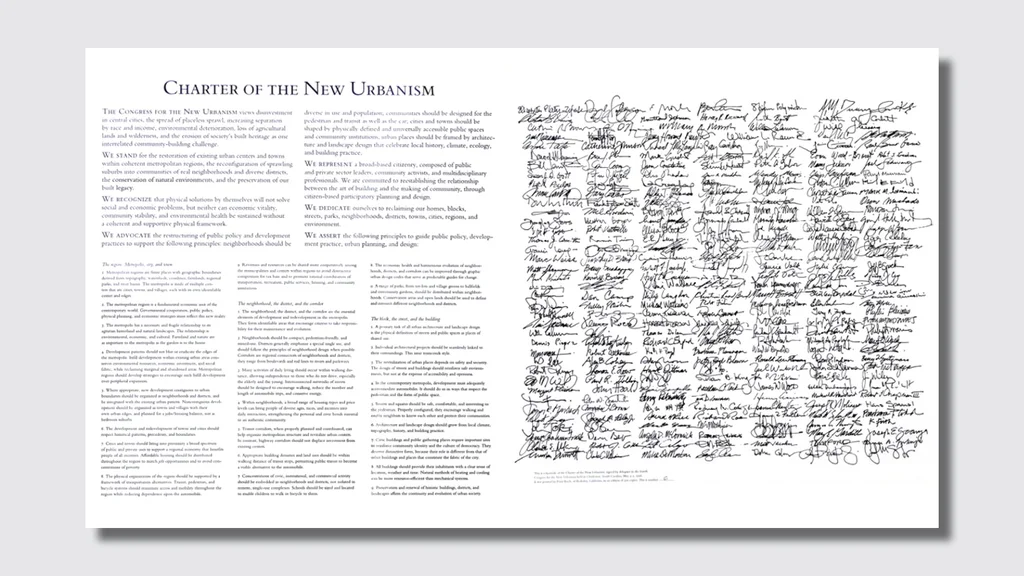
“It was signed dramatically. Everybody walked up on stage to sign it,” Plater-Zyberk says.
The charter signing was considered a starting point for New Urbanism, and an opening of the invitation-only organization to a broader membership. And with so much of the American landscape dominated by disconnected concentrations of single family homes or office parks or big box retail clusters, people were ready to get behind an alternative.
By the end of 1996, CNU would claim more than 500 official members. Attendance numbers would rise with each annual congress, as did interest in the organization’s anti-sprawl sentiment. The organization’s openness and its challenges to the status quo brought attention that grew into a movement.
“We do not protect the ideas or even the use of the term New Urbanism. It’s totally freeware,” Duany says. “You can’t just get a Harvard degree. You can’t just get LEED certification. Well, we say these are the principles called New Urbanism, don’t mangle it and get on with it.”
Sounds straightforward, but the principles called for a widespread rethinking of the accepted practices of the day, and systemic changes in the financial infrastructure of real estate development. “Segregated land use was something that was so baked into the system. You had to change how appraisals were done. You had to change how banks lent on buildings,” Moule says. “They wouldn’t lend you something if you wanted to put retail on the ground floor and housing or offices on top. It just didn’t happen.”
Some were skeptical of New Urbanism from the start. Writing in Harvard Design Magazine in 1997, the urban geographer and Marxist scholar David Harvey called out the movement as naive, arguing that it “connects to a facile contemporary attempt to transform large and teeming cities, so seemingly out of control, into an interlinked series of ‘urban villages’ where, it is believed, everyone can relate in a civil and urbane fashion to everyone else.” The head of Harvard’s Department of Urban Planning and Design in the late 1990s and early 2000s, Alex Krieger, was another critic of the movement and its emphasis on designing new communities with traditional styles instead of fixing the communities that already existed.
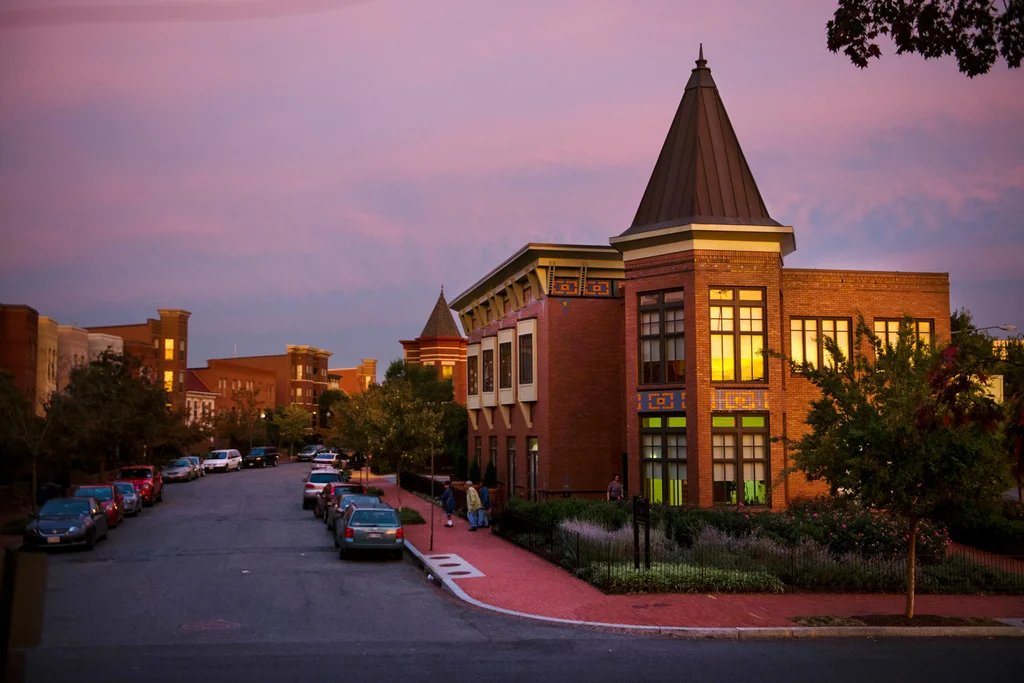
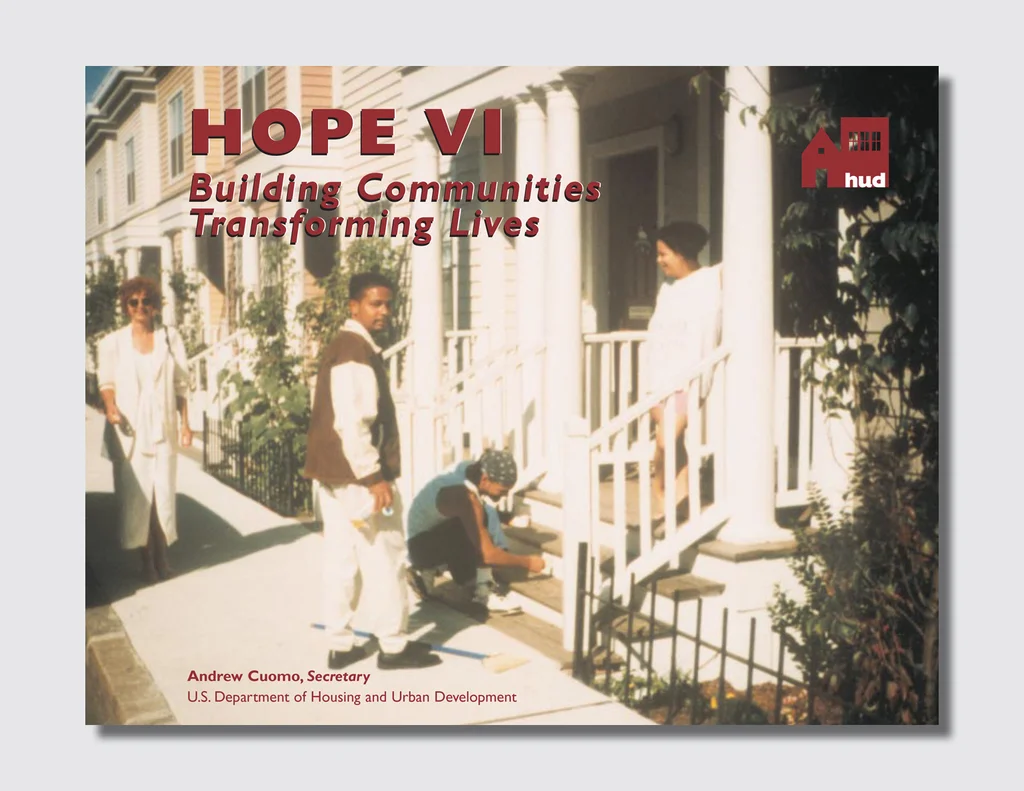
Not long after its official birth, New Urbanism got the chance to do just that. HUD secretary Henry Cisneros, the highest profile signatory of the Charter of the New Urbanism, ended up enabling one of the movement’s biggest successes through the HOPE VI program, a HUD effort had launched in 1992 to undertake a large-scale redevelopment and revitalization of the country’s public housing projects. Throughout the late 1990s and early 2000s, CNU members and the nonprofit CNU organization itself worked directly with HUD to establish the design guidelines for the program, transforming decaying public housing barracks and towers into mixed-income neighborhoods.
The work spread across more than 260 sites in cities like Atlanta, Boston, Charlotte, Los Angeles, Pittsburgh, San Francisco, and Washington D.C., and resulted in the redesign of 100,000 units of public housing. Decaying housing towers and bleak low-rise housing clusters were replaced with walkable neighborhoods that blended into their context and erased the line between public housing and the rest of the city. “Most of the members of the early CNU were very involved,” says Calthorpe. “That was really the beauty of the thing. Unlike the architects who are constantly competing with each other, we just wanted to collaborate.”
Research led by Harvard University’s Raj Chetty and released in 2026 found that children growing up in the neighborhoods revitalized through the HOPE VI program earned more money as adults, were more likely to attend college, and were less likely to be incarcerated.
“HOPE VI made policy of the idea that the design of community can have a profound influence on people’s lives,” says Mallory Baches, the current president of CNU. “It takes 30 years to do a longitudinal study on the effects of those projects, but 30 years later we have the evidence that that early influence made a big difference.”
Edging into the mainstream
Over time, many of the main principles of New Urbanism have steadily moved from the fringe of city planning and development to the mainstream. Mixed use and higher density development, and the zoning reform they tended to require, have become commonplace policies in cities across the U.S. Walkable town centers, infill development, alternative transportation, an emphasis on local economies, form-based codes, and transit-oriented development are all normal elements of many cities and their approach to growth and development. (The movement has even spawned a partly serious progressive urbanist online community called New Urbanist Memes for Transit-Oriented Teens.)
“There’s been enormous success,” says Polyzoides. “It is impossible to imagine that in a continental country like ours, you could move within a generation from people doing crap everywhere to doing the right thing on so many fronts when it comes to urbanism.”
New Urbanism and the CNU continue to affect city planning, urban development, policy, and governance, but the movement hasn’t risen to CIAM’s level of modernist influence on the shape and form of the built environment, nor has it thoroughly changed de facto development industry practices.
“New Urbanism has had a big effect, but there’s still the large companies that are buying land to build a single unit-type subdivision in the old-fashioned way,” says Plater-Zyberk. “And there’s too much of that going on. But under the current affordability crisis, in some cases, people are trying to make more of that happen.”
Calthorpe argues New Urbanism is essentially a progressive movement, with roots in the counterculture of the 1960s, and its modest uptake in the planning and development world has a lot to do with the politics of the current era. “In the end, sprawl just kept happening and we were more of a footnote or counterpoint. We never became normative in America,” he says.
One challenge that’s dogged the movement is its aesthetic lean. Style has always been a lightning rod within New Urbanism, with some embracing the movement’s goals but balking at its tendency toward classical or neotraditional architectural approaches. Plater-Zyberk recalls the issue of style being one of the biggest points of contention ahead of the charter signing back in 1996. “That was a very sensitive point,” she says.
This aesthetic approach has recently taken on political undertones, as President Donald Trump has controversially made traditional architecture the preferred style for federal buildings.
Polyzoides, who is dean of one of the most traditionally-focused American architecture schools, rejects any connection between New Urbanism and Trump’s architectural choices, calling them an aberration. “What ties this particular president to the Mussolinis and the others in the world is they see classical architecture as an opportunity to exert power. But what classical architecture is about at its source is an architecture of community,” he says. “It’s an architecture of common expression, common ideals. So, an architecture of democracy.”
The future of the New Urbanism movement may hinge on larger concerns, and on bringing younger people into the fold. Baches, who now leads the organization, says she’s focused on helping younger generations engage with the principles and ideals set out by the founding generation of New Urbanists, many now at the tail end of their careers.
In 2023, CNU initiated a process of amending the original Charter of the New Urbanism. The amended charter now includes principles around increasing diversity, equity, and inclusion; countering involuntary displacement; ensuring the attainability of housing; and contextualizing the built environment’s role in climate change. These new principles, she argues, will keep the movement relevant into the future, while also making the output of New Urbanism—a better alternative to sprawl—even more attractive.
“Communities across the country have so much more of an appetite for great urbanism, but there’s a limited supply. And until we have created more, or adapted sprawl into better urbanism, the attainability of living the kind of quality life that great urbanism can provide is going to be only available to those who can afford it,” she says. “We need to expand access to that great urbanism.”
CNU’s 35th congress will take place in June.