
Blue Origin’s New Glenn rocket successfully made its way to orbit for the second time on Nov. 13, 2025. Although the second launch is never as flashy as the first, this mission is still significant in several ways.
For one, it launched a pair of NASA spacecraft named ESCAPADE, which are headed to Mars orbit to study that planet’s magnetic environment and atmosphere. The twin spacecraft will first travel to a Lagrange point, a place where the gravity between Earth, the Moon, and the Sun balances. The ESCAPADE spacecraft will remain there until Mars is in better alignment to travel to.
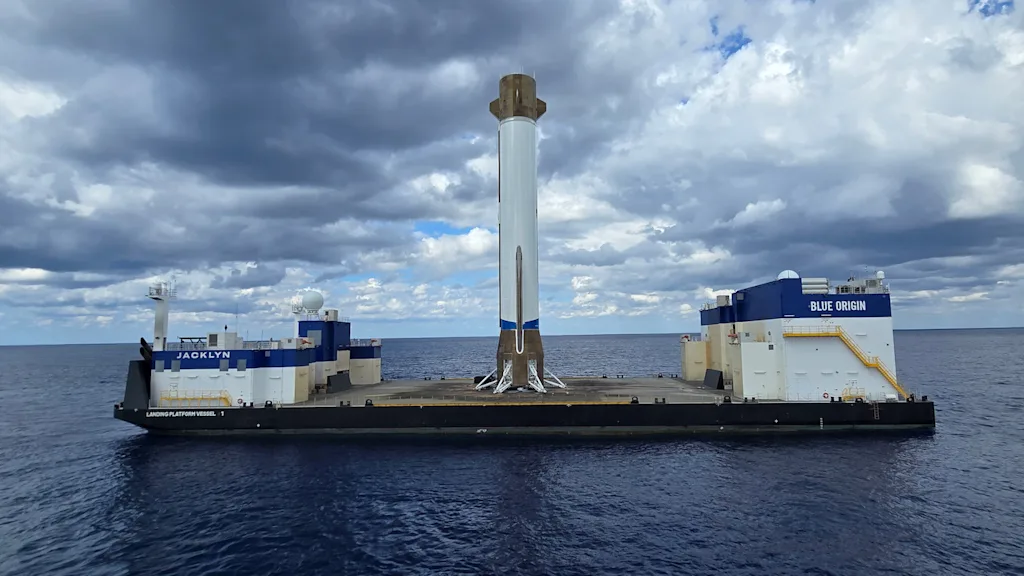
And two, importantly for Blue Origin, New Glenn’s first stage booster successfully returned to Earth and landed on a barge at sea. This landing allows the booster to be reused, substantially reducing the cost to get to space.
Blue Origin launched its New Glenn rocket and landed the booster on a barge at sea on Nov. 13, 2025.
As a space policy expert, I see this launch as a positive development for the commercial space industry. Even though SpaceX has pioneered this form of launch and reuse, New Glenn’s capabilities are just as important.
New Glenn in context
Although Blue Origin would seem to be following in SpaceX’s footsteps with New Glenn, there are significant differences between the two companies and their rockets.
For most launches today, the rocket consists of several parts. The first stage helps propel the rocket and its spacecraft toward space and then drops away when its fuel is used up. A second stage then takes over, propelling the payload all the way to orbit.
While both New Glenn and Falcon Heavy, SpaceX’s most powerful rocket currently available, are partially reusable, New Glenn is taller, more powerful, and can carry a greater amount of payload to orbit.
Blue Origin plans to use New Glenn for a variety of missions for customers such as NASA, Amazon, and others. These will include missions to Earth’s orbit and eventually to the Moon to support Blue Origin’s own lunar and space exploration goals, as well as NASA’s.
NASA’s Artemis program, which endeavors to return humans to the Moon, is where New Glenn may become important. In the past several months, several space policy leaders, as well as NASA officials, have expressed concern that Artemis is progressing too slowly. If Artemis stagnates, China may have the opportunity to leap ahead and beat NASA and its partners to the lunar South Pole.
These concerns stem from problems with two rockets that could potentially bring Americans back to the Moon: the space launch system and SpaceX’s Starship. NASA’s space launch system, which will launch astronauts on its Orion crew vehicle, has been criticized as too complex and costly. SpaceX’s Starship is important because NASA plans to use it to land humans on the Moon during the Artemis III mission. But its development has been much slower than anticipated.
In response, Blue Origin has detailed some of its lunar exploration plans. They will begin with the launch of its uncrewed lunar lander, Blue Moon, early next year. The company is also developing a crewed version of Blue Moon that it will use on the Artemis V mission, the planned third lunar landing of humans.
Blue Origin officials have said they are in discussions with NASA over how they might help accelerate the Artemis program.
New Glenn’s significance
New Glenn’s booster landing makes this most recent launch quite significant for the company. While it took SpaceX several tries to land its first booster, Blue Origin has achieved this feat on only the second try. Landing the boosters – and, more importantly, reusing them – has been key to reducing the cost to get to space for SpaceX, as well as others such as Rocket Lab.
That two commercial space companies now have orbital rockets that can be partially reused shows that SpaceX’s success was no fluke.
With this accomplishment, Blue Origin has been able to build on its previous experience and success with its suborbital rocket, New Shepard. Launching from Blue Origin facilities in Texas since 2015, New Shepard has taken people and cargo to the edge of space, before returning to its launch site under its own power.
New Glenn is also significant for the larger commercial space industry and U.S. space capabilities. It represents real competition for SpaceX, especially its Starship rocket. It also provides more launch options for NASA, the U.S. government, and other commercial customers, reducing reliance on SpaceX or any other launch company.
In the meantime, Blue Origin is looking to build on the success of New Glenn’s launch and its booster landing. New Glenn will next launch Blue Origin’s Blue Moon uncrewed lander in early 2026.
This second successful New Glenn launch will also contribute to the rocket’s certification for national security space launches. This accomplishment will allow the company to compete for contracts to launch sensitive reconnaissance and defense satellites for the U.S. government.
Blue Origin will also need to increase its number of launches and reduce the time between them to compete with SpaceX. SpaceX is on pace for between 165 and 170 launches in 2025 alone. While Blue Origin may not be able to achieve that remarkable cadence, to truly build on New Glenn’s success it will need to show it can scale up its launch operations.
Wendy Whitman Cobb is a professor of strategy and security studies at Air University.
This article is republished from The Conversation under a Creative Commons license. Read the original article.