
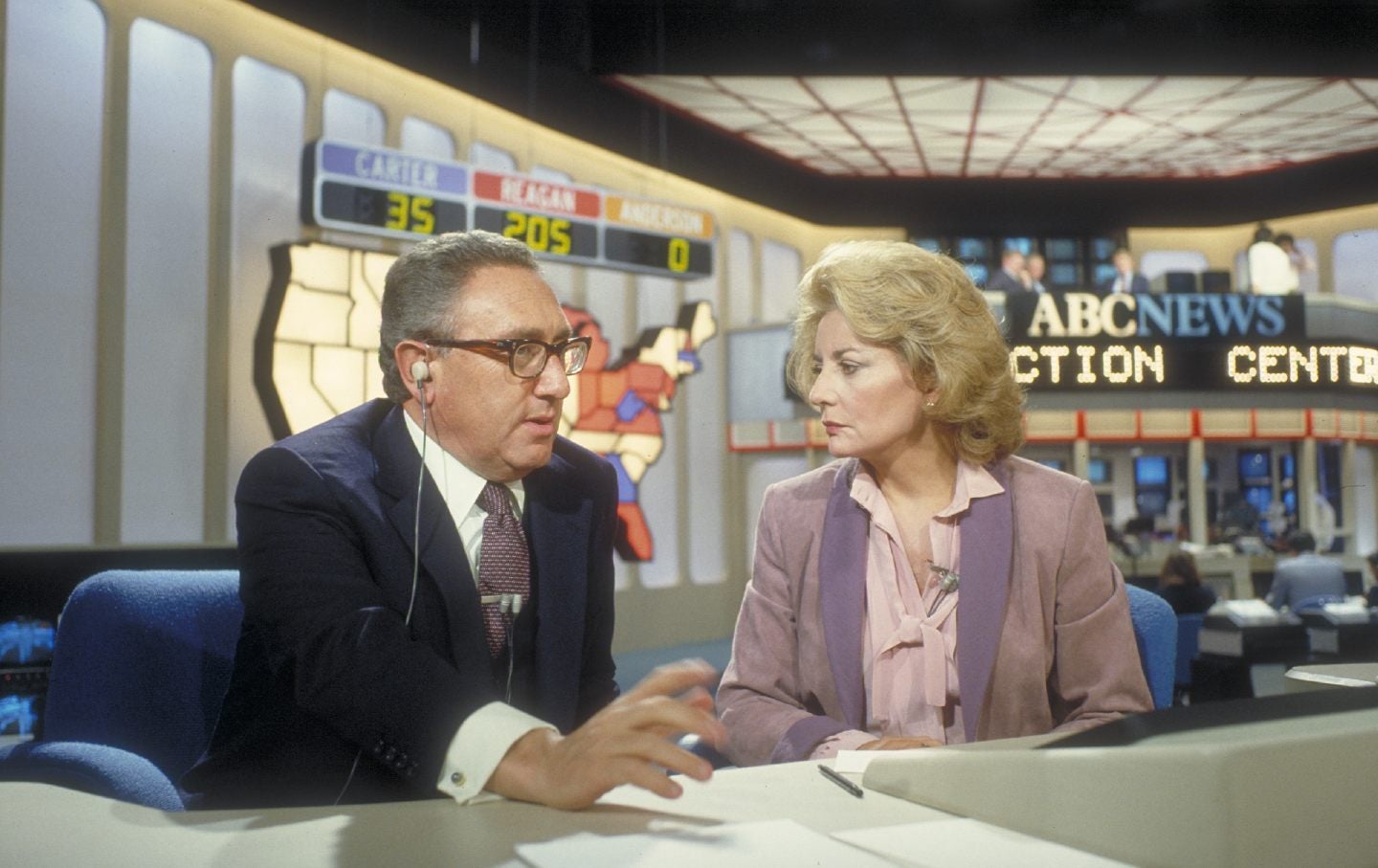
Barbara J. Keys’s new book, Super K, reveals Kissinger’s ceaseless efforts to burnish his bloody legacy.
Barbara J. Keys’s new book, “Super K,” reveals Kissinger’s ceaseless efforts to burnish his bloody legacy.
On November 7, 2002, I attended a lunch meeting with Henry Kissinger’s personal lawyer, William D. Rogers, at a tony Spanish restaurant in downtown Washington, DC. Rogers was concerned about my forthcoming book, The Pinochet File—what it would reveal about Kissinger’s documented roles as chief architect of US efforts to undermine Chile’s democratically elected president, Salvador Allende, as well as lead enabler of Gen. Augusto Pinochet’s consolidation of his vicious dictatorship. Based on advance access to my manuscript, a year earlier 60 Minutes had broadcast a hard-hitting segment that tied Kissinger to the CIA’s violent plot to neutralize Chile’s commander in chief of the armed forces, Gen. René Schneider, who had opposed a preemptive coup to prevent Allende’s inauguration. On Henry’s behalf, Rogers had cause for concern.
Nevertheless, our conversation was civil; we discussed our differences on key points of the dark history of US intervention in Chile and agreed that we would debate each other in a special event when the book was published on the 30th anniversary of the Chilean coup.
Somewhat naïvely, I agreed to give him an advance galley of the book so he could prepare.
Rogers’s mission, as he reported to Kissinger via e-mail, was “to head off [Kornbluh’s] book or diffuse it.” I later learned that he had a team of associates pick apart the galleys to refute the evidence the book would present. Rogers drafted a 14-page rebuttal to share with those in the media who could counter my arguments. When he received a tip that I planned to write an opinion piece in The Washington Post on the 30th anniversary of the coup, he pressed editors there for “equal time and ink” and advised Kissinger to reach out to his friend senior associate editor Lally Graham Weymouth. In what became the biggest “project” to countermand the book, Rogers enlisted conservative academic Mark Falcoff to write a major article on what Rogers called “the powerful and pernicious myth” of US involvement in Chile. “Mark and I met yesterday for some extensive editing of his paper,” Rogers reported to Kissinger in mid-August 2003, as the anniversary of the coup approached. “I told him I would not—unless I heard otherwise from you—be sending you the draft beforehand. Thus, we can all say that the appropriate niceties of authorial independence were strictly observed.”
Their plan was to publish Falcoff’s attack article in Foreign Affairs, the prestigious journal of the Council on Foreign Relations (CFR), where Kissinger wielded tremendous influence by bringing in big donors to support the “Henry A. Kissinger Chair for U.S. Foreign Policy.” But that plan fell through when the editor James Hoge rejected the Falcoff article as “too narrow a defense of Kissinger.” Instead, the CFR’s Latin America specialist, Kenneth Maxwell, wrote a lengthy and moderately favorable review of The Pinochet File, sending Kissinger into a complete meltdown.
For Kissinger, “being attacked in Foreign Affairs was like being mugged in his own living room,” writes historian Barbara J. Keys in her compelling and damning new book, Super K: The Making, Breaking, and Remaking of Henry Kissinger’s Legacy. As Kissinger told his colleagues, Foreign Affairs had been used “to smear a former secretary of state closely associated with the Council for fifty years in a manner comparable to those of the most radical journals.” In addition to trying to get the entire Foreign Affairs issue pulled from circulation and threatening to resign from the Council and take the endowed chair along with its wealthy donors with him, Keys recounts, Kissinger “briefly contemplated a libel lawsuit before launching into a monthslong campaign to discredit the review.”
Current Issue

As a target (along with Ken Maxwell) of Henry Kissinger’s wrath, one of the great rewards of reading Super K was to learn that mine was not a special case. When William Shawcross published his meticulously documented Sideshow: Kissinger, Nixon, and the Destruction of Cambodia, Kissinger fired off a long letter to The Economist (reprinted in The New York Times) denouncing the book as “based on omissions, inaccuracies and inventions.” He tasked his assistant, Peter Rodman, with drafting a 17-page “independent examination” to be distributed to journalists and editors attacking the book as “a compendium of errors,” “shoddy,” and “deceitful.” Keys describes how Kissinger also halted the prepublication process of his forthcoming memoir, already in galleys, to rewrite the chapter on Cambodia; he added complete falsehoods about the secret bombing campaign in a damage-control effort against Shawcross’s book, which, as Keys points out, “tether[ed] Kissinger to one of the twentieth century’s worst genocides.”
In the case of investigative reporter Seymour Hersh’s The Price of Power: Kissinger in the Nixon White House, Kissinger launched his counteroffensive even before the book was published. He tracked Hersh’s interviews with former colleagues to ascertain whom he was talking to, what issues he was researching, and what evidence he was seeking. “His lawyers used the Freedom of Information Act to get copies of Hersh’s own FOIA requests,” Keys reports. They also sent prepublication letters of intimidation to Hersh’s publisher, Simon & Schuster, threatening libel lawsuits. Kissinger’s office developed a “dirt file” on Hersh to challenge his integrity as a reporter. When The New York Times gave The Price of Power a positive review, Kissinger sent a bitter 22-page letter to the executive editor, A. M. Rosenthal, excoriating Hersh and claiming that books like his would deter “people who value their reputations” from pursuing public office, thus doing damage to US national security. In a damning episode that Super K describes in detail, Kissinger collaborated with one of his most influential mainstream media buddies, Ted Koppel, to use his popular ABC News program, Nightline, as a platform to trash Hersh and the best-selling book he had written.
And when then–Nation magazine columnist Christopher Hitchens published The Trial of Henry Kissinger in 2001, Kissinger did his best to attack him as well. In her chapter titled “War Criminal,” Keys recounts how the history-changing arrest of Gen. Augusto Pinochet in London in October 1998 for human rights crimes offered a legal foundation on which Hitchens built his case for prosecuting Kissinger. If the international legal community could breach Pinochet’s immunity, it could do the same with Kissinger and hold him accountable for the thousands of human lives lost to his immoral foreign policies.
“Not since Hersh’s The Price of Power in 1983 had a book so enraged and provoked Kissinger,” Keys notes. Hitchens’s was “a far smaller book,” thinly researched with no new revelations. “Yet thanks to a propitious climate it inflicted more damage to Kissinger’s reputation,” not to mention threatened his very freedom.
Kissinger understood that Pinochet’s predicament could quickly become his own. He enlisted his media mogul friends in Britain, Conrad Black and Rupert Murdoch, to use their news outlets to demand the release of the former Chilean dictator. He began researching the powers of the International Criminal Court and wrote an article in Foreign Affairs condemning universal jurisdiction—the legal concept used to detain Pinochet—not mentioning that he himself was likely to become a target.
Nevertheless, the Pinochet precedent would haunt him. Not long after The Trial of Henry Kissinger was published, French policemen showed up at the Ritz hotel in Paris, where Kissinger was staying, with a summons for him to testify on his knowledge of Pinochet’s human rights crimes. Soon thereafter, judges in Chile and Argentina sought him for questioning. As Kissinger prepared to travel to Brazil to receive a prestigious award, a special prosecutor announced a plan to interrogate him; he promptly canceled his trip.
To attack Hitchens, Kissinger’s office compiled a 1,000-page rebuttal to his 160-page book. Kissinger hired a defamation lawyer in London to sue The Guardian, which had published excerpts. In the end, however, the suit did not move forward. “A lawsuit would have played into Hitchens’s hands, allowing the critic to subpoena documents and witnesses, from Kissinger and third parties, that might bring new, damning material to light,” Keys writes. “More documents would expose more issues and invite new lines of inquiry, without any guarantee of interpretative control—exactly what Kissinger wanted to avoid.”
Kissinger’s aggressive quest for guaranteed “interpretive control” of his legacy after he left government service is the central subject of Super K. The title is drawn from the many “mythologizing monikers” bestowed on Kissinger during his time in office—in this case, the June 1974 cover of Newsweek magazine, which depicted a soaring secretary of state with six-pack abs, red cape flapping in the wind, under the banner “It’s Super K!” The Superman image encapsulated the way Kissinger saw himself—and wanted to be seen. “Like the comic book superhero, in this telling, he possessed special powers: a strategic mind that grasped what eluded others and diplomatic skills that could unlock any impasse,” as Keys writes in her ultra-engaging introduction. “He was, it seemed, indispensable.”
Kissinger’s Super K persona was, of course, a myth—one that he assiduously cultivated through constant “reputation management.” When he left government, he built a self-promotion machine to protect and burnish his image, as Super K reveals, and “he spent the next forty-seven years of his life defending, explaining, and justifying his record.”
Sometimes Kissinger’s aggressive efforts backfired spectacularly. In the case of my book, as Super K recounts, Kissinger’s campaign to discredit the review in Foreign Affairs led to Ken Maxwell’s high-profile resignation—and his publication of a 30-page exposé of how Kissinger had bullied top officials at the Council on Foreign Relations to censor honest discourse on his own role in Chile. The scandal inside America’s preeminent foreign policy institution generated significant publicity: The Nation published a substantive article; The New York Times published two articles; and The Washington Post ran a three-page spread (with a half-page photo of a smiling Kissinger shaking Pinochet’s hand). The media coverage was negative for Kissinger’s reputation but positive for book sales.
But often Kissinger’s efforts to cast himself as the indispensable statesman and savior of humankind proved quite effective. His master manipulation of the media kept him in the public eye on his own terms; his close friendships with celebrity reporters such as Koppel and Barbara Walters, and top officials at The Washington Post, Time magazine, NBC, and ABC News, among other major outlets, provided a steady supply of positive press and ready channels for Kissinger’s self-promotional information warfare when needed.
But to truly secure his eternal legacy, Kissinger needed a like-minded, kindred-spirit biographer. In the final chapter of her book, “Kissinger’s Last Battle,” Keys tells the story of how he recruited a young, fiercely conservative British historian named Niall Ferguson to write the definitive, authorized history of Henry Alfred Kissinger.
Popular
“swipe left below to view more authors”Swipe →
“Kissinger sought to bind his biographer with ties of friendship and intimacy,” Keys reports, plying Ferguson with access to “the rarefied world of power and money that Kissinger inhabited.” This courtship of hospitality succeeded. “I’m in Henry Kissinger’s swimming pool talking about his meeting with Mao Tse-tung, thinking I must be dreaming,” Ferguson exclaimed. The first of his two-volume biography, Kissinger: 1923–1968: The Idealist, was published in 2015, covering Kissinger’s pre-government life. The second volume, which will address Kissinger’s years in the Nixon and Ford administrations, is reportedly finished but yet to be released.
Keys, however, seems to have obtained an advance sneak peek. “He will say that Kissinger made the entire globe more stable, and that the suffering of millions unlucky enough to live outside strategically vital regions was the necessary price for this stability,” she reports. “In the end, much of what Hersh and Hitchens wrote about is trivial,” Ferguson writes dismissively in the forthcoming volume. Two years after his death at age 100, it seems, Kissinger’s efforts at reputation management continue from the grave.
But regardless of what Kissinger’s handpicked biographer publishes in the future, the man that Newsweek dubbed “Super K” will forever be vulnerable to the kryptonite of history. As Keys’s book reminds us, the historical record haunted Kissinger’s many attempts to spin, falsify, or simply fabricate the true history of his role on the world stage when he was alive. And that historical record will continue to offset efforts to rewrite the past since his death.
William Shawcross used the Freedom of Information Act to obtain declassified Pentagon records that exposed Kissinger’s mendacity on Cambodia; Sy Hersh obtained troves of TOP SECRET records from various secret sources to write The Price of Power. Super K features my late (and great) colleague at the National Security Archive, William Burr, who was the first to obtain the declassified memoranda of conversations Kissinger held with leaders of the Soviet Union and China and publish them in The Kissinger Transcripts. And through legal efforts that Keys describes, the National Security Archive was able to force Kissinger to return some 30,000 pages of telephone transcripts that he illicitly took with him when he left office, precisely so he could control the historical narrative as he fostered his legacy.
Super K itself is evidence of how the effort to excavate the historical record on Kissinger’s true legacy continues. To write the untold history of how Kissinger sought to salvage and shape his enduring reputation, Keys has obtained access to many of his private papers, including letters and communications he himself wrote after he left office.
As her important book demonstrates, those records provide a powerful indictment of Kissinger’s insidious efforts to create a false legacy and cover up the true history of his rampant abuses of power. In the end, it is not just historians and reporters who have exposed the myth of Super K. It is his own words.
More from The Nation
Apparently grit and diligence are only virtues when they’re being portrayed as something Black people lack. Once Indian Americans demonstrate them, they’re suspect.
In this week’s Elie v. U.S., our justice correspondent digs into the freakout over the coming congressional investigations. Plus: the freakout over court reform.
The Shenzhen “summit” was a charade intended to generate handshake-and-hug memes rather than binding international agreements.
From military spending to climate change, the senator makes the case for a foreign policy rooted in democracy and our common humanity.