
A federal judge on Wednesday extended a temporary block on President Donald Trump’s proposed monumental arch just outside Arlington National Cemetery, and the stopped clock gives the public more time to reflect on Trump’s plans for the land.
There’s a consensus that a 250-foot-tall structure is a misfit for the site. But maybe an alternative project might be better suited to it? A pair of landscape architecture students think it could become a circular reflecting pool.
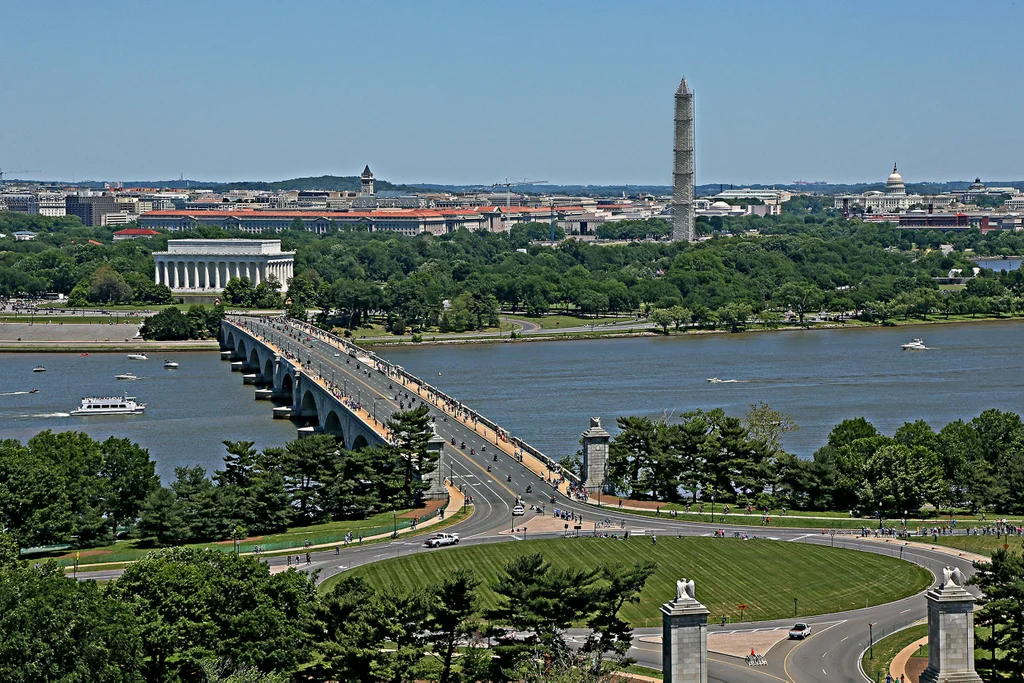
Memorial Circle, where Trump wants to build the arch, is for now an empty roundabout. It sits between Arlington Cemetery to its southwest and the Lincoln Memorial just across the Potomac to its northeast. Despite its location between popular tourist destinations, it’s not designed for pedestrians to access.
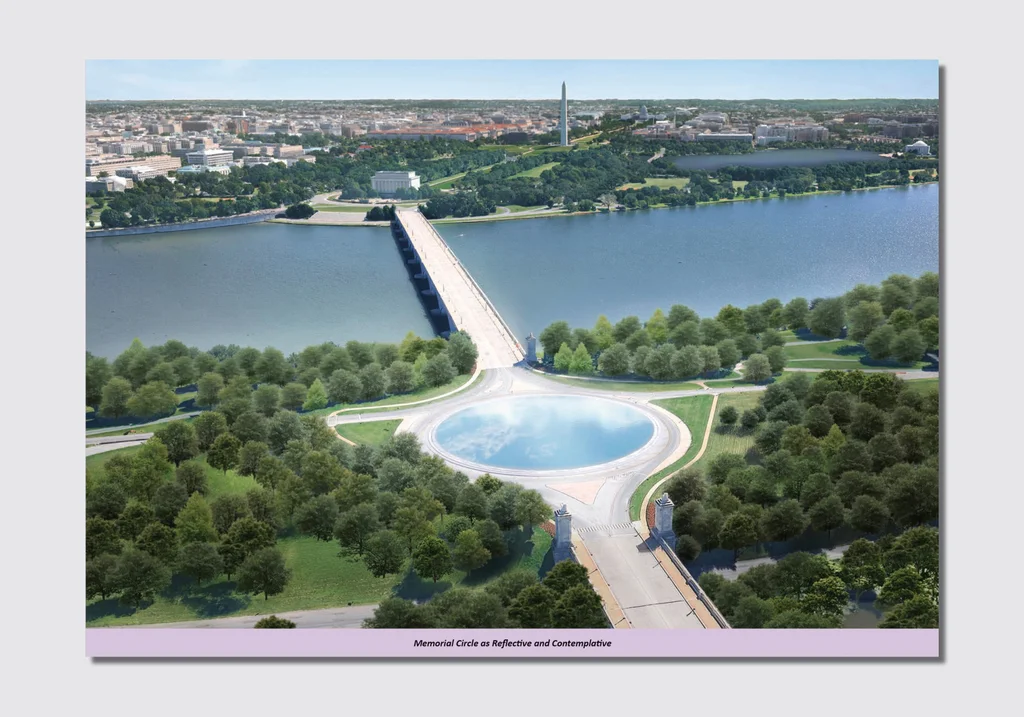
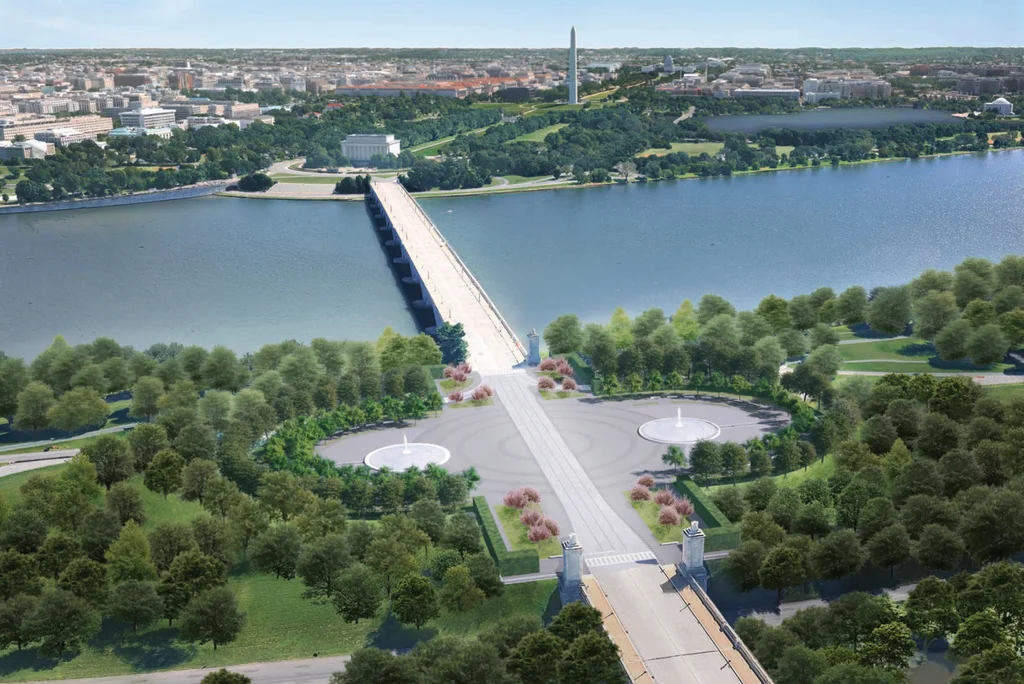
The two alternative designs for what to do with the circle, released this week by the Cultural Landscape Foundation, a nonprofit education and advocacy group, imagine the space in new ways. One concept turns the circle into a single, circular reflecting pool, making the Lincoln Memorial a hinge between two reflecting pools; the other imagines it as a larger park configured as pedestrian-friendly, civic space.
“We are having right now in Washington a crisis of imagination and also an inability to understand that Washington is a mosaic of spaces that people move through in the public realm,” Charles A. Birnbaum, founding president and CEO of the foundation, tells Fast Company. “The projects that we’ve been seeing from the administration, whether it’s the ballroom or the arch or the Garden of Heroes [a statue park proposed for parkland south of the Lincoln Memorial], they’re all being forced upon the civil and cultural landscape of Washington.”
The foundation’s two alternative design provocations were made in collaboration with Jeremy Dvorak and Jake Geitner, landscape architecture students in a class Birnbaum teaches at the Harvard University Graduate School of Design. Both proposals use water to convey monumentality instead of sheer height, as in Trump’s plan.
Trump’s proposed 250-foot arch would tower above D.C.’s maximum 130-foot height limit. The project is being sued by veterans, who say it will block the sight line from the cemetery to the Lincoln Memorial, meant to symbolize national reunification after the Civil War, as well as by Arlington County, the Commonwealth of Virginia, and the District of Columbia, who’ve argued it’s unauthorized. It’s also unpopular. Two-thirds of Americans, including half of Republicans, oppose Trump’s dedicating time and energy to construction projects like the arch, according to a Reuters-Ipsos poll conducted last month.
Neither of the students’ proposals rise to a level that would block anyone’s view.
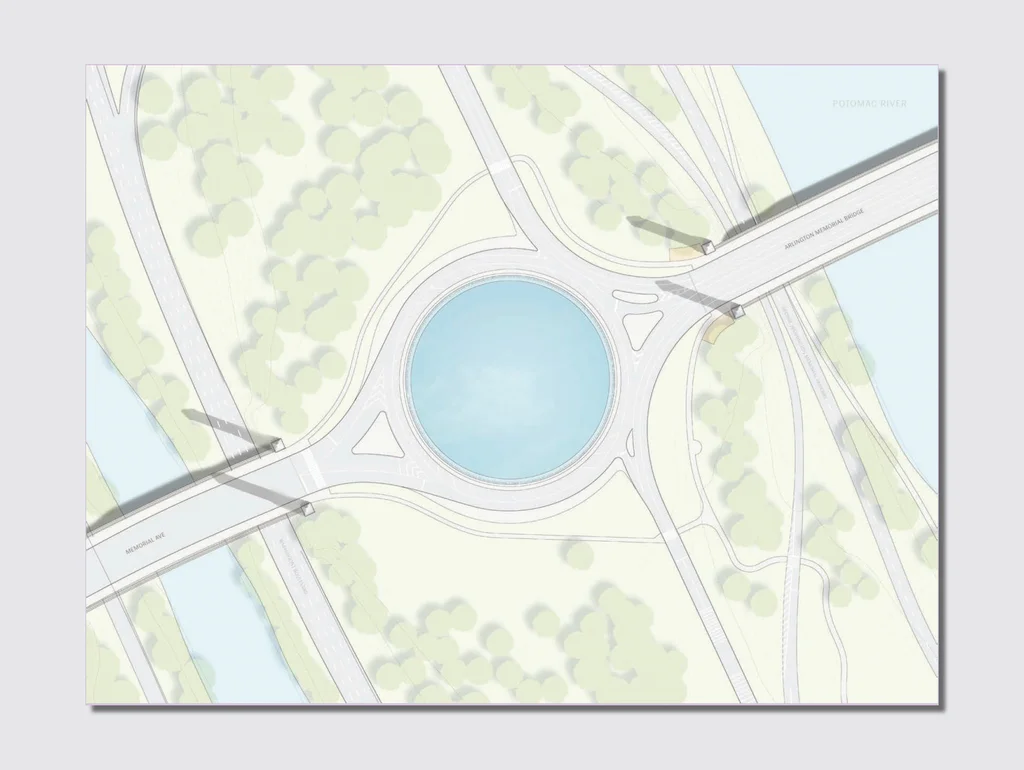
The first alternative proposal would turn Memorial Circle into a circular reflecting pool meant to be viewed by passing cars. The pool purposely sits at a low elevation so you can see it at car level, since there’s no safe passage to cross the street as a pedestrian in its current configuration. It’s a minimalist, modest monument for motorists that keeps Memorial Circle’s function intact while simultaneously elevating it as a space for reflection. Words conveying unity and belonging would be inscribed in a granite profile enclosing the reflecting pool.
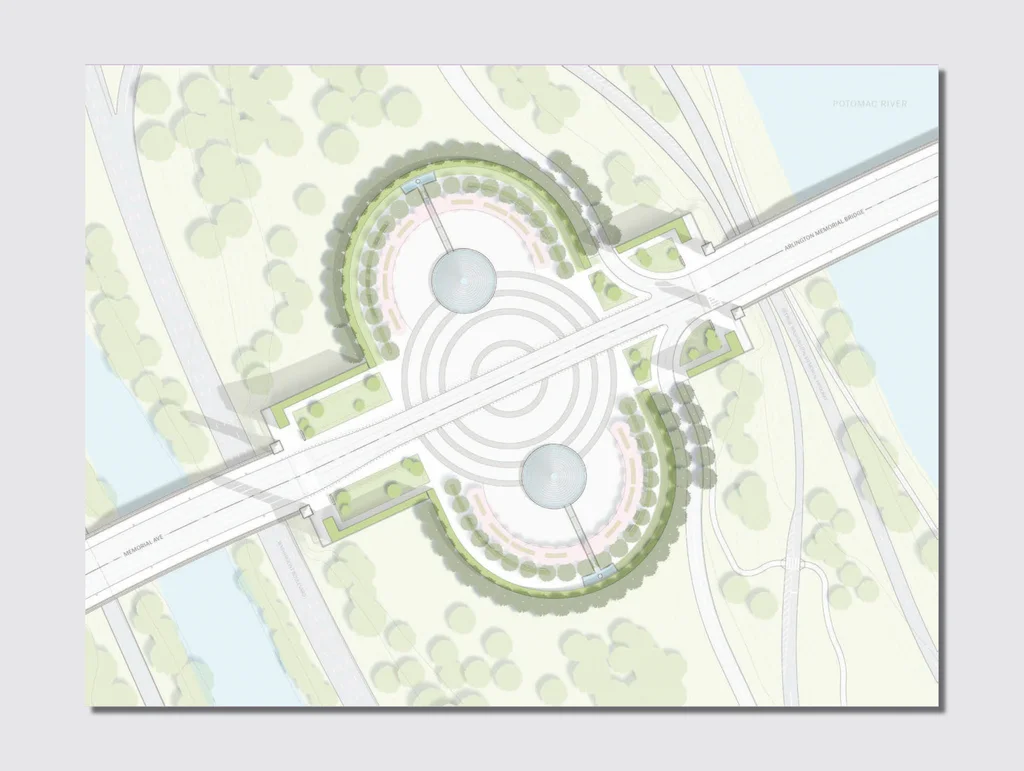
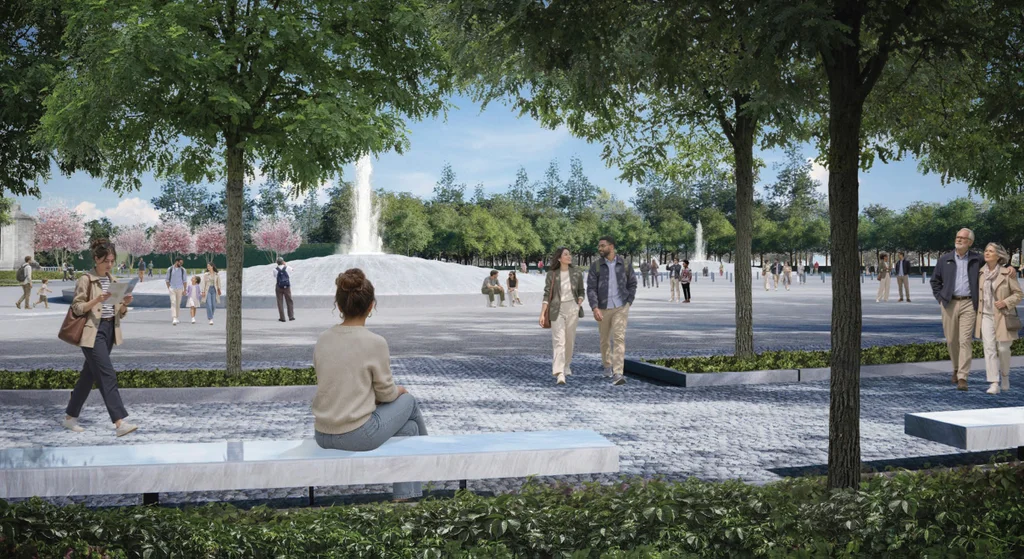
The second alternative proposal would reconfigure the roundabout, turning the Memorial Avenue corridor into a pill-shaped park for pedestrians. Anchored by two fountain pools with high water sprays, the park would have trees and benches ringing the outside, giving tourists and visitors shade and seating. The lack of a single focal point for this idea was purposeful, Birnbaum says. It becomes a processional experience between the Lincoln Memorial and Arlington Cemetery. Instead of an arch or other central element that announces itself, it serves as a midpoint that visually and environmentally ties the cemetery to the National Mall.
Section 106 of the National Historic Preservation Act of 1966 requires an assessment of adverse effects of any projects on historic federal properties, and these proposals more closely follow that mandate than a grand arch does, Birnbaum says.
“The letter of the law is to avoid, minimize, and mitigate adverse effects,” he says.
He also argues they more closely follow Interior Secretary Doug Burgum’s stated rationale for the project, which is “to reinforce the historical and ceremonial role of the Arlington Memorial Bridge and Memorial Avenue corridor as a symbolic gateway between Washington, D.C., and Arlington National Cemetery, while providing a new destination for public interpretation, reflection, and appreciation of the nation’s history.”
For the students and foundation, these proposals are just a starting point.
“This is about fostering a dialogue, but also addressing what we feel is a lack of imagination,” Birnbaum says.