
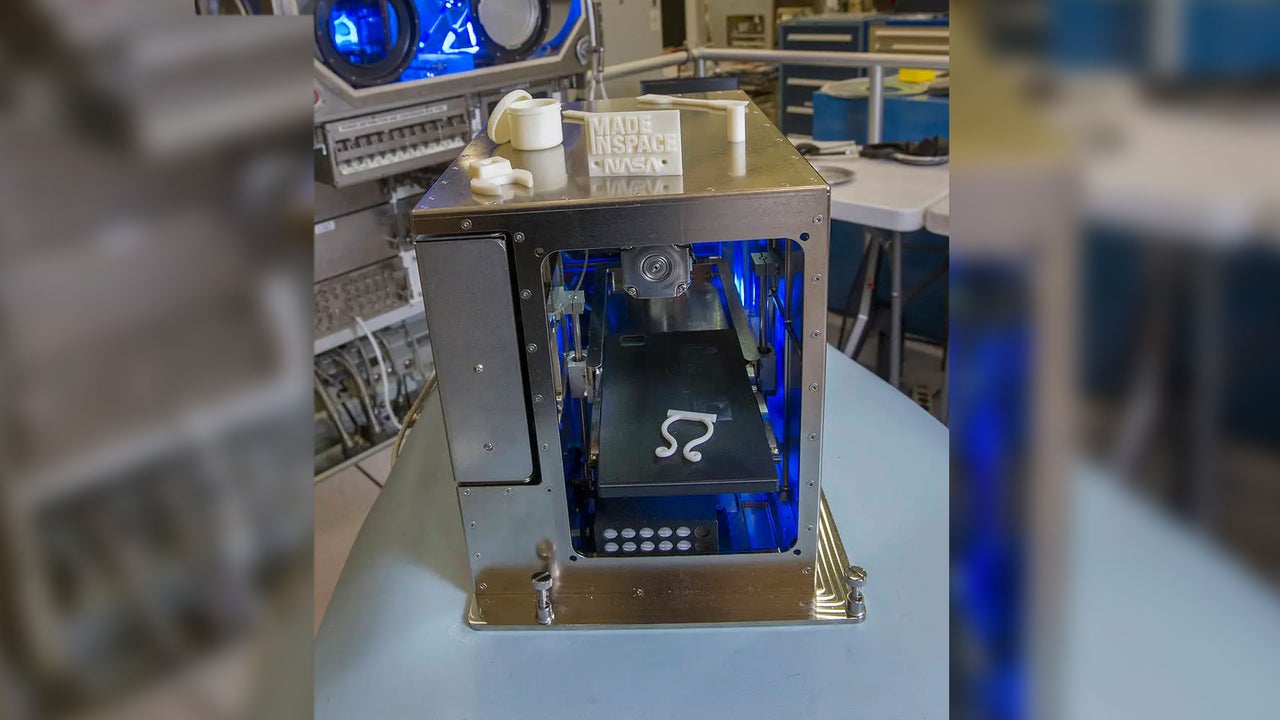
One of the newest items to go on display in the National Air and Space Museum in downtown Washington is also one of its most unassuming: a metal box with a glass door on one side, tucked inside a display case dominated by a humanoid robot with arms extended toward the viewer.
A small white wrench standing next to that box could be even easier to overlook.
But the wrench was made in that box—a 3D printer developed by Made in Space and flown to the International Space Station as the world’s first experiment in 3D printing while in orbit.
NASA spec safety
This was not a venture NASA rushed into casually.
“They’re definitely cautious,” Michael Snyder, Made in Space’s former CEO, says of the space agency. On Earth, 3D printers can emit tiny particles that get stuck in people’s lungs; on the ISS, there’s no opening a window to clear the air.
The answer from Made in Space—a space manufacturing startup that was bought in 2020 by the space hardware company Redwire—was to place the printing hardware inside that glass-doored enclosure.
“That kept everything out of their system,” he says, calling the design mindset “NASA-like caution.”
The absence of gravity—technically, “microgravity”—also required modifying standard 3D-printing hardware to yield consistent results; testing was conducted aboard aircraft on parabolic flights to simulate that condition.
“Surface tension dominates in microgravity,” Snyder explains. Engineers had to tweak extruder designs to push out feedstock with enough force and deposit each additional layer consistently.
Made in Space’s engineers then had to optimize the design for easy operation by astronauts juggling dozens of other tasks.
“We wanted it to be a lot more versatile in terms of usability, so you could just swap out canisters of material without even touching any settings,” Snyder says. “All the things are modular in there.”
For example, Made in Space designed an extruder head that an astronaut could easily pop out—“like a seat belt, almost, in terms of ease,” Snyder says.
And these engineers had to get the printer to sip power.
“Basically, we’re taking a device that uses about 1.2 kilowatts of power and shrinking it down,” Snyder recalls—down to a peak power consumption of 196 watts and normal usage of 150 watts.
The hardware had to fit inside a single cargo transfer bag (of course NASA has an abbreviation for that: “CTB”) tucked into a SpaceX Cargo Dragon capsule. Says Snyder: “The total volume we had was probably a little larger than a carry-on suitcase.”
Ratcheting along
Testing proceeded according to a strict script for the first 20 parts, all printed from files already loaded onto the printer. The 21st part would test how it handled uploaded files.
“Originally that uplink part was going to be this really easy wire tie,” Snyder recalls. But then Butch Wilmore, one of the astronauts, mentioned that he wished he had his wrench while doing light maintenance on the printer, prompting a change of plans.
“At that moment, we were like, we should totally change that uplink part,” Snyder says. They expected NASA to wave off the idea but instead got a green light: “Let’s try it.”
But “let’s try it” means something different in the NASA context. To start, the ratchet wrench had to emerge from the printer fully assembled, to avoid the risk of any part breaking away and becoming a source of “FOD” (foreign object damage).
Handing over a copy of this wrench, Snyder says, “After about a day and a half we had this.” It feels absurdly light.
And then NASA had one last request: a label on the wrench showing its torque rating, in case another astronaut grabbed it and needed to know how much turning force it could apply.
With that rating determined, Made in Space was ready to “launch” the wrench to the ISS as an uploaded file.
“Day five, we uplinked it, and it was in Butch’s hand later that day”—with a “3 in.-lbs.” label printed in raised letters on the handle.
To metal, the moon, and beyond
The immediate appeal of being able to fabricate tools and components on demand aboard a spacecraft is reducing the need for Apollo 13-level brainstorming if something goes wrong. But that capability shouldn’t stop at plastic.
Made in Space had been planning to follow up on a second printer it had sent to the ISS with a 2020 demonstration of metal “additive manufacturing” in orbit. “We just needed to box it up and put in a payload form,” Snyder recalls.
But those plans fell afoul of changing priorities—Snyder isn’t saying whose—leaving it to the European Space Agency to begin the first demonstration of 3D-printed metal aboard the ISS in 2024.
NASA’s long-term plans include not just continued human occupancy of space stations in low Earth orbit but also constructing a moon base. Astronauts living and working at a lunar outpost and looking to print their own parts will face a different combination of opportunities and challenges.
Or as Snyder puts it: “The moon’s an interesting beast.”
Its biggest potential advantage is offering raw materials right outside a moon base’s airlock.
“There’s plenty of metal on the moon,” says Snyder. You just have to extract it chemically, through heating or another process: “One of the byproducts in most of the regolith [moon rocks and dust] oxides is usually a metal of some sort.”
But lunar gravity being only one-sixth of Earth’s means new math for calculating hazards like how a flame could propagate. “One-sixth gravity, it turns out, is worse than zero-g in some instances,” Snyder says.
Engineers and astronauts will have to figure these things out to make human settlement viable on the moon, some 238,000 miles from Earth
Says Snyder: “I don’t think you can sustainably stay on the moon—programmatically or cost wise—without being able to fix stuff.”