
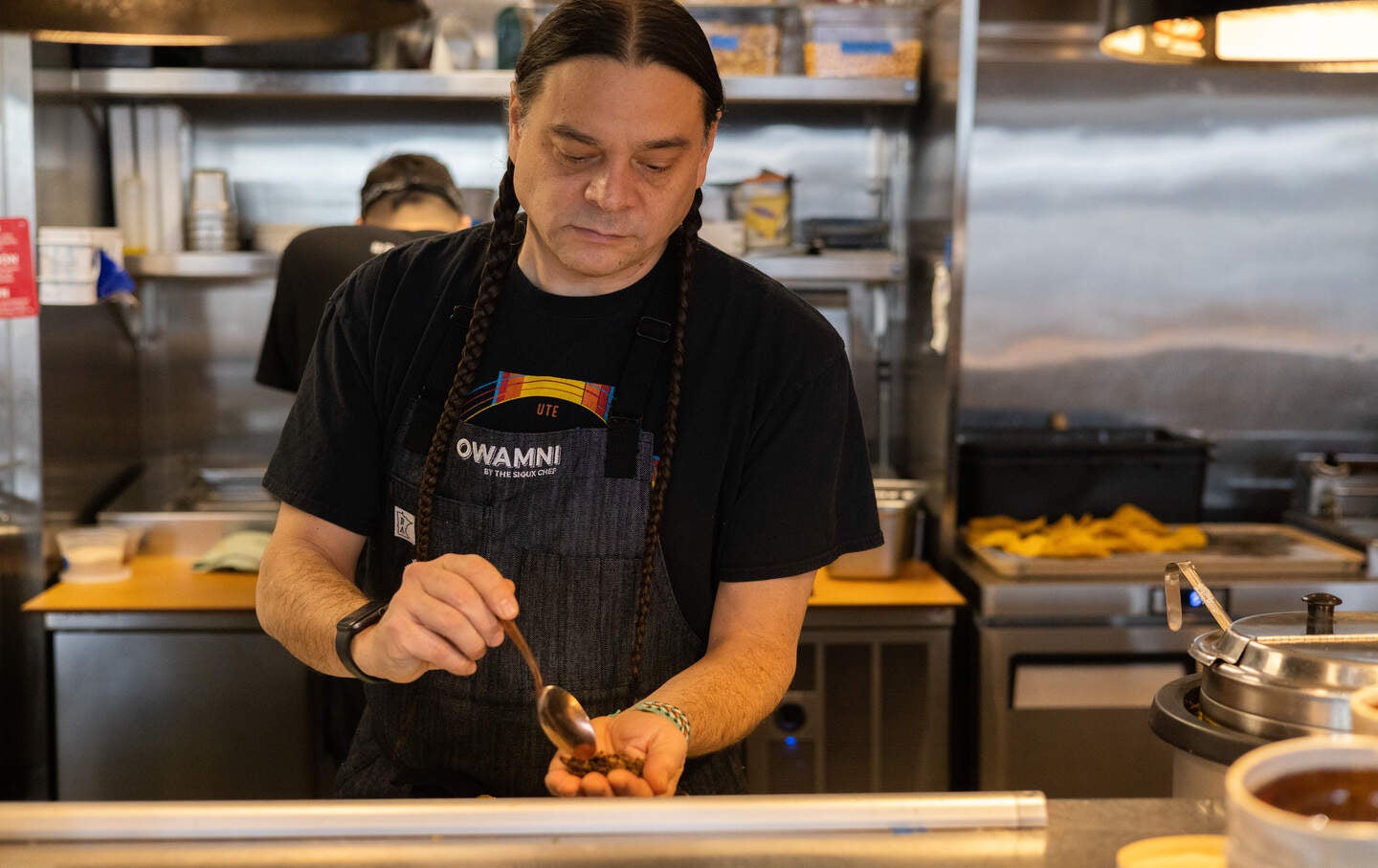
Ep. 8 – Revitalizing Indigenous Foodways with Chef Sean Sherman
Shilpi Chhotray [00:00:04] This is A People’s Climate, powered by Wildseeds Fund, from Counterstream Media and The Nation. I’m your host, Shilpi Chhotray.
CLIP [00:00:13] In the heart of Minneapolis, just off the shore of the Mississippi River, Chef Sean Sherman is rewriting the culinary narrative one recipe at a time.
CLIP [00:00:21] So we’re one of the first and only indigenous restaurants in the country. We’re completely decolonized, so we don’t have any beef, pork, chicken, no dairy, gluten, or soy.
CLIP [00:00:31] So it’s understanding Native American agriculture and seed saving, plant identification, understanding how it can grow with your environment and utilize all these plants for food and medicine and crafting.
CLIP [00:00:44] As I started eating this bison meatball soup and a salad and he started talking about his vision and about the concept behind the company, I am not exaggerating when I say that I felt electrical currents running through my entire body, the bottoms of my feet into the earth. I felt like my ancestors were there with me.
CLIP [00:01:08] Our ancestors are proud tonight because we’re doing something different. We’re putting health on the table, we’re putting culture on the table and we’re putting our stories on the tables.
Shilpi Chhotray [00:01:21] Hey, y’all, welcome back to A People’s Climate. Today’s guest is Shawn Sherman, a three-time James Beard award-winning Oglala Lakota chef, author, and advocate for Indigenous food sovereignty. He just opened a new restaurant over the summer called Indígena by Owamni in Minneapolis. Sean has dedicated his career to reclaiming Indigenous foodways rooted in native plants and traditional knowledge. His work connects what we eat to much bigger questions about land, sovereignty, and our relationship to the environment. Hey Sean, it’s great to see you again. Welcome to A People’s Climate. It’s really wonderful to have you with us. I know you’re a busy man.
Sean Sherman [00:02:10] Absolutely, thanks for having me.
Shilpi Chhotray [00:02:12] So Sean, you know, you live in Minneapolis now in the Twin Cities, but you grew up on the Pine Ridge Reservation in South Dakota. And this is part of the ancestral homelands of the Oglala Lakota. Can you talk a little bit about what it was like growing up on this reservation and how the land shaped the way you think about food today?
Sean Sherman [00:02:33] Well, we spent a lot of time outdoors growing up. You know, we’re on the Great Plains. The Badlands are a part of the reservation, so we’d spend a lot time just kind of hiking around and just having fun as kids. We’d spend our summers up in the Black Hills, which wasn’t too far away. For me, it was just really great to have that kind of free roaming, just a little bit feral kind of childhood of just being outside all the time.
Shilpi Chhotray [00:02:56] I love it. It’s really indicative of how I was raised too. I like to call it like a little bit of Lord of the Flies kind of childhood I grew up in the Midwest. There’s this perception that when Indigenous folks grow up on reservations, they’re cultivating their own land, they are cultivating their own food. But that’s actually not true at all for a lot of folks. It did mean being heavily reliant on federal food systems. Did you have an experience like that?
Sean Sherman [00:03:23] Absolutely. I mean, I was definitely a product growing up of being a part of the FDPIR and commodity food program foods. So just getting a lot of government subsidies of things that were in our cupboards, like canned fruits that are packed in corn syrups and canned vegetables packed in sodium water. So it wasn’t the best food. There wasn’t hardly anything really culturally relevant growing up, which was a big part of my own awakening later on.
Shilpi Chhotray [00:03:48] You’ve said at different points that the absence of Indigenous foods wasn’t accidental, right? This was actually very systematic. How do those systems still show up today in places like Pine Ridge in terms of what folks are eating and in the conditions around food access?
Sean Sherman [00:04:05] Pine Ridge, I feel like, is a unique story, but it’s been one of the poorest areas of the United States since its inception. And so access to nutrition has been very difficult, because when I was growing up, we had a single grocery store that covers an area almost the size of Connecticut. And so a lot of people are eating fast food daily, and it’s just not the best food system for people. And you can see it in statistics. So if you look at statistics on someplace like Pine Ridge you’re gonna see astronomical rates of type two diabetes, obesity, heart disease, and all these foodborne illnesses because of that.
Shilpi Chhotray [00:04:39] Thank you for naming some of these statistics. A few other statistics that I thought were pretty extreme is that over 90% of food on the reservation is shipped in. So this goes into what you’ve experienced. And approximately 50% of adults over the age of 40 have diabetes compared to 12% of the U.S. population as a whole. And 80% of the population is unemployed. So again, this is why there’s this over-reliance on the federal distribution programs, which as you’ve said is not the most nutritious food to say the least.
Sean Sherman [00:05:19] Absolutely, because I feel like people don’t always take the time to recognize that reservation systems were segregated communities in large, you know. And so they’re still rolling with that situation where there’s a distinct line that a difference of what kind of economic opportunities are on some place like a reservation compared to some neighboring townships.
Shilpi Chhotray [00:05:39] When you talk about what was taken and lost, and the bison comes into play here for me, but that’s only a part of it. What else was lost?
Sean Sherman [00:05:49] Oh, a massive amount. I use my great-grandfather as an example quite a bit because he was born in the late 1860s. He was 18 during the Battle of Little Bighorn. He grows up seeing conflict because he grows up in Crazy Horse’s camp, seeing our own Lakota fighting against the United States government in multiple skirmishes and battles. He sees, like, so many people being forcibly pushed onto the reservation. He’s seeing a complete change in the way of life. He’s seen his children being a first generation of boarding school children, to be forced to cut their hair, to be forced to learn English and learn a different religion, Christianity. And everything changes so drastically. And the food is completely replaced on what the US government was giving them. So the over-reliance on food became a tactical tool for the US government and defeating a lot of Indigenous peoples. And so I think about that a lot because when I started this work, I wasn’t trying to go backwards and understand what were we eating in 1491. You know, I was looking at just my great grandfather’s generation of what changed in their food diets because he grew up with a full extent knowledge of what it meant to be Lakota with all of the knowledge of identifying plants and hunting and building and crafting and medicinals. But he would have been the last generation to receive that 100% full extent of that. And so we lose so much more, it’s not just bison disappearing that caused the difference of a way of life. It was being forced onto segregated communities, being over-reliant, being faced with oppression, being jailed for being knowledge keepers, because you remember it was illegal to even celebrate our own religions until 1978.
Shilpi Chhotray [00:07:26] Mm-hmm. I also read it was illegal to harvest your own foods.
Sean Sherman [00:07:31] Mm-hmm. Yeah, so they kept very strict rules.
Shilpi Chhotray [00:07:35] Your work decolonizing food systems is so important for health and for culture, but it’s also a response to our current food system. Can you talk about why we need to move away from industrial ag in particular?
Sean Sherman [00:07:47] Yeah, I mean, you’re looking at these multinational companies that control way too much of the world’s food systems that are dominating what we have access to and when we have access to, and the pricing. So like, not only do you have these gigantic food giants out there producing foods and forcing GMOs on everywhere, taking over small farms, decimating water systems and soil systems, they have an allied presidency which enables them to use more of that with less transparency. It’s a mess.
Shilpi Chhotray [00:08:18] Just to paint a little bit of a statistical awareness. In the US, roughly 60% of calories now come from ultra-processed foods. So this is heavily shaped by industrial commodity crops like corn, soy, and wheat. But I think it’s important to also say diet-related diseases are now one of the leading drivers of death and disability in the United States. So ultimately, we’re ending up with a very corrupt system that’s depleting soil, contaminating water. But also producing cheap calorie dense food while shifting the health consequences onto the people, everyday people, many of which have fewer other choices than to eat it. So that kind of brings me into this next question here, Sean, is in contrast to the current status quo, this current industrial agricultural system, which is driven by scale and profit, how would you describe Indigenous foodways?
Sean Sherman [00:09:12] Well, Indigenous foodways were communal food systems. So everybody played a role in the food systems for their entire community. So people have to be highly in tune with nature to know when it’s ready to harvest something, to be able to take care of the plants ahead of time and to keep an eye on them. So tribes had very clean paths in the forest where they knew where the different food pieces were, whether they’re berries or maple or whatever might be ready for gathering. So I think it’s really important to understand that was developed over thousands of generations of learning how to give plants respect and animals respect for giving up their lives and energy for us to stay alive.
Shilpi Chhotray [00:09:49] There’s such a spiritual aspect of it.
Sean Sherman [00:09:51] Massively spiritual aspect to it all and I think that’s something that’s completely dead in the Western vision of how food works, you know. And so that’s why it’s really important to understand and embrace food as medicine also because like what we eat really affects how we are built, you now, and what’s going on inside our bodies internally and how it affects every piece of us.
Shilpi Chhotray [00:10:11] You know, I’ve heard you talk about your philosophy when it comes to ingredients. I wanna play this clip from when you were on The Daily Show earlier this year.
CLIP [00:10:22] Basically, the philosophy was, in order to showcase and highlight modern Indigenous foods in Native America, we cut out European colonial ingredients that European immigrants had brought over. So there’s no dairy, no wheat flour, no cane sugar, no beef, pork, and chicken. No jell-o. No jell-o. No ranch dressing. We won a James Beard Award for best restaurant in the U.S. without ranch dressing! You beat the white people at their own war. It’s true, it’s true.
Shilpi Chhotray [00:10:56] I love this, but okay tell me more about why this approach is so important and how it impacts the environment.
Sean Sherman [00:11:03] The Indigenous approach to the foods is completely, you’re looking at what’s in season, what’s growing naturally around you. If there was agriculture, what kinds of corns and seeds and techniques did people develop or utilizing some of those pieces? And it just creates massively diverse diets everywhere. And that’s how we should be looking at foods, using a massive amount of plant diversity, protein diversity, which comes from thousands of generations of learning how to live healthy. And sustainably with what’s around you. And that gentle approach to environment, that gentle to protecting waterways, and having a symbiotic relationship with our food and our plants and our medicines, which are all tied together, and it makes so much more sense.
Shilpi Chhotray [00:11:41] I feel like your work is so tactical. You know, with your restaurant Indígena, you’re doing this by prioritizing the Indigenous workforce. Can you talk about the role of workforce development here?
Sean Sherman [00:11:52] Yeah, so the restaurant Indígena, which is our brand new restaurant, we’re just in the fourth week of it being open. Our original restaurant, Owamni, you know, was a 78-seat restaurant right on the Mississippi River. Then the new restaurant is nearly 200 seats. With the original restaurant the way we tracked how much purchases we made from Indigenous producers, because we prioritized purchasing from Indigenous first, but we were tracking around $600,000 a year going directly towards Indigenous producers, which is a massive boost for those Indigenous economies. But this new restaurant, I’m guessing we’re going to be closer to $2 million when it comes to how much food dealers, because we’re growing so quickly. And it’s about showing people the power of food services, of how we could really spur and boost economies out there. So we use the restaurant as a tool, because a restaurant will never be a space for food relief or food access. Particularly because it’s a privilege to go inside a restaurant, because you need money to go and eat at a restaurant. And we created a really expensive high-end downtown restaurant with the purpose of creating a massive staff because we have 160 people on staff. Because of that huge workforce, a bunch of leaders, future leaders are going to come out of that because people are going stay and grow and learn and connect with these values. Because when I’ve been growing up, chefs are always like, oh, I’m a classically chef, French-trained chef, blah, blah. But now we’re gonna have kids who’ve been working with us since high school and they can say like…
Shilpi Chhotray [00:13:14] Oh, that’s so awesome.
Sean Sherman [00:13:14] I’m a classically Native trained chef and we’re going to have a whole generation…
Shilpi Chhotray [00:13:20] Crickets and popcorn!
Sean Sherman [00:13:20] Absolutely, we’re gonna have a generation of kids doing that and growing into this workforce and to be able to create better restaurants in the future.
Shilpi Chhotray [00:13:26] That’s really incredible because there aren’t that many Indigenous restaurants in this country. I’m lucky to live near one in Oakland, Wahpepah’s Kitchen.
Sean Sherman [00:13:37] Yeah, Crystal is a good friend, absolutely.
Shilpi Chhotray [00:13:39] Oh, awesome. But this is few and far between. Do you actually know, Sean, how many restaurants total are in the U.S.? Like, I don’t even think there’s any in New York City, which is crazy.
Sean Sherman [00:13:48] No, there’s none in New York at all. But it’s hard, you know, for rest, for like physical, like brick and mortars. Like we have Javelina in Portland. We have Crystal’s Wahpepah’s Kitchen in Oakland. We’ve got Tocabe in Denver. We’ve Got ourselves in Minnesota. And we’ve got a couple of native restaurants in Minnesota with Gatherings Café and Indígena. And we’re getting ready to open up a new restaurant called Šhotá, which will be a native barbecue concept that we’re working on.
Shilpi Chhotray [00:14:15] Oh, nice!
Sean Sherman [00:14:15] And it’ll be a little bit lower price point than our downtown restaurant and just barbecue, you know, Native barbecue. But yeah, there’s not that much out there, you know. But there are a lot more Native chefs out there. It’s just as far as brick and mortars go, they’re very far and few between.
Shilpi Chhotray [00:14:38] I want to go back to something you had mentioned earlier, which is the monumental loss of biodiversity. By some estimates, up to 75% of the global crop diversity has actually disappeared over the 20th century. One food I’d like to hone in on that faces numerous threats is Manoomin, or wild rice.
CLIP [00:15:00] Manoomin is native to northern Minnesota’s glacier-carved lakes and rivers. And according to oral tradition, it’s actually why the Anishinaabe first decided to settle here. Meet Michaa Aubid and Veronica Skinaway. They’re both Anishinaabe, which means the original people.
CLIP [00:15:19] We’ve been here a very long time. This is a tradition that survived for hundreds, thousands of years. And so it’s real unique, and there isn’t anything like this food in the world. It’s the best food for your body, the best for your heart, your soul, everything.
Sean Sherman [00:15:44] Yeah, I mean, manoomin or what people know as wild rice, but it’s the true wild rice that grows naturally on the lakes here in Minnesota and some of the other Great Lakes. But it’s only a certain area of the world where this particular rice is harvested in mass like it is and Minnesota is one of the biggest spots, right? And so most people think of wild rice, they think of the black rice that you find at a grocery store. That rice was modified. It’s really hard. It takes a long time to cook, but that rice was modify to be able to grow in paddies and so people can use machinery and combines to harvest it. We just call that paddy rice. And so the true rice is hand harvested. We buy from tribal communities. They’re out there on canoes every year gathering. And it’s something that is delicate because it’s obviously, it’s very seasonal, but like things like weather patterns can affect it. If it’s too windy or big storms come through, it could decimate an entire rice patch when the timing is right, you know?
Shilpi Chhotray [00:16:38] So just this morning, I saw that one major area where wild rice grows is on fire. This is the Boundary Waters area in northern Minnesota and in addition to these wildfires, this pristine wilderness is now facing a new threat.
CLIP 03 [00:16:54] Donald Trump has said as president he wants to undo the 20-year ban on mining near the Boundary Waters.
CLIP [00:17:01] I will end that mining ban. We’ll do it together, Tom. We will end the ban in about, what do you think, about 10 minutes? I would say 10 to 15 minutes.
CLIP [00:17:09] The U.S. Senate just overturned a ban on copper and nickel mining in the area. The ban protected more than 225,000 acres of the Superior National Forest.
CLIP [00:17:19] I feel like it’s a pretty dark day for Minnesota. Feels like another attack on Minnesota by this administration, frankly.
CLIP [00:17:28] Of all the places that we have in this country. This place has such special meaning. It is a sacred place, and we will never stop defending it.
Sean Sherman [00:17:39] We have this really beautiful protected area that’s been generational for many people to be able to experience the natural beauty of that little area between Minnesota and Canada. It’s so insane to think that they just like open up these leases to these mining companies, but it’s dangerous because we know that it’s not a matter of if those pipelines will leak, but when and how much damage will they do and how and how much damage will they leave behind? And will it be generational, like will our children and grandchildren have access to this? But again, colonialism has never died in human history and this administration is absolutely guilty of furthering a modern day era of colonialism by continuing to possibly decimate some of these amazing pristine areas that have so much cultural meaning and there’s so few spaces of clean earth left, you know. We should be protecting, especially as we’re walking into water crisis, we should not be doing anything that risks the pollution of waterways right now.
Shilpi Chhotray [00:18:36] The Minnesota Republican representative, Pete Stauber, who represents the area said on social media, mining is our past, present, and future, and the future looks bright. So I’m bringing this up because it feels like the Boundary Waters debate forces a broader definition of food sovereignty than just farming practices or food production. It’s really getting at the climate crisis in real time, you know, the land grabs and the extractive practices.
Sean Sherman [00:19:02] Yeah, absolutely. We need protection of natural spaces to really attain food sovereignty, especially for tribal communities. And food sovereignty we’re just looking at, you know, having the power to grow our own foods outside of government oversight. So we should be able to, for tribal communities especially, who have sovereign powers, who should be to write their own food laws and food codes and not be bound by things like the Farm Bill that dictates what we can and cannot eat on a tribal reservation. And someplace like Pine Ridge that struggled for so long. We can turn that around if we put our efforts into creating more food systems, you know, to really pushing more food production, to putting efforts into developing more commercial kitchens. This is how you create a food distribution and food production situation to be able to cover the needs of making healthy, culturally, regionally relevant foods.
Shilpi Chhotray [00:19:50] There’s like a massive culture shift focus that your work is part of that’s, I feel like somewhat unique to being a chef and a restaurant owner.
Sean Sherman [00:19:59] Absolutely, I mean we’re just challenging because like we’re challenging ourselves all the time How can we be more Indigenous and how can we push this a little bit further and we can be bold because chefs can be bold. You know, when you have things like authoritarianism being really coddled by the ruling party in our country like this is not the time to be silent. You need to be loud and you need to bold.
Shilpi Chhotray [00:20:21] I love that. Yeah, I wouldn’t get into that a bit where you live, right? Minneapolis had a brutal winter.
Sean Sherman [00:20:28] It was a very ICE-y winter.
Shilpi Chhotray [00:20:30] A very icy winter, literally. We are talking about Operation Metro Surge, where our listeners are very familiar with. Nearly 3,000 federal agents were deployed, just to remind folks, resulting in thousands of arrests and the murders of Renee Good and Alex Pretti. In fact, 11 people have been fatally shot since Trump’s second term began. And of course, this shouldn’t surprise anyone. This is a result of a cruel and violent system which your ancestors know alll too well.
CLIP [00:21:04] Anti-ice protests intensifying in Minneapolis. Agents clashing with demonstrators one week after Renee Good was shot and killed by an ICE officer.
CLIP [00:21:13] What this is doing to our Indigenous and immigrant families and neighbors, it’s heartbreaking. It’s truly heartbreaking. And to the federal government that says that they’re doing this to protect us, we can see the hypocrisy. And everything that they accuse us of, we know it’s just an admission of their own guilt. Domestic terrorism, who is terrorizing our community? It’s not us. We’re protecting our community.
CLIP [00:21:37] Every day I go to work thinking that I’m going to be the next, because the way I talk, my accent, the way that I look, it doesn’t matter if I’m a US citizen.
Shilpi Chhotray [00:21:52] I want to ask you a couple questions here, because you are pretty vocal about ICE. There was a piece you titled, ‘Fuck Your Fascism,’ which is on Substack, which I found absolutely brilliant. Where do you see that continuity most clearly today with ICE?
Sean Sherman [00:22:09] It was so insane, you know, because the whole city felt locked down again, just like COVID days almost, because this was a present danger that was caused by our own government. And we had no protection because our own city couldn’t protect us, our governor and our state couldn’t protect us. And we were at the hands of this merciless thugs that just were hired and being led by like these guys who are obviously white supremacists, like Greg Bovino. And it was insane to watch how the city just kind of had to just fend for itself because so much – like, Minneapolis is a small city, but we have immense amount of diversity and the majority of the people living in the city love the diversity that we have here. We have a lot of people of color working with us and even Native people were not feeling safe and Native people are being picked up in this situation just because of the color of our skin. And so things were super, super messed up and we had three employees surrounded at gunpoint outside of one of our own buildings and one of them, one of them taken away and just this young, young man who ended up in Texas by the end of the day. And we were able to get them out but still we had to create our own safe passages, you know, and there were so many signal chats going around telling people where and when Greg Bovino was moving around town, for example, and trying to make sure we had passage to get people food and supplies to their homes because they felt too unsafe, because it wasn’t safe to go to a grocery store or to ride a bus. So all we could do is really be vocal. So I created a signup sheet just to get people to sign up to demand the Senate to not give money to the DHS. You know, I went to Washington, I went to Senator Tina Smith’s office and just like, what’s happening in Minnesota, I feel like we’re going to weather this cause we’ve been through a lot, you know, and we can deal with this, but this cannot spread to other cities. This cannot be, this cannot be normal in other areas. And so whatever you guys do, do not give them more money because this is what they’re gonna do. They’re gonna terrorize American citizens. They’re going to kill people in the streets, which they’re still doing even as of two days ago.
Shilpi Chhotray [00:24:06] That’s right.
Sean Sherman [00:24:07] And so it’s insane, you know? And so we need to be standing up because this just the president’s personal army of racists.
Shilpi Chhotray [00:24:14] Is your employee okay, the one that was abducted?
Sean Sherman [00:24:17] Yeah, but it was very traumatizing. Yeah, he’s back, but it was very, very traumatizing, you know, and…
Shilpi Chhotray [00:24:22] I’m so sorry to hear that.
Sean Sherman [00:24:23] He was in like four different facilities in a few weeks and it was a mess and yeah and it just touched really close to us. And again, all restaurants in Minneapolis during that time period were probably down 80% because nobody felt safe to go out to eat and why would we you knok? And so like our whole city lost so much money just because again of our own government and obviously it’s just some kind of weird like revenge fetish that our president has against Minnesota because he hates Ilhan, he hates Governor Walz. Just, he probably hates that we’re very liberal, you know?
Shilpi Chhotray [00:24:56] Progressive, yes. It’s all such despicable, violent behavior.
Sean Sherman [00:25:02] Yeah, and I felt like the only thing we could do is be bold. So, you know, my substacks during January, February were very, very bold.
Shilpi Chhotray [00:25:07] Well, I appreciate what you named a few things about how food systems actually function in moments of crisis and just the way a lot of the restaurants and chefs showed up for mutual aid for community healing during that time. I was excited to hear, you know, maybe a slight positive, a slight silver lining that the Oglala Sioux tribe banned ICE from the Pine Ridge Reservation earlier this year. It was really incredible to see this kind of momentum. And I wanted to ask you, do you see this as like a scalable solution and what would it take to go beyond tribal nations to like actual cities or other institutions to do the same?
Sean Sherman [00:25:45] Well, I mean, really the best solution is to completely abolish ICE, to completely disband the whole situation because it’s not protecting borders, it’s harassing American citizens. And I can almost guarantee this administration is going to activate them to try and mess with the midterm elections, you know, as intimidation tactics, you now. To me, it all comes back to the midterms because if we can shift the power, then we can really start to work on some bigger solutions, which is just getting rid of this completely. This has now become… they’re basically proud boys, you know.
Shilpi Chhotray [00:26:17] It’s like January 6th on steroids.
Sean Sherman [00:26:20] Absolutely, and they have billions of dollars, carte blanche, to do whatever they want to for a decade.
Shilpi Chhotray [00:26:26] I really appreciate that and I actually want to close with something from your sub stack because I think it is so powerful and you know, the passage I want you to read. So I’ll hand it over to you to go over that section.
Sean Sherman [00:26:41] The Trump administration understands escalation and thrives on it. It’s part of their plan. Send more agents, provoke confrontation, allow violence, justify more control. Violence creates urgency, urgency creates permission, permission creates normalization. Escalation is required in states like Minnesota that refuse to bend.
Shilpi Chhotray [00:27:01] Yeah, I love that so much because you’re not only on the forefront of this as someone very visible as a restaurant owner in the heart of the downtown area, but I love the way you broke it down because I think we have to get much smarter about the tactics being used against us and really learn their playbook, you know, which they did lay out in Project 2025.
Sean Sherman [00:27:21] Yeah.
Shilpi Chhotray [00:27:21] But you know after everything you have seen and experienced historically, like everything we talked about in this earlier conversation, but right now in Minneapolis. What actually works, and what should people understand so that we can keep going on in the fight for a livable future?
Sean Sherman [00:27:39] Well, I think just like moving away from trying to normalize this because that’s what the Trump administration really needs, that it’s okay for ICE to be violent because they’re attacking criminals, but they’re criminalizing people at the same time. So they’re using the law and bending what that means for their own purposes. And so they want people to turn an eye. They want people be like, oh, no, that’s never going to happen to us, so we shouldn’t worry about it. But we have to never let this stuff be normalized. We have to let it be okay to shoot people in the streets for nothing other than just standing up to somebody and using their First Amendment rights.
Shilpi Chhotray [00:28:12] In front of their kids.
Sean Sherman [00:28:14] Exactly, in front of kids. And so we cannot be silent, and we cannot allow them to force our silence. And so it’s dangerous watching the people down in Texas that were given 50-year sentences for moving magazines, just because there might’ve been some anti-fascist ideology in some of those magazines. And that’s really dangerous because they’re trying to silence dissenters, which just means people that disagree with them.
Shilpi Chhotray [00:28:38] They love to spin the narrative.
Sean Sherman [00:28:40] They’re spinning the narrative so hard. I think it’s really important that you have to really understand either you’re allowing fascism to happen or you’re against it. And which politicians are bending the knee towards authoritarianism right now. And we need to move away from that. Our best option is to really getting the right people in Washington sooner than later and shifting the power of what’s going on with this really dangerous administration right now
Shilpi Chhotray [00:29:07] Decolonize and deescalate.
Sean Sherman [00:29:10] Absolutely, and hold accountability for all sides, you know, because I feel like the Democrats want a status quo of just the way things were and we can’t, we need something more bold. We need something that really leans more into humanity. We need to change everything.
Shilpi Chhotray [00:29:23] Yeah, the moderate role is obsolete at this point, it is not working, you know, and we just have to be much more savvy and strategic in this next phase.
Sean Sherman [00:29:36] Absolutely.
Shilpi Chhotray [00:29:38] Well, thank you so much for this timely conversation around cultural and political resistance. I am so excited to get out to Minneapolis and check out Indígena and continue this conversation with you at this delicious menu.
Sean Sherman [00:29:53] Absolutely. So I look forward to seeing you and yeah, come experience.
Shilpi Chhotray [00:30:01] My conversation with Sean has me thinking about food in much more systemic ways. Of course, food is sustenance and a way to preserve culture, but building a different food system isn’t just about what we grow or what we eat. Sean reminds us that protecting the people, the land and knowledge, brings us much closer to a decolonized future. Thanks for listening to A People’s Climate. We’ll catch you next time. Thank you to Wildseeds Fund for making this podcast possible. This episode of A People’s Climate is executive produced by Mindy Ramaker, with engineering and sound design by Dennis Maxwell, theme music by Khafre Jay, additional research by Asia Simms, recorded at Studio 132 in Oakland, California. From Counterstream Media and The Nation, I’m your host Shilpi Chhotray. Until next time.