
In this week’s Elie v. U.S., our justice correspondent digs into the freakout over the coming congressional investigations. Plus: the freakout over court reform.
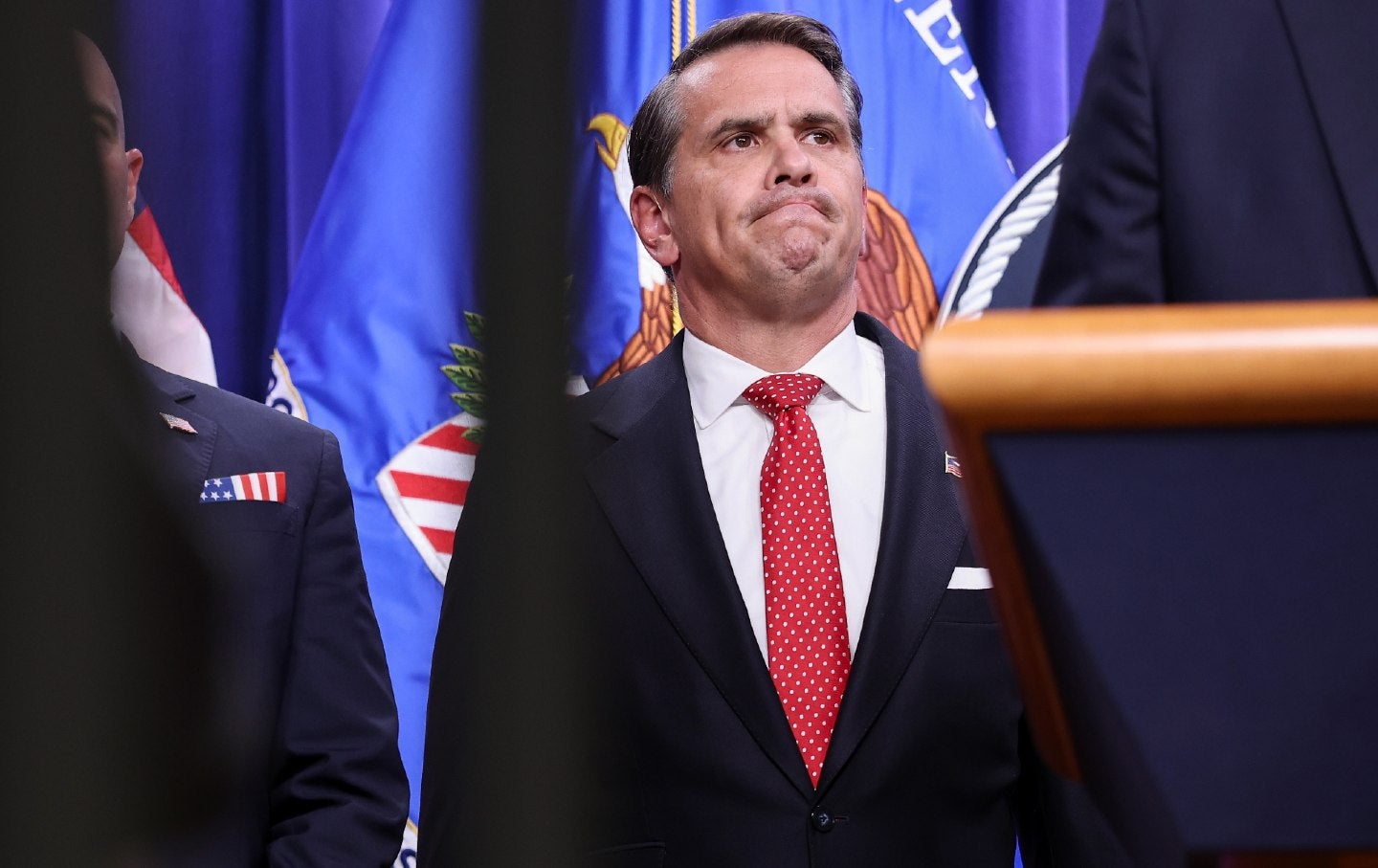
US Attorney General Todd Blanche gives a press conference at the US Department of Justice.
(Win McNamee / Getty Images)
With Democrats taking control of the House and the Senate, the Trump administration is finally about to face some oversight. Robert Garcia (D-CA) is poised to take over the House Oversight Committee while Jamie Raskin (D-MD) is set to take over the House Judiciary Committee. Both have indicated that they are willing—and, dare I say, eager—to conduct investigations into the Trump administration and the Justice Department.
The Trump administration is responding in the only way it knows how: with threats, intimidation tactics, and a complete disregard for the Constitution. Garcia has received threatening letters from White House counsel Will Scharf “reminding” him of the limits of congressional authority. Todd Blanche, the attorney general, has threatened Garcia and others with lawsuits and promised to defend people like Trump’s chief of staff, Stephen Miller, even though that’s not his job.
The Trump official who appears to be having the biggest meltdown of all is Aaron Reitz, the Trump-appointed US Attorney for the Southern District of Texas. This guy, who I only learned existed this week, has sent letters to Democratic congresspeople and senators threatening malicious, retaliatory, criminal prosecutions should the Democrats investigate Trump. He’s been running his mouth all over town threatening to “destroy” the left by bringing every prosecutorial tool in his quiver against them, no matter the merits.
I’m not being hyperbolic. Here’s one of his statements, as reported by Popular Information:
“The left doesn’t care about my opponents, but they are deadly threatened by what’s coming. They know that I’m going to destroy them. If I can’t sue you, I’m going to investigate you. If I can’t investigate you, I’m going to drag you into so much trouble, you might as well just declare bankruptcy now.”
I get it. All these Trump-aligned lawyers are used to dealing with people like, well, me. People who can be harassed and bankrupted and who have to tread carefully around white men having a nutty. These lawyers, however, are clearly not used to dealing with members of Congress: people who are already lawyered up and constitutionally protected by the Speech or Debate Clause. That clause prohibits the executive and judicial branches from using investigations and lawsuits to intimidate or silence congresspeople. It is a literal point-and-click constitutional violation to do what Reitz and Blanche are threatening to do.
Since it is unlikely that the lawyers working for Trump have read and understood the Constitution, let me put this in language they can understand: They can huff, and they can puff, but they cannot blow the House of Representatives down.
Current Issue
The Bad and the Ugly
- Mary Peltola has been declared the winner of the Senate race in Alaska. She received over 50 percent of the vote, thus defeating both Dan Sullivans combined and obviating the need for the state to engage its ranked-choice system. For our next trick: How about somebody call Lisa Murkowski and see if we can get her to switch parties? We can offer John Fetterman in the trade.
- Hakeem Jeffries overwhelmingly won a secret-ballot election to be the next speaker of the House. I know a lot of progressives have concerns about Jeffries’s leadership. I have my own qualms. But electing the first Black speaker of the House in United States history is objectively an amazing thing—and, goddamn it, I’m allowed to be happy and hopeful about his leadership for at least a couple of weeks.
- The Supreme Court declined to hear an ammosexual challenge to Maryland’s restrictions on bringing guns to “sensitive places” (like schools and sporting events). I wouldn’t get too excited, though. Clarence Thomas indicated that the rejection had more to do with the wide-ranging nature of the gun-nut challenge than with the idea behind the challenge itself. Once these ammosexual yahoos decide on a particular place to turn into a shooting gallery, the court will likely take the case and overturn the ban.
- The MAHA movement has managed to make measles great again. In absolutely related news, a group of parents are asking the Supreme Court to allow them to ignore vaccine mandates in schools. The acceptable snarky response here is something like, “Darwin, take the wheel,” but I can’t go there. Measles can be deadly, especially for children. Kids do not deserve to be stricken with a preventable disease simply because their parents are freaking idiots.
- In October 2025, four Baltimore high school students were set upon by police officers, thrown to the ground, and arrested right outside of their school. The “reason” was that an AI surveillance system named Omnilert had reported to authorities that one of the students was carrying a weapon. But the AI “hallucinated” the danger. It misidentified… a bag of chips. Those students (and their parents) are now suing the school and Omnilert. Their lawsuit claims that Omnilert gives false positives 99 percent of the time. Omnilert was also used in a Nashville school district. It failed to identify the weapon being carried by 17-year-old Solomon Henderson, who shot up his school cafeteria, killing one other student before killing himself. Whatever the problem is, AI is not the solution.
Inspired Takes
- Amid all of the amazing things that happened during the midterms, I missed a truly incredible one: Montana passed a state law aimed at overturning Citizens United. Dubbed the “Montana Plan,” the law says that no “artificial persons,” like corporations, are allowed to spend money on candidates, PACs, or ballot initiatives. David Moore has a full explanation of what the law does in The Nation. Republicans filed a lawsuit challenging the law before the final votes were even counted, so I will certainly have an opportunity to write more about this plan as it winds its way toward its inevitable showdown in front of the Supreme Court.
- You’re aware that Black people are being hanged, again? Well, I’d forgive you if you didn’t know, because these suspicious outdoor hanging deaths—at least 10 across the country since September 2025—have all been ruled “suicides.” I don’t buy it for a single second, and in The Nation, Kali Holloway explains why I am right to discount the official narratives.
Worst Argument of the Week
William Baude, the legal scholar who is a John Roberts sycophant on his best day, wrote an absolutely ludicrous column for The New York Times titled “The Supreme Court Deserves Celebration, Not Condemnation.” I’d like to think that Baude was forced to write this at the point of one of Sam Alito’s flagpoles, because the level of credulous simplicity required to make this argument beggars belief.
Popular
“swipe left below to view more authors”Swipe →
His central premise is that, while people on the left may well disagree with the court on issues as petty as abortion rights and voting rights, the court should be praised because it has ruled against Trump in a few high-profile cases. Baude cites the court’s rulings on Trump’s tariffs, Trump’s attempt to federalize the National Guard, birthright citizenship, and the independence of the Federal Reserve as evidence of the court’s praiseworthy good faith.
Those are four cases. Here are some others.
- In Mullin v. Al Orto Lado, the court ruled that the Trump administration could turn asylum seekers away from the United States at the southern border.
- In Trump v. Slaughter, the court ruled that Trump could fire an FTC commissioner, in violation of a 130-year-old precedent.
- In Trump v. Wilcox, the court ruled that Trump could fire members of the National Labor Relations Board.
- In Department of Homeland Security v. D.V.D., the court ruled that Trump could deport people to third-party countries, at least for now.
- In Department of State v. AIDS Vaccine Advocacy Coalition, the court ruled that Trump could withhold $4 billion in foreign aid funding, mostly directed at USAID, in a move that has killed an untold number of people.
- In Noem v. National TPS Alliance, the court ruled that Trump could revoke Temporary Protected Status without a thorough investigation.
- In Noem v. Perdomo, the court ruled that Trump could use racial profiling.
- In National Park Service v. National Trust for Historic Preservation, the court ruled that Trump could build his fucking ballroom.
- In Blanche v. Lau, the court ruled that the Trump administration didn’t need evidence of a crime before deporting a green-card holder suspected of committing a crime.
- And in Trump v. United States, the court ruled that Trump is absolutely immune from criminal prosecution for official acts.
These are 10 cases that I happened to remember off the top of my head. Baude’s strategy of mentioning a few cases that Trump lost at the Supreme Court while ignoring the overwhelming number of cases he won is risible. I understand that Baude wants to launder the reputation of the Roberts court, but this is just straight-up bad analysis. I don’t even blame Baude for it, I blame the editors at The New York Times who allowed this slop into print without so much as a parenthetical pointing out that Trump has won a ton of cases in front of the Supreme Court.
In any event, having picked a few cherries off the poisonous tree, Baude gets to his main point, which is that Supreme Court reform is unnecessary. He writes, “But the best court reform would just be for the justices to try harder and do a better job. Discretion is inevitable and hard to reform from the outside.”
I… don’t even have a response to this. If you know all that a University of Chicago Law professor like William Baude knows about the Supreme Court and still conclude that the real solution is to ask the justices to try harder, you have left the realm of good-faith public discourse. “Try harder” is not a reform; it’s something you scream at the television when a basketball player doesn’t run back on defense.
Let’s do a close read of the next two paragraphs, which Baude uses to dismiss the rampant corruption at the Supreme Court:
- “Ethics concerns about the justices are largely superficial as well.”
- Just shoot me in the fucking head, please… and also sorry, I’m cursing now, so please don’t share the rest of this with my mother.
- “The justices travel in elite circles and receive fancy gifts, and some make millions of dollars from their books. The country certainly has a right to decide that this lucre is unseemly and that public servants should not be allowed to do these things.”
- Oh, so we agree that “the public” should be allowed to tell “public servants” that they’re not allowed to be “corrupt assholes.” Good to know.
- “But we should not overestimate what ethics reform will accomplish.”
- Nobody thinks ethics reform will transubstantiate the Roberts court into the Warren court, but do go on.
- “The justices’ views on big issues are well formed. The justices themselves aren’t for sale; book income reflects their increasing celebrity, not any specific quid pro quo.”
- Do you notice how Baude is focusing on the books, because that is something that all the justices do, rather than on the purchasing of recreational vehicles, vacations, and property for the justices, which is something that only the Republican justices enjoy?
- “To be sure, it is quite possible that travel and gifts and book sales subtly reinforce the justices’ incentives to play to their respective fan bases.”
- So you get it’s corrupt, you just don’t care.
- “But this kind of corruption is quite indirect, and at the same time comes from so much more than money.”
- He’s basically saying that the justices are so ensconced in a corrupt world that it’s impossible to disentangle financial incentives from their decision-making process—as a way to defend the justices and argue against anti-corruption measures.
- “So ethics reform is unlikely to change much about what the court actually does.”
- Bad-faith writers do this all the time. They start off saying they’re going to argue one thing (“ethics concerns are superficial”) and conclude by arguing a completely different thing (“ethics reform is unlikely to change what the court does”). Whether or not reform changes the justices behavior has nothing to do with whether or not the concerns about their ethics are superficial. I, for instance, have never for a day argued that ethics reform was the key to unlocking different decisions, and I don’t know anybody who has. Instead, the argument for ethics reform is that corruption is bad, and should be stopped as a matter of fucking principle.
Baude finishes his essay by arguing that the real problem for the Supreme Court is its “image” and that the “one good argument for court reform” is the “placebo effect,” where nothing will change but people get to feel like they tried.
As I sit here, trying to recover from the aneurysm I gave myself by reading this dumb article, I am heartened by this thought: The white wing is pulling out all the stops to argue against court reform. That means they know Democrats are serious about it; they know it’s popular, and they know it’s a threat to their empire.
What I Wrote
I wrote about how to “Make America Function Again,” and if enough people like the piece, I might try to start my own cult movement. Only, instead of asking people to sacrifice their dignity to join me, I’ll instruct them to empower one of their friends with this message of hope… Wait, no, that sounds too much like a multilevel marketing scheme. Look, I’m still working out the details, but I’ve already ordered the hats.
In News Unrelated to the Current Chaos
Grand Theft Auto 6 was released on Thursday to rave reviews. By the time you’re reading this, I’ll be playing it. I will report back later, assuming I still have a job after taking however many unexcused days of absence I need to finish the game.
* * *
If you enjoyed this installment of Elie v. U.S., click here to receive the newsletter in your inbox each Friday.