
The Pink Tide that first pulled politics leftward throughout much of Latin America in the 2000s took a bit longer to reach Colombia. Dominated for decades by a right-wing ruling class that accepted massive US military aid to carry out bloody campaigns against armed left-wing rebels, coca farmers, and many, many civilians, Colombia remained what Venezuelan president Hugo Chávez once called the “unsinkable aircraft carrier” for US interests in Latin America at a time when many neighboring countries launched bids for national autonomy and progressive governance.
That changed four years ago, when former leftist guerrilla Gustavo Petro and his Pacto Histórico movement captured the presidency. Since then, Petro has led a pragmatic, social-democratic administration, raising the minimum wage, introducing pro-worker labor reforms, overseeing land redistribution, increasing spending on public education, and bringing down poverty rates. He has also taken principled stances against Israel’s genocide in the Gaza Strip, breaking relations with Israel and drawing the ire of Donald Trump, who last year canceled Petro’s visa to the United States after he attended a pro-Palestine rally in Manhattan. Just last week, a scheduled meeting in New York between Petro and Mayor Zohran Mamdani was spiked in the face of pressure from the Trump administration.
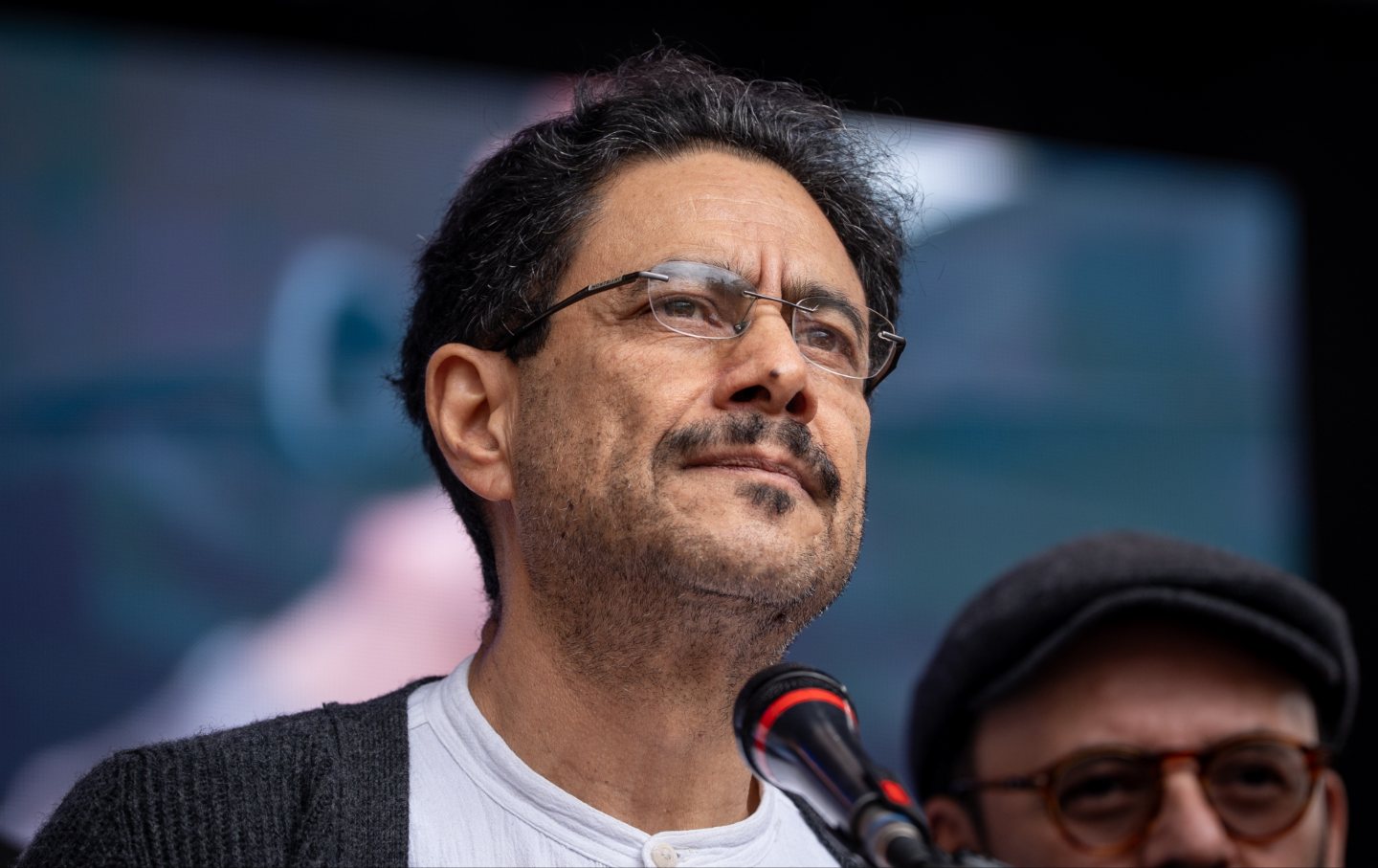
With Petro constitutionally barred from running again, Pacto Histórico has chosen Senator Iván Cepeda as its candidate in this year’s presidential election. A longtime human rights advocate, Cepeda has spent much of his career seeking justice for victims of the state-sponsored extermination of thousands of leaders of the left-wing alliance Unión Patriótica, including his father, Senator Manuel Cepeda, who was gunned down in 1994. He is pledging to continue the advances achieved under Petro and pursue peace negotiations with the country’s various armed groups. A truck driver near Bogotá summed up Cepeda’s campaign to The New York Times: “He wants to help the common people, so the rich aren’t always calling the shots.”
On May 31, Cepeda came in second in the first round of presidential elections to far-right populist candidate Abelardo de la Espriella. The two will now face each other in a runoff on Sunday, June 21. At stake is whether the country will treat its turn to leftism as a fluke and revert to a violent and unequal status quo ante, or continue its path to a more equal, dignified, and independent future.
In advance of the runoff, Micah Uetricht and Alex Caring-Lobel spoke with Cepeda about US meddling in Colombia’s democratic process, his far-right opponent’s narco-paramilitary ties, and how his government plans to fight neoliberal austerity with republican austerity.
Alex Caring-Lobel: You’re heading a broad coalition against the far right. How does your leftist background inform your approach to coalition politics? And why is this political tradition more capable than the center in defeating reaction?
Iván Cepeda: I come from a political tradition deeply rooted in our nation’s history. What we are today, the Pacto Histórico, is the result of the historical evolution of the struggles—social, political, and cultural—that we’ve waged during the last century, or even longer.
So these are not improvised ideas. What we are defending is a historical accumulation. It’s not merely the accumulated legacy of the left but of various political left-wing currents and social movements comprising a wide range of forces, peoples, communities, traditions, and forms of resistance. This political and popular resistance—without wishing to draw smug comparisons to others on our continent—is distinguished by its survival in the face of extremely intense criminal practices and persecution. We even maintain that Colombia has witnessed genocides in the plural—not just one but several genocides against indigenous peoples, against political formations.
And in this long, historic process, we’ve come to acquire a cultural heritage, a way of seeing the world shaped by our political plurality. So the vision that we defend today is not the work of a single candidate or even our political leader, President Petro, but rather corresponds, as I said, to a long-standing tradition.
Within this tradition, we have also developed a political vision of alliances—party alliances, political movement alliances, but also class alliances, social alliances. And today we’ve come to the end, or are coming to the end, of our first progressive administration, whose track record could certainly be examined from differing perspectives, but that has brought about historic changes in the country and that has served—with challenges, which I’m not unfamiliar with—to govern alongside other political tendencies.
So, to get right to the point [laughs], we hold a worldview that emerges from that history, from those struggles, and that encompasses a vision of political alliances: their purpose, timing, scope, and necessity. And today we’re confronting fascism—fascism—in Colombia and around the world.
Of course, there’s room for debate here—neofascism, far right, ultraright, ultraconservativism, etc.—but we’re effectively facing a political axis with fascist features. And therefore we believe it is essential to have a broad, highly pluralistic alliance grounded in programmatic identities, or at least programmatic affinities.
The center in Colombia has its history too. I’m not going to expound on it here, but it has resulted from splinterings from the left as much as from establishment or right-wing parties. And it is subject to the same trends affecting the political center in many parts of the world.
In the face of global problems of such scale and depth as we have today, the planetary crises we’re confronting as consequences of neoliberalism, the center seeks solutions that are, to put it plainly, unfeasible, because these problems do not allow for intermediate or neutral positions but rather demand very clear responses addressed to the country, the people, the nation, and the world. One such case is the climate crisis.
It is sometimes difficult to enter into these political plays, let’s call them, which is not to say that we’re not willing to make concessions, engage in dialogue, or reach pacts. Our party is called the Pacto Histórico, after all. That is why we believe our approach is the right one: not to rule out alliances with the political center, or even parts of the right, in order to move forward.
Micah Uetricht: Petro has struggled to pass some of his big reforms through a hostile Congress, and although Pacto Histórico expanded its seats in Congress in March, it still doesn’t hold an outright majority. Are there reforms that your administration could pursue immediately upon taking office?
IC: Yes, there are decisions we can make without going to Congress, but there are others we cannot without passing laws or constitutional reforms.
There has been a great deal of controversy in Colombia because the president has proposed a constituent assembly. For my part, as the Pacto Histórico candidate, I’ve taken the position of seeking a national agreement. What does a national agreement mean? Well, like any agreement, it entails a process of dialogue, ideally one of consensus and respect for decisions that can be translated into laws, constitutional reforms, or simply executive decisions. But the initial phase of my administration will have to involve a national dialogue.
There are many skeptical about the possibility of one. Some tell us: “No, the far right and the Colombian elite won’t compromise. They never have.” Well, I hold a different view. I come from a political tradition based in dialogue. So we’re going to try, no?
There are three urgent problems. These aren’t merely issues to address in the future or with long-term programs. The crisis of Colombia’s healthcare system cannot wait. The healthcare system is collapsing. Why? Because it was privatized, and corruption set in. Second, we are confronting a crisis caused by the El Niño phenomenon—specifically, prolonged drought. This brings with it energy problems, because our electricity supply relies on large dams, and reservoir levels are already dropping. We haven’t compromised on oil policy [Colombia halted the expansion of its oil industry], so that presents a problem—a serious one.
And we have a third problem: the fiscal deficit. The public finances our government inherited were seriously battered by the policies implemented by the right. They left us with an immense debt because they had to avoid the collection of a specific tax—the gasoline tax—to make their policy, supremely unfair to the population, tolerable. Our government settled the tax debt. So now we have an exorbitant fiscal situation, a grave fiscal crisis.
We now have to face the challenge of dealing with the fiscal deficit and settling the issue of the state’s financial solvency, all while managing the enormous public debt we have to pay. In sum, these three issues need to be resolved, or at least a path found to their resolution, in the first hundred days of the administration. That, then, is the first item we’ll have to tackle.
MU: Your opponent, Abelardo de la Espriella, has been a prominent lawyer for narco and paramilitary groups. On Thursday, your campaign filed a criminal complaint with the attorney general and the International Criminal Court against him for his alleged ties to narco-paramilitary groups. Could you tell us a bit about these charges?
IC: First, let me say that De la Espriella represents not only that political underworld but also something else. His law firm has for years been based in Miami. He is a man with very strong ties to the US far right. He’s an associate of María Elvira Salazar, a far-right Republican in Florida. He is a man very close to Marco Rubio and also to President Trump’s administration.
From that position, he has handled litigation in Miami linked to professional services for imprisoned drug traffickers that are either extradited to the United States or have ended up there under other circumstances. In other words, this is a man who maintains very close relationships with agencies like the DEA and, very likely, the CIA.
I’m not revealing any secrets. He proclaims this himself. He says that if Colombia’s problems don’t have a solution, or if there’s timidity in settling them, he’s going to ask President Trump and the US government to solve our problems—in matters of justice, drug trafficking, violence, and so on. To put it clearly, we’re not talking about a man who has right-wing convictions and happens to practice law. We’re talking about a clear representative of not just the mafioso, drug-trafficking Colombian far right. We’re talking about someone deeply connected to the US far right.
So [on Thursday] we began, in this final stretch of the electoral process, to demonstrate aspects of the professional and political life of Mr. De la Espriella. We have started with an early chapter of his life: his work as a lawyer, which was his direct link to narco-paramilitary structures at the beginning of this century.
When he was still a young lawyer, fresh out of a right-leaning university, Sergio Arboleda University, he established an organization called the Fundación Iniciativas por la Paz, which became a vehicle of the paramilitaries to capture financial resources and also to finance themselves—that’s to say, the organization was the funder and at the same time was funded by the paramilitaries to carry out the work of what you could call improving their public image.
This is well-documented given the many justice and truth-telling processes in Colombia, like the Truth Commission, which was in session until recently and was the result of the 2016 peace accords with FARC; the Justice and Peace System, a legal framework created during the era of talks of paramilitary demobilization; and the Special Jurisdiction for Peace, another tribunal established under the 2016 peace accords. In these forums, paramilitary leaders and individuals connected to paramilitary groups and drug trafficking presented numerous testimonies. Drawing on these sources and investigations by the ordinary justice system, [on Thursday] we compiled six major testimonies indicating that De la Espriella acted as a legal operative who may well have been part of that paramilitary or narco-paramilitary structure, and whose role essentially involved public relations and securing judicial favors, allegedly bribing politicians and judicial officials to benefit the paramilitary leaders.
We also presented evidence of financial ties and specific tasks that De la Espriella carried out. Yet this only covers his time as a young lawyer. We’re going to continue to reveal further details in the coming days. This is not the only criminal complaint we’re filing. There will be others.
ACL: Speaking of the US right in Southern Florida and their political interventions, the Trump administration seems to have blocked a meeting planned between President Petro and New York’s socialist mayor, Zohran Mamdani. Why do you think the right-wing opposition sees this meeting as such a threat as to intimidate the Colombian government in order to prevent it?
IC: Well, first of all, I reject such decisions because they violate autonomy and sovereignty—in this case, of our country. Our president is our head of state and he can and should meet with whomever he deems necessary. The mayor of New York is a political figure, also a state leader, so they should have the freedom to meet.
Second, as I mentioned, they are both outstanding political leaders. President Petro has been consistent and visionary in his stances on environmental defense, on the effects of the climate crisis, about the need for an energy transition that abandons an economy centered exclusively or primarily on oil as a source of energy, and in the defense of humanity’s sanctuaries like the Amazon rain forest. Furthermore, he has maintained a very clear position regarding the genocide in Gaza and the government of Netanyahu. In general, he has come to the defense of the victims of aggression and genocide that we see being perpetrated today. And ultimately, he is a leader in the pursuit of peace.
As for the mayor of New York, there’s no need for me to introduce him. So I think that fear, if fear is indeed what promoted this arbitrary decision, could arise from the certainty that such a meeting would generate ideas and political purpose. These could be—at least for us, if not for others—highly productive and beneficial at this moment.
In general, I believe the far right—and here I’m not referring to this specific decision but rather in general—has built a strong international. That’s to say, the far right acts with relative synchronization on a global scale. We see certain models, certain narratives, certain arguments being replicated everywhere, copied or adapted to each specific context.
For instance, Mr. De la Espriella wants to adopt various schemes of Mr. Bukele, or of Mr. Milei in economic matters, in Colombia. The far right acts globally—something that deserves observation and study—while the progressive field, the left, finds it challenging to do so. It is slower; its processes are difficult. I think the far right perceives this clearly and wants the left to stay this way—relatively isolated (relative because there are indeed instances of dialogue in the international progressive movement)—so we fail to establish shared goals for shared problems.
ACL: The Pacto Histórico was swept to power amid a national revolt against neoliberalism and austerity. What conditions have changed so that austerity is back on the menu, now represented by another Uribista candidate?
IC: Well, I’ll start by commenting on how conditions have changed. One positive shift is the level of mobilization, organization, and awareness among the Colombian people. This government has fostered the development of social organization and mobilization. Consequently, our government’s popular base has grown in these years.
Popular
“swipe left below to view more authors”Swipe →
This raises the question of what a new administration would look like. We’re going to take things further. One of the changes we’re going to introduce is to give a more prominent role to social movements, not just through government representation but, above all, through mechanisms for popular decision-making and the opportunity for these movements to engage directly with the state—without, of course, losing their autonomy.
Now, there are two issues that we must indeed address. One is the corruption that has occurred in our government. Corruption is not simply a moral problem. It is the result of the privatization of the state. Services have been privatized; bureaucratic machinery has become overly complex, and relations within the state are mediated by businesses. There exist apparatuses of corruption at all levels of the state. So a battle must be waged against corruption, which is not merely moral but political, and it is a battle to build a society that is more democratic, free, and just.
Then there’s the issue of austerity. You have two concepts of austerity. There is neoliberal austerity, the austerity heralded by the far right, which, to put simply, means tightening the people’s belts or imposing harsher conditions on them, while the government holds greater resources or possibilities. And this obviously entails doing away with the state, too, especially its social functions.
We counter that concept of austerity with a different kind: republican austerity. It is a concept that Morena has developed in Mexico. And it’s the idea that the state should be austere. Public spending on government officials must be kept as moderate as possible, and the savings that austerity produces should be for the people, for social spending. In other words, redirect funds away from waste, corruption, and all the absolutely unnecessary and detrimental expenditures of the state and government and toward social spending. That is the concept of austerity we’re going to champion.
With the midterm elections now firmly upon us, the question is whether Democratic candidates will do more than merely occupy ballot lines as mild alternatives to the red-hot crisis that is Donald Trump.
As Trump spends over $1 billion a day on a globally destabilizing war on Iran and admits that he doesn’t “think about Americans’ financial situation,” millions across the country are struggling with the surging costs of essentials. Democrats must seize this moment and advance bold, small-“d” populist ideas—not settle for cynical caution that once again snatches defeat from the jaws of victory.
The Nation elevates progressive ideas, movements, and elected officials achieving real change across the country into the national conversation. At the same time, our journalists are exposing how crypto and AI-funded super PACs are spending hundreds of millions of dollars to knock out candidates they oppose, reporting on the devastating impact of the Supreme Court’s evisceration of the Voting Rights Act, and sounding the alarm on attempts by red states to quickly redraw electoral maps, disenfranchising Southern Black voters.
We can play this critical role because of support from readers like you. This June, we’re raising $20,000 to power The Nation’s independent journalism in the run-up to November’s immensely consequential elections.
It’s in our power to build a more just society, and your support at this critical moment brings us closer to that bold vision. I hope you’ll donate today.
Onward,
Katrina vanden Heuvel
Editor and Publisher, The Nation
More from The Nation
The newly leaked Memo of Understanding to end the conflict makes it clear that the president has nothing to show for his expensive, destructive fool’s errand.
Sovereign wealth, private equity money, and a network of oily alliances between FIFA and the world’s most reprehensible regimes have transformed the sport forever.
The UN confronts a “perfect storm” of US-sponsored deprivation on the island.
Mayor of Greater Manchester Andy Burnham is expected to challenge Starmer for leadership of the Labour Party.
Ordinary people are rising up against neoliberal orthodoxy.