
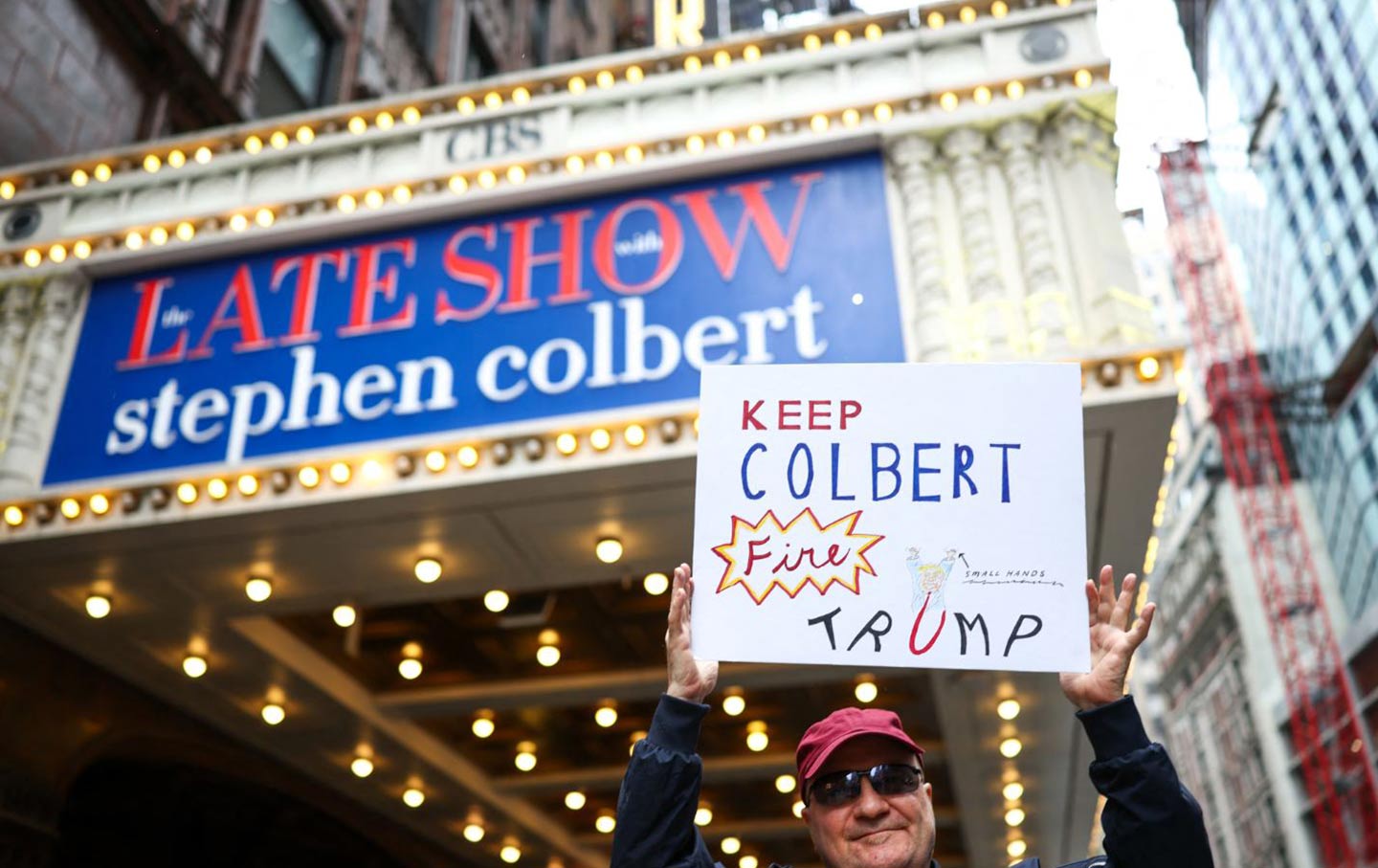
In this authoritarian moment, we need defiant comedy more than ever.
Whatever happened to our court jesters? Stephen Colbert’s late-night show has been canceled. Jimmy Kimmel has signaled that he might just retire when his ABC contract expires in 2027. Seth Meyers—whose set at the 2011 White House Correspondents Dinner humiliated Donald Trump so deeply it has become part of his presidential-villain origin story—may be on borrowed time. Jimmy Fallon, who playfully tousled Donald Trump’s hair just weeks ahead of the election in 2016, was never actually interested in challenging power in the first place. In exactly the moment when we have a power apparatus that demands reverence and punishes dissent, we need defiant comedy more than ever.
During an interview on the eponymously named Conan O’Brien Needs a Friend podcast, comedian Zach Galifianakis took note of the jester’s disappearance. The conversation between Galifianakis and O’Brien had inevitably turned to Between Two Ferns, Galifianakis’s mock interview show, which cast him as a cable-access host who routinely humiliated an endless stream of rich, famous, and powerful guests. The show remains beloved because of how masterfully it skewered the inanity of celebrity interviews, late-night TV, and promotional media. The topic was timely, too, coming as it did after Trump demanded, for the second time, that ABC fire comedian Jimmy Kimmel over a joke, but before the final broadcast of Stephen Colbert’s show, whose cancellation Trump also demanded. Galifianakis used the moment to call out the comedians who hosted Trump on their podcasts ahead of the 2024 election only to fawn all over him like fanboys.
“All the podcasters that have had the president on now—they don’t do their court jester,” Galfianakis said. “They just suck up to him. So, the comedians, [who] are podcasters, that have had Trump on, they’re not doing their job. That’s not the job of a comedian. You are to challenge. You are to make uncomfortable. You’re not to sit there and fake laugh. That is not the job of the court jester. Period.”
He didn’t name names, but he didn’t need to. He was nodding to those comedians who, as The Cut writer Jesse David so perfectly puts it, “all position themselves as outside the mainstream due to their resistance to political correctness, contrarian takes on liberal conventional wisdom, and ‘both sides are corrupt’ nihilism.” Their entire brand is about being anti-establishment, objective skeptics who bow and scrape to no one. Yet when Trump embarked on a tour of roughly a dozen of those manosphere—my descriptor, perhaps not theirs—podcasts throughout the 2024 campaign season, every host glazed him like an absolute doughnut. Those anti-woke podcast comedians who are all about saying what no one else will say seemed to lose their voices as soon as Trump entered the room.
There was Andrew Schulz, giggling but failing to make a good joke when Trump, the world’s most prolific liar, described himself as “basically a truthful person.” We had Theo “Aw-Shucks” Von calling Trump “homie” and failing to challenge JD Vance as the vice president wormed around justifications for funding genocide. Internet celebrity and podcast bro Adin Ross—who to be fair, isn’t even a comedian—deserves a mention here for pulling the ultimate simpmaxxing beta cuck move of gifting Trump a Rolex and a Cybertruck. And, of course, there is comedian Joe Rogan, who hosted Trump, the man he had called “an existential threat to democracy,” just two years earlier, for three hours. The two chatted amiably about Martian life, Trump’s great “comedic instincts,” and how he had advised Kim Jong Un to take a vacation day off from “building nuclear.”
Of course, comedians are people, and famously have political opinions. The issue isn’t that the manosphere bros have their own politics. It’s no surprise that any podcaster whose material can be categorized as “anti-woke” would pull the lever for Trump. The issue is their rapid turn to obsequiousness in the face of power. Galifianakis makes no secret of his own leftist political leanings, and the 2014 episode of Between Two Ferns featuring Barack Obama was mostly just an opportunity for the then-president to urge people to sign up with a new healthcare thing called the Affordable Care Act. But Galifianakis remained in character for the episode, subjecting the then-president to the same disdain and mockery as any other guest. “I have to know,” Galifianakis asked at one point, “what is it like to be the last Black president?” As O’Brien noted during the podcast, “I don’t think anyone’s talked to, certainly a sitting president” like that.
Current Issue

Not one had, and that’s precisely what made the whole display funny. The performative ignorance and shocking rudeness of Galifianakis’s behavior—and the resulting awkwardness and discomfort—were the point. This is the historical role of the court jester: to say what no other member of the royal court would be permitted to without fear of losing their head. The jester is not just allowed but encouraged and even expected to openly mock the king in ways unthinkable for the rest of us. The throne allows this because it actually benefits from this little fleeting illusion of ridicule. Obama understood that when power willingly submits to the jester and plays along, it renders the powerful more likable, more real and, above all, more human.
Trump actually gets this innately and it’s precisely what terrifies him so much. For the autocrat, whose only interest is in being feared and obeyed, being humanized is anathema. Thin-skinned would-be dictators cannot stand the idea of being laughed at because laughter takes the wind out of their puffery, shrinking him back down to size. “Laughter matters because tyrants require seriousness. They need to be feared, obeyed, treated as unstoppable, inevitable. Mockery breaks the spell. It pokes and jabs at the thin skin beneath the armor and sends the message they hate most: we are not afraid,” Nadine Smith, a journalist and activist writes in an essay titled “Laughter, Not Obedience.” “When you laugh at a strongman, you strip him of the mystique he needs to rule. You remind everyone watching that this person is not unbeatable; he is absurd.” This is why Trump seeks out podcasters who flatter him and rages at comedians who don’t.
It is also why Trump, despite the fact that the whole media ecosystem is increasingly owned by MAGA sympathizers, remains so fixated on what comedians are saying about him. He used disingenuous outrage over political events to go after longtime critic and late-night host Jimmy Kimmel, successfully pressuring ABC to suspend him last year. Recently, Trump attack dog and FCC head Brendan Carr demanded that the network and its owner, The Walt Disney Company, submit reviews of its broadcast licenses now, instead of when scheduled in 2028. The company has rightly called the demand “an extraordinary demonstration of power and coercion directed at disfavored editorial voices which sends a clear warning to every broadcaster in America,” and an obvious “threat to the First Amendment.” Since his first term, the president has called for Saturday Night Live, an American institution, to be pulled from the air for making jokes about him, and previously tried to have both the FCC and the Department of Justice conduct probes into the show. He has called on NBC to cancel both Seth Meyers and even Jimmy Fallon. He celebrated Colbert’s cancellation by posting an AI video of himself throwing the comedian into the garbage. He has threatened to sue comedian Trevor Noah and suggested that he might remove American citizenship from longtime comic critic Rosie O’Donnell.
These things may seem extraordinary in the context of American history, but they are utterly predictable from the history of autocrats. “Dictators fear laughter more than bombs,” to quote antifascist journalist Arthur Koestler, who survived both Hitler and Stalin and lived to write about it. Nazi propagandist Joseph Goebbels expelled three “Aryan” comedians from the Reich’s Chamber of Culture and, though it was not explicitly stated, a 1939 New York Times article suggested that what most inflamed the Nazis’ ire was how “they deftly, but unmistakably, caricatured some gestures, poses and physical characteristics of National Socialist leaders.” After Kukly, a satirical Russian puppet show, ignored the Kremlin’s demands to refrain from mocking Vladimir Putin, its network was brought under state control and the show promptly canceled. In 1969, Richard Nixon—in many ways Trump v. 1.0—got his FCC to lean on CBS executives to cancel the staunchly anti–Vietnam War Smothers Brothers Comedy Hour, but outrage kept the show on the air. In 2023 under Xi Jinping, whose power Trump has openly coveted, China fined a comedy studio $2 million over a joke it claimed “wantonly slander[ed] the glorious image of the People’s Liberation Army.” And of course on the heels of his 1940 Hitler takedown, The Great Dictator, Charlie Chaplin was forced to leave the United States as McCarthyism took hold of the country. The fact that dictators consistently work to silence comedians is evidence that comedy, and satire above all, has actual cultural power.
“In a totalitarian state, you can crush the courts; you can crush elections; you can crush everything. But you can’t crush laughter. If a caricature cracks people up, it’s because it rings true,” Viktor Shenderovich—the Russian satirist and showrunner of Kukly when it was targeted by Putin, told Politico last year. “Satire is the sharpest instrument of free speech. And the first thing all dictators do is crack down on freedom of speech.”
Perhaps the most urgent directive from Yale historian Timothy Snyder in his now landmark book On Tyranny is not to give into fascism proactively. “Most of the power of authoritarianism is freely given,” Snyder writes, noting that a citizen who preemptively concedes to repressive regimes “is teaching power what it can do.” The root problem is not that podcast comedians played host to Trump. It’s what Snyder calls the “anticipatory obedience,” or the ease with which they abandoned the adversarial stance comedy has long held in the face of power—a stance that anti-woke comedians, more than anyone, have elevated to their entire identities. Sitting around and guffawing at Trump’s jokes and nodding along with his rambling is less comedy than access journalism. Perhaps my favorite description of this phenomenon is from journalist Seth Abramovich, who wrote that brocasters’ “signature achievement has been to convert politics into hangout material and then to insist, sincerely, that nothing political happened.” These are the people who insist that they’re uniquely fearless—unafraid to shout down college students, DEI proponents, and women who have decided that childrearing is not for them. But when actual state power enters the room, they prove remarkably deferential. Turns out they only speak truth to the powerless, I guess.
Galifianakis recalled that ahead of his Between Two Ferns interview with then–Democratic presidential candidate Hillary Clinton, her team demanded that “her e-mails” be off limits. He responded by suggesting that they call the whole thing off. Her team quickly backed off. (“When you tell powerful people ‘no’— it’s crazy,” Galifianakis recalled.) Compare that to Trump’s podcaster interviews, which were so deferential, Trump allies would later suggest they’d helped him get elected. After Trump’s victory speech in 2024, a triumphant Dana White, CEO of the Ultimate Fighting Championship, gave them a gushing shout-out. “I want to thank the Nelk Boys,” White shouted, jubilant, “Adin Ross, Theo Von, Bussin’ With the Boys and, last but not least, the mighty and powerful Joe Rogan!”
Popular
“swipe left below to view more authors”Swipe →
Comedy is one of the rare cultural institutions that’s specifically tasked with challenging authority. Comedians have license to say the thing we want to say out loud but fear would upset polite company—and anti-woke comedians have basically martyred themselves over their willingness to do that more loudly and crudely than anyone else. No one, and certainly not Galifianakis, is suggesting that they needed to act as rigorous journalists, grilling Trump on policy; nor did they have to turn their shows into some kind of political debate. But they should have at least been willing to subject Trump to the same irreverence and discomfort they regularly inflict on people with none of Trump’s power. What this moment needs from comedians, more than anything, is a refusal to be reverential before actual power—and to recognize what that looks like, while understanding that irreverence is not partisanship. If the podcast era has given us bro-comedians who think access is tantamount to bravery and punching down is hilarity, I long for a next wave that will recognize Nadine Smith’s sage advice: “When authoritarians claim failure as victory, laugh. When they demand loyalty, mock their incompetence. Make their movement embarrassing. Make it uncool to repeat their talking points without irony.”
More from The Nation
In public, Harvard has waged a battle against the Trump administration. In private, workers say the university wants to appease it.

The US prison population is aging rapidly, and incarcerated seniors are not getting the care they need.

The Trump administration is on the verge of releasing a proposed rule that would eliminate crucial quality standards at the nation’s preschool program for low-income children.

The pontiff just excommunicated a reactionary splinter group committed to undermining the church. Democratic leaders could learn something.
The Italian American establishment’s hysterical response to Mayor Mamdani’s map of immigrant enclaves reveals a cynical politics of victimhood.