
All of the mayor’s endorsed candidates won last week. His ability to reshape New York City’s political landscape shows what happens when a socialist takes executive power.
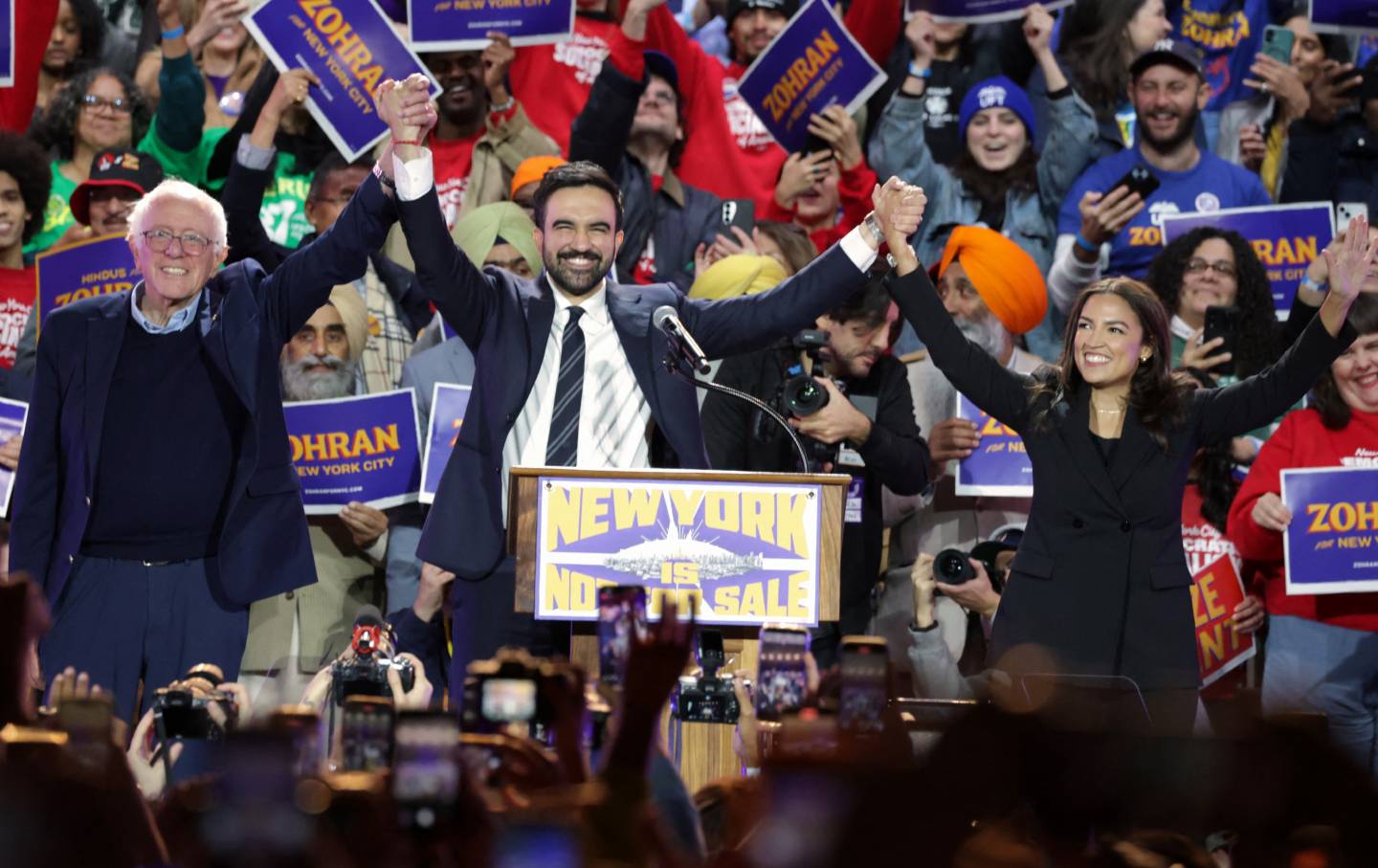
New York City mayoral candidate Zohran Mamdani (C) holds hands with Senator Bernie Sanders (I-VT) (L) and Representative Alexandria Ocasio-Cortez (D-NY) at the end of a campaign rally at Forest Hills Stadium in the Queens borough of New York City on October 26, 2025.
(Angela Weiss / AFP via Getty Images)
Last Tuesday, all of Zohran Mamdani endorsed candidates won—the mayor went three-for-three in congressional endorsements and five-for-five in state legislative endorsements. His clean sweep offers a glimpse of how a leader can reshape an entire party—and it shows why it’s time for the left to get behind a possible presidential run by Congresswoman Alexandria Ocasio-Cortez. Because as Mamdani’s kingmaker status demonstrates, there’s almost nothing that can expand a faction’s appeal within a party more than the head of the party being from that faction.
That’s not to say that Mamdani’s support was the only variable in the left’s wins on Tuesday. NY-DSA’s door-to-door organizing capacity is incredibly important. Voter backlash against incumbents’ AIPAC-fueled support for Israel was a major factor. And more broadly, the Democratic base’s rage at the failure of party elites to stop Trump has shifted the terrain on which all insurgent primary challenges are playing out.
But Mamdani was unquestionably a key driver in these races. That is particularly clear in Claire Valdez’s lopsided victory in NY-7 over Antonio Reynoso, a former insurgent himself with a record of genuine progressive accomplishments and whose platform was virtually identical to Valdez’s. The most important distinguishing factor in that race was Mamdani’s endorsement. It seemed like every Valdez mailer had Mamdani’s smiling face on it. And it made all the difference.
The lesson here is that, at least within their particular jurisdiction, a chief executive becomes the leader of their party. And when you’re the chief executive and leader of your party, as Donald Trump put it, “Everyone wants to be [your] friend.” This bandwagon effect doesn’t always materialize—nobody is arguing that Chicago’s beleaguered Mayor Brandon Johnson is remaking that city’s politics in his image. But the attentional advantages of an effective chief executive mean that when such a leader has a clear vision for where their party needs to go and explicitly communicates that vision to party members, they can remake their party.
Current Issue
We saw this dynamic clearly in Trump’s consolidation of the GOP. Over just a few cycles, he shattered the Republican establishment and turned it into a vessel for the MAGA movement. We even saw Biden, despite his obvious frailties, engender a trace of this—it’s no accident that insurgent progressive primary wins largely trailed off during his term, because in general, the average party member wants to be with their leader.
And that’s exactly what we’re seeing today with Mamdani’s success in reshaping the Democratic establishment in New York City. Politico summed up this dynamic well in an article about how centrist Democrats “are freaking out” that progressives are “becoming more mainstream as they keep winning—reshaping the Democratic Party.” Or as Liam Kerr, head of the Manchin-glazing WelcomePAC, put it: “Centrist Democrats, normie Democrats, need to realize we’re the insurgents, and they’re the new establishment.”
That is, of course, DSA’s goal: to create a new, pro-working class, anti-oligarchy establishment to run the Democratic Party. And Mamdani’s success last week shows that taking a big swing for the top executive spot can pay such outsized dividends toward that end that it’s worth the risk.
In hindsight, this all seems obvious. But it’s worth remembering that it was not so clear at the beginning of Mamdani’s mayoral campaign. Many of NY-DSA’s members in office advocated against endorsing Mamdani, arguing that the potential downsides of his run were too great and the movement should continue focusing on building up its ranks of lower-level elected officials.
Many on the left today have a similar analysis when it comes to the 2028 presidential campaign. It’s time for us to exorcise those doubts. There’s simply nothing that matters more than a leftist winning the Democratic presidential nomination. It matters for our chances of defeating MAGA—because the Democratic Party’s best shot to beat Trump’s successor is with a candidate who embraces real economic populism. It matters for our substantive goals—because, as Trump has demonstrated, the US presidency has accumulated essentially imperial power to pursue an agenda through executive and administrative action. Perhaps most of all, it matters for the left’s project of remaking the Democratic Party into one that can actually tackle the obscene inequality, rampant corruption, escalating climate crisis, and other existential challenges of our era—because as Mamdani’s mayoralty has demonstrated in New York City, if a leftist can become the leader of the national Democratic Party, the median Democratic voter will follow.
That’s where Ocasio-Cortez comes in.
Of course, AOC is not the only progressive who could plausibly run for president. Congressman Ro Khanna has been boldly supporting populists across the country, calling out the sclerosis of Democrats’ congressional leadership, and leading the charge in prosecuting the case against the Epstein class. Senator Chris Van Hollen, who has been a courageous voice against Israeli apartheid, also recently expressed an interest in at least exploring a presidential campaign. And I, for one, would be all in for a third Bernie Sanders run.
But the chances of that materializing at Sanders’s age—he will be 86 in 2028—seem close to nil, which is likely why Sanders has been working so hard to build up the next generation of left leadership. And though nobody can ever quite fill his shoes, there is only one clear inheritor of Sanders’s role as standard-bearer for the US left: AOC.
Much of the chatter about AOC’s political future has focused on whether she should run for president or challenge Chuck Schumer for Senate. But at this point, challenging Schumer is a waste of her talents. Schumer’s favorability among New Yorkers sits at just 38 percent, the Democratic base is furious at him for his capitulations to Trump, and the issue most central to his political identity—unquestioning loyalty to the Israeli government—has become toxic among Democratic primary voters. You don’t need an AOC to take him out—there are numerous other progressive leaders in the state who could do so.
Popular
“swipe left below to view more authors”Swipe →
By contrast, it’s hard to imagine anyone on the left being in a better position for a presidential run than AOC is right now. She’s one of the most effective communicators in the Democratic Party. She’s one of the strongest grassroots fundraisers in Congress. She’s one of the most popular politicians in the country. And she is uniquely positioned to build the kind of increasingly potent Democratic primary coalition—young people, Latinos, and working-class voters—that powered other major anti-establishment victories, from Mamdani to James Talarico in Texas. This goes beyond identity politics—it’s not just that AOC is young, Latina, and working class. It’s that she can genuinely and compellingly speak to the experiences, fears, and aspirations of these constituencies.
What she isn’t, at this point, is clearly set on pursuing a presidential campaign in 2028. When asked by David Axelrod if she was running, she answered, “My ambition is to change this country. Presidents come and go. Senate, House seats, elected officials come and go. But single-payer healthcare is forever… I make decisions by waking up in the morning, looking out the window and observing the conditions of this country. And saying what move or what decision can I make today that is going to get us closer to that future, stronger, faster, better than yesterday.”
This response was celebrated online as a piece of rhetoric, and rightly so—it’s a phenomenal answer. But as a statement of actual political strategy, it’s a little off. If you want single-payer healthcare, there’s nothing that could have a greater impact than electing a president who will actually fight to pass single-payer healthcare. And there’s nobody in a stronger position right now to be that president than AOC, if she chooses to run.
That’s not to say she is perfect. She’s a politician, and none of us will agree with all her choices. I personally found her recent explanation for supporting Hakeem Jeffries as the Democratic leader in the House frustrating. And she made mistakes in the 2024 campaign—others have called for her to apologize for whitewashing Kamala Harris’s Gaza stance during her speech at the DNC, and as someone who worked to oust Biden from the Democratic ticket, I was upset when she (and other progressives) threw him a lifeline after his debate fiasco. Needless to say, the left will have to hold her to account like any elected leader.
But given the upsides of an AOC presidency, those of us on the left should be urging her to run. If our ultimate aim is to reshape the Democratic Party into a force that can defeat the authoritarian right and transform this country for the better, the struggle for the White House isn’t a distraction. It’s perhaps the most important political fight of our lifetimes—and AOC can win it.
With the midterm elections now firmly upon us, the question is whether Democratic candidates will do more than merely occupy ballot lines as mild alternatives to the red-hot crisis that is Donald Trump.
As Trump spends over $1 billion a day on a globally destabilizing war on Iran and admits that he doesn’t “think about Americans’ financial situation,” millions across the country are struggling with the surging costs of essentials. Democrats must seize this moment and advance bold, small-“d” populist ideas—not settle for cynical caution that once again snatches defeat from the jaws of victory.
The Nation elevates progressive ideas, movements, and elected officials achieving real change across the country into the national conversation. At the same time, our journalists are exposing how crypto and AI-funded super PACs are spending hundreds of millions of dollars to knock out candidates they oppose, reporting on the devastating impact of the Supreme Court’s evisceration of the Voting Rights Act, and sounding the alarm on attempts by red states to quickly redraw electoral maps, disenfranchising Southern Black voters.
We can play this critical role because of support from readers like you. This June, we’re raising $20,000 to power The Nation’s independent journalism in the run-up to November’s immensely consequential elections.
It’s in our power to build a more just society, and your support at this critical moment brings us closer to that bold vision. I hope you’ll donate today.
Onward,
Katrina vanden Heuvel
Editor and Publisher, The Nation