
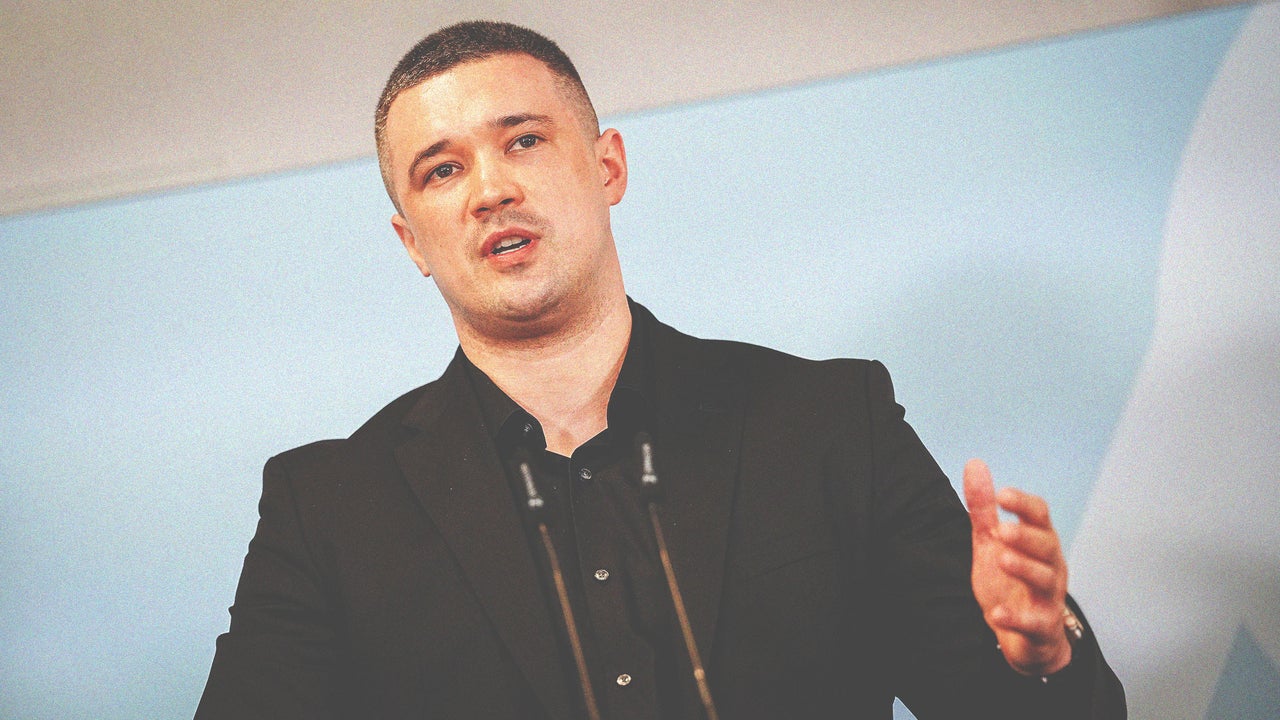
On July 15, Ukrainian President Volodymyr Zelensky dismissed Defense Minister Mykhailo Fedorov, the official most closely identified with Ukraine’s much-lauded effort to turn drones, software, and commercial technology into military advantage. The move could have implications not just for Kyiv, but also for Washington.
Ukraine has become the clearest test of how a smaller force can use inexpensive systems and rapid development to counter a larger conventional army. Those are meaningful lessons to a Pentagon preparing for wars in which U.S. forces may need to disperse and function while under long-range attack. American military leaders and defense companies alike are studying Ukraine’s rapid feedback loops between frontline units, developers, and manufacturers, which means Zelensky’s decision may affect how quickly those lessons continue to emerge.
Fedorov, 35, entered the Defense Ministry in January after more than six years as Ukraine’s minister of digital transformation, where he oversaw Diia, the country’s system for moving government documents and services online. In his new role, he brought the tech-executive ethos to a military bureaucracy.
His ministry expanded digital platforms for service members, reservists, and conscripts; created systems that enabled units to order equipment directly from Ukrainian manufacturers; and rewarded drone teams for verified battlefield results with credits toward additional technology. It also pushed manufacturers toward common controls for fiber-optic drones, making different models easier for troops to use, and required more suppliers to compete for government contracts. Fedorov said one ammunition tender lowered prices by 16 to 20%.
Some of his most visible successes involved the technology Ukraine uses to offset Russia’s advantages in troop numbers and industrial capacity. Fedorov helped persuade Elon Musk to restrict unauthorized Russian access to Starlink, disrupting Russian drone operations. His six-month tenure also coincided with an expansion of Ukrainian long-range strikes against refineries, logistics sites, and military targets in Russia and occupied Crimea. Those campaigns can’t be credited to one official, though Fedorov helped build the procurement and technology system behind them.
The reason for his removal remains only partly explained. Zelensky said a rift between Fedorov and Gen. Oleksandr Syrskyi, Ukraine’s commander in chief—over military reforms and the division of authority between the Defense Ministry and the armed forces leadership—had forced him to pick a side.
Fedorov, for his part, claimed in a press conference that he had urged Zelensky to replace Syrskyi and the chief of the general staff. Fedorov later agreed to work with the military leadership, he said, but found that his efforts to restructure units and create specialized centers were being blocked. The Kyiv Independent also reported that some lawmakers believed Fedorov had moved too slowly to reform the system for recruiting civilians into the armed forces. (The Defense Ministry did not respond to Fast Company’s request for comment.)
Zelensky faced a legitimate management problem. A civilian defense minister and the military commander can’t pursue incompatible strategies for long. Fedorov had held the job for only six months, lacked military service experience, and sometimes presented technology as a more complete answer than it could realistically provide. Ukraine still needs trained infantry, a coherent command structure, and a functioning mobilization system.
The decision could have ramifications that ripple through the war effort. By retaining Syrskyi and removing Fedorov, Zelensky preserved continuity in the chain of command. But he also, in effect, weakened the office with the clearest mandate to challenge procurement practices, personnel systems, and a command culture that many Ukrainian soldiers consider too centralized. Little wonder, then, that there have been mass protests over Fedorov’s dismissal.
This personnel dispute has implications for the U.S. because Ukraine has become a model for quickly deploying low-cost drones, autonomous systems, and software on the battlefield. Because as good as hardware is, a military needs the ability to buy and quickly deploy promising systems at scale and update them as the enemy adapts. Slow procurement can register useful tech as outdated before it ever reaches the front lines.
Zelensky has asked the new acting Defense Minister, Yevhen Khmara, to continue several of Fedorov’s programs. Khmara’s background in special operations and drone strikes suggests that the technological emphasis will remain. The central test is whether he will have enough authority to confront the same institutions that resisted his predecessor.
Ukraine’s military advantage depends partly on how quickly it can adapt its systems. Zelensky now has to show that removing Fedorov won’t slow that process.