
Brown students have formed a neighborhood organizing group that uses courthouse patrols, rapid-response alerts, and mass mobilization to disrupt ICE’s Rhode Island operations.
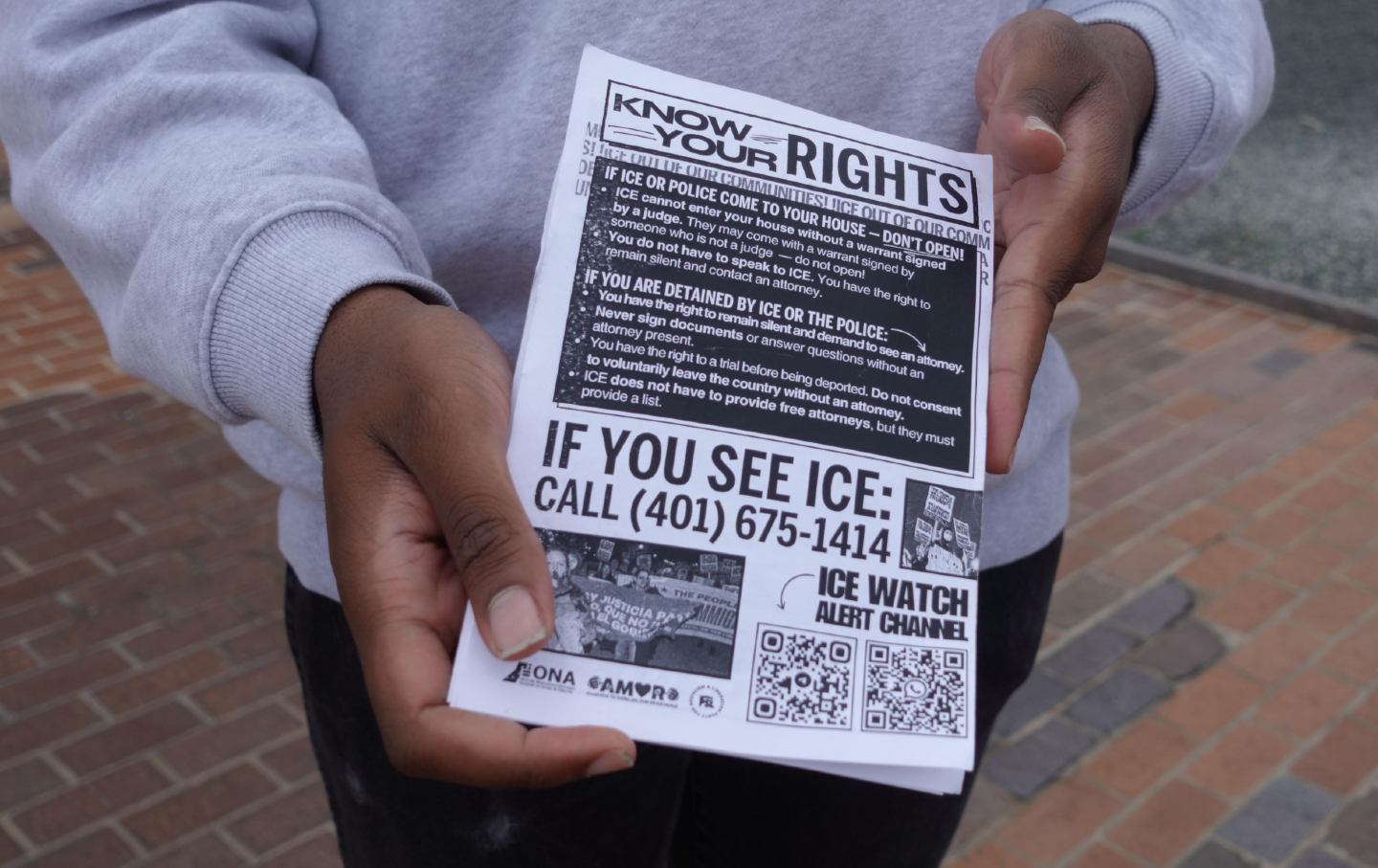
A student holds a “know your rights” flyer.
(Leyad Zavriyev)
The Star Wars franchise is fertile ground for political allegory. While the internet has compared Immigration Customs Enforcement (ICE) to the Galactic Empire, Brown University sophomore Dakota Pippins would like to draw another parallel.
Pippins is a volunteer with the Rhode Island Deportation Defense Network (DDN), a collection of six neighborhood groups across the state that organize ICE-watches and mass mobilizations with a bilingual deportation defense hotline. The DDN is sprawling and somewhat amorphous. It has also been greatly successful in deterring ICE from making detainments in certain parts of the state.
Pippins explained how the decentralized nature of the movement can be understood by looking at the depiction of the Rebel Alliance in Andor—one of several Disney series prequelling the 1977 film. In the original Star Wars, you’re introduced to the rebellion as a centralized group of dissidents, but grass-roots opposition doesn’t materialize out of nowhere. Andor shows “how you build up to a rebellion,” he said. “You have a bunch of different groups and people who all share a distaste or hatred for the empire.”
The unit of the DDN that draws volunteers from Brown is called the College Hill Organizing Group (CHOG); they patrol at the Garrahy courthouse—a uniquely ugly building—in Downtown Providence. What over the past year has unfolded outside of the courthouse has also occurred at courthouses across the country: “Court hearings are public record, so [ICE] knows when certain people are going to be there,” said Etta Robb, a volunteer with the DDN and a recent Brown University graduate. “They wait outside their court hearings, and take them as soon as they leave the building.”
During shifts at the courthouse (some call them “outreach,” some “ICE-watch,” others “patrol”), volunteers stop passersby to discuss the hotline and the DDN’s legislative efforts, all while on the lookout for ICE. When federal agents appear, a message is relayed to a deportation defense hotline which makes an announcement to over five thousand people in Providence through WhatsApp and Telegram channels. “We go down there and we do outreach, and we talk to people, and we protest, and we get really loud, and we let people know ICE is in the area, and then they leave without taking anyone,” Robb said.
“[The ICE agents] will troll a little bit,” said Diego Castillo, a volunteer with the DDN and a junior at Brown. “But when we we’re willing to be out there, even for hours with them, I think it really just shows how much we care, and for the most part they leave.”
Current Issue

The CHOG was born following Brown community members’ mounting fear of ICE after the detainments of Mahmoud Khalil and Rümeysa Öztürk from Columbia and Tufts respectively. Robb recalled that over 300 people showed up to the first meeting in late spring of 2025. “We were trying to figure out what it would mean to mass mobilize in a little bit of time,” Robb said. “We’ve seen how all of these institutions just roll right over when ICE actually comes, and so we’re like, we need to take it into our own hands,” she added. “There’s a lot of focus on institutions like Brown as [the buffer] between Trump and students. But, the truth is it’s students, us, the ones on the ground, who can actually protect each other.”
Robb pulled out the call log of the hotline: “So today, so far there’s been, I think, only one. Yesterday there were six,” she said. “There are days when there’s definitely like,” Robb counted off her phone screen, “12.”
Over the past year, the DDN has refined its operation. While the deportation defense hotline is active 5 am to 9 pm daily, the CHOG has narrowed in on exactly when ICE is likely to appear at the Garrahy courthouse, limiting its patrols to 9 am to noon Monday through Friday. “We’ve gotten good at it, like I think we’re at a point where we’re kind of better than the ICE agents,” said Raya Gupta, a volunteer with the DDN and a sophomore at Brown. “I mean, it flip flops, because we all have to adjust our tactics, but in the past couple mobilizations, there were a bunch of them, and none of the times were they able to take people,” she continued. “We’re very persistent and tactical.”
As the network has grown, volunteers have become more confident in their procedures. “I know what to do when ICE shows up to the courthouse. I’m not scared to knock on windows anymore and ask people if they’re law enforcement to confirm if it’s ICE or not,” Gupta said.
Tracking ICE vehicles’ license plate numbers helps the DDN identify agents and quickly summon community members to the courthouse to protest. “They always use American made cars and always have tinted windows,” Pippins said. “The quicker we can recognize ICE and respond means a better chance of keeping people safe.” But volunteers have noticed ICE agents catching on to this strategy. “We’ve seen them change up their license plates a lot to try and throw us off,” Robb said. “They hide from us all the time.”
Despite the mounting game of cat and mouse, the CHOG has found their tactics remain successful. “We’ve seen them respond to us in all sorts of ways,” Robb said. “I would say, since we’ve been there at the courthouse, they’ve been unsuccessful with their kidnapping attempts close to 80% of the time.”
Popular
“swipe left below to view more authors”Swipe →
The CHOG is fueled by a sprawling network of campus activist groups, including Brown Rise Up (BRU), the Sunrise Movement, Brown Divest Coalition, Brown Dream Team, the Graduate Labor Organization, among many others. “You have a bunch of groups that are aligned in this resistance,” Pippins said. “But these different groups have different people, different backgrounds, and different approaches—BRU’s theory of change will not be the same as PSL’s theory of change, and not the same as AMOR’s theory of change.”
Brown Rise Up (BRU), a group dedicated to anti-authoritarianism that pivoted to organizing against ICE after the university rejected Trump’s federal Compact restricting academic freedom and independence, is one of the many campus organizations recruiting students to the DDN. While BRU has primarily been involved in organizing protests, most—if not all—of BRU volunteers for the DDN. “It might sometimes seem from the outside that [BRU] organizes protests or rallies, while the DDN does this thing. But, there’s, in practice, a lot more overlap,” said Castillo. Pippins has helped bridge the DDN and BRU, where he serves as partnerships co-coordinator.
“This is a very broad coalition, and there are a lot of student groups, unions, clubs, etc… which all either explicitly sponsor the DDN or have one or multiple of their members that volunteer with us,” said Castillo.
In recent months, ICE has retreated from its large-scale swarming of whole cities after intense pushback in Minnesota. But, they have continued to show up to the Garrahy courthouse, Robb said. For many volunteers with the DDN, Minneapolis provided them with a playbook. “The retreat that we’re seeing is really truly because of the mass movement,” Robb said. “The Democrats might see something else, like they’re winning in Congress. I think that’s fucking ridiculous.”
Robb thinks ICE is well aware of the threat growing opposition to the agency poses to their ability to continue with their work. The agency was planning on going to Ohio, she said, but decided against it after the outpouring of protest in Minneapolis. “If this movement keeps growing it’s really actually threatening to them. They can’t just ignore it,” Robb said.
Standing outside Garrahy courthouse near the end of his shift, Brown senior Kenneth Kalu, a volunteer with the DDN, described his interactions with ICE. “We operate within the bounds of the law. We can’t confront ICE physically, so a lot of what happens when ICE shows up is recording,” he said. “If they see lots of people doing outreach and making it clear that ICE is present, they’ll often leave of their own volition.”
One day in December, Kalu was on a shift outside of the courthouse when he was threatened by an ICE officer brandishing a baton. After spotting several ICE vehicles, Kalu and his colleagues notified the hotline. “When the ICE agents got out of their vehicle, I started recording immediately,” Kalu said. “A woman had walked out of the courthouse, eight ICE vehicles swarmed her car, they broke the window, they dragged her out of the vehicle, and they left her car just sitting there.” He approached the passenger’s side of the car, and tried to ask the woman being detained for her name, so that the hotline could get in contact with her family, Kalu said. “One of the ICE agents had one of those extendable batons, and pulled it out, extended it, and said: ‘if you get any closer, I’m gonna beat you up.’”
Kalu joined the DDN after hearing of the deportation of Brown Professor Rasha Alawieh. Since then, he has found himself at the courthouse sometimes every weekday on shifts and participating in mobilizations. “It really fluctuates depending on how many people they’re seeking to kidnap, how much they seek to escalate the situation,” Kalu said.
As we talked, Robb and Kalu stopped people entering and exiting the courthouse: “Hey have you heard about the anti-ICE hotline?” One woman took a flyer and smiled graciously at the two students, but still didn’t slow her trajectory towards the courthouse. “If you see ICE in Rhode Island you can call that number and also if you scan that QR code there’s a Whatsapp channel that will tell you whenever ICE is in Rhode Island,” Kalu said, his voice growing louder as the lady gained distance.
“The courthouse is a busy place,” he said, turning back to me. “Sometimes it’s ‘I love what you’re doing, but I gotta go.’” The best interactions, he said, are those when people get talking.
For Kalu, this kind of courthouse outreach is an urgent necessity. “We, as students, are one of the few groups in society where we can just drop everything and show up for our community,” he said. “I think there’s a responsibility incumbent on us to do that.”
With the midterm elections now firmly upon us, the question is whether Democratic candidates will do more than merely occupy ballot lines as mild alternatives to the red-hot crisis that is Donald Trump.
As Trump spends over $1 billion a day on a globally destabilizing war on Iran and admits that he doesn’t “think about Americans’ financial situation,” millions across the country are struggling with the surging costs of essentials. Democrats must seize this moment and advance bold, small-“d” populist ideas—not settle for cynical caution that once again snatches defeat from the jaws of victory.
The Nation elevates progressive ideas, movements, and elected officials achieving real change across the country into the national conversation. At the same time, our journalists are exposing how crypto and AI-funded super PACs are spending hundreds of millions of dollars to knock out candidates they oppose, reporting on the devastating impact of the Supreme Court’s evisceration of the Voting Rights Act, and sounding the alarm on attempts by red states to quickly redraw electoral maps, disenfranchising Southern Black voters.
We can play this critical role because of support from readers like you. This June, we’re raising $20,000 to power The Nation’s independent journalism in the run-up to November’s immensely consequential elections.
It’s in our power to build a more just society, and your support at this critical moment brings us closer to that bold vision. I hope you’ll donate today.
Onward,
Katrina vanden Huevel
Editor and Publisher, The Nation
More from The Nation
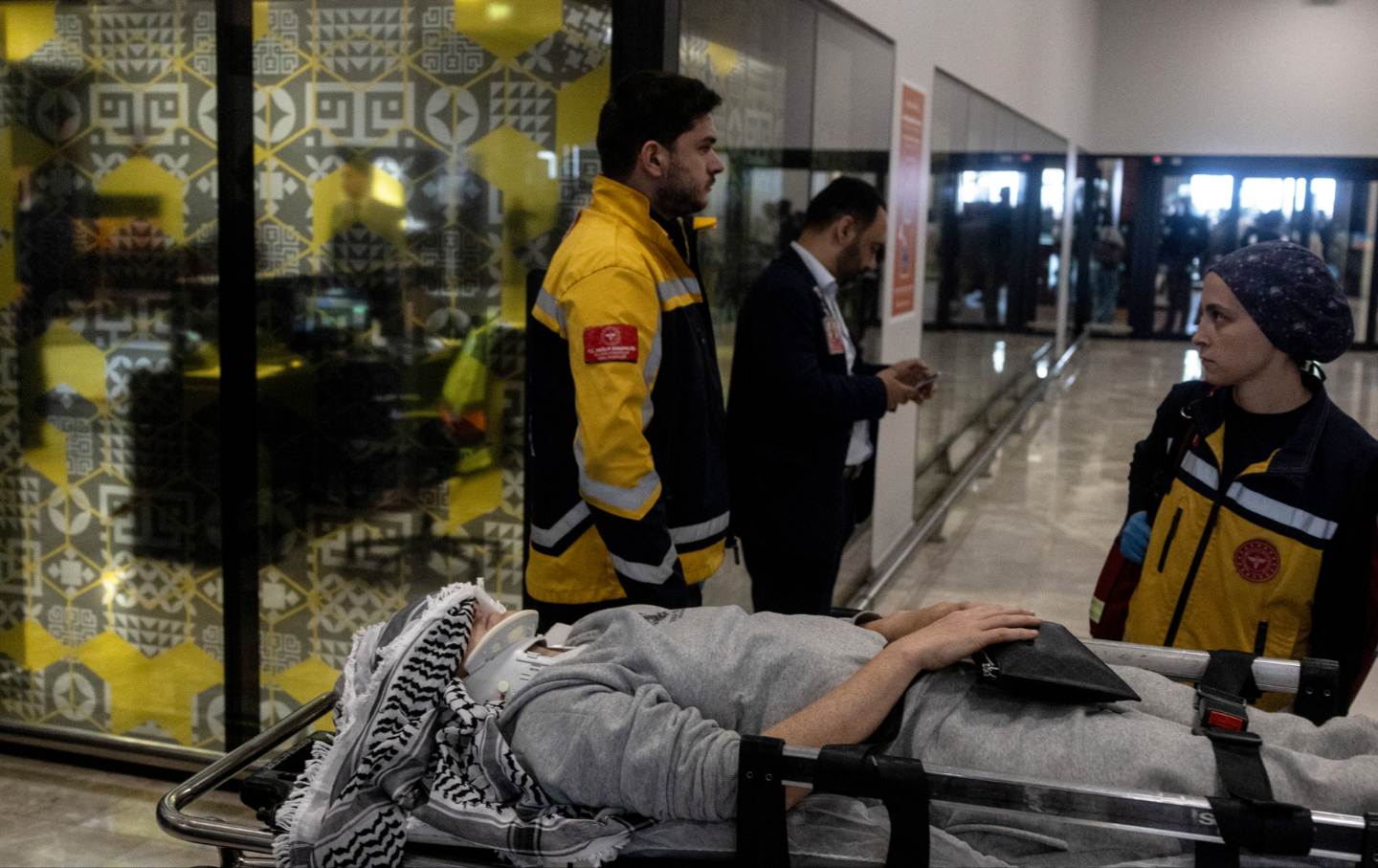
Multiple Gaza flotilla activists describe severe violence and psychological torment while in Israeli detention.
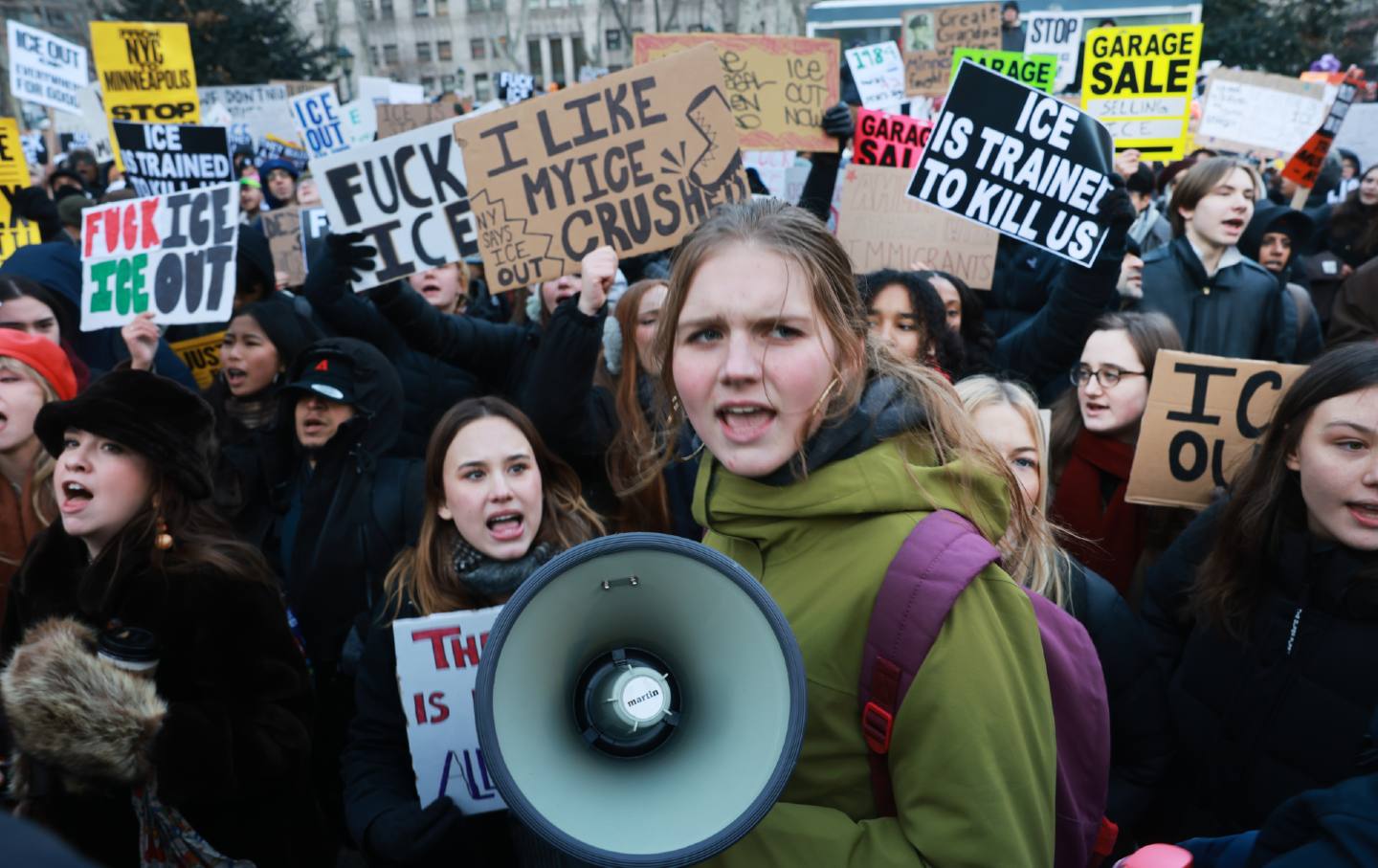
A controversial bill is proposing that NYPD create a plan for instituting anti-protest buffer zones around many NYC schools.
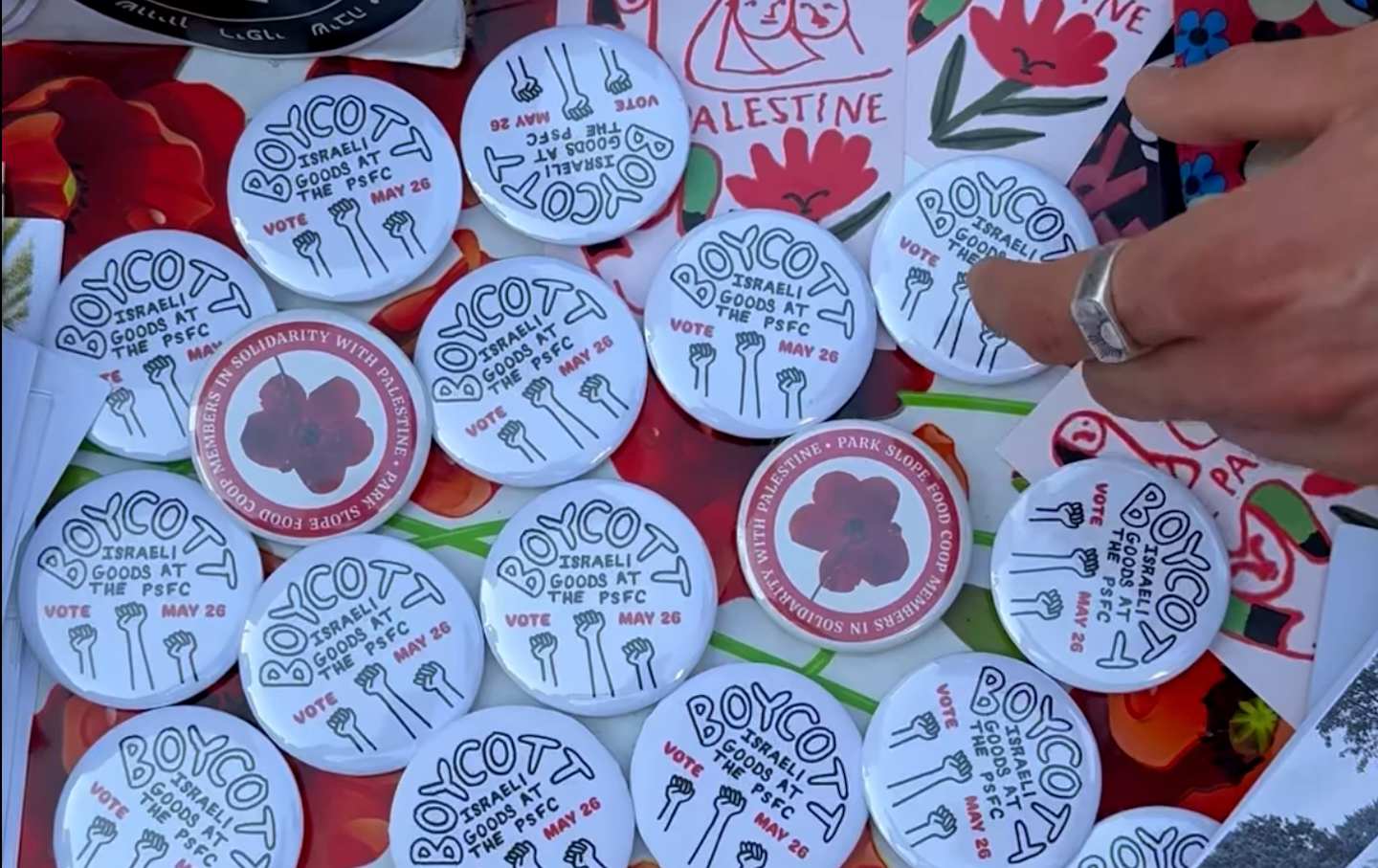
Organizers trying to get the iconic store to ban Israeli goods believe in the power of tangible collective action at a moment when doing so feels increasingly difficult.

As reproductive rights shrink nationwide, university students are building grassroots networks to get contraception to their peers.

Midwestern Nice… Today’s “Jewish Question”…