
Key Takeaways
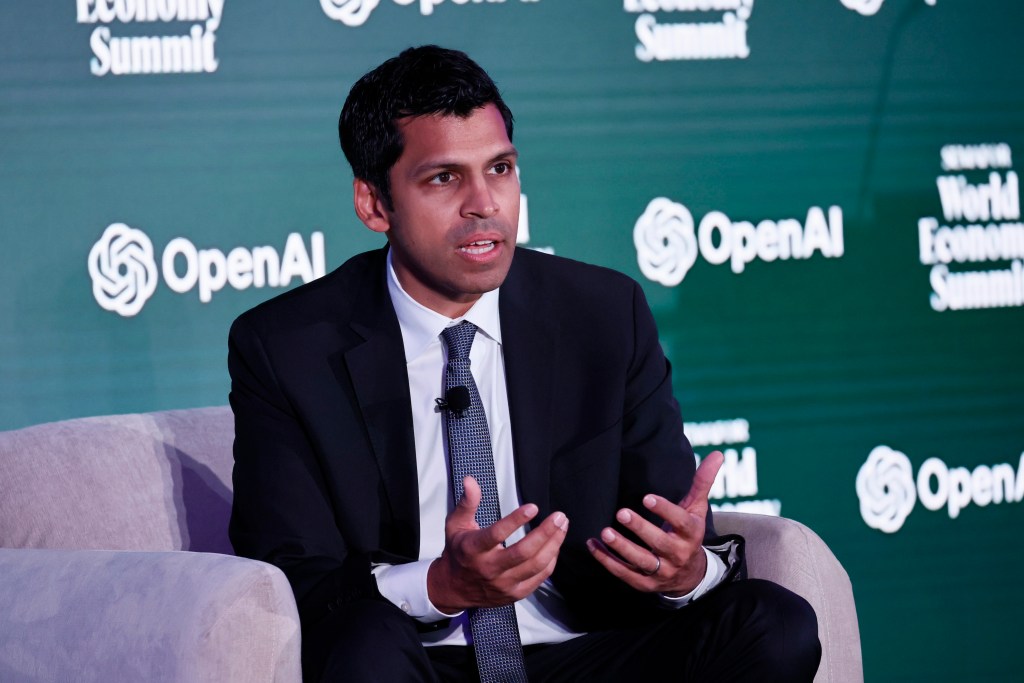
- OpenAI’s chief economist, Aaron “Ronnie” Chatterji, goes against traditional career advice.
- He says not to look at successful people’s resumes and not to try to replicate their success.
- In his words, a successful person’s resume often omits periods of failure and uncertainty.
Are you looking at the careers of successful people, trying to retrace each step they took to get to where they are? It’s a futile endeavor, says OpenAI’s chief economist Aaron “Ronnie” Chatterji.
Chatterji, who is also a distinguished professor at Duke University, said in a recent interview on the Summation podcast that job-seekers often study success in the hopes of making it their own. Conventional wisdom advises them to look at other people’s resumes and try to replicate their wins. This is “relatively bad advice,” Chatterji said.
“People often say something like ‘success leaves clues,’ meaning you should follow the paths of other successful people,” Chatterji said.
However, a successful person’s public resume often omits times of uncertainty, failure and hardship. It is the polished version of their history, not the most truthful. Economic moments shaped the choices they took; their success depended on the environment they lived in, he said.
“The path that they took whenever they took it was very context dependent,” Chatterji said. “Very rare to find someone self-aware enough to say, you know, the way I did it won’t work for you anymore. It won’t work for anybody.”
Silicon Valley success stories
When Chatterji spoke, he avoided singling anyone out, but the pattern is hard to miss. Many of Silicon Valley’s most recognizable leaders emerged alongside life-changing technological shifts, situating their success within broader trends.
For example, Mark Zuckerberg grew Facebook just as widespread Internet access pushed social networking into the mainstream. Meanwhile, Jeff Bezos built Amazon as ecommerce began to take off, and Sam Altman has steered OpenAI through the AI surge.
“We should use our heroes, our career heroes, our occupational heroes for inspiration but not step-by-step advice,” Chatterji said.
Skills to emphasize
As AI grows more popular, it requires workers to evaluate their skills. Chatterji said that coding, math, formal reasoning and AI skills will be vital in an AI-driven economy. He said that as AI absorbs a growing share of routine work, skills like sound judgment, adaptability and resilience will only grow in importance.
Other leaders emphasize skills like critical thinking. For example, JPMorgan Chase CEO Jamie Dimon said last year that AI taking over tasks “doesn’t mean that people won’t have other jobs.”
“Learn EQ [emotional quotient or emotional intelligence], learn how to be good in a meeting, how to communicate, how to write,” Dimon told Fox News’ Sunday Morning Futures. “You’ll have plenty of jobs.”
Meanwhile, Meta’s chief AI officer, Alexandr Wang, said last year that AI’s coding abilities were a game changer for him.
“It’s impossible to understate the degree to which I’ve been radicalized by AI coding,” Wang said on the TBPN podcast.
He said that teenagers should spend “all” of their time vibe-coding, or using AI to generate blocks of code from simple English prompts. He added that teenagers who spend “10,000 hours” getting familiar with AI coding tools have “a huge advantage.”
Key Takeaways
- OpenAI’s chief economist, Aaron “Ronnie” Chatterji, goes against traditional career advice.
- He says not to look at successful people’s resumes and not to try to replicate their success.
- In his words, a successful person’s resume often omits periods of failure and uncertainty.
Are you looking at the careers of successful people, trying to retrace each step they took to get to where they are? It’s a futile endeavor, says OpenAI’s chief economist Aaron “Ronnie” Chatterji.
Chatterji, who is also a distinguished professor at Duke University, said in a recent interview on the Summation podcast that job-seekers often study success in the hopes of making it their own. Conventional wisdom advises them to look at other people’s resumes and try to replicate their wins. This is “relatively bad advice,” Chatterji said.
“People often say something like ‘success leaves clues,’ meaning you should follow the paths of other successful people,” Chatterji said.