
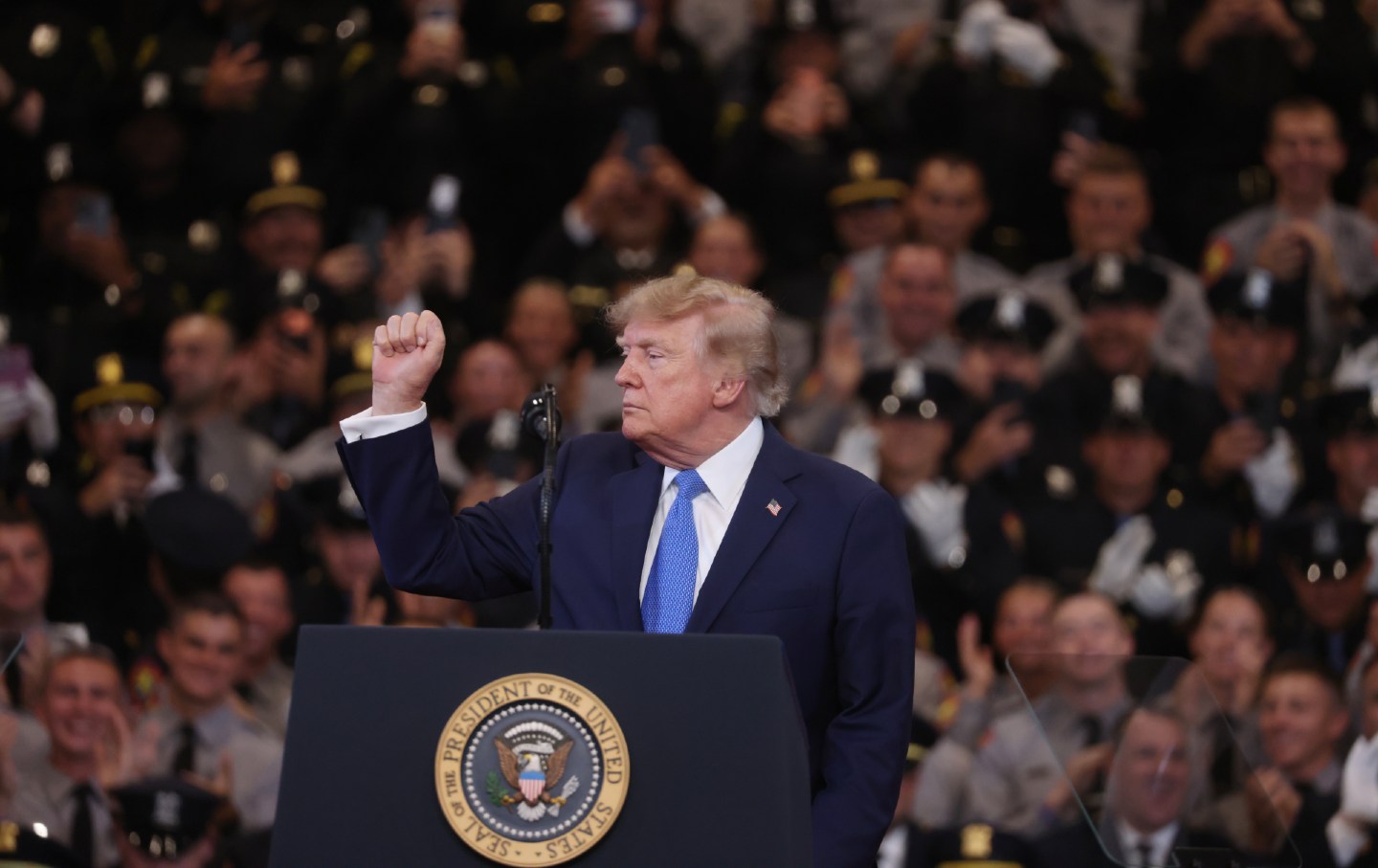
President Donald Trump speaks at the Nassau County Police Academy’s David S. Mack Center for Training and Intelligence in Garden City, New York, on August 14, 2026.
(Michael Nagle / Bloomberg via Getty Images)
In early 2024, as the presidential election season heated up and Donald Trump’s antidemocratic language intensified, two alumni of the Washington power structure began publishing a series of memos titled “Dancing in the Dark” in The Washington Spectator.
The authors were Mark Medish, an attorney who served as a special assistant to the president, a senior director at the National Security Council, and a deputy assistant to the secretary of the US Treasury under President Bill Clinton; and Joel McCleary, who was a deputy assistant to the president during the Carter administration.
In the lead-up to the 2024 election, Medish and McCleary published three long essays detailing ways in which Trump and the MAGA movement were corroding democratic norms. Then they went quiet. Two weeks ago, the duo re-emerged with an alarming new essay, “It’s the Power, Stupid: Dancing in the Dark, Part 4.”
The warnings in Medish and McCleary’s latest essay are stark. They center around the possibility that a cornered, wrathful Trump—enabled by supine leadership in the Justice Department, the Pentagon, and other key departments of government, as well as by GOP leadership in Congress—could declare a national emergency in the run-up to and aftermath of the midterm elections. Their fear is that, if he does so, he might then activate the highly secretive, Cold War era Presidential Emergency Action Documents (PEADs), authored to ensure continuity of the government following a nuclear attack, in an attempt to suspend the constitutional order.
Current Issue
PEADs exist outside of the regular legislative and legal framework of the country. Drafted by a series of White House lawyers from the Eisenhower presidency onward, they are, by definition, extra-constitutional. Congress isn’t looped in on their specifics; few attorneys within government, outside of a handful at the epicenter of White House power, are thought to have seen them; only a select few cabinet members, including the vice president, the defense secretary, the national security director, and the head of the CIA, are thought to have access to them; and those who do are forbidden to even acknowledge their existence. “They’re in a weird category of executive legal authority,” Medish told me. “The way to think about this is a set of contingency plans, in effect draft orders based on contingency scenarios—what should the president do in order to maintain continuity of government?”
Over the past several decades, according to those who have studied this shadowy world, the Department of Defense has spent billions of dollars out of secret, black-budget funds, building up an infrastructure to implement PEADs and other continuity-of-government measures should an emergency situation arise. Much of this was done, McCleary alleges, at the direction of Dick Cheney and Donald Rumsfeld during the War on Terror, although the mechanisms for mass incarceration of political dissidents were worked out earlier, especially during the Reagan administration, under an operational plan known as Rex 84, when national-security officials strategized how to respond should there be a mass uprising against US interventions in Latin America. Today, under the National Security Presidential Memorandum-7 (NSPM-7) directive, the FBI and other agencies, in conjunction with Big Tech and other purveyors of surveillance infrastructure, are investigating large numbers of political dissidents and critics.
“There’s a pretty firm belief that detention is strongly in these PEADs,” McCleary told me, choosing his words carefully. “This thing would move pretty quickly.”
As a result of their potential impact, these draft orders—at one point presumably kept under lock and key in the White House, nowadays probably maintained in highly secret digital files—have become as totemic and mysterious a symbol of presidential power as the nuclear football. He who has access to the nuclear codes can order the destruction of the world; he who has access to the PEADs—and can convince security forces that these PEADs are in fact genuine and legitimate and that orders to implement them should be followed even if they place the implementers in violation of the law—can order a sudden upending of America’s 250-year constitutional system of governance. In the hands of a man like Trump, facing a calamitous rejection from the electorate, such orders, if followed through on by law enforcement, security agents, and the military, could do untold damage to American democracy.
Popular
“swipe left below to view more authors”Swipe →
Both Medish and McCleary believe the warning signs are flashing red that Trump could attempt to subvert the mechanisms of, and confidence in, the midterm voting process over the next two months—what Medish called, in a Freedom Media Watch presentation this week, “pre-delegitimizing the election.” Then, if the Republicans still lose, they believe that between November and January Trump could attempt to prevent the counting of votes, order the seizure of ballot boxes, try to invoke the Insurrection Act, invoke “commander-in-chief powers” domestically, and, if all else fails, use PEADs in an effort to take control of the electoral process and stifle dissent. “It’s a question of connecting the dots,” Medish said to me. “This is the devil’s accordion.”
Medish and McCleary worry that Trump could use PEADs to attempt to silence critics in the media and other institutions and to order the detention of political opponents and those considered “terrorists” under the expansive language of NSPM-7. They are deeply concerned that the Department of Homeland Security and agencies such as ICE have built an incarceration infrastructure that could be flipped from being targeted at immigrants to also being used against the regime’s political opponents. “These are extreme scenarios,” Medish said. “But knowing all we know about this presidency, it would be naïve to completely discount extreme scenarios and desperate acts.”
At the Brennan Center for Justice’s Liberty and National Security Program, senior director Liza Goitein also thinks it possible that Trump will invoke a national emergency and then attempt to use that declaration to attack the election process. There are, she says, 137 provisions in federal laws that could be activated in the event of his declaring a national emergency in addition to the PEADs that exist outside the legislative framework. Goitein does, however, believe that the courts would intervene to strike down patently unconstitutional actions, even in the context of a declared national emergency. The Supreme Court could do this without weighing in on whether Trump was correct in declaring the emergency in the first place. That, she says, is how the Supreme Court has reacted in the four cases, including tariff implementation, in which Trump’s actions occurred within the context of a declared national emergency. In each of those cases, the Supreme Court ruled that the laws Trump was relying on didn’t in fact give him the powers that he was claiming. As a consequence, Goitein remains cautiously optimistic that, despite Trump’s best efforts, free and fair elections will take place in November, that “people who have a vested interest in defending democracy are ready to defend the legal right to vote,” and that courts will rapidly swat down moves to attack that right.
Medish and McCleary are far less confident that the courts will hold. They told me that they are penning these warnings now not to instill a sense of fatalism or despair, but so that a) politicians and elections officials can approach the coming months with eyes wide open; and b) the populace as a whole can more fully understand the stakes and how important it is to deliver Republicans an electoral defeat so large that it becomes politically impossible for the administration to activate PEADs or other emergency powers to do an end run around the GOP and Trump’s humiliation.
The public’s role in this is critical since Trump, Medish explained, could argue that in a national-emergency situation (defined largely by himself), he needs to activate previously unused executive powers to protect the homeland, “and to do that, he’s going to need to suspend statutes, due process rights, and so forth. It’s analogous to Lincoln and the suspension of habeas corpus.” At that point, worries Medish, all the power resides with the executive. “They basically say, ‘Sue me, take it to court,’” and the courts then spend so long deliberating over it that by the time judges reach decisions, the damage—in this case to the election process—has already been done. “The courts have a huge difficulty stopping executive action on national security in real time.”
And, Medish and McCleary say, if the courts can’t stop Trump and the GOP-led Congress won’t stop him, that places the burden on an aroused and enraged public to push back against Trump and his instincts to declare an emergency so as to preserve his hold on power. To vote as if the future of their democracy depends on it. And to be willing to protest, even to engage in civil disobedience, should Trump arrogate extraordinary powers to himself. “Look, we are in a difficult situation,” McCleary concluded. “People understand how dangerous it is, but they don’t understand all the elements of the danger.”