
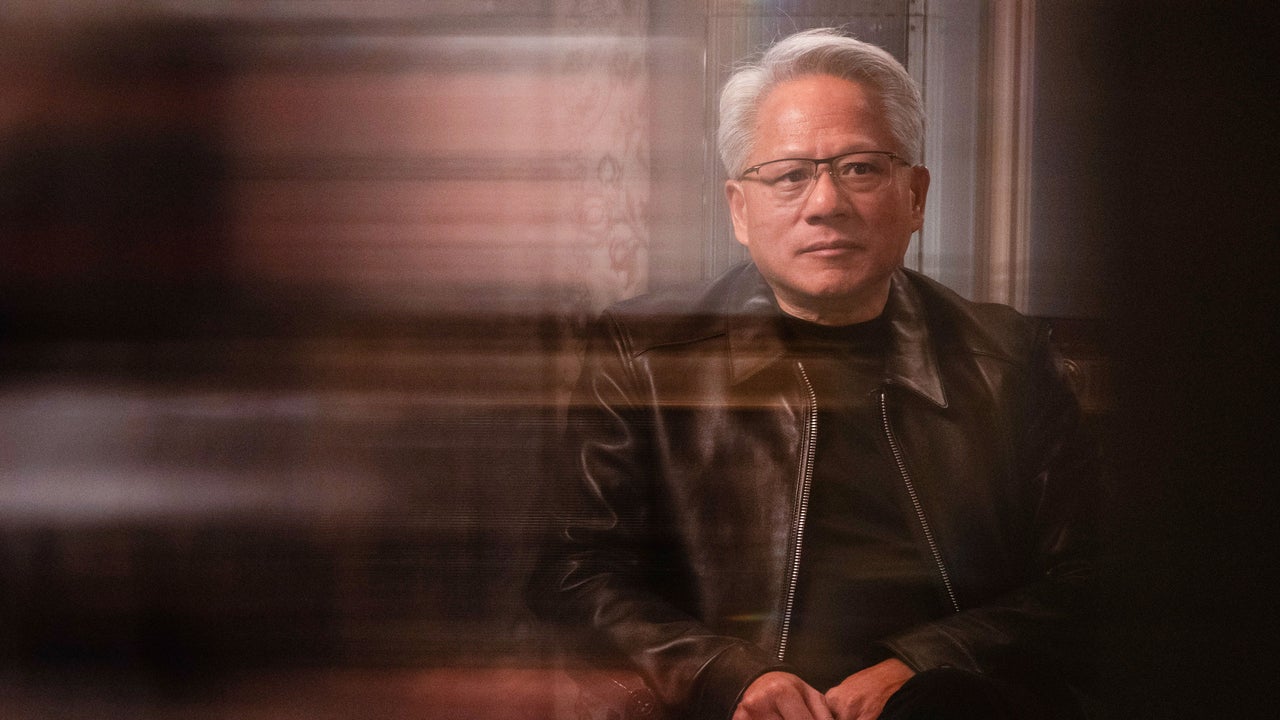
The scandal engulfing Nvidia CEO Jensen Huang is no longer simply a question of whether one of Silicon Valley’s most powerful men had an affair with a suspected Chinese spy. It’s also a question of what the White House knew—and what it might have chosen to overlook.
Huang and Nvidia confirmed the relationship Sunday, following a bombshell New York Times report. Alice Huang (no relation to Jensen)—the woman at the center of the revelations—is an executive at Singapore-based data center company Megaspeed, a major customer of Nvidia chips. U.S. intelligence surveillance reportedly showed that she had been funneling information directly to the Chinese government.
What remains unclear is how much sensitive information may have been compromised, what Huang knew about the woman he was seeing, and why U.S. intelligence officials apparently failed to warn him about her suspected ties to Beijing. The answers could prove deeply damaging to both Huang and the White House.
“It was pretty clear to a lot of people that [Jensen Huang] would be a target of Chinese intelligence collection,” given his proximity to President Donald Trump and his leadership of a company that is “central to the U.S.-China AI competition,” says Sam Bresnick, a research fellow at Georgetown University’s Center for Security and Emerging Technology.
Nvidia’s changing story
The admission of the affair also contradicts how Nvidia and Huang himself had previously characterized his ties to Alice Huang. As recently as October 29, company spokesperson John Rizzo described their interactions as routine business dealings, while Huang insisted they were “completely normal and not unusual.”
Huang now faces an investigation by Nvidia’s board, although directors said in a statement Sunday that they had “no reason to believe that either national security or Nvidia secrets were compromised” and expressed “confidence in Jensen and his leadership team.”
The board’s investigation may be the least of Huang’s worries. The powerful CEO faces the prospect of bipartisan congressional scrutiny, along with mounting questions about his influence in Washington and his future at Nvidia.
The questions Congress wants answered
Late last week, three House members—Republicans Brian Mast, John Moolenaar, and Eric Crawford—sent Huang a letter requesting that he attend a closed-door hearing on the matter in Washington, D.C. Asked by Fast Company on Monday whether Huang intends to attend, Nvidia declined to answer on the record. Next year, the new Democrat-controlled Congress will likely call a number of tech leaders, including Huang, to testify about their dealings with Trump.
On Monday, Senator Chris Coons of Delaware called for an investigation into Huang and Nvidia to determine whether national security had been compromised. “We need answers about the relationship between AI billionaires and the Trump administration,” he wrote on X. Coons is poised to chair the Senate Foreign Relations Committee when Democrats take control of Congress in January, giving him considerable power to pursue those answers.
There is certainly plenty to investigate. For one, we don’t know whether Alice Huang obtained sensitive information from Jensen Huang and transmitted it to the Chinese government. Bresnick says Huang and his devices may have been in possession of several types of valuable information, including trade secrets about upcoming Nvidia chips, the company’s research strategies, or U.S. government plans to restrict China’s access to advanced AI technology.
“Did he provide information to her about the Trump administration’s thinking on AI—U.S.-China competition, export controls, and trade policy more broadly?” Bresnick asks. “Because if [the Chinese] have greater texture on what the administration’s thinking, it’s easier for them to position themselves.” (The White House did not respond to Fast Company’s request for comment.)
It’s also unclear what Huang knew about the woman, and when. He certainly knew he was having an extramarital affair with an executive at a customer company, which violates Nvidia’s code of conduct. But we don’t know when he learned that she was a suspected spy.
What did the White House know?
Then there’s the question of when U.S. intelligence learned about Alice Huang’s activities.
According to the reporting, the U.S. government had known about her ties to Beijing for months. Bresnick finds it strange that intelligence officials apparently failed to warn the Nvidia CEO, given his close relationship with the president and his position atop a company developing some of the world’s most advanced AI technology. “The fact that this potentially could have been at risk” makes the apparent lack of intervention all the more puzzling, he says.
One possibility is that the White House prevented intelligence agencies from warning Huang about the suspected spy. After all, the Trump administration has compelling reasons to keep Huang and Nvidia out of the headlines.
The stock market’s strong performance has been a central selling point for the administration, and Nvidia is the crown jewel of the AI-related stocks that have driven much of its growth. AI and AI-related companies accounted for as much as half of the market’s gains this year, according to a new J.P. Morgan report.
The White House may have had an even more direct financial incentive. The federal government stands to collect revenue from Nvidia’s AI chip sales to China. Last year, Huang persuaded Trump to allow Nvidia to sell its H200 chips in China, provided the U.S. government received a 25% cut of the sales.
Huang also reportedly discussed selling Nvidia’s top-of-the-line Blackwell graphics processing units in China, but that proposal was ultimately shut down over national security concerns. In August 2025, Huang agreed to give the U.S. government a 15% cut in exchange for permission to sell the lower-performing H20 chip to China.
“Was the government hoping to get a bunch of money from these deals, from Chinese buyers getting access to these things?” Bresnick asks.
Nvidia’s influence comes under scrutiny
Alice Huang’s employer, Megaspeed, became an official Nvidia Cloud Partner in November 2023 and purchased more than $4.8 billion worth of Nvidia chips over roughly two years, according to the Associated Press. But the company was also under investigation by the U.S. Commerce Department over suspicions that it was funneling restricted AI chips to China.
A New York Times investigation last year found that Megaspeed’s offices in Singapore and Malaysia were largely empty, while many of its executives are based in China. Commerce Department officials who spoke to The Times even described finding boxes of restricted Nvidia chips in a Megaspeed facility in Malaysia.
On Monday, The Times reported that the Commerce Department’s investigation came to an abrupt halt last year after Nvidia’s general counsel, Tim Teter, contacted investigators seeking information about the case. Teter reportedly told them that Jeff Kessler, a senior Commerce official appointed by Trump, had given Nvidia permission to reach out. The communication alarmed investigators, some of whom worried that Kessler’s involvement had potentially compromised their work.
The case was subsequently transferred to the Justice Department, which is now conducting a criminal investigation into Megaspeed. Officials familiar with the matter told The Times the transfer was intended to prevent the investigation from being compromised.
There is no evidence that Kessler instructed investigators to share information with Nvidia, but the unusual circumstances of the transfer have raised questions about the company’s influence over the very officials responsible for policing its chip sales.
For Bresnick, the investigation also raises questions about how Megaspeed was able to acquire billions of dollars’ worth of advanced Nvidia chips despite suspicions about its operations. “We had no idea where those chips went,” he says.
Together, the revelations raise questions about whether Nvidia’s political influence complicated the government’s response to potential national security threats. This all comes at a politically sensitive moment: Corruption was a major factor in voters’ decisions in the midterms, and Nvidia now risks becoming entangled in a controversy that could damage its standing in Washington.
Despite Huang’s scandal, Creative Strategies chairman and longtime analyst Tim Bajarin suggests those calling for his ouster could meet serious opposition.
“Removal of Jensen would be a very difficult decision because he is the heart and soul of Nvidia,” Bajarin says. “I have met with Jensen many times over the years, and he was always the smartest guy in the room. More importantly, he has the global vision for Nvidia’s future and needs to be the one driving their future.”