
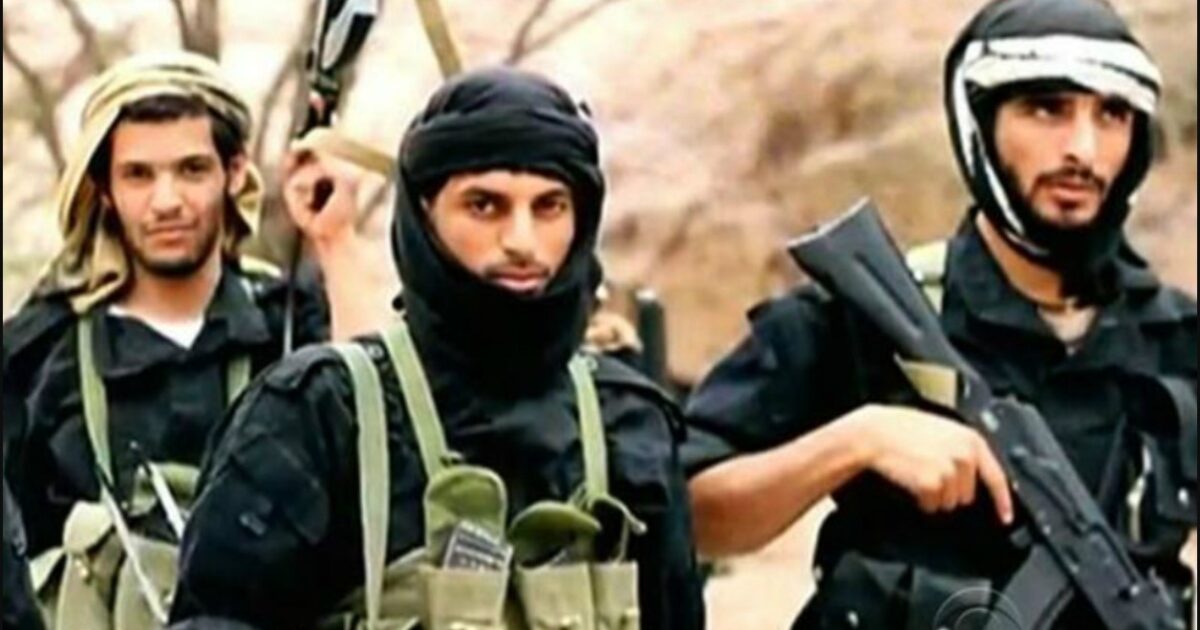
The September 11, 2001, attacks on the World Trade Center and the Pentagon remain the single largest terrorist attack on U.S. soil. In response, the U.S. launched the War on Terror. Since that time, apologists for Islamic terrorism have consistently maintained that Islamic extremism exists as a reaction to the botched U.S. War on Terror. Of course, the opposite is true, and Islamic extremism predates the War on Terror by decades.
Furthermore, regarding the allegedly botched War on Terror, you could certainly point to failings and shortcomings, but the war against ISIS stopped the caliphate, which had grown across and consumed tens of thousands of square miles of territory across Iraq and Syria. And as for claims of the War on Terror being motivated by Islamophobia or racism, the vast majority of people killed by ISIS and freed from its control by the U.S. were Muslim.
In the First Gulf War, the U.S. liberated Kuwait, a Muslim nation. Furthermore, U.S. allies in the War on Terror and in the fight against ISIS and Iranian proxies have included Muslims, including Kurds from Iraq and Syria, as well as Arabs from Saudi Arabia, the UAE, and other nations.
Groups carrying out mass-casualty attacks against civilians, soldiers, and Western targets in the name of Islamist ideology were active for nearly three decades before 2001. In 1970, the Marxist-Leninist Popular Front for the Liberation of Palestine hijacked four airliners in the Dawson’s Field hijackings, blowing up three of them after evacuating the hostages.
A Fatah/PLO offshoot, Black September, took the Israeli team hostage at the 1972 Munich Olympics, killing 11 athletes and coaches. Egyptian President Anwar Sadat was assassinated on October 6, 1981, during a military parade in Cairo, when members of Egyptian Islamic Jihad opened fire on his reviewing stand. And in 1983, 241 U.S. service members were killed when a Hezbollah suicide bomber drove an explosives-laden truck into their barracks at Beirut International Airport.
Osama bin Laden had already declared war on the United States in writing three years before 9/11. Al-Qaeda itself was founded in 1988 by Osama bin Laden and Abdullah Azzam at the close of the Soviet-Afghan War. Before 9/11, the group carried out the 1998 U.S. embassy bombings in Kenya and Tanzania and the 2000 USS Cole bombing in Yemen, and issued a 1998 fatwa formally declaring war on the United States.
Hezbollah was established in Lebanon in 1982 during the Lebanese Civil War with direct support from Iran’s Islamic Revolutionary Guard Corps. The group carried out the 1992 and 1994 bombings in Buenos Aires and, through its Saudi wing, the 1996 Khobar Towers bombing in Saudi Arabia, which killed 19 U.S. airmen and was tied by U.S. investigators to Iranian direction.
Egypt produced two of the era’s most consequential groups. Egyptian Islamic Jihad, founded in 1979 by Muhammad ‘Abd al-Salam Farraj and later led by Ayman al-Zawahiri, assassinated President Anwar Sadat in 1981 and bombed Egypt’s embassy in Islamabad in 1995, killing 17.
The group formed a funding alliance with al-Qaeda in 1998 and fully merged with it in June 2001. Al-Gama’a al-Islamiyya, the Islamic Group, formed in Egyptian universities in the 1970s and carried out the 1997 Luxor massacre, killing 62 people, most of them foreign tourists, the deadliest of a string of attacks on tourists in Egypt through the mid-1990s.
Hamas, founded in December 1987 by Sheik Ahmed Yassin as the Muslim Brotherhood’s political arm in Gaza at the onset of the First Intifada, ran a sustained campaign of suicide bombings against Israeli military and civilian targets through the 1990s. Palestinian Islamic Jihad, founded in Gaza in 1981 by Fathi Shaqaqi and influenced by the 1979 Iranian Revolution, carried out its own armed attacks and suicide bombings against Israeli targets across the 1980s and 1990s.
Elsewhere, the Armed Islamic Group of Algeria, formed in 1992 during the Algerian Civil War, was responsible for civilian massacres across Algeria, the 1994 hijacking of Air France Flight 8969, and a series of 1995 bombings in Paris.
In the southern Philippines, the Abu Sayyaf Group, founded in 1991 by Abdurajak Abubakar Janjalani with early funding ties to the nascent al-Qaeda network, carried out bombings, mass kidnappings, and executions across the Philippines and Malaysia through the 1990s.
In South Asia, Harkat-ul-Mujahideen, formed in 1985 during the Soviet-Afghan War before shifting its focus to Kashmir, hijacked Indian Airlines Flight 814 in 1999. And in Southeast Asia, Jemaah Islamiyah, established in 1993 by Abu Bakar Bashir and Abdullah Sungkar, carried out a coordinated series of church bombings across Indonesia on Christmas Eve 2000, killing 18-19 people. Members of the same network helped plan a related bombing campaign against transit and public targets in Metro Manila six days later that killed 22. Jemaah Islamiyah went on to build the operational network behind the 2002 Bali bombings.
A claim often made in defense of Islamic extremism is that all religions and countries have some form of terrorism, and that Americans who support strict counterterrorism measures, including stricter immigration laws, are cherry-picking data to make Islamists look more dangerous while ignoring other groups because they are white or Christian. However, the data supports the claim that Islamists are dangerous and should be a concern. Today, 9 of the world’s 10 deadliest terrorist organizations, per the Global Terrorism Index, are Islamist.
Islamic State core remains active in Syria and Iraq as a decentralized global network; its territorial caliphate has shrunk, but it continues to direct and inspire regional affiliates across Western Asia, Africa, and Central and South Asia. Those affiliates now span the globe. In West Africa’s Lake Chad Basin, Islamic State West Africa Province focuses on military bases, government forces, and rural civilians, operating alongside Boko Haram, which relies on village raids, mass abductions, and suicide bombings across northeast Nigeria, Cameroon, Chad, and Niger.
In Afghanistan, Pakistan, and Central Asia, Islamic State Khorasan Province, formed in 2014 by defectors from the Pakistani Taliban, al-Qaeda, and the Afghan Taliban, targets state actors, religious minorities, and Western interests.
In the eastern Democratic Republic of the Congo and Uganda, the Allied Democratic Forces, designated by the State Department as ISIS-DRC, has killed thousands of civilians since 2014 in attacks on churches, health clinics, and transit routes. And in northern Mozambique’s Cabo Delgado province, ISIS-Mozambique, also known as Ansar al-Sunna, has killed more than 1,300 civilians and displaced nearly 670,000 people since 2017, targeting gas infrastructure, security forces, and local communities.
Al-Qaeda’s own regional network runs in parallel. In the Central Sahel, Burkina Faso, Mali, and Niger, Jama’at Nusrat al-Islam wal-Muslimin (JNIM) is the primary al-Qaeda-aligned coalition.
In Somalia and Kenya, al-Shabaab is al-Qaeda’s Horn of Africa branch, holding rural territory while conducting complex urban strikes and cross-border raids. Al-Qaeda in the Arabian Peninsula operates out of Yemen, ambushing security units and planning external operations, while Al-Qaeda in the Islamic Maghreb serves as the parent organization for several West African jihadist factions across North Africa and the western Sahel.
Supporting counterterrorism and stricter border protection is often called “Islamophobic,” but a phobia is an irrational fear. By contrast, fear of allowing extremists into the country is completely rational.
Ad block users: Some site features may not work correctly while an ad blocker is enabled, because they break scripts and content this website depends on. If you can’t see comments below, for example, please disable your ad blocker.