
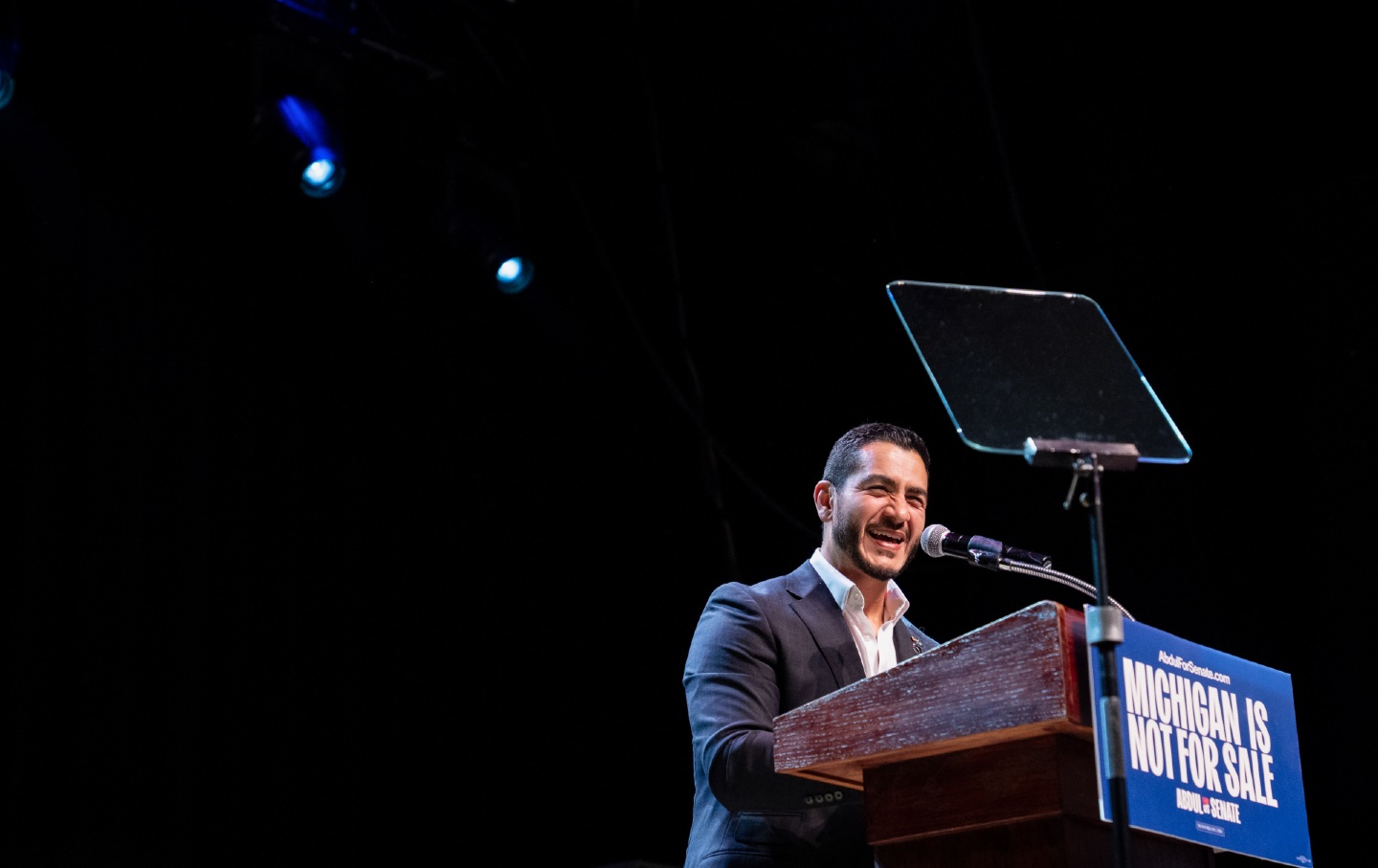
Dark money has been flooding into Democratic primaries, from the pop-up super PACs swamping Illinois House races this spring to outside spending groups funneling tens of millions into Michigan’s Senate primary.
Now Democratic National Committee Chair Ken Martin says the DNC is on the verge of adopting a plan to eliminate anonymous spending and unlimited corporate money in a high-profile contest it controls: the 2028 presidential primary.
Martin, who was elected as chair with a groundswell of support from state parties, moved forward last year with a process to craft new rules for the party’s White House hopefuls. But the plan—which Martin did not present to DNC members this summer, as originally scheduled—is still being debated behind closed doors inside the national party, even as 2028 White House hopefuls get ready to announce.
In August 2025, in a breakthrough step, Martin proposed a resolution to DNC members that the party was “committed to eliminating unlimited corporate and dark money in our presidential nominating process beginning in the current 2028 cycle.” It directed the party to develop “real, enforceable steps the DNC can take” to curb super PAC influence and independent expenditures in the presidential primary. The resolution was passed unanimously by the DNC Resolutions Committee and by the full DNC of around 450 members.
For over a decade, progressives and Democratic reformers have advocated for rules changes that would aim to reorient primaries around voters and party-building, curbing deep-pocketed outside spending groups from unloading cash to back their favored candidates. The DNC’s plan would be limited to its presidential primary—it would not apply to candidates backed by independent expenditures in congressional races or general elections. Recognizing that the Supreme Court has defended unlimited outside spending in elections, the resolution called for broader campaign finance reforms to undo what it called the “disastrous” Citizens United decision.
The text of the Resolution on Integrity in the Financing of Our Presidential Primary Elections directed a new DNC reform body “to produce a report on this matter to the full DNC by its summer meeting in 2026.” The resulting DNC Task Force on Reforms debated and produced what it calls a set of recommendations that were delivered to Martin in late June, according to the panel’s co-chairs and several members involved who spoke with The Nation.
Current Issue

But the task force’s recommendations were not presented at the DNC’s August 13–15 summer meeting in Austin—because, a DNC official said, other panels inside the national party were still weighing in on the proposal. The official told The Nation that despite the 2025 resolution’s instruction for a report to be adopted at the summer meeting, that timeline was just aspirational, and that the task force’s recommendations were not binding. They referred to its assignment as “brainstorming” rather than drafting a formal resolution for the full DNC membership to approve.
“I have made my position on this clear from day one as chair: We must end the influence of dark money in our politics and restore power back to the people,” Martin said in a statement to The Nation. “The Democratic Party has fought and will keep fighting to get dark money out of politics through Congress and in court, but the DNC isn’t standing idly by in the meantime. That’s why I introduced a resolution in 2025 instructing the DNC to explore other options to rein in corporate and dark money in Democratic presidential primaries. That important work is ongoing, but will be completed in the coming months.”
The DNC official would not comment on the process for the plan to be adopted or the task force’s recommendations to Martin, pointing to ongoing discussions inside the party over the rules changes. Candidates readying for the 2028 presidential primary would receive an update before announcing in the months ahead, the official said.
As described by its members, the task force’s recommendations would require Democratic presidential candidates to disavow independent expenditures in the primary, among other steps—signing a version of the “People’s Pledge” that has been agreed to by candidates in past election cycles like the 2012 Massachusetts Senate race, and that several Democratic candidates joined again this cycle. Since mid-2025, four state Democratic parties—Arizona, North Carolina, New Mexico, and recently Massachusetts—have adopted resolutions committing to developing and implementing versions of the People’s Pledge, ensuring that democratic deliberation is not drowned out by super PAC cash.
“Progressives made cracking down on billionaire super PAC money part of our New Affordability Agenda, and we’ll keep leading the fight to overturn Citizens United. Until then, the DNC can and should lead by example in our own presidential primary,” Texas Democratic Representative Greg Casar, chair of the Congressional Progressive Caucus, told The Nation.
“In March, I joined my fellow co-chairs of the Congressional Progressive Caucus PAC in calling on the DNC to approve strong reforms at its August meeting. That deadline passed,” Casar said. With co-chairs Representatives Pramila Jayapal (WA) and Maxwell Frost (FL), the CPC emphatically cheered on the DNC’s reform effort earlier this year and called on more state parties to follow suit to curb the targeting of voters by “misleading ‘shell PACs’” and billionaire-funded vehicles. “Ken Martin says the work will be done in the coming months, and I want to see him finish the job. Voters deserve to see the rules for 2028 before the race begins, so the DNC should follow through on the task force’s recommendations and make them public before any candidate announces,” Casar said.
The task force’s recommendations were not made available by the DNC, and other approving bodies inside the party were not named—so questions remain as to how forcefully the new rules would be applied to candidates in the presidential primary, where the DNC governs events like the debate stage and access to party resources like the voter file. “A super PAC money rule only matters if it’s enforced,” Casar said. “The DNC should say exactly how it will enforce this and what happens to a campaign that breaks it. And if a campaign does break it, the DNC has to act.”
Undisclosed and unchecked election spending is running rampant: Dark money in federal races hit a record high in the 2024 cycle of more than $1.9 billion, according to the nonpartisan Brennan Center, and in this cycle secret money continues to pour into super PACs battling over control of Congress. Corporations had already blown past $517 million in 2026 midterms spending through the first quarter of this year, nearly triple the amount spent in the entire 2022 midterms cycle, according to Public Citizen. This cycle, the cryptocurrency and AI industries continued shelling out huge sums to target messages to Democratic voters and champion their favorites, much of it supporting centrists and opposing progressives. Lobbying groups like the American Israel Public Affairs Committee increasingly routed super PAC spending through pop-up PACs with anodyne-sounding names—as in several House races in Illinois, featuring PACs like Affordable Chicago Now!—that obscured the true source of funding until after voters had cast their ballots.
This cycle also saw the Democratic congressional primary with the largest-ever amount of super PAC spending: the Michigan Senate primary that came down to progressive Abdul El-Sayed against establishment-backed moderate Representative Haley Stevens. Outside groups poured at least $58.6 million into independent expenditures, according to a review of Federal Election Commission data through the primary election day—not counting millions more in ad buys from nonprofits that don’t report all of their spending to the FEC. In some Democratic races, super PAC spending is replacing spending by campaigns themselves.
“A Pervasive and Destructive Problem”
The 15-member Task Force on Reforms, co-chaired by New York Senator James Skoufis and Kansas Democratic Party chair Jeanna Repass, was announced to DNC members in November 2025 alongside other bodies working on technology, messaging, and meeting accessibility.
Popular
“swipe left below to view more authors”Swipe →
“We spent upwards of five months on this issue over the course of close to a dozen meetings, and we did issue our ideas and our recommendations by the stated deadline,” Skoufis said. “Now chair Martin and his team at the DNC are digging into those ideas and those recommendations. The true deadline is that we want to get our approach to dark money out into the world and in effect before the first presidential candidates are announcing their campaigns.”
Skoufis said the panel undertook a creative process of drafting rules to discourage independent expenditures around presidential candidates, which are allowed under campaign finance laws, but can be tagged by the DNC with penalties for participating candidates who benefit and don’t take quick steps to reject the spending. “We had to examine what ways were available to us by which we can disincentivize, and ultimately address, this very significant negative issue that we’ve seen play out in primary after primary,” he said. Co-chair Repass joined in emphasizing that the task force, under Martin, was focused on ensuring the integrity and fairness of the 2028 process.
The presence of independent expenditures “has become a more pervasive and destructive problem within our democratic process and within our primaries,” Skoufis said. “It’s our expectation that the DNC is going to move forward in a very aggressive way to tackle this issue in the presidential primary.”
Larry Cohen, a longtime DNC reformer who participated on the task force, said, “Having worked on getting super PACs out of our primaries for years, it was great to see Ken Martin lead on this at every step, from his campaign for chair to authoring the DNC resolution that mandated the party reform task force.”
“As a task force member, I am satisfied with our recommended actions, and remain confident that chair Martin will soon announce the implementation plan,” Cohen, chair of the progressive group Our Revolution, said. “It is hypocritical for Democrats to talk about repealing Citizens United, facing enormous odds for years to come, and not take dramatic action ourselves so that voters determine our nominees, and not the billionaires and corporations that fund the super PACs.”
James Zogby, another decades-long DNC reformer who was on the task force, said the body extensively discussed options for placing rules around independent expenditures. “There were ideas about what would be possible if a candidate didn’t sign the pledge,” Zogby said, “and that’s a sticky issue. But you also want to make sure that there is a broad consensus—not just in the party but nationally—that dark money is ruining our politics. It is taking decision-making away from voters and putting it in the hands of folks who will spend an unseemly amount of money that will not be attributed to them because it’s not reportable, and they’ll end up skewing the process.”
Zogby praised the process of crafting mechanisms to enforce the independent expenditure rules—while mentioning that the resolution does not go as far as he has sought toward banning dark money in all Democratic primaries. “This is important,” he said. “This is limited to presidential primaries, but it’s a good start.” An April letter from Senator Bernie Sanders to party leaders, calling for a ban on billionaire- and corporate-backed super PACs in Democratic primaries across the board, was joined by five Democratic senators, including Tina Smith (MN) and Chris Van Hollen (MD), most of the members of the Senate “Fight Club” that formed to challenge the corporate-tied orthodoxy of candidates recruited by Democratic leadership.
Zogby said that Martin’s reform measure was surely facing resistance from the DNC’s consultant class. “There are people who are wary of the fact that he’s sending so much money to states and not to consultant groups,” he said. “They end up doing stuff that the party used to: Consultants pay to get canvassers when you ought to be empowering the state parties to fill the ranks of precinct captains and committee people,” Zogby said.
“It’s an existential crisis: Is there going to be a party or are there going to be super PACs?”
More from The Nation
Allegations of gang rape and sex trafficking at Cornell University highlight persistent concerns about rape culture, even years after the #MeToo movement.
Candidates in 2026 are responding to an electorate that’s ready to abolish ICE, tax the billionaire class, and free Palestine.
In livestreaming Nidal Hasan’s execution, the secretary of war is marking his territory in the snuff movie business—and radicalizing people along the way.
But that doesn’t mean the danger from Musk’s lies is over.

Hispanic Heritage Month celebrates Latino culture and pride while prompting reflection on Columbus Day and Indigenous recognition.