
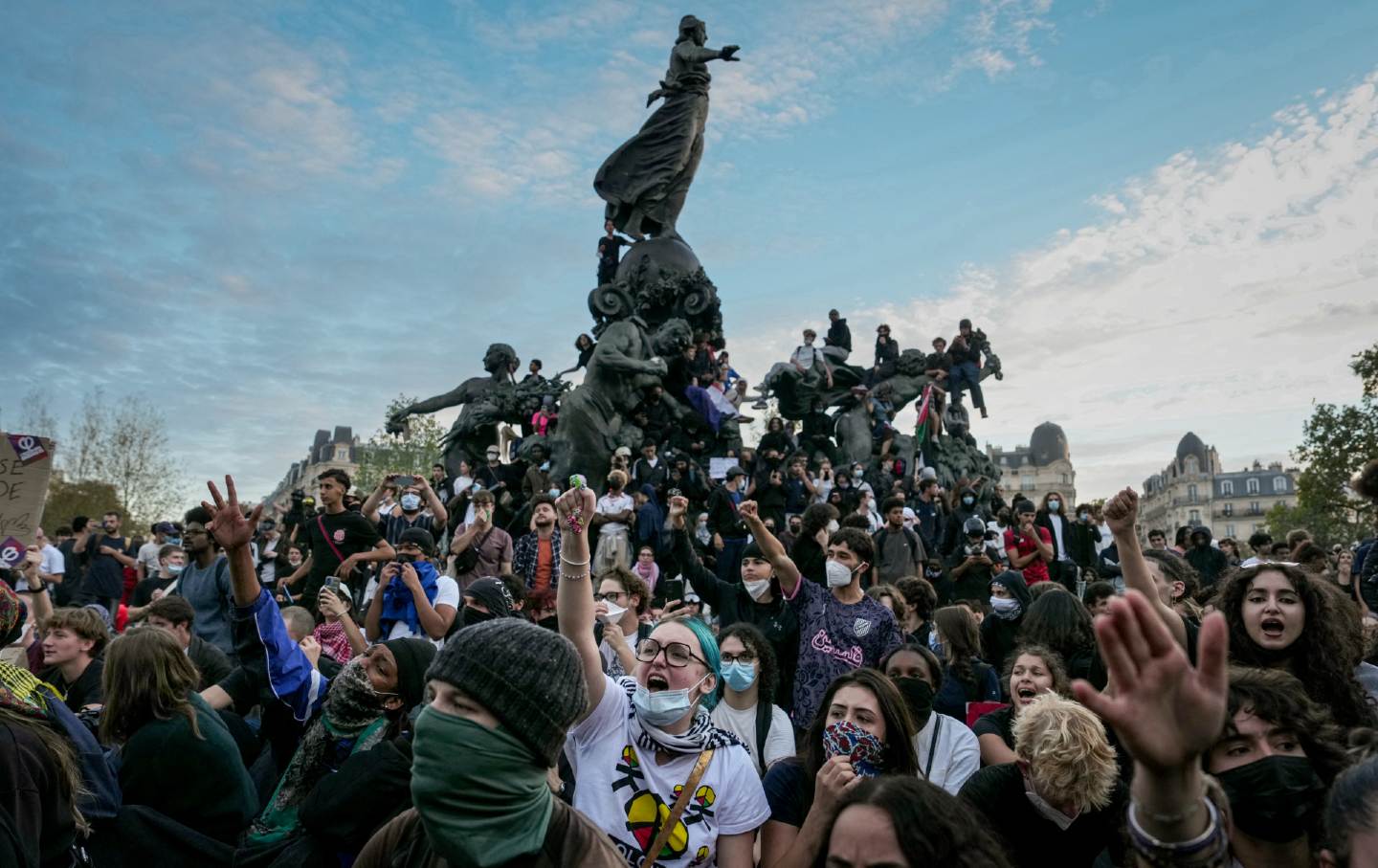
Without full-time teachers, temperature-regulated classrooms, or school nurses, French students are turning their grievances into a national movement.
People gather on and around the statue in the center of the Place de la République at the end of a demonstration part of a nationwide day of actions called by high-school students who have been demanding better learning conditions in protests punctuated by violent confrontations in Paris.
(Dimitar Dilkoff / AFP via Getty Images)
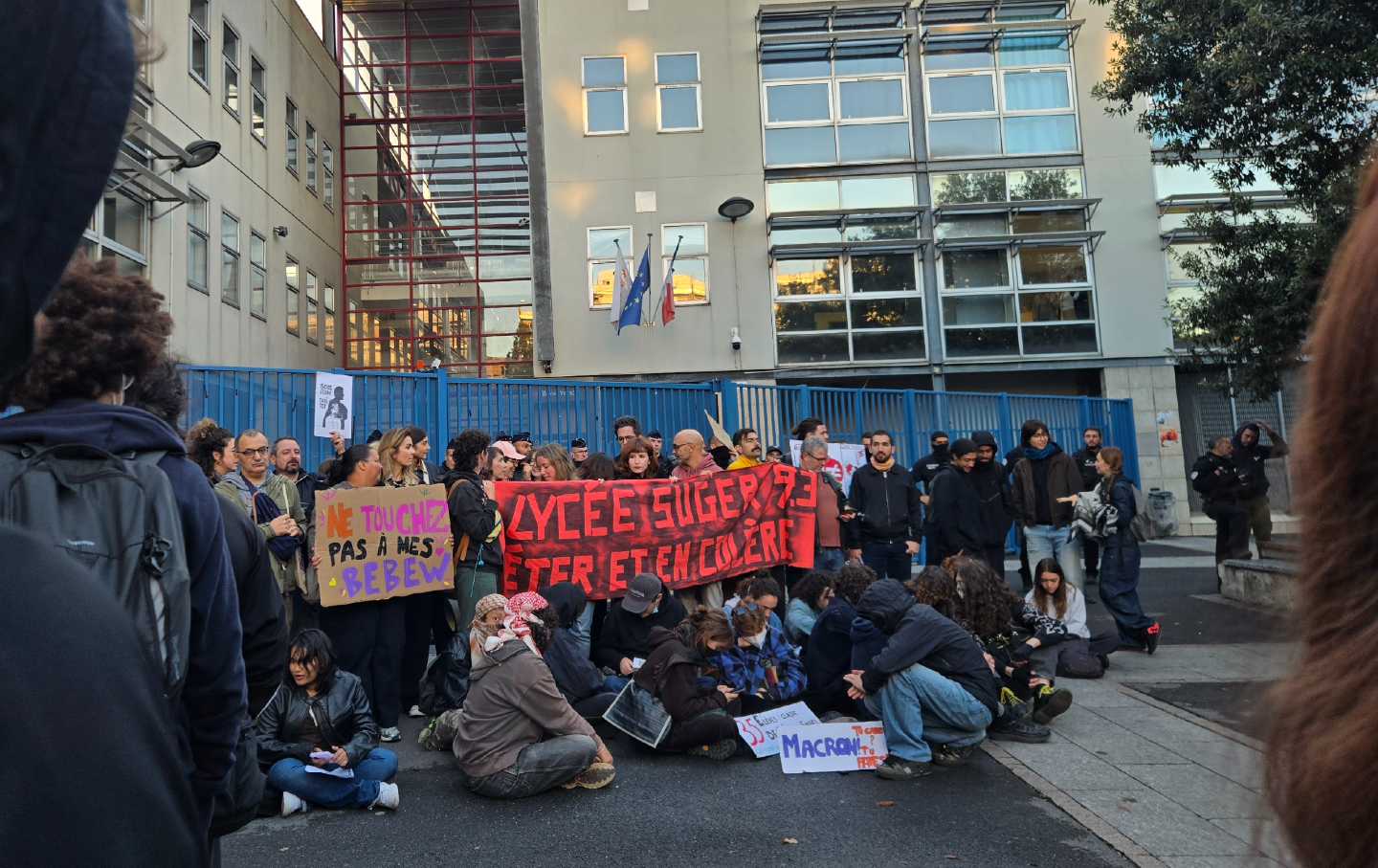
Around 7:30 am on Thursday, October 8, the students of Lycée Suger in Saint-Denis, France, arrived at the gates of a school that would remain closed all day. Clad in sweatshirts and rubbing their arms against the autumn morning chill, they sat down on the pavement before their teachers who held a large red banner reading: “Suger High School 93, Determined and Angry.” Across France, this same scene could be found in more than one thousand other high schools over the course of the week: high schoolers protesting, demanding better resources for the sake of their futures.
The most recent wave of mobilizations began at Lycée Saint-Exupéry, a high school 40 minutes southwest of central Paris. On September 21, students and professors gathered outside the school to demand increased staffing, fed up from absences that had left students without professors for months during the past school year. Within the week, the school was sent extra staff. Their protest ended.
Other schools quickly took note of their success and began their own mobilizations, most notably in the Parisian suburb of Seine-Saint-Denis, which holds the largest proportion of youth and the lowest average income of any French department. These students are demanding the replacement of absent teachers, better school infrastructure (such as heating in the winter), smaller class sizes, shorter school days, and an overhaul of the online French college application system, known as Parcoursup.
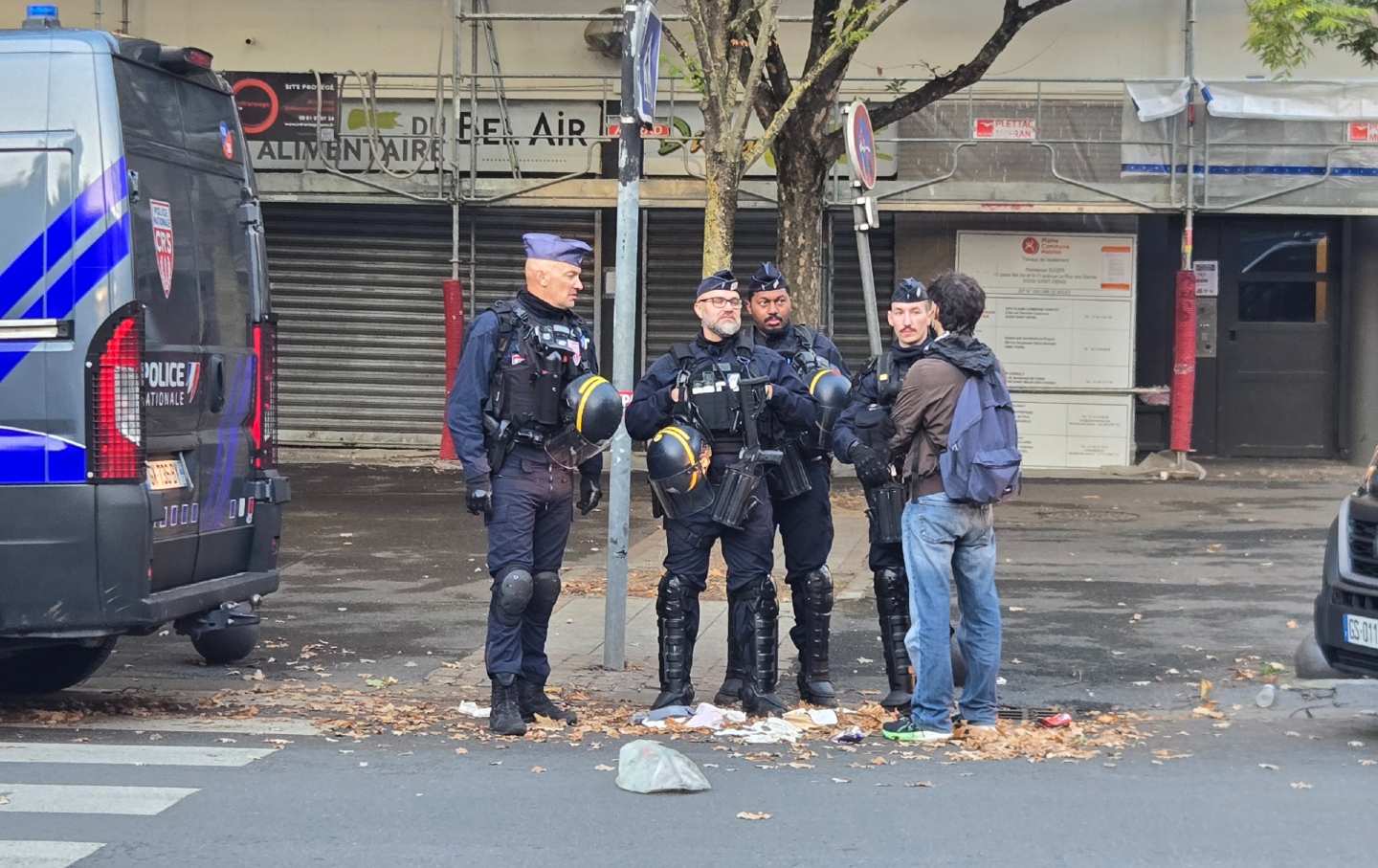
Since the protests began, nearly 7,000 people have been taken into custody, 86 percent of those being minors, and a third of which are now facing charges. Yet, beyond these numbers, it is the images of police brutality and violence against students that has shocked the country. On October 5, a 15-year old in the North of France lost his hand to a stun grenade. In suburbs northwest of Paris, a 14-year old lost teeth and suffered a fractured jaw when an officer threw a tear gas grenade at his face. In Tours, a 16-year-old lost the use of his right eye to what local prosecutors suspect to have been a “defensive blast ball bullet.”
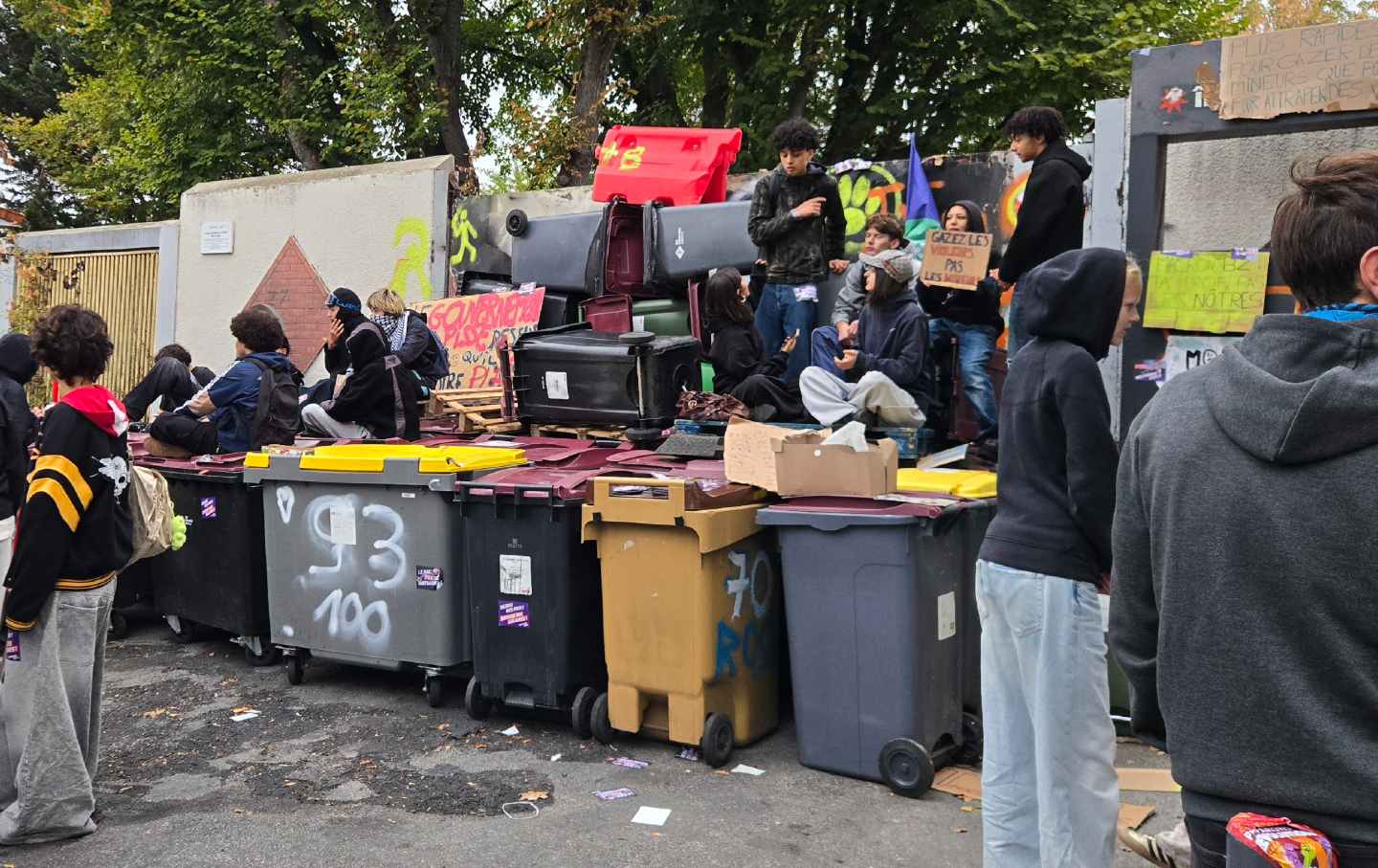
In the Parisian suburb of Montreuil, the students of Lycée Jean Juarès began their mobilization on September 29 and ended up blockading the school the whole week.
Current Issue
“It’s been a long while that things have not been going well with French education,” said 15-year-old Elsa. “I remember in middle school we had a protest because they wanted to eliminate classes.… Last year we had a protest for basically the same reasons. So really it dates back a long time.”
Indeed, the degradation of secondary education quality has been a long-term process. While spending on education has doubled, staffing recruitment and infrastructure has not kept up. In the past school year, nearly 10 percent of teaching hours went un-taught, largely because of non-replacement of teachers.
“I didn’t have professors in technology or German for a long time,” Thimothée, a 16-year-old student at Lycée Juan Juarès explained, “It happens every year, even in essential subjects. You know people who haven’t had a French or philosophy teacher, even though they have to pass their BAC [French national exam] at the end of the year.”
On top of teaching absences, schools are lacking nurses. Seventeen-year-old Ether of Lycée Suger explained how this issue came to a head in her class last year, a moment that inspired her to push for a student strike.
“A girl in my class passed out in the bathroom during an exam. No one was there to help her. And that’s how I realized there hadn’t been a [full-time] nurse in two years.”
Many schools’ physical infrastructure is also in deep disrepair; roughly 20 percent of schools are considered to be in “significantly degraded” conditions, according to Reuters. Additionally, a survey launched by the education worker’s union found that 95 percent of staff reported specifically suffering from elevated temperatures specifically linked to poor ventilation and lack of air conditioning.
Siane, a 17-year-old student of Lycée Suger confirmed these conditions at her school.
“Building A does not have heating, air conditioning, nothing. And there are broken windows. Building B, in fact, is overheated.”
Popular
“swipe left below to view more authors”Swipe →
Ether, explained the effects this had.
“It’s to the point where we sweat constantly. It’s not normal. It makes us sick.… We had to do our final exams in 36° (96.8° F). That’s not feasible.”
Taken together, these experiences can perhaps help explain the performance of French students on the international level. According to the Organisation for Economic Co-operation and Development, reading and math scores in the Programme for International Student Assessment (PISA) of 15-year-olds have fallen faster than the OECD average since 2015. The students are well aware of these numbers, and highlight them in their demands.
“They place all our budget on other things while we, and they, say that we are the future.… We are constantly reminded of the importance of the PISA placement. But if you don’t put anyone in front of us (in the classroom), how can we fix this?” said Elsa.
The question of the budget is central to the mobilization. On October 1, Prime Minister Sébastien Lecornu presented the proposed budget of 2027 featuring cuts, increased taxes, and frozen wages in the public sector, all in service of reducing the national debt. As this budget enters a period of debate, which will last until next spring, students are hoping to push education higher on the agenda. They are also unwilling to wait until next year to better their conditions. This sense of urgency has been spurred by the intensity of police repression the students have faced.
In the face of state violence, the movement shows no sign of stopping. At a protest on Thursday, October 8, roughly 24,500 people showed up at Place de la Bastille to support the student movement. Across the country, an estimated 71,500 people have taken part in the mobilization.
These large numbers have pushed the government into urgent conversations with the youth. That same Thursday evening, Education Minister Edouard Geffray announced a plan to send 3,000 extra teachers to schools identified to be “in the red” in terms of staffing. While student leaders welcomed this plan, they made it clear that they would not settle, calling on social media for another mass mobilization on October 13, with a few simple words.
“We will continue. They will hear us.”
More from The Nation
Protests like that of Macklemore on Palestine should never be silenced by billionaire owners.
“We won’t be silenced anymore. Our university needs to start protecting us, like they should’ve with Jane Doe and all other survivors on campus.”
Scenes from the defiant protest against the genocidal leader’s UN speech.

I talked to the political prisoner about the politics of love, her case, surviving as a trans woman in a men’s prison, and how she makes it through the day.
In troubled times, history offers a lesson: Seemingly impossible change can begin with ordinary people who refuse to give up.
The feminist icon lived the struggle for gender equality and always found time to lend support and solidarity to other women leaders, even in her final days.