
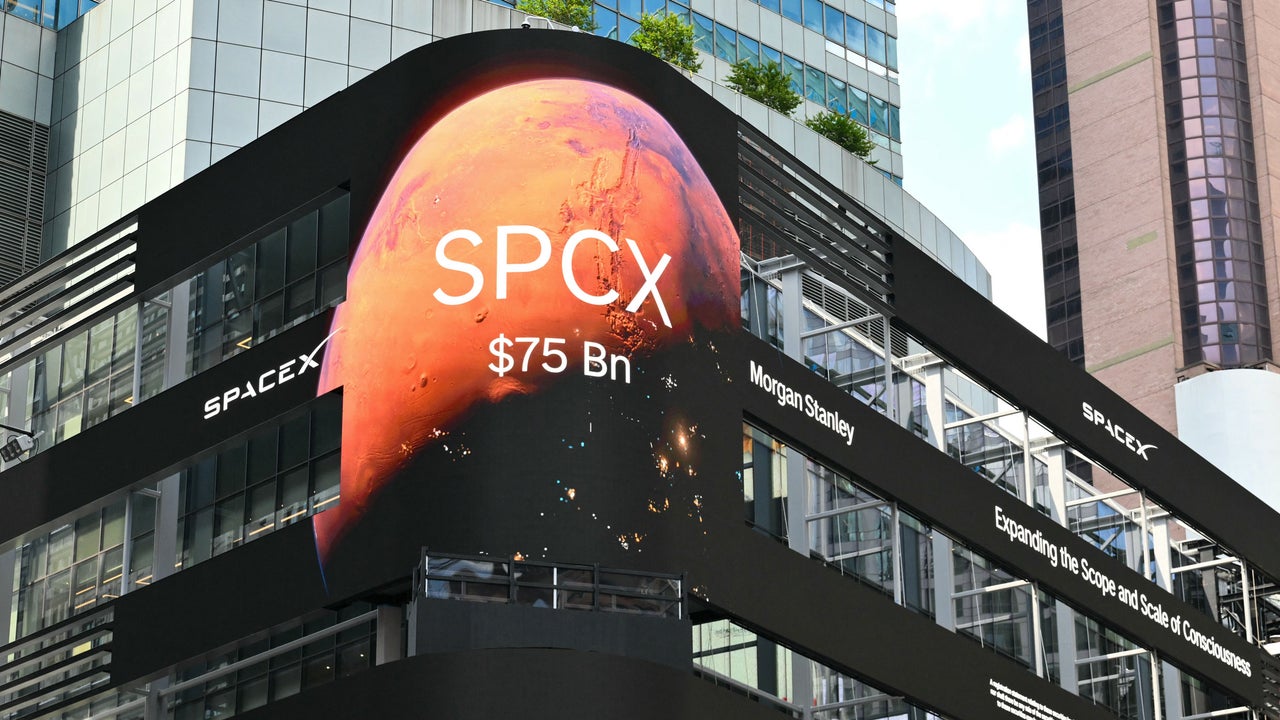
Two days after going public, SpaceX is already bigger than both Amazon and Microsoft.
With Tuesday’s early market gains adding to Monday’s advance, Elon Musk’s rocket-and-AI company boasted a market cap of $2.95 trillion as of 10:05 a.m. ET. That put it ahead of Amazon’s $2.66 trillion and briefly above Microsoft’s $2.93 trillion. It has since fallen below Microsoft’s market cap again.
It’s a remarkable feat, one that defies rational explanation but underscores investors’ intense appetite for AI—and the magnetic draw of Elon Musk.
With the boost, SpaceX briefly became the fourth-largest company on Wall Street by market value. It currently sits at fifth.
Apple is currently the third-largest publicly traded company on Wall Street, with a $4.4 trillion market cap. Alphabet stands at $4.5 trillion, and Nvidia leads the pack at $5.1 trillion.
Up, up and away
It has been a remarkable short run for SpaceX, which began trading midday Friday with a market cap of just under $1.8 trillion. The surge in valuation is even more notable because many Wall Street analysts have warned investors that the company appears artificially inflated.
Prior to the IPO, Morningstar launched coverage of SpaceX, with analyst Nicolas Owens saying his fair value estimate of the company was roughly $780 billion—less than half of the company’s target at the time.
“We think the company has been significantly overvalued and investors will have opportunities to buy the stock at more attractive levels after the IPO,” he wrote.
He wasn’t alone in his warnings. Aswath Damodaran, a professor at NYU’s Stern School of Business best known as the “dean of valuation,” said he believed SpaceX’s equity value was roughly $1.3 trillion, nearly half a trillion less than the company claimed. And Ed Elson, an analyst who also co-hosts the Prof G Markets podcast with entrepreneur Scott Galloway, said the pre-IPO valuation defied all logic.
“The stock is set to be priced at 107 times sales, which would make it one of the most expensive stocks in history,” Elson wrote on his Substack. “It will be twice as valuable [as] Walmart while generating less revenue than Macy’s.”
Investor exuberance
It’s not uncommon for an IPO to soar in its first few days on the market, particularly one as hyped as SpaceX. Offerings are often timed to land at the peak of investor excitement. And there could be more room for SpaceX to climb.
But gravity is an irresistible force, even on Wall Street. A recent study by Truist of 30 major IPOs found that all finished their first year with stock prices that were notably lower. The most successful of those companies was down 20% after one year. The worst tumbled 90%. On average, the first-year drawdown was 55%.
SpaceX is also looking at an unusual lockup period for its workers. Typically, employees are restricted from selling their shares for 180 days. SpaceX will allow some insiders to sell up to 20% of their locked-up shares after the company reports earnings for the three months through June. And if the stock is trading at least 30% above the IPO price at that time, they can sell another 10%.
From there, it’s a rolling schedule, with another 7% unlocking at the 70-, 90-, 105-, 120-, and 135-day post-IPO marks. After SpaceX files its second earnings report, another 28% can be sold. Whatever is left at the 180-day mark can be sold at will.
Amazon isn’t likely to see the volatility that could be ahead for SpaceX, barring a larger market meltdown. The company’s fundamentals remain strong and are supported by current revenue and sales, not an estimate of future income.
SpaceX might be surpassing Wall Street’s biggest companies today—and could join them on a permanent basis someday—but this current game of market-cap leapfrog is likely to be short-lived once earnings come out and lockups expire.