
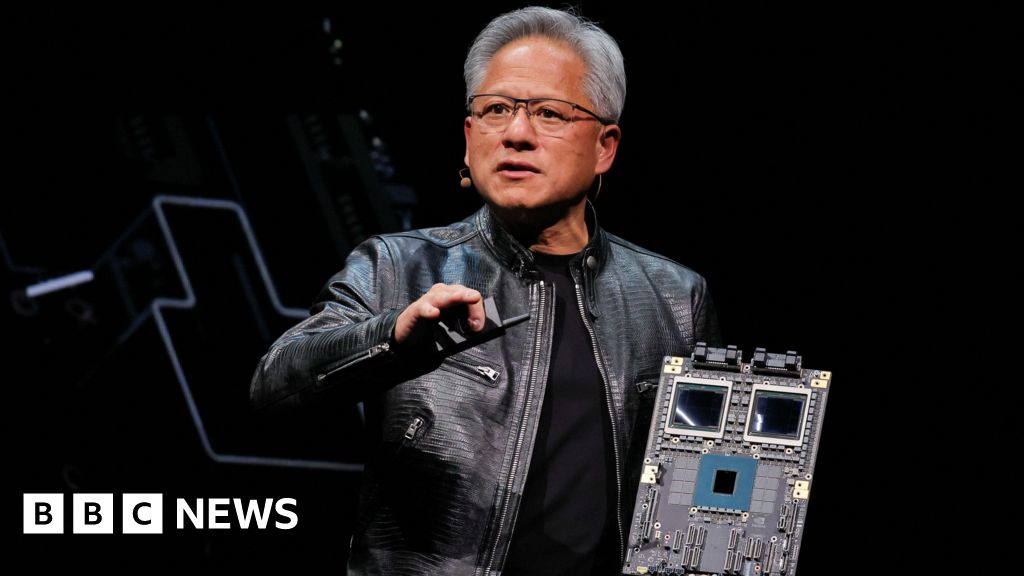
Chip giants Nvidia and AMD have agreed to pay the US government 15% of Chinese revenues as part of an “unprecedented” deal to secure export licences to China, the BBC has been told.
The US had previously banned the sale of powerful chips used in areas like artificial intelligence (AI) to China under export controls usually related to national security concerns.
Security experts, including some who served during President Donald Trump’s first term, recently wrote to the administration expressing “deep concern” that Nvidia’s H20 chip was “a potent accelerator” of China’s AI capabilities.
Trump on Monday dismissed security concerns, saying the chip in question was “old”.
Under the agreement, Nvidia will pay 15% of its revenues from H20 chip sales in China to the US government.
AMD will also give 15% of revenue generated from sales of its MI308 chip in China to the Trump administration, which was first reported by the Financial Times.
Nvidia told the BBC: “We follow rules the US government sets for our participation in worldwide markets.”
It added: “While we haven’t shipped H20 to China for months, we hope export control rules will let America compete in China and worldwide.”
AMD did not immediately respond to a request for comment.
The deal sparked surprise and concern in the US, where critics said it raised security risks and questions about the Trump administration’s approach to dealing with private businesses.
“You either have a national security problem or you don’t,” said Deborah Elms, head of trade policy at the Hinrich Foundation.
“If you have a 15% payment, it doesn’t somehow eliminate the national security issue,” she added.
On social media, some investors called the arrangement a “shakedown“, while others compared the requirement to a tax on exports – which has long been considered illegal in the US.
“Regardless of whether you think Nvidia should be able to sell H20s in China, charging a fee in exchange for relaxing national security export controls is a terrible precedent,” wrote Peter Harrell, a fellow at the Carnegie Endowment for International Peace who formerly worked for the Biden administration.
“In addition to the policy problems with just charging Nvidia and AMD a 15% share of revenues to sell advanced chips in China, the US Constitution flatly forbids export taxes,” he added.
Democratic congressman Jake Auchincloss said: “Now the US government is financially motivated to sell AI to China? Makes me shudder to think what a TikTok deal might look like.”
The H20 chip was developed specifically for the Chinese market after US export restrictions were imposed by the Biden administration in 2023.
Sales of the chip were effectively banned by Trump’s government in April this year.
Beijing has previously criticised the US government, accusing it of “abusing export control measures, and engaging in unilateral bullying”.
Nvidia’s chief executive Jensen Huang has spent months lobbying both sides for a resumption of sales of the chips in China. He reportedly met US President Donald Trump last week.
Charlie Dai, vice president and principal analyst at global research firm Forrester, said the agreement to hand over 15% of China chip sales to the US government in exchange for export licences was “unprecedented”.
“The arrangement underscores the high cost of market access amid escalating tech trade tensions, creating substantial financial pressure and strategic uncertainty for tech vendors,” he added.
In a letter last month to US Commerce Secretary Howard Lutnick, a group of 20 security specialists said that while the biggest buyers of Nvidia’s H20 chips were civilian companies in China, they expect them to be used by the military.
They wrote: “Chips optimized for AI inference will not simply power consumer products or factory logistics; they will enable autonomous weapons systems, intelligence surveillance platforms and rapid advances in battlefield decision-making.”
In a statement to the BBC, Nvidia said: “America cannot repeat 5G and lose telecommunication leadership. America’s AI tech stack can be the world’s standard if we race.”
The Nvdia and AMD agreement comes as the boss of Intel, a rival chip maker, met with Trump at the White House on Monday after the president called for his immediate resignation due to his ties to China.
Intel said the pair had “a candid and constructive discussion on Intel’s commitment to strengthening U.S. technology and manufacturing leadership”.
Trump wrote on Truth Social the meeting was “a very interesting one”.
“Mr. Tan and my Cabinet members are going to spend time together, and bring suggestions to me during the next week,” Trump added.
Last week, Trump said on social media that Lip-Bu Tan was “highly conflicted”, apparently referring to his alleged investments in companies that the US said were tied to the Chinese military.
Mr Tan pushed back, stating it was “misinformation”.