
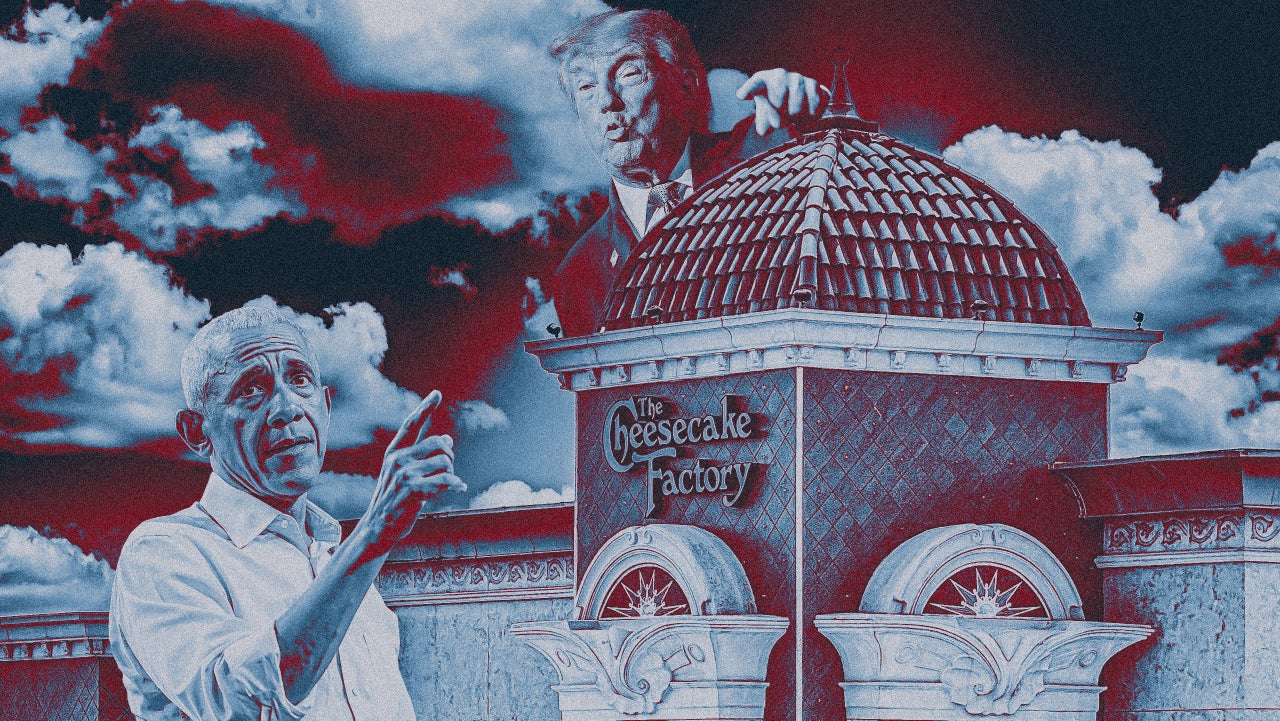
In the thick of a heated midterm electoral season, the Cheesecake Factory, of all things, became the latest brand to get sucked into a political food fight against its will. This week, Democrats and Republicans converted the familiar restaurant into a symbol for who is and isn’t out of touch with mainstream America. But largely because the chain has remained stoically above the fray, the incident has worked out rather sweetly for the restaurant.
The fracas started with a remark last weekend from former President Barack Obama, poking fun at current President Donald Trump’s focus on renovation projects and penchant for maximum aesthetic opulence.
“He’s got the White House looking like Saddam Hussein opened a Cheesecake Factory,” Obama joked. If you’ve never been: The chain is known partly for a maximalist decor that mixes opulent elements from Egyptian columns to Victorian beadboard paneling, European café details, decorative ceilings, and deep booths in a mash-up that might strike some as, let’s say, tacky.
Of course, the GOP pounced. The Wall Street Journal editorial board found it necessary to weigh in, slamming Obama as “condescending” for “making fun” of the popular chain. The remark was said to show why Democrats lost the middle class. Treasury Secretary Scott Bessent, interviewed outside a Cheesecake Factory, sniped: “I would tell the Martha’s Vineyard set to give it a try.”
Trump called the Cheesecake Factory “a very successful company” and claimed Obama “doesn’t like successful companies.” The White House posted an AI clip of a cartoon Trump waving outside a Cheesecake Factory.
And it wasn’t just Republicans. The Atlantic, not exactly known for defending Trump, published a bemused but warm defense of the Cheesecake Factory: “Like any number of kitschy, charming American chain restaurants . . . the Factory can obviously be mocked. But it must be mocked from a place of love. It should exist above partisan politics as a sacred third space, one of the few we Americans have left.”
A writer for Washingtonian even interviewed a former Cheesecake in-house design director. Rick McCormack, who was vice president of design at the chain for 13 years, praised the design vision of founder David Overton, and tsk-tsked at Obama for “disparag[ing] such a great American success story.”
As it happens, McCormack joked in an interview with Eater back in 2017 that the Cheesecake Factory’s design may not be for everyone: “If I try to describe to you what it looks like, you’d probably think it was one of the most horrible-looking places around.”
The New York Times chimed in to note that Obama was hardly the first to give the Cheesecake aesthetic the side eye; one past critic called it “the culinary embodiment of the Kardashians.”
The Cheesecake Factory, however, has maintained a steady silence in reaction to being added to the menu of the culture wars. (The company did not respond to a query from Fast Company.)
The entire episode went unmentioned in the conference call accompanying its earnings release this week, when, as it turns out, the Cheesecake Factory reported gaudy numbers, with over $1 billion in quarterly revenue (up more than 10% over last year) and earnings well ahead of analyst estimates; its share price has doubled this year.
The incident is almost an inverse of the usual version of a brand stumbling into the mire of partisan politics. A prominent recent example was Cracker Barrel changing its logo and being accused of woke-ism and threatened with boycotts. (And ultimately reversing the redesign.) Even in cases where a brand has taken no particular action to get swept into the news cycle, it’s often led to some kind of public statement.
In 2016, for example, Donald Trump Jr. compared accepting Syrian refugees to eating from a bowl of Skittles containing a few poisoned candies. “Skittles are candy. Refugees are people,” the company stated. “We don’t feel it’s an appropriate analogy.”
Similarly, when the senior Trump’s 2005 Access Hollywood recording surfaced in 2016 in which he references using Tic Tacs before kissing women, the brand responded directly: “Tic Tac respects all women. We find the recent statements and behavior completely inappropriate and unacceptable.”
One reason the Cheesecake Factory’s silence proved wise is that in the end nobody really wanted to be perceived as against the brand—not even, in the end, Obama. The White House put more effort into responding to his “joke” than into fighting inflation, the former president said.
“They don’t have solutions to actual problems, so they’d rather have the media and you talking about the Cheesecake Factory.” Moreover, he added, as a father of two he had put in plenty of time at the Cheesecake Factory: “That was my jam for about a decade.”
Clearly, then, the lesson of the brand’s nonresponse is a familiar one, albeit not one we often associate with the rococo Cheesecake Factory: Sometimes, less is more.