
Want more housing market stories from Lance Lambert’s ResiClub in your inbox? Subscribe to the ResiClub newsletter.
D.R. Horton, the nation’s largest homebuilder by volume, has signed a multiyear commercial agreement with Promise Robotics to use the startup’s robotic factory capacity on more than 1,250 homes. The deal, announced October 13, makes D.R. Horton the first major U.S. builder to sign on to Promise Robotics’s factory-as-a-service model.
On a typical jobsite, framing crews build walls by hand, cutting studs, nailing them together, and standing them up on the foundation. That labor-intensive, weather-dependent work is where builders feel labor shortages most. Promise Robotics moves much of the framing into a factory, where robots assemble wall panels from the builder’s existing plans. The panels are then trucked to the site and set in place, which is far faster than framing from scratch.
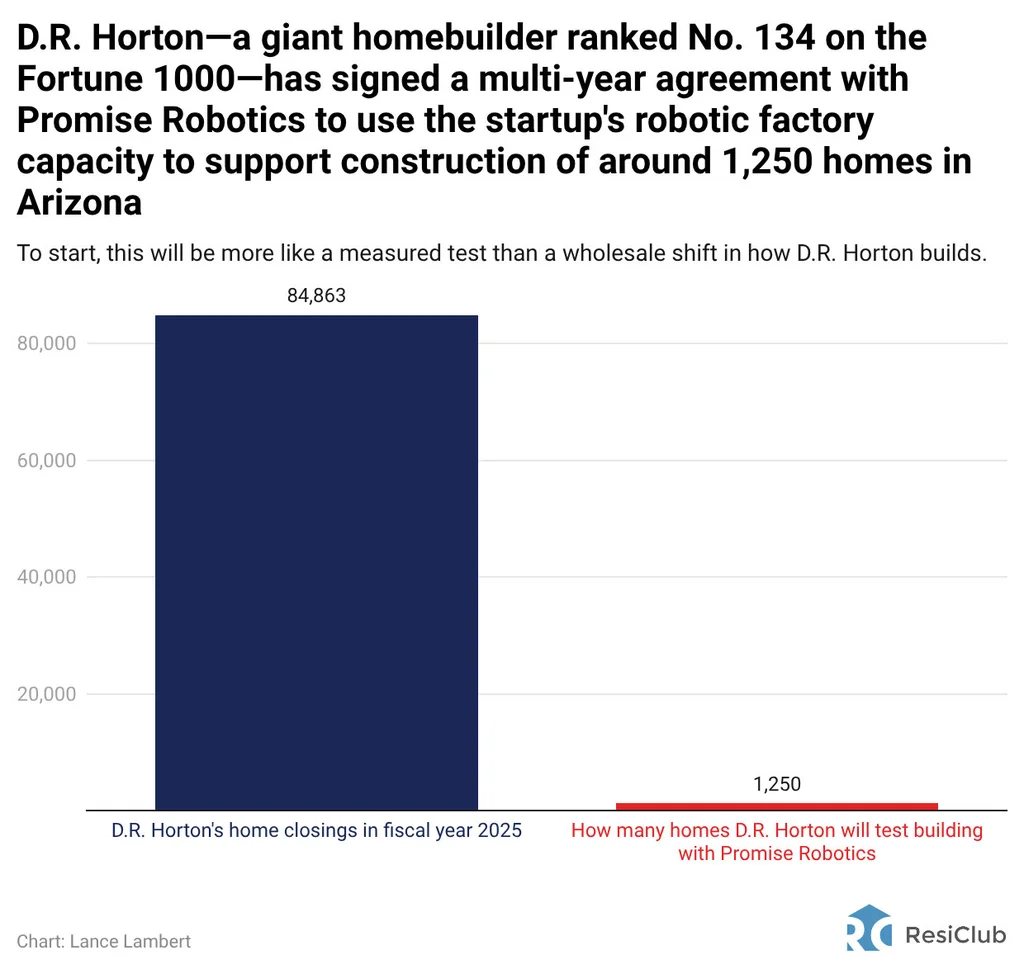
D.R. Horton closed 84,863 homes in fiscal 2025, so the around 1,250 homes planned with Promise Robotics amount to about 1.5% of a single year’s volume. To start, this looks more like a measured test than a wholesale shift in how D.R. Horton builds.
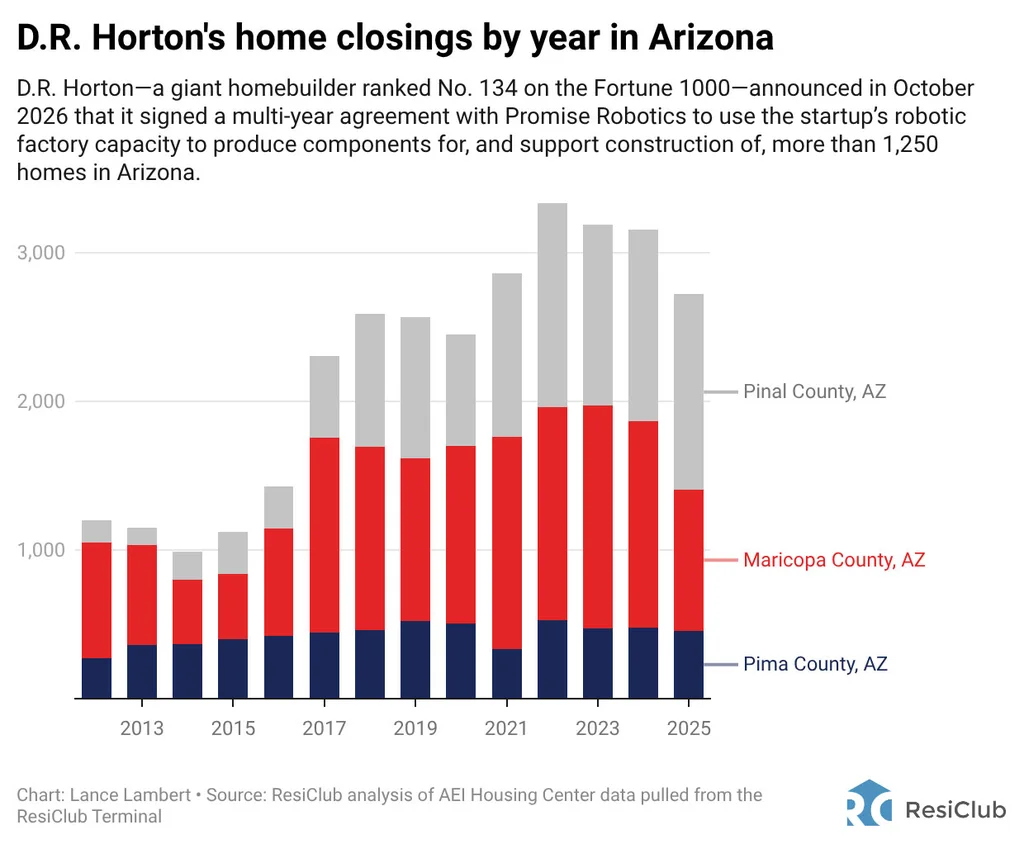
In metro Phoenix, where Promise Robotics tells ResiClub all the 1,250 homes will be built and located, it’s a different story: 1,250 homes is more than half a year of D.R. Horton’s recent annual combined closings across Arizona’s Maricopa, Pinal, and Pima counties. The structure of the deal matters, too. D.R. Horton isn’t buying robots or building a factory. It’s renting automated production capacity from a third party that owns the plants, the software, and the robotics—and that says it can now replicate the model market by market, starting with a factory in Gilbert, Arizona.
The deal
Under the agreement, D.R. Horton will tap the Promise Robotics production platform to help build 1,250-plus homes. The companies did not disclose financial terms, a delivery timeline, or which Phoenix communities the homes will go to.
Brad Conlon, D.R. Horton’s senior vice president of strategic growth and innovation, framed the deal around three operating goals: faster cycle times, more production capacity, and more consistency and predictability. He called the Promise Robotics platform a new capability for pursuing those goals.
How Factory-as-a-Service works
The pitch from Promise Robotics is that builders shouldn’t have to own a factory to get factory-style production. Under its factory-as-a-service model, Promise Robotics owns and runs the plants, robotics, and software, and builders buy output.
The workflow runs in four steps:
- Design translation: The Promise Robotics AI ingests a builder’s existing home plans, so the builder doesn’t have to redesign product for the factory.
- Production planning: The software generates production plans and machine instructions for the robots.
- Robotic manufacturing: Off-the-shelf industrial robots produce building components on the factory line.
- Site installation: Promise Robotics coordinates delivery and installation of those components on the jobsite.
The company says the integration is the differentiator: Rather than automating one task, such as nailing or cutting, it ties design, factory, and jobsite into a single production system. Earlier coverage of the company describes its output as framing components such as wall panels, though the D.R. Horton announcement doesn’t specify which components are in scope.
That asset-light structure matters for builders. Off-site construction has a long history of builders and startups sinking capital into factories that then sat underutilized when local demand cooled. Promise Robotics CEO Ramtin Attar made the same point back in 2023, when the startup raised a $15 million Series A: Builders are reluctant to invest in costly factories and then spend years on trial and error.
From Edmonton to Calgary to Phoenix
Speaking to ResiClub, Attar laid out how Promise Robotics sees its path from Canadian pilot to U.S. scale:
“Promise is building the production infrastructure homebuilding scales on. Builders are increasingly looking to secure industrial production capacity through multiyear commitments because they need to deliver more homes with faster, more predictable cycle times. But building and operationalizing that capacity takes significant capital, time, and expertise. Our platform removes those barriers: It turns a builder’s designs into production instructions, orchestrates production, and gets better with every build. We proved the model in Edmonton and scaled it in Calgary, where we’ve been in continuous production since September 2025. Now we’re replicating that model in Phoenix, creating the template for every market that follows.”
The Canadian track record is still short. Promise Robotics, founded by Attar, a former Autodesk R&D executive, and Canadian homebuilder Reza Nasseri, ran its first production line in Edmonton, Alberta. It then opened a 60,000-square-foot plant in an existing Calgary warehouse, which it has called a flagship hub and a model to replicate in U.S. markets. The Calgary plant was backed in part by a federal contribution from Prairies Economic Development Canada.
Calgary’s anchor customer is the Alberta division of Mattamy Homes, which signed its own multiyear agreement with Promise Robotics to supply single-family, semidetached, and multifamily homes in two master-planned communities. The D.R. Horton deal follows the same template: a multiyear capacity commitment from a large builder, tied to a Promise-run plant.
Phoenix is the test of whether that template travels to the United States. It’s Promise Robotics’s first U.S. production market, a different labor pool, supply chain, and building code environment, and a market where the company will need to win business from builders who have their own trade bases and framing crews.
Why a builder would rent capacity instead of building it
For a production builder, the appeal is less about robots than about cycle time and cost per home. Faster, more predictable builds mean inventory turns faster and less capital sits tied up in homes under construction.
Those levers matter more when margins are under pressure. Among the 15 largest homebuilders tracked by ResiClub, 13 are seeing year-over-year gross margin compression. In that environment, any tool that shaves weeks or labor hours off a build is worth testing.
The factory-as-a-service structure also limits the downside. D.R. Horton takes no factory on its balance sheet and carries no fixed overhead if local demand softens. If the Promise Robotics plants don’t deliver on schedule or on cost, the builder can fall back on its existing trade partners. Promise Robotics carries the capital and operating risk; D.R. Horton carries execution risk on 1,250 homes.
Attar’s comment points to a broader shift he says Promise Robotics is seeing: builders locking in industrial production capacity through multiyear commitments. Two such deals, Mattamy in Alberta and now D.R. Horton, are early evidence for that claim, but not yet a trend.