
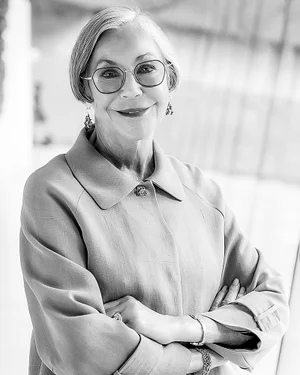
On any given day, a visitor to the Crystal Bridges Museum of American Art in Bentonville, Arkansas, could encounter something uncommon. Alice Walton, daughter of Walmart founder Sam Walton and the current richest woman on Earth, is known to stroll the galleries of the world-class art museum she built in a ravine in the Ozark Mountains. Since its 2011 opening, the admission-free Crystal Bridges has turned Walmart’s modest hometown into a global arts destination, and kicked off a remarkable 15-year spree of cultural and civic development.
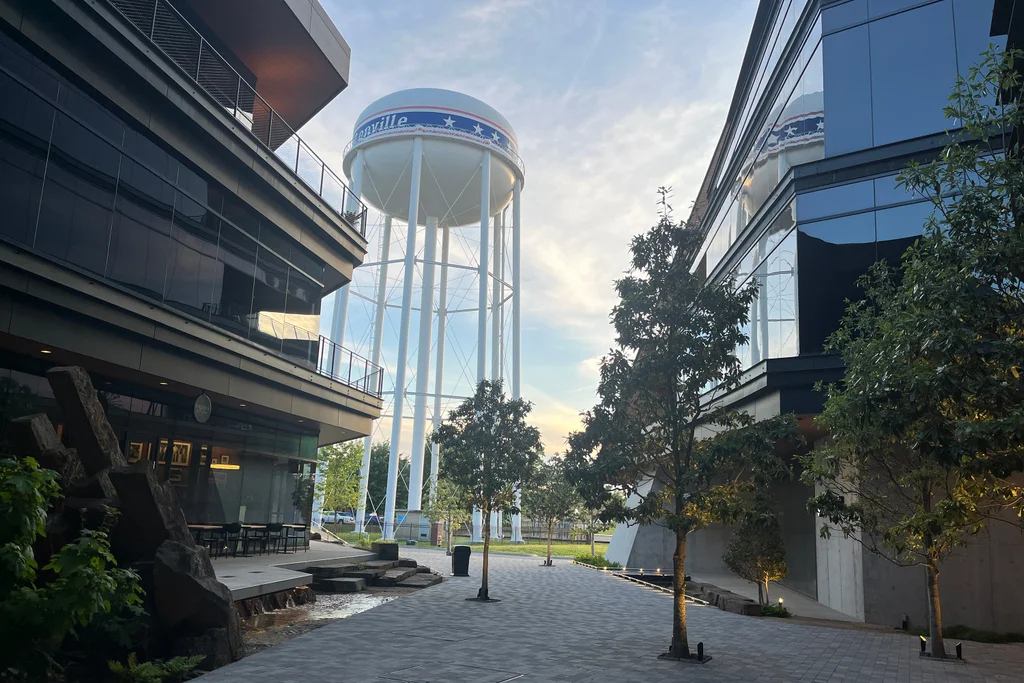
It’s impossible to miss the scope of transformation that’s happened in Bentonville, population 63,000. From the downtown square alone, one can see two high-end hotels, a pedestrianized street lined with public art, a large public park under construction, a stretch of the 40-mile Razorback Greenway bike trail, and a modern office building designed so that people can ride their bikes up a winding ramp to a sixth-floor overlook.
Beyond the square, you’ll find a contemporary arts venue, a new school of medicine, a forthcoming healthcare campus, and a science, technology, engineering, and mathematics (STEM) university that’s just breaking ground.
.jpg)
Almost all of this has been directly instigated or indirectly supported by Walton, her extended family, and their various philanthropic and business arms.
The June 6 opening of the major expansion of Crystal Bridges is a victory lap for Walton and the museum itself, where she’s routinely seen walking through the galleries “in her little tennis shoes,” as one aide put it. With about 800,000 visitors a year, Crystal Bridges has become the heart of the town, and the fuel for a widespread metamorphosis of the region.
Walton, 76, won’t exactly take personal credit for remaking Bentonville. But that doesn’t stop her from taking in the pleasures of the museum, which sits a short walk from her family home on land she’s steadily converting from a private estate into a publicly accessible campus of art, health, and wellness.
She can often be found inside the museum because, like most visitors, she’s there to see the art, most of it technically her own personal collection. But she’s also bearing witness to the real-time impact of her investment—on locals, on visitors, and on a growing roster of projects that have made Bentonville one of the fastest-growing communities in the country.
“It brings me great joy to see all the kids running around, and young people out on dates, and people enjoying it,” Walton tells me. “I believed that it could be transformational for the town, but I would never have expected it to be where it is today.”
Yet for all the uniqueness of this situation, the fact that the richest people from the richest company in the world are transforming a small town is not what stands out in Bentonville. Rather, it’s the particular way the Walton family has chosen to transform their town: zeroing in on projects that can enrich the lives of people living there while also giving people who don’t a reason to visit.
Not everyone is a fan of the extraordinary change that’s occurred, and the knock-on effects have left some in the community behind. It’s urban development on steroids, with one very powerful philanthropic hand guiding the way. But by and large, the outcome is creating a place and a quality of life that many people across the U.S. would envy. And, surprisingly, this one-off unicorn of a small-town makeover may actually offer replicable lessons for communities that don’t have the benefit of a neighbor like Walton.
Along the Walmart trail
It’s about a 2-mile trip from the doors of Crystal Bridges to the fountainhead of the wealth that enabled it: Walmart’s headquarters. The brand-new corporate campus was built in 2025, right down the road from the original, where a dozen modern office buildings now sit in a parklike setting amid ground-floor retail and restaurants. A snaking bike path runs right through the middle of it all.
That bike path, a portion of the Razorback Greenway, is directly adjacent to many of the new attractions and amenities that have remade Bentonville, which makes it a perfect route to survey this small town’s transformation.
So I rented a bike and went for a ride.
Winding through the woods that surround Crystal Bridges, past a skyspace by artist James Turrell and sculptures mounted among the trees, the trail dips in and out of the museum’s curatorial scope before emerging on the north edge of downtown. It rolls past the artsy 21c Museum Hotel, opened in 2013, across a recently pedestrianized road from the active construction site of a mixed-use development designed by Swiss architecture firm Herzog & de Meuron.
The trail tucks behind a few civic buildings and into view of the Compton, another boutique hotel that opened just off the square in December. The path then skirts away from the built-up downtown and into a parklike setting outside the mansion where Walmart cofounder Bud Walton once lived.
A few curves later is the contemporary arts and music venue the Momentary, a satellite of Crystal Bridges that opened in 2020 inside the shell of a former Kraft cheese factory. (Despite being closed since 2013, the factory building reportedly smelled like cheese for several years ahead of its redevelopment.)
Across the parking lot is the site of a forthcoming 2,500-capacity music theater designed by the Bjarke Ingels Group that the Momentary is developing with Live Nation. Through a narrow alley of trees, the trail then emerges out to cross a road onto the new Walmart Home Office campus, where about half of its 350 acres are landscaped like a park and open to the public.
This can all be seen in less than 20 minutes.
Most of these projects have been made possible through direct investments by Alice Walton and the Alice L. Walton Foundation, other members of her family, or the Walton Family Foundation. All of them happened after Crystal Bridges opened.
“Just the announcement of the investment in the museum supercharged investments in Bentonville and Northwest Arkansas, building out amenities that you might come to expect in a region that is much larger than we are even today,” says Mervin Jebaraj, director of the Center for Business and Economic Research at the University of Arkansas business school, which is named after Sam Walton.
Jebaraj says the years leading up the museum’s completion renewed interest in the region. The museum’s immediate success—650,000 people visited in the first year, more than double the number anticipated—opened the floodgates. Hotels, bars, and restaurants quickly emerged, catering to the growing tourism generated by the museum. At the same time, significant investments were being made by Alice’s nephews, brothers Tom and Steuart Walton, to develop dozens and then hundreds of miles of mountain biking trails, and later a broad network of mixed-use trails through the city.
Not unrelated, these investments were happening at the early edge of a regional growth surge. The U.S. Census estimates Bentonville’s population was about 35,000 in 2010. By 2020, it was 52,000. Now the city is home to about 63,000 people, a near doubling of its population in just 15 years.
Northwest Arkansas, where roughly 600,000 people reside, is expected to top 1 million by 2050. For a region of largely rural towns with limited commercial activity, the growing population made many new kinds of businesses, like cafés, bike shops, and breweries, suddenly viable.
“A lot of that has to do with the fact that the Waltons and other Fortune 500 companies that are based here decided to invest in the region to make it more attractive, not just for their employees, but for the employees of their suppliers and then the broader ecosystem that goes along with it,” Jebaraj says.
Tyson Foods and the multimodal logistics giant J.B. Hunt are the region’s other major businesses. Each has played a role in seeding development through their foundations, but hardly with the scale and scope that the Walmart fortune has made possible.
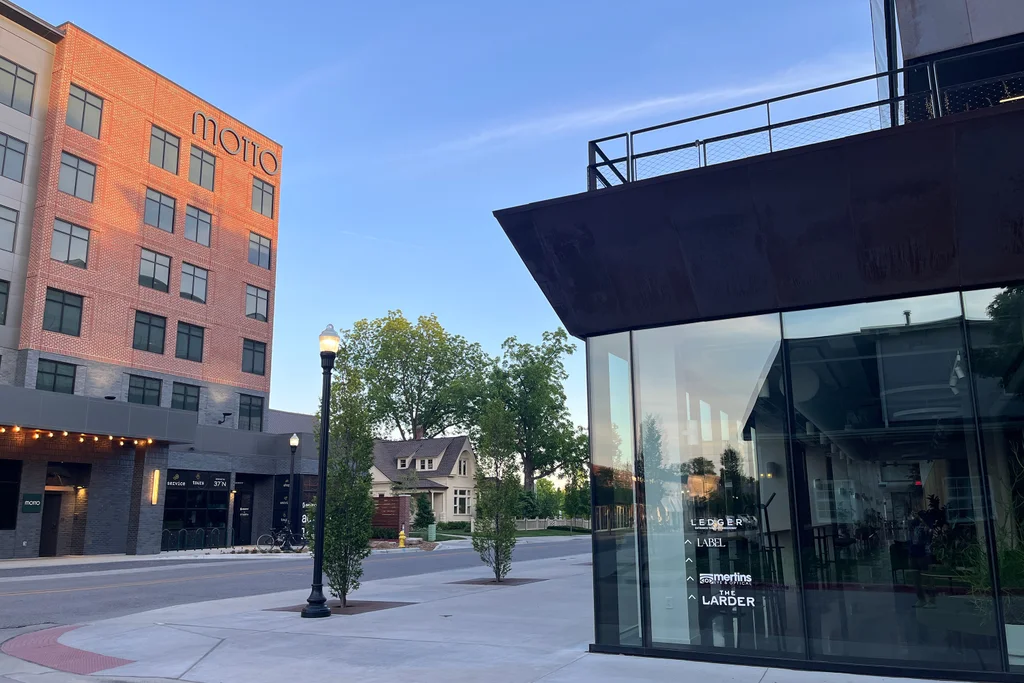
“I think we’re on track to be one of the great cities in America,” Tom Walton, grandson of Sam and nephew of Alice, tells me over coffee in the lobby of the Compton hotel. Tom was the developer of the property, and of many other projects across Bentonville, through the real estate arm of Runway, the holding company he runs with his brother, Steuart.
Leaning forward in his chair, his wrist in a cast after a recent surgery, Tom ticks off some of the varied projects his company has built or is building locally, from the Herzog & de Meuron mixed-use development to the forthcoming STEM university to hundreds of miles of mountain biking and shared-use trails.
Tom believes much of the recent opportunity found in Bentonville can be traced back to Alice’s idea to use a piece of family land and $800 million of endowments from the Walton Family Foundation to build a world-class art museum.
“She was willing to place a big bet,” he says. “I wouldn’t be here if it wasn’t for Crystal Bridges. It changed the way that we thought about this town, this region—and it was catalytic in every sense for inspiring people to think bigger.”
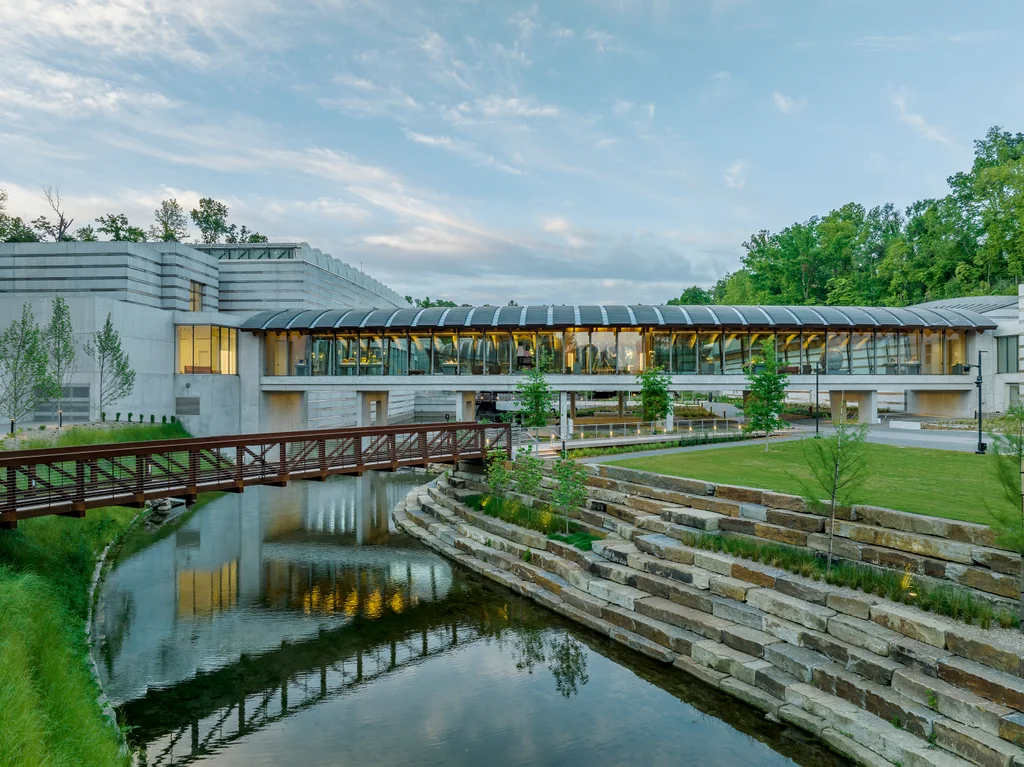
Betting on a ravine
Alice’s fingerprints are all over the new wing of the Crystal Bridges Museum of American Art, if you know where to look.
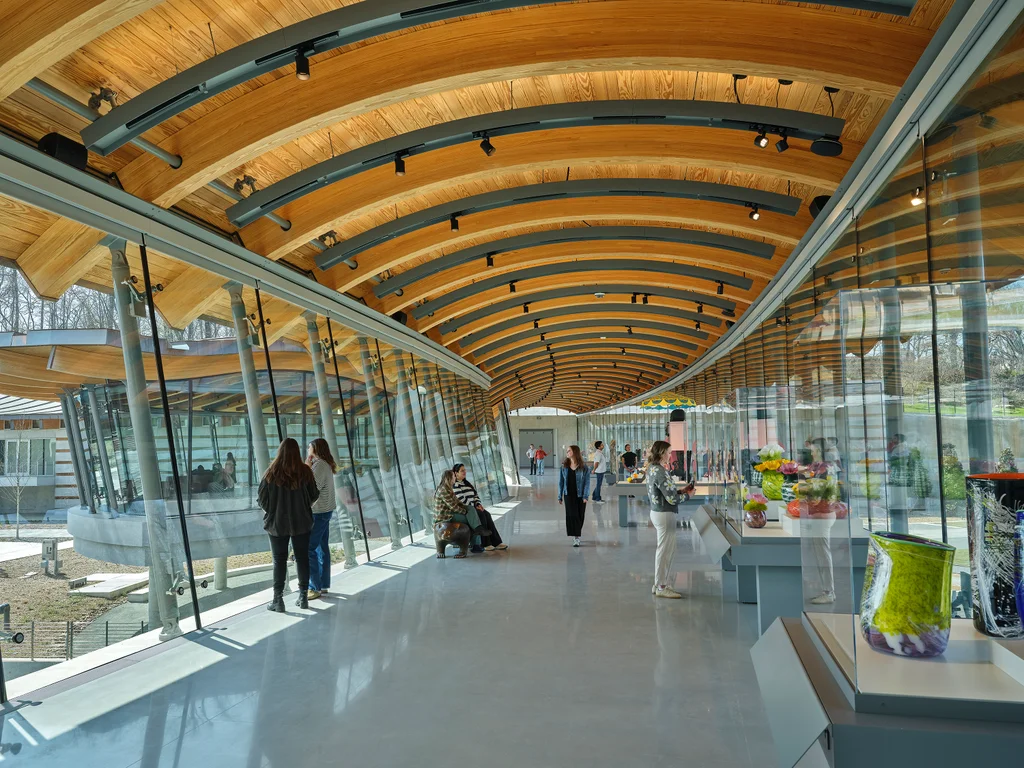
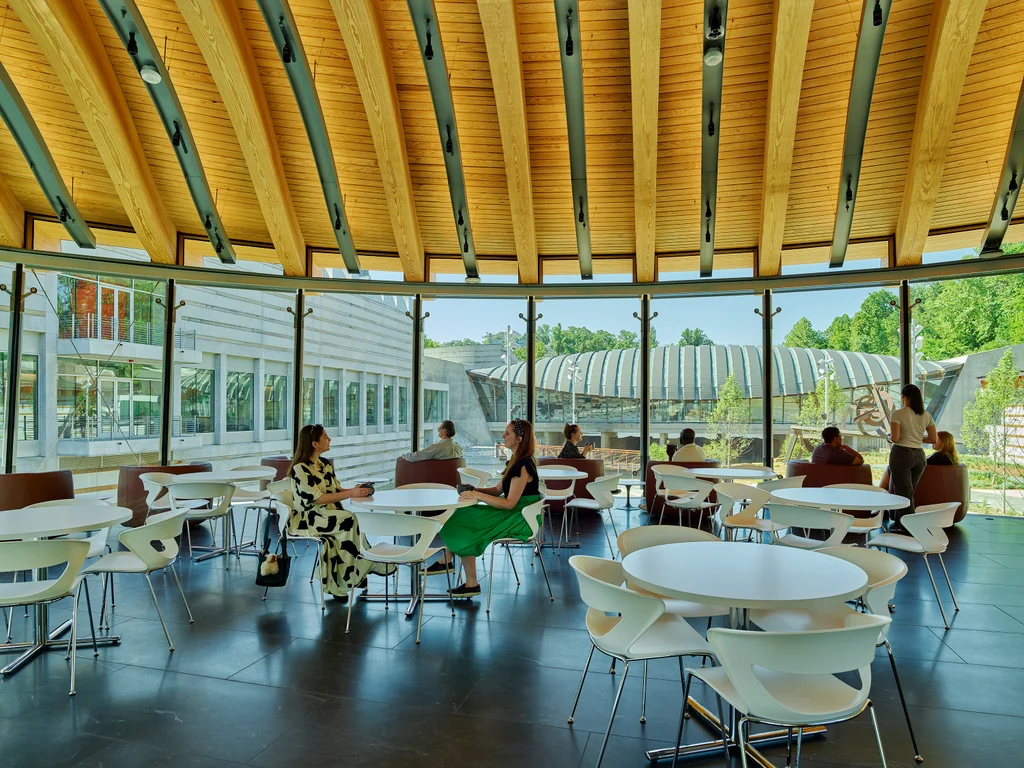
In early May, Austen Barron Bailly, the museum’s deputy director of curatorial affairs, walks me through the still-unopened new pavilions of the museum. She points to a chair situated in one of the signature gallery areas, a new “bridge” space that contains art but also offers up- and downstream views of Town Branch Creek and the wooded ravine in which it sits. The chair, a cushy swivel, offers a place to rest, take in some art, or just gaze out the floor-to-ceiling windows.
“She’s obsessed with the swivel chair,” Bailly says.
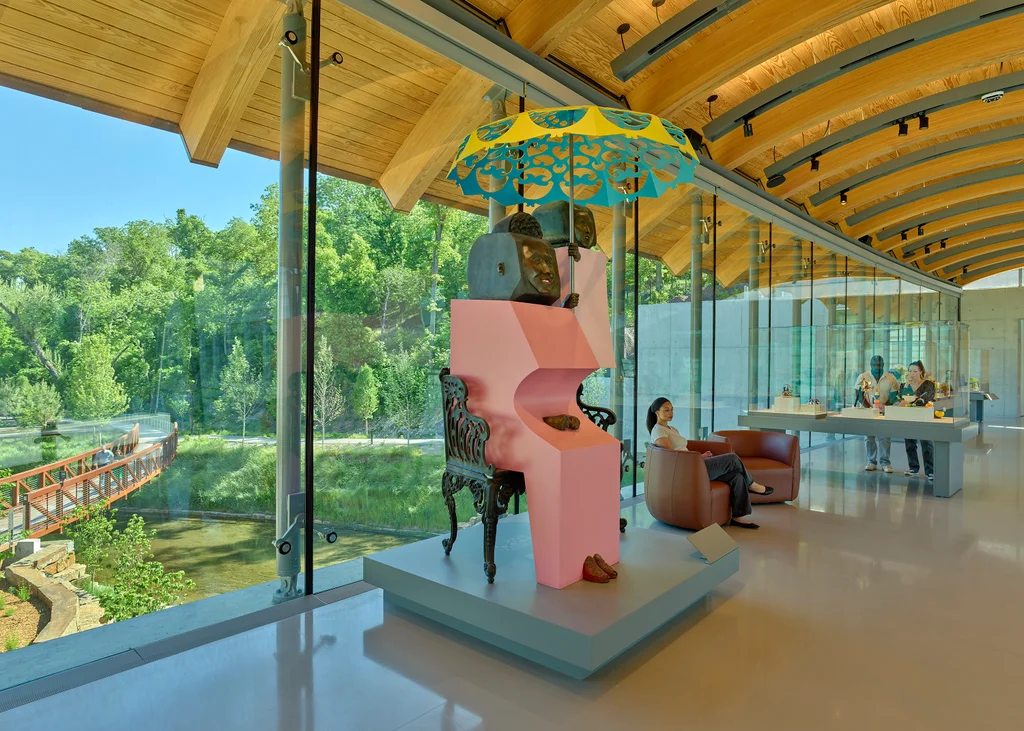
Other touches are more noticeable, including eschewing typically white gallery walls for a liberal use of color. Ahead of the expansion’s opening, the museum’s curators reconsidered and painstakingly rehung the entire collection, moving some pieces and concentrating new groups of others. Part of that process involved adding color to some of the walls as a way of embracing the outsider approach Crystal Bridges is bringing to the art world.
“[Alice] wanted more color,” Bailly says, smiling.
Moshe Safdie, the architect whose firm designed Crystal Bridges and its expansion, says Alice is a particularly strong client. “She has very, very strong opinions. But she’s also open.”
Safdie got the job to design Crystal Bridges in the mid-2000s after traveling to Bentonville to walk the family land with Alice. At one point, he slipped into an icy creek running through a ravine, and even with that shiver pushed Walton to drop a plan to clear-cut a hilltop for the museum’s footprint and bring it down into the ravine instead, surrounded by nature rather than replacing it. Later that same day, on the drive to drop Safdie at the airport, Alice told him he got the job, no further interview required, no design competition necessary.
“This is very unusual in the industry, if I could put it that way,” Safdie says.
Unbeknownst to Safdie, Walton had been doing her own research ahead of time, visiting two other museums he’d designed, the Skirball Cultural Center in Los Angeles and the Peabody Essex Museum in Salem, Massachusetts. To give more shape to the idea of building a museum in a ravine in Bentonville, the two traveled together to visit museums around the world, including another Safdie project, the National Gallery of Canada in Ottawa, as well as museums in London and Paris.
The most influential turned out to be the Louisiana Museum of Modern Art, north of Copenhagen, set in a wooded landscape that borders a pond and overlooks the frigid waves of the sound between Denmark and Sweden. Its mid-century galleries are like rooms in a Scandinavian home, with many windows looking out on the grounds.
“You don’t want a museum where you go in and you go from gallery to gallery and you forget where you are until you come out,” says Safdie, who already had about 20 museums under his belt by the time Alice came calling. After their tour, he and Walton agreed that Crystal Bridges should have a Louisiana Museum-style embrace of its natural setting.
Others did not agree. “Everybody was up in arms,” Safdie says, recalling outrage of the potential for flooding, the risk it posed to priceless art, and the bureaucratic challenge of complying with the regulations of the U.S. Army Corps of Engineers, which has jurisdiction over all navigable waterways in the U.S. “But [Alice] bought into the idea and backed me up and we got it approved.”
Alice later hired Safdie again to design her a home, and then again to create a 25-year master plan for the potential future of Crystal Bridges. “At some point, she and her board decided, why wait 25 years, let’s build it all now,” says Safdie, now 87. “So that was nice.”
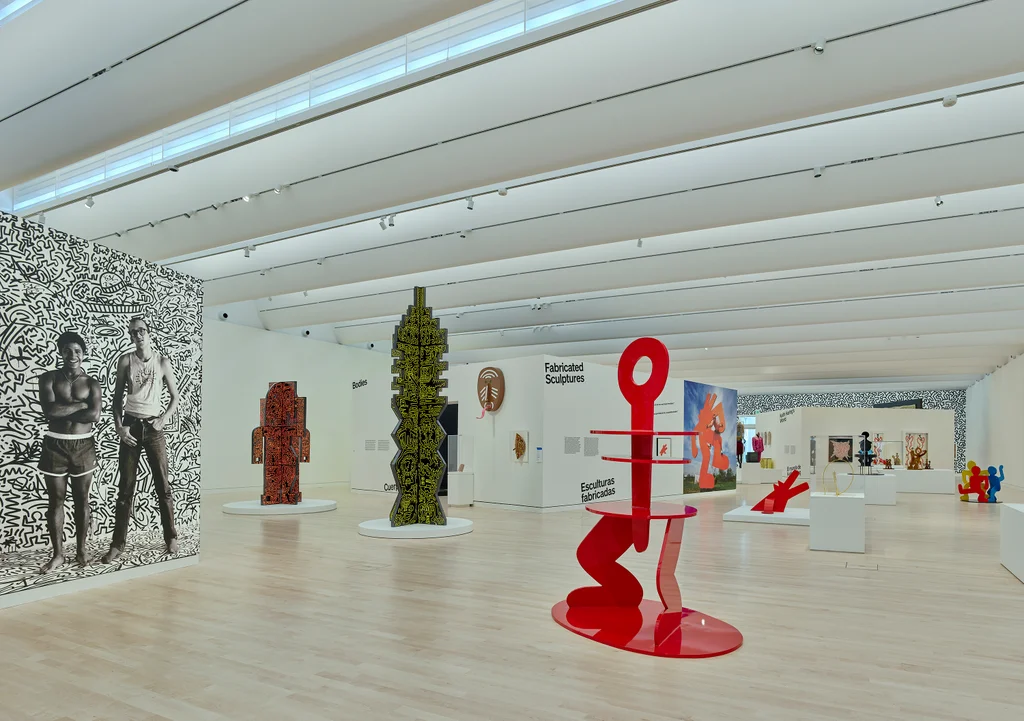
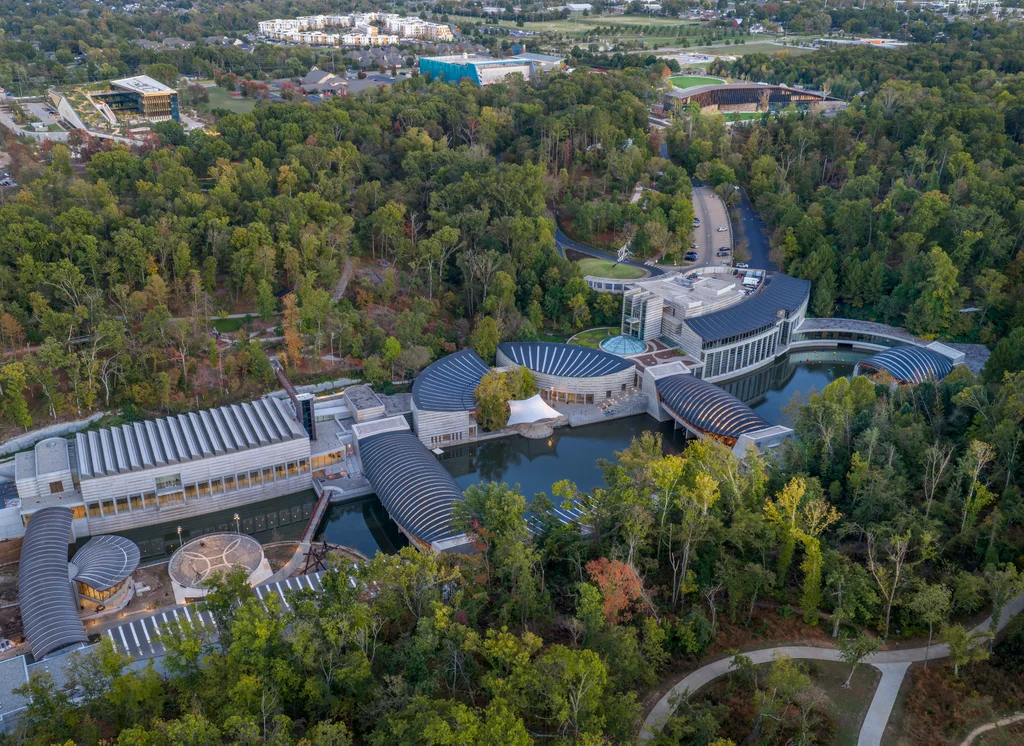
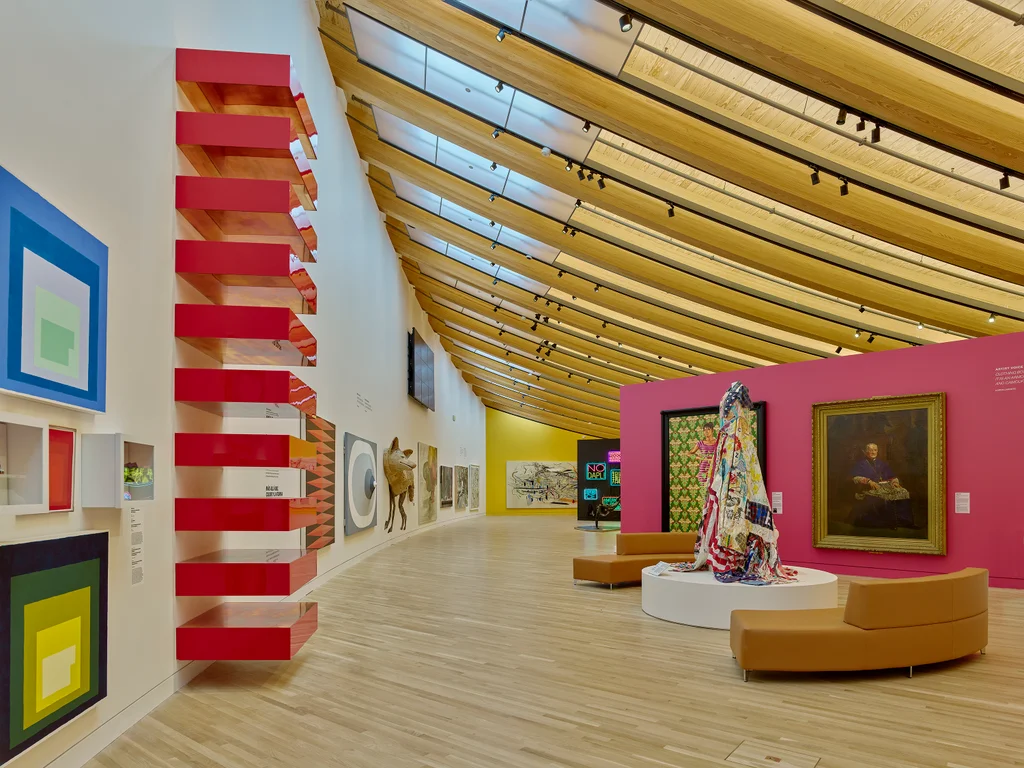
That master plan has materialized into what is essentially a doubling of the original museum, bringing it up to 314,000 square feet. The connected series of curving pavilions border and bridge the waters of Town Branch Creek. The museum’s extension adds two new wings on the creek’s edges, and a window-lined bridge between them holding a café overlooking a splash pad, alongside various artworks that are insensitive to the dappled light that streams through from both sides.
Light is a bit of an obsession for Safdie, and his influence has rubbed off on Alice Walton. The museum expansion includes a 14,000-square-foot column-free exhibition space with specially designed skylights shaped like scalloped waves popping up from the roof. Open to the north, they pull in less-intense light through tunable louvers but also use a system of reflectors to bounce stronger southern light off the backs of each scallop, augmenting the room’s artificial light.
The approach creates such precision that, for the space’s inaugural show—a retrospective of the 3D and sculptural works of artist Keith Haring—highly sensitive clothes decorated with paint and markers are able to sit on display under a strip of light that’s much dimmer than the rest of the room.
Across the bridge, the other new wing has its own set of parallel skylights, which can be adjusted to bring the room from bright to near darkness. However, on the creekside edge of the wing, a long line of clerestory windows sits at the top of the wall, just below the ceiling. Adding this extra light source, to the consternation of some on the curatorial side, was an Alice requirement, despite the fact that the wing was already deep in the construction process.
“This clerestory was not here,” Bailly says, pointing up. “She and Moshe just locked arms and said, ‘Put in the windows.’ So we had to make a lot of changes to be able to make that work.”
For a non-curator, the downside of the clerestory windows is negligible, and the effect is a subtle connection with the sky outside. The gallery itself has more than enough to focus on, though. Its walls are jam-packed with modern and contemporary art, including pieces by Donald Judd, Mark Rothko, Amy Sherald, Refik Anadol, Yayoi Kusama, and Julie Mehretu. The walls are splashed with color, including Alice’s favorite, green.
These “wild” colors might have rankled a younger Safdie, he says. But through two decades working with Alice, he’s grown accustomed to her strong vision for the museum and for everything else she’s built along the way.
“It’s been an amazingly fascinating relationship,” he says.
Civic problem-solving
Alice’s architectural education started at her family home, which sits along a creek not far from Crystal Bridges. Designed in 1958 by celebrated Arkansas architect E. Fay Jones, an apprentice of Frank Lloyd Wright, it was a low-slung L-shaped house designed around large stone fireplaces and grand seating areas.
Built from Arkansas fieldstone and cedar, it had shades of Wright’s signature style, with built-in furniture, geometrical gridlines in the walls and ceilings, and tall glass panels blurring inside and out. Jones even designed a leg of the building to jut out and over a section of creek he’d dammed to create a small pond. (Safdie toured the property before designing Crystal Bridges, and the echoes are apparent.)
“When I was growing up, we lived in the country,” Alice says, recalling the home’s close connection to nature. “Bentonville was 2,000 people. So it’s a little different.”
A bolt of lightning struck the house in 1972, burning it to the ground. Sam and Helen Walton had it rebuilt to nearly the same design, but this time with more space for entertaining and built-in air conditioning.
After graduating from Trinity College in San Antonio, Alice worked in securities trading and investment banking, living for a time in New Orleans. She had two brief marriages in the ’70s, then returned to Bentonville to manage investments for several banks her father had purchased.
In 1990, she served as the inaugural chair of the Northwest Arkansas Council, a regional development organization created by Sam Walton, J.B. Hunt, and Tyson Foods founder Don Tyson, along with other local business leaders. They’d formed the council to push for regional investments and planning that could improve economic development in what was then a mostly rural area, albeit one sprinkled with a handful of billion-dollar corporations.
Under Alice’s leadership, the council’s biggest early accomplishment was the 1998 opening of Northwest Arkansas Regional Airport, just 13 miles from Bentonville’s town square. “If the airport weren’t there, Crystal Bridges couldn’t be there,” Alice says. Now a national airport, its 14-gate terminal is named after her.
Alice spent many years living in Texas, where she got into horse ranching, raising cutting horses that are bred to separate cows from a herd. Since around 2008, when she formally approached the rest of the Walton family with the idea of using some of the family fortune to create Crystal Bridges, she has spent more and more time in Bentonville, eventually returning in 2015 and moving into the old family home. In the years that have followed, she’s increasingly steered her resources to local projects.
“Everything I’ve done kind of fits together. There wasn’t a long-term plan, but it was always about what’s needed most in the region,” she says. “It’s pretty simple. There’s no grand strategic design. It’s just, what’s needed and can I figure out a way to solve that problem?”
Architecture of access
What’s needed now is healthcare. “I used to say we have a crisis in rural healthcare, but the reality is we don’t have rural healthcare,” Alice says.
In 2019, she created the Heartland Whole Health Institute, a nonprofit focused on advancing value-based care. It’s an approach that aims to prevent and reverse disease rather than just respond to it, prioritizing nutrition, mental health and wellness, and tying payments to outcomes rather than the quantity of service provided.
Alice tells me this focus is personal, describing her own healthcare journey as “tough.”
“I spent 12 years running a low-grade fever. I had 30 operations, probably spent a year in the hospital in that period of time,” she says. “It just showed me how siloed things are. One doc doesn’t talk to the other. The ego’s involved. It’s never about the patient. It’s always about the money and the ego.”
Recognizing that restructuring the financial incentives in the American healthcare system is “a big lift,” Alice created this specialized institute to spend its time figuring out a better way. Her view is that art is essential to mental health and wellness, so she decided to place the institute on the Crystal Bridges campus.
A short walk through the woods from the museum, the institute is a long, curving building that bends along the landscape and looks out on a ravine. Standing outside, architect Marlon Blackwell sweeps his arm over the contours of the building. His Fayetteville-based firm, Marlon Blackwell Architects, won the project in a design competition in 2019 with a more rectangular design, but things quickly changed.
“We were informed by Alice that as much as she liked our concepts she’s not a fan of boxes,” Blackwell says.
He worked closely with Alice on the design of the building, just as he had when designing the Crystal Bridges museum store, except this time most of the work happened during the pandemic. “We kept plugging away, and I would go visit Alice sometimes at her house with some models. We’d sit outside and talk,” he says.
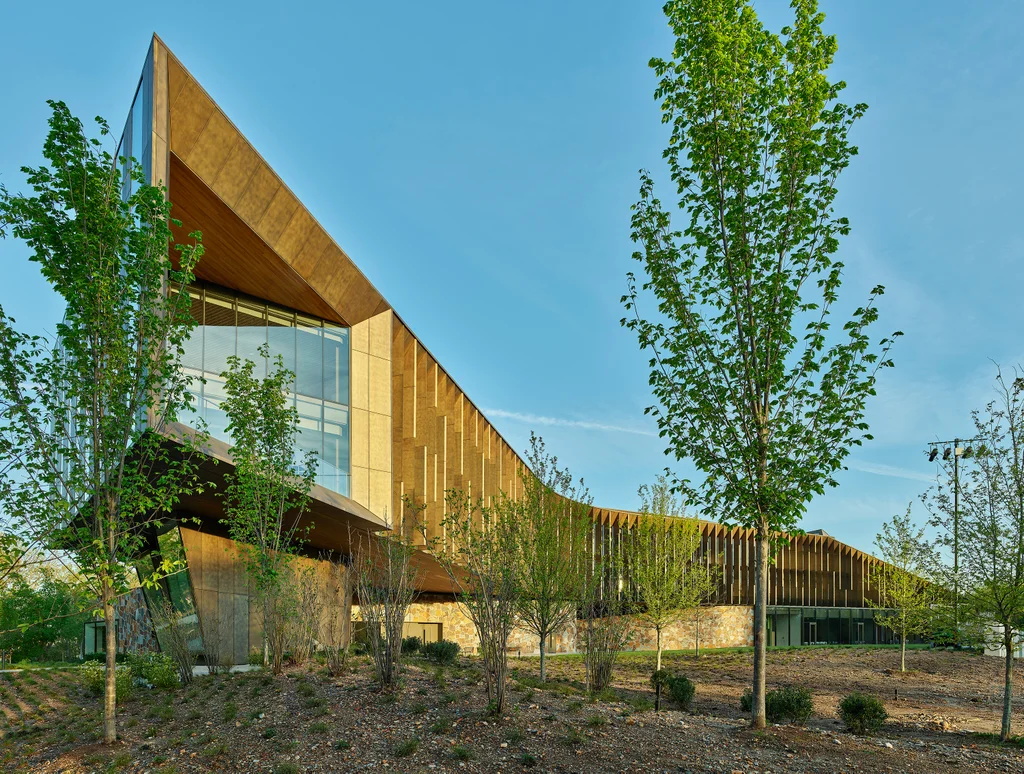
The building opened in 2025. It’s part workplace, part museum, with large and free gallery spaces displaying art throughout the ground floor, a sculptural ceiling of CNC-milled local pecan wood, and two upper floors lined with windows but shielded from direct sun by subtly shaped ribs on the building’s exterior.
Alice has her own compact office in the institute’s building. A desk lined with greeting cards looks out a full wall of windows onto the woods, a view shared equitably by nearly every seat on the floor.
Access is a driving ideal for Alice, both for art and for healthcare. Before making her big investments in Bentonville, she recognized that residents had hours to drive whether they wanted to get to a proper art museum or needed specialized medical care. Bringing those assets closer to home would require building, which she has done, but also the ground-up development of local expertise to serve those community needs.
In 2021, she founded the Alice L. Walton School of Medicine, or AWSOM, as it’s sometimes called, to help train the next generation of doctors to think differently about patient health and wellness. The school is just another short walk through the woods on the Crystal Bridges campus. Like the Heartland Whole Health Institute, it’s focused on changing healthcare and is similarly housed in a large, architecturally expressive building.
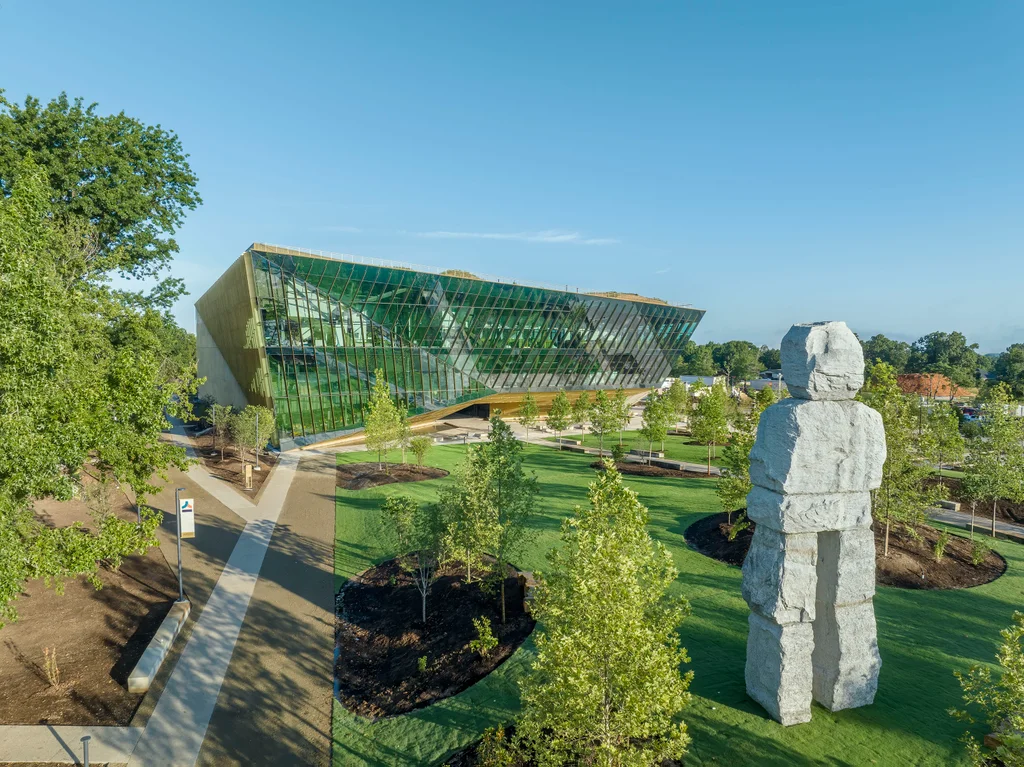
Designed by Arkansas-based architecture firm Polk Stanley Wilcox, the project was inspired by the bluff shelters common to the region’s forests. These large rocky projections have offered spaces of respite for people for thousands of years, and the designers saw a connection with the caregiving that would be taught in the new medical school.
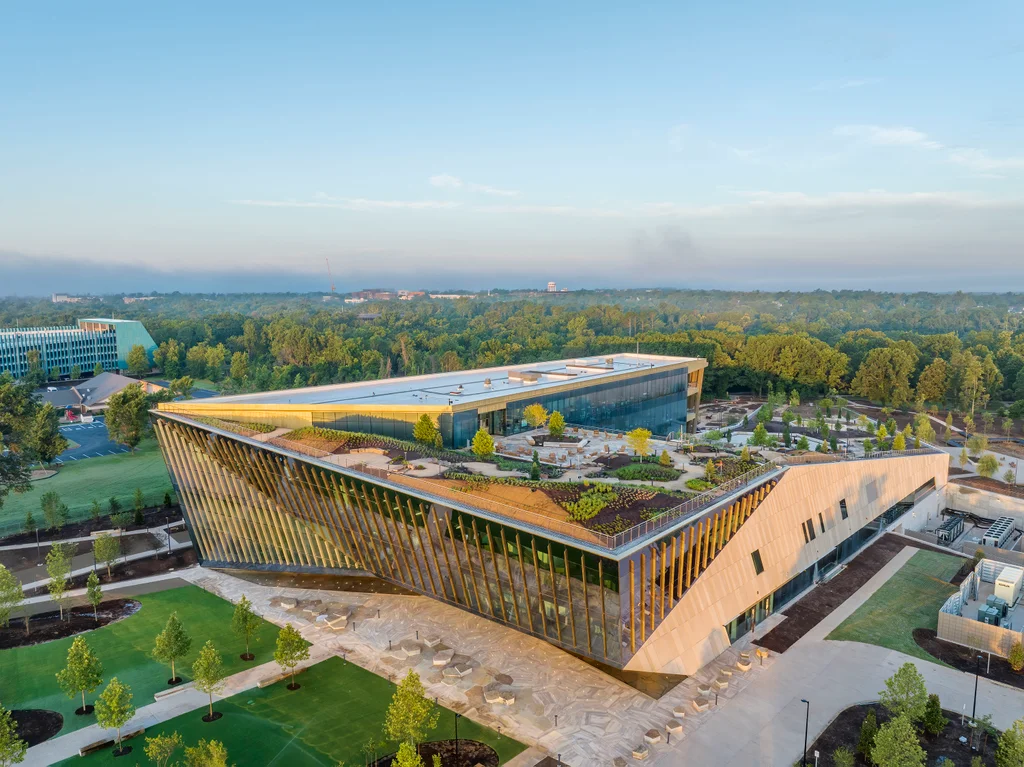
But that didn’t just mean building a monolith on the site. Alice and her team of advisers called for the building to be screened from the nearby hiking trails, leading the architects to propose building it into the landscape itself. The trailside end slowly rises up into a publicly accessible roof park, cloaking the bulk of the 150,000-square-foot building, while the bluff end looks out on a more developed part of town with a mirrored facade of glass and brass.
Walking up the park’s steep slope, Wesley Walls, the lead architect on the project, compares the building to an “abstracted piece of Ozark geology that grows out of the landscape.”
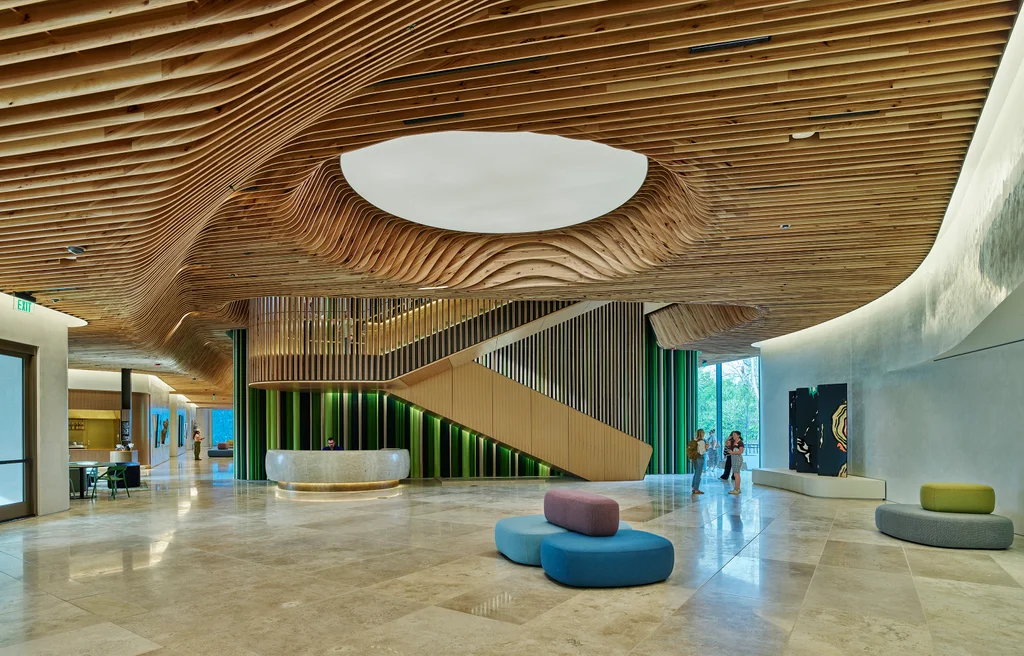
Inside, it’s a sleek university, with lobbies and teaching rooms that could easily double as spaces in a tech office. One room has plasticized cadavers for anatomical study; another is packed with 3D-imaging and printing tools. The biggest teaching rooms were made, at Alice’s suggestion, as open plan as possible, allowing flexibility in how the space is used and how classes are taught.
The school’s first cohort started classes last summer, tuition-free, and roughly 40% of this initial class comes from the region. The goal is that the school will serve as a feeder for the next massive project Alice is building in Bentonville: a 100-acre, $700 million healthcare campus that she hopes will be another big part of changing a healthcare system she sees as inherently flawed. “I think I’ll be spending the rest of my life on this one,” she says.
A new kind of city building
Tom Walton and his brother, Steuart, are currently in the process of demolishing the old Walmart Home Office, making way for the STEM university they’re launching in Bentonville. Rubble spans an entire city block, just down the road from the drab, window-poor and asphalt-ringed building where Sam Walton had his office. That building is also on the chopping block.
If Sam built the wealth that made Bentonville, and Alice set the model for using it to transform the town, Tom and Steuart are part of the third generation stepping up to carry on the family legacy in their hometown. Big projects are in the works, including the university and the healthcare campus, but so are smaller efforts focused on improving the quality of life in the region.
There are the civic buildings and public spaces in towns like Springdale and Rogers that have had their designs subsidized by the Walton Family Foundation’s Northwest Arkansas Design Excellence Program. There is the growing network of parks throughout Bentonville that feature public art and recreation side by side. And then there are all the bike paths.
For his part, Tom is clear-eyed about his family’s peculiar balancing act of using a vast pool of resources to improve conditions without imposing some unwanted destiny. “You can always make the argument like, ‘Oh my gosh, this changed and everything’s developing and it’s different than what it was.’ But I think when you step back and you look at it, net-net there’s a lot more good than bad that’s come out of it,” he says.
While some other billionaires have approached the concept of citymaking through blank slate utopianism or the sandbox of an endless budget, the Waltons are tackling the more feasible, if messier, prospect of changing an already existing place. Experts see lessons to learn from their experience. The Congress for the New Urbanism, the organization behind the traditional walkable town planning approach, recently held its annual conference in Northwest Arkansas, including part of the program in Bentonville.
Carol Coletta was one of the attendees. She’s a Bloomberg Public Innovation Fellow at the Bloomberg Center for Public Innovation at Johns Hopkins University, with decades of experience working with cities and philanthropies on placemaking projects. She’s also been a regular visitor to Bentonville over the years and has seen it transform before her eyes.
“I wish every town had an Alice Walton and a Tom Walton. That would be great,” she says. “But I think there is a pattern to what they’ve done that we can all learn from and we can all emulate. They concentrate their investment geographically, and therefore it has leverage.”
Rather than “sprinkling it like salt,” Coletta says, the Waltons are directing their philanthropy into projects and efforts that can build off each other. The benefit of working in a small town is they can dial in on very specific livability efforts, surgically improving a pedestrian connection downtown or supporting an emerging retail hub. Better trail access is a benefit for residents while also making it easy for visitors to walk to Crystal Bridges.
“The fact that they are able to work and think at that scale and do it with such insight, they clearly have a theory of the game when it comes to making a great place to live,” Coletta says. “I do think there are transferable lessons, but you’re not always going to have a family as well-resourced and as strategic as the Waltons.”
Even at Crystal Bridges—not exactly easy to replicate—there are elements of the institutional mission that don’t necessarily need an $800 million museum to hang on. Olivia Walton, who’s married to Tom Walton, has been the board chair at Crystal Bridges since 2021, taking over the role from Alice. She says Alice’s focus on expanding access to the museum and its offerings will continue to guide its mission.
For the Waltons, that extends past the campus of the museum, spreading out through the rest of town and beyond. But even as they look to the future of what Bentonville can become, all their efforts connect back to the project that kicked off this most exceptional small-town resurgence.
“Crystal Bridges widened everyone’s belief about what was possible in Bentonville and in Arkansas. It felt so unlikely to have a monumental, world-class art museum in the middle of this Ozark forest in a relatively small town in a relatively rural part of the country,” Olivia says. “I think that’s one of the best uses of philanthropy, to take more risk than you would if you had more limited capital.”
Local or Walmart?
“Local or Walmart?” That’s the icebreaker question—or the social appraisal—from the bartender at one of the many nice post-Crystal Bridges restaurants in Bentonville. It’s a question that could have been asked at any time here over the past five decades, when Walmart’s growth turned tiny Bentonville into a regular stopover for the higher-ups of major corporations, and where even the smaller of its suppliers saw fit to open local offices near their undeniably biggest customer.
But since Crystal Bridges opened, the question has a different undertone, possibly accusatory, trying to pin down whether one is part of the new wave, or among those being washed over and priced out.
For anyone living through it, the past 15 years of development, population doubling, and out-of-nowhere tourism would undoubtedly feel dizzying. New development is happening on nearly every street in town, with some homes being rebuilt and others being replaced by newer and larger buildings.
What were once small single-family homes are now property-line-pushing townhomes and multiunit buildings, in line with a recently adopted progressive master plan called Plan Bentonville, developed by veteran New Urbanist planning firm DPZ CoDesign. It’s the kind of infill housing development many towns would be glad to see, but it comes with the basic supply-and-demand challenges of a city experiencing so much growth so quickly. The median sale price for a home today is about $475,000, up from less than $300,000 just five years ago.
“The fast growth has meant that housing prices have skyrocketed compared to where they used to be,” says Jebaraj of the University of Arkansas Center for Business and Economic Research.
Jebaraj notes that housing affordability is just the most visible struggle in Bentonville and the region at large. Other growing pains are more widespread and maybe more limiting in the long term, including a lack of public transit, and a water and sewer system that’s increasingly stressed by rapid population growth.
“I think probably the biggest challenge to our growth and economic development here would be choking on our own success and not addressing the housing affordability, not addressing the infrastructure challenges,” he says.
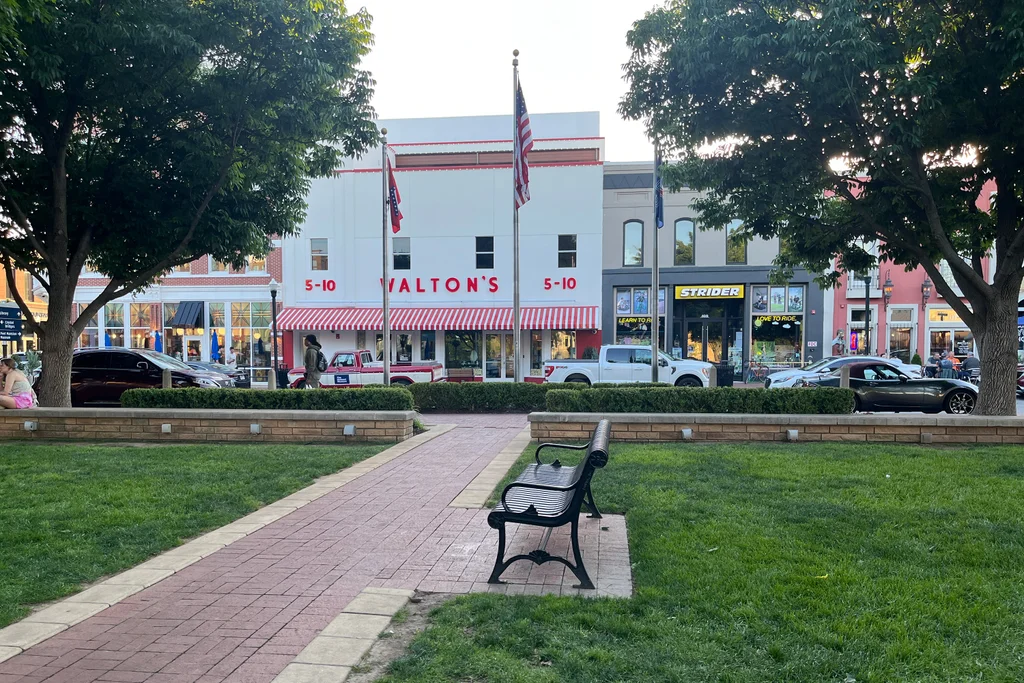
Inside the original Walton’s 5 & 10 store on the town square in Bentonville, the view is more optimistic. The space has been transformed into a bright, maximalist corporate museum. It’s packed with vitrines displaying products sold in Walmarts through the years, tidy multimedia exhibits covering the corporation’s history, and a replica of Sam Walton’s office, complete with a bulletin board map of all Walmart stores and a framed portrait of Walton with two of his hunting dogs.
Upstairs, there’s a small theater of bench seats looking at a rectangular white box featuring a life-size image of Sam sitting on a stool. An attendant explains this is a hologram version of Walton, and he’s been designed to answer questions about Walmart and his own life.
I ask Sam how Bentonville has changed over time. Wearing his signature Walmart trucker hat, he stirs to life, a small smirk emerging as the attendant poses the question to the hologram’s system. Gesturing with his hands, he recalls moving to Bentonville to open his store in 1950 and finding only a handful of retailers, each with its own narrow niche that often led customers to drive to other towns to find what they needed.
“We changed that way of thinking right off and generally sparked up the atmosphere around town,” he said.
Hologram Sam, as futuristic as he appears inside the Walmart museum, is nonetheless frozen in time. He’s able to respond only to questions like this based on what the actual Walton knew by the time of his death in 1991, pulling from his own words. If he thought Bentonville was getting sparked up back then, he had no idea what was coming.