
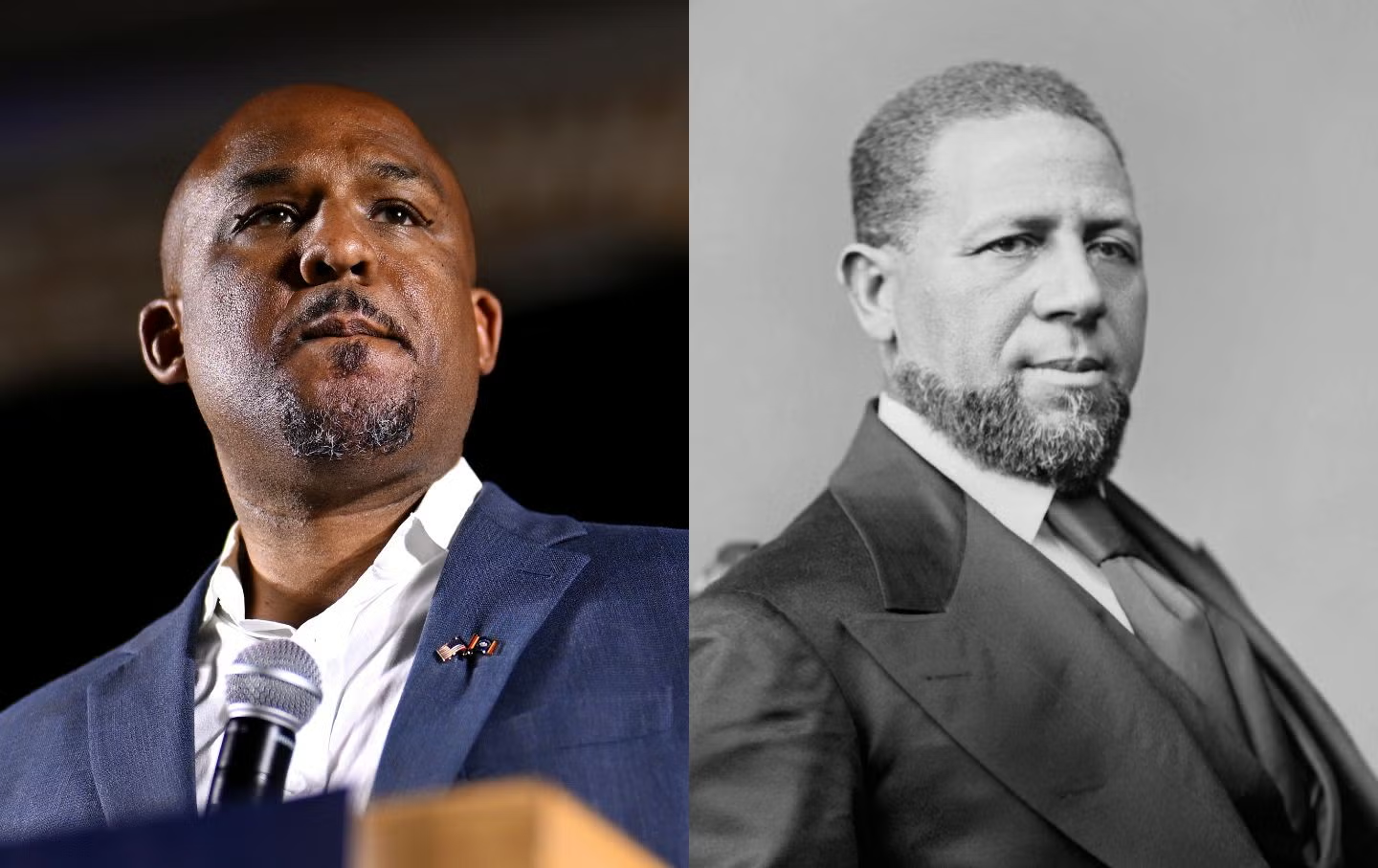
It’s a great pleasure to be here for this historic evening and to celebrate the election of Hiram Revels to the US Senate.
Everybody in the United States probably knows that in our two centuries or so of existence, Barack Obama has been the only African American president. Less familiar is the fact that of the approximately 2,000 men and women who have served in the US Senate since 1789, only 10 have been Black. Ten out of 2,000, or one-half of 1 percent, is a considerably worse ratio than one president out of 45. Of those 10, two—Hiram Revels and then Blanche K. Bruce—were elected from Mississippi during Reconstruction, the era that followed the Civil War. These numbers offer a stark reminder of the almost insurmountable barriers that have kept African Americans from the highest offices in this land, and they also remind us how unique a moment Reconstruction was in the history of American democracy.
This month, February 2020, appropriately Black History Month, marks the 150th anniversary of two momentous events. On February 3, 1870, Iowa became the 28th state to ratify the 15th Amendment, which prohibited denial of voting rights because of race, making the 15th Amendment part of the Constitution. Three weeks later, on February 25, Hiram Revels became the first African American to take a seat in Congress—either house. Later that year, Joseph Rainey of South Carolina became the first Black member of the House of Representatives.
Revels was elected to fill an unexpired term that had been vacant since Mississippi’s secession from the Union in 1861. He served for only one year. No senator could be expected to accomplish a great deal in one year as a freshman senator. “We could have wished for more activity in a virgin field for Negro talent,” commented Frederick Douglass’s newspaper, the New National Era, when Revels’s term concluded, “but on the whole we are content. The precedent itself was something…. by the blacks he was hailed with joy as the harbinger of a better time and a brighter period for the black man and the nation.” As this observation suggests, Revels accomplished more as a symbol than as a legislator.
One indication of his impact on public consciousness lies in the wide circulation of his pictorial image. These years saw the production of numerous lithographs celebrating the overthrow of slavery and the achievement by African Americans of equal civil and political rights. They generally depicted scenes of slavery and freedom, along with likenesses of Abraham Lincoln and prominent Black leaders—Revels almost always among them. In addition, an engraving of a portrait of Revels by the German-born artist Theodore Kaufmann was widely sold during and after Reconstruction, especially to Black families. Frederick Douglass noted that African Americans “so often see ourselves described and painted as monkeys that we think it is a great piece of fortune to find an exception to this rule.” The dignified portrait of Revels was on the wall of many, many Black families in this post–Civil War era.
Revels’s election to the Senate would have been inconceivable without the advent in 1867 of what historians called Radical Reconstruction, when Congress required the former Confederate states, with the exception of Tennessee, to extend the right to vote to Black men. At that time, most Northern states, as well as the border slave states that had remained in the Union, still limited voting to whites. In fact, it’s ironic that African American men in the South, the vast majority of them recently emancipated slaves, won the right to vote three years before most of those in the rest of the country.
Black male suffrage in the South led directly to the election of the country’s first Black political officials. During Reconstruction, some 2,000 African American men, by my estimate, occupied public offices, ranging from Mississippi’s two US senators to 14 members of the House of Representatives, hundreds elected to state constitutional conventions and legislatures, and numerous sheriffs, city councilmen, magistrates, and many others. This was a remarkable experiment in biracial democracy, something virtually without precedent in world history up to that point, and it aroused intense opposition from adherents of white supremacy. It was met with violent assaults on Black voters and officials by the Ku Klux Klan and similar organizations. Democrats—then the party of white nationalism, to use a modern phrase—also launched a highly organized campaign of vilification (fake news, we would call it today) portraying Black voters as incapable of participating intelligently in political life, and Black officials as ignorant, corrupt, and unfit for public service.
At the beginning of the 20th century, as the rights Blacks had acquired in Reconstruction were being systematically stripped away, this political propaganda was given scholarly legitimacy by the nation’s historians. Indeed, Reconstruction stands as a prime example of what we might call the politics of history. I don’t mean whether the historian is a Democrat or Republican. What I’m talking about is the way in which historical interpretation both reflects and helps to shape the politics of the time in which the historian is writing.
For most of the 20th century, what we call the Dunning school—after my long-ago predecessor William Dunning, who taught Civil War history at Columbia University—dominated historical writing and popular thinking on Reconstruction. In that view, Reconstruction marked the lowest point in the saga of American democracy. It was a time of corruption and misgovernment. This portrait reached a broad public in the film Birth of a Nation, which had its premiere in Woodrow Wilson’s White House. One crucial scene in that film vividly demonstrates the so-called incapacity of Black legislators: They sit with bare feet propped on their desks, swigging whiskey, munching on chicken bones, and lasciviously eyeing white women in the galleries.
As late as 1947, the University of Georgia historian E. Merton Coulter, a former president of the Southern Historical Association, described Black officeholding in Reconstruction as, quote, “the most spectacular and exotic development in government in the history of white civilization, the longest to be remembered, shuddered at, and execrated.”
The Dunning school has long since been repudiated by professional historians, although its outlook survives to this day in some corners of popular historical consciousness. But it enjoyed a remarkable longevity, which can be explained by the fact that it harmonized with the racial system of the United States from around 1900 until the civil rights era of the 1960s, because the political lesson of this interpretation of history was very clear: It was a mistake to give Black people the right to vote and hold office; therefore, the white South was correct—legitimated—when it later took those rights away. As Gunnar Myrdal noted in his influential 1944 book An American Dilemma, when confronted with demands for change in the racial system, white Southerners, quote, “will regularly bring forward the horrors of the Reconstruction governments.” That was the trump card if you said that African Americans should enjoy the same rights as anybody else in the South.
When the civil rights revolution took place, the pillars of this old interpretation, especially its overt racism, fell to the ground, and Reconstruction was completely reinterpreted. Today, most historians see it as a noble, if ultimately unsuccessful, effort to establish for the first time in American history an interracial democracy—a precursor of the modern civil rights movement, which was sometimes called the Second Reconstruction. If the era was tragic, we now think, it was not because it was attempted but because it failed, and thus left to subsequent generations the difficult problem of racial justice. Yet far too many Americans still know little or nothing about this transformative period in our history.
So Hiram Revels is worth remembering today both as a pioneer of Black officeholding and as a refutation of outdated stereotypes. Modern research has established that, far from being ignorant and impoverished field hands, as portrayed by the Dunning school, the majority of Black officeholders in Reconstruction owned property, had access to education before or immediately after the Civil War, and many had been free before the war. Some were indeed corrupt, but no more so than white politicians of both parties in an era dubbed by Mark Twain the Gilded Age because of its less than exacting standard of political rectitude.
Of course, Black Reconstruction officials were almost all men of modest means. They stood in sharp contrast to the wealthy lawyers and plantation owners who dominated Southern government before the Civil War. In fact, the emergence of these men like Revels offers living proof of what Thomas Paine, writing about the American Revolution, described as “all the extent and capacity of ordinary people, invisible in normal times, that never fails to appear in revolutions.”
Rather than an ignorant former slave unfit for office, Hiram Revels, for one, was well educated, widely traveled, and fully prepared for legislative responsibilities. But it’s inconceivable that Revels and others like him could have been elevated to public office without the transformative events of the 1860s: the Civil War, emancipation, the rewriting of the Constitution, and the advent of biracial democracy in the South. To understand how this happened requires a very brief look at the unfolding of Reconstruction.
Before the Civil War, slavery powerfully shaped the boundaries of the American body politic. Only a handful of—maybe less than five—Black officials existed anywhere in the country, a few justices of the peace in Northern communities with strong abolitionist sentiments. On the eve of the Civil War, no person, free or slave, could be a citizen of the United States. That was what the Supreme Court decided in 1857 in the infamous Dred Scott decision.
The only ones before the war who advocated a nonracial definition of American nationality were the abolitionists, white and Black. They not only fought against slavery but also for equal rights for free Black Americans. Black political gatherings before the Civil War consciously chose to call themselves conventions of colored citizens. They were claiming a citizenship that the nation denied them. They put forward a definition of citizenship based on birthright—being born in the country—severed from the concept of race.
This is what came about during Reconstruction, with the ratification in December 1865 of the 13th Amendment to the Constitution, which irrevocably abolished slavery. “The one question of the age,” one congressman declared, “was settled.” But if it resolved the fate of slavery, abolition opened a host of other issues. Was the racial inequality inseparable from slavery also being abolished? What would be the status of the former slaves, and who would determine it? What did it mean to be a free person in postwar America? These were the questions on which the politics of Reconstruction persistently turned.
White Southerners had their own answers, as became clear when Abraham Lincoln was assassinated and Andrew Johnson became president. Once lionized in the Dunning school as a heroic defender of the Constitution against vindictive Radical Republicans, Johnson today has a strong claim to being considered the worst president in American history. There are other claimants, but he is a—he is a contender, let’s put it that way.
Johnson lacked all of Lincoln’s qualities of greatness. He was deeply racist, unwilling to ever change his mind, had no sense of Northern public opinion, and lacked the ability to work with Congress. Johnson set up new governments in the South in the months after the Civil War, controlled entirely by white men. These governments, including that of Mississippi, enacted a series of laws called the Black Codes to define the freedom African Americans now enjoyed. These laws gave Blacks virtually no civil or political rights. They required all adult Black men, at the beginning of each year, to sign a labor contract to go to work for a white employer or be deemed a vagrant and sold to someone who would pay his fine.
The Black Codes alarmed the Republican Party, which controlled Congress, into thinking that the South was trying to restore slavery in all but name. Most Republicans agreed that the 13th Amendment, which freed all the slaves, empowered Congress to ensure, as one senator put it, that “the man made free by the Constitution is a free man.” Indeed, Congress soon passed one of the most important laws in American history, the Civil Rights Act of 1866, the first law to declare who is a free citizen of the United States and what rights they are to enjoy.
The Civil Rights Act declared that all persons born in the United States—except Native Americans, who were still considered members of their tribal sovereignty—all other persons born in the country are American citizens. This is the principle of birthright citizenship, a statement that anyone can be a loyal American. Race, religion, national origin do not matter, nor does the legal status of one’s parents. It severs citizenship from race, as the abolitionists had long demanded.
The Civil Rights Act went on to declare that all these citizens must enjoy basic legal equality. States cannot pass one set of laws for Black people—as, indeed, they have just done—and another set for whites. The law guarantees equality of civil rights, specifically the right to sign contracts, own property, testify in court, sue and be sued. These are the rights of free labor, necessary to compete in the economic marketplace.
Andrew Johnson vetoed the civil rights bill, and it became the first important law in American history enacted over a veto. Johnson’s veto message denounced the law for what today is called reverse discrimination. This is Johnson on the civil rights bill: “The distinction of race and color is by the bill made to operate in favor of the colored and against the white race.” But of course, a law a law can always be repealed. So very soon, Congress put these principles and others into the 14th Amendment, the most important change in our Constitution since the Bill of Rights.
Among other things, the amendment tried to address an ironic consequence of abolition. The end of slavery also ended the three-fifths clause of the Constitution. Under that, the white—the free population and three-fifths of the slaves were counted in apportioning members of Congress among the states. Now, with all free, the entire Black population—five-fifths—would be counted, giving the Southern states enhanced representation in the House of Representatives. Radical Republicans in Congress insisted that the only way to guarantee that Southern congressmen fully respected Black freedom was to give the right to vote to African American men.
But Black suffrage still remained highly controversial, and the more moderate majority in Congress believed the Northern public would not embrace such a departure from the long tradition of state control of voting qualifications. The result was a complicated compromise: a section, which has never been enforced, that deprives states of part of their representation in the House if they denied the right to vote to any group of male citizens. Thus Mississippi, whose population then was a little over 50 percent Black, would lose half its congressmen if it continued to deny Black men the right to vote. But, as I say, it was never enforced.
This section also raised an outcry among the era’s feminist movement, because for the first time it introduced the word “male” into the Constitution. Unlike men, there was no penalty if states denied women, Black or white, the right to vote, as all of them, of course, did at that time.
But the heart of the 14th Amendment is the first section. This constitutionalizes the principle of birthright citizenship and goes on to bar states from abridging the privileges or immunities of citizens or denying to any person—citizen or immigrant—the equal protection of the law. The 14th Amendment introduces a commitment to equality into the Constitution for the first time, and the language is race-neutral, which has had enormous consequences in our own time. In recent decades, the courts have used this amendment to expand the legal rights of numerous groups of Americans, most recently gay men and women seeking to marry. All in all, to borrow a phrase from the editor George William Curtis at the time, the 14th Amendment changed the constitution for white men into a constitution for mankind.
Encouraged by President Johnson, the all-white governments he had established in the South, except for Tennessee, refused by overwhelming margins to ratify the 14th Amendment. The vote in the Mississippi legislature, probably in this very room, was 115 to 0. Clearly, the principle of equal rights regardless of race was not easy to accept. After winning a sweeping victory in the congressional elections of 1866, Northern Republicans decided that the only way to secure both ratification of the 14th Amendment and what they called loyal government in the South was to replace the Johnson regimes which one with ones in which African Americans enjoyed the right to vote and hold office. Thus began Radical Reconstruction.
Black voters celebrated the winning of the right to vote—at least for men—as recognition that they were now full members of the American body politic. They flocked to the polls in remarkable numbers. In Southern elections in 1867 and 1868, over 80 percent of those eligible to vote cast ballots, a far higher percentage than we experienced in elections today.
Along with white allies, Black voters elected biracial constitutional conventions, which drew up new documents for the Southern states based on political equality. The 15th Amendment, as I noted, soon followed, its ratification sweeping away the laws of the 17 states that still limited voting to white men. Republicans, Black and white, celebrated the 15th Amendment as the triumphant conclusion of what the party leader Carl Schurz called the “constitutional revolution” of Reconstruction.
At a gathering here in Jackson, James Lynch, Mississippi’s newly elected African American secretary of state—a predecessor of Congressman Espy, who I think was secretary of state here also a while ago—James Lynch described the amendment as both an embodiment of the ideals of the Declaration of Independence and part of the worldwide spread of democracy. “Nothing in all history,” exclaimed the veteran abolitionist editor William Lloyd Garrison, “equaled this wonderful, quiet, sudden transformation of 4 million human beings from the auction block to the ballot box.”
Hiram Revels’s life and his brief career in the US Senate reflected this constitutional revolution. Born free in Fayetteville, North Carolina, in 1827, Revels was descended from ancestors as diverse as America itself. They included Native Americans, whites, and Blacks. However, Revels enjoyed opportunities, especially extensive access to education, unavailable to most African Americans before the Civil War. His forebears, he wrote in a brief autobiographical essay, “had been free as far back as my knowledge extends.” He recalled that two fine colored schools existed in Fayetteville, and one of them he attended as a youth. In 1844, Revels moved to Indiana, where he received further education as the only Black student in a Quaker seminary. He went to attend another seminary in Ohio, a school in Baltimore, and at a time when only a tiny number of Americans of any race attended college, he studied for a year at Knox College in Illinois.
Even in a society known for its migratory population, Revels before the Civil War was unusually well traveled. Ordained a minister in the African Methodist Episcopal Church in 1845, he preached as an itinerant missionary in Indiana, Illinois, and Kansas. He even ventured into the Upper South slave states of Kentucky, Tennessee, and Missouri, hoping to bring religious instruction to slaves. His presence there sparked what he later described as “a great deal of opposition.” At one point, he was jailed for “preaching the gospel to Negroes.” Revels later claimed not to have said anything that might incite enslaved men and women to run away, but he added that when in the free states, “I always assisted the fugitive slave.”
When the Civil War broke out, Revels was working in Baltimore as an AME minister and principal of a high school for Black students. In 1863, he moved to St. Louis, where he founded a school for freed slaves and, according to some accounts, helped to organize Missouri’s first regiment of Black Union soldiers. He appears to have come to Mississippi in 1864. He threw himself into educating the freedmen and women, and in 1868 became pastor of an AME church in Natchez.
Revels’s political career began in 1868, when Union Gen. Adelbert Ames, the state’s provisional governor, appointed him to the Natchez Board of Aldermen. Revels was soon elected here to the state Senate. Before the ratification of the 17th Amendment in 1913, US senators were elected by the state legislatures, not by popular vote. With a large Republican majority, which included almost three dozen Black members, Mississippi’s lawmakers chose Governor Ames to fill one Senate seat, which was a full term, and Revels to fill the shorter term, which, as I said, expired in one year. His election came as something of a surprise, as Revels was little known in Republican Party circles outside Natchez.
John R. Lynch, later a Black congressman from Mississippi, claimed that the invocation Revels delivered at the opening of the legislative session, which he called “one of the most impressive and eloquent prayers ever delivered in the Senate chamber,” made Revels a candidate for the US Senate seat. But it’s also true that as a presiding elder of the Methodist Episcopal Church, which he had recently left the AME to join, Revels was well known in Mississippi’s Black community. In any event, the Black members of the legislature pressed for the elevation of one of their own to the Senate. The assertiveness of Blacks—of Mississippi’s Black political leadership continued throughout Reconstruction, to the chagrin of many white Republicans.
Revels arrived in Washington in February 1870. He received an enthusiastic welcome from the city’s Black community, complete with dinners in his honor, including one attended by President Grant and the members of his cabinet. The Senate’s small contingent of Democrats challenged Revels’s right to take his seat. The Constitution requires a senator to have been a citizen for at least nine years, but Black citizenship, Democrats insisted, had only been established by the Civil Rights Act of 1866 and the 14th Amendment, ratified in 1868. Before then, they said, the Dred Scott decision, which limited citizenship to whites, was the law of the land. Thus, they said, Revels fell several years short of eligibility.
This debate, which also played out in the nation’s press, took on a starkly racist tone. The New York World, the nation’s leading Democratic paper, described Revels as, quote, “a lineal descendant” of an orangutan. Senator Garrett Davis of Kentucky claimed that Dred Scott had been correctly decided and indeed was still the law of the land. The Republican leader Senator Jacob Howard of Michigan declared himself nauseated by the overtly racist language and that anyone in 1870 could still invoke Dred Scott. Republicans insisted that the Reconstruction Amendments—13, 14, and 15—not to mention Union victory in the Civil War, had nullified central parts of the prewar legal order rooted in slavery, the disqualification of Blacks from citizenship among them. On February 25, 1870, by a vote of 48 to eight, entirely along party lines, the Senate voted to seat Hiram Revels.
During his year in the Senate, Revels later insisted, “I did all I could for the benefit of my needy and much imposed-upon people.” He spoke vigorously for the reinstatement of Black legislators who had been illegally expelled from Georgia’s General Assembly. He persuaded Secretary of War William Belknap to arrange for Black mechanics to be hired for the first time at the Baltimore Navy Yard. When a bill to establish a free public school system in the nation’s capital came before the Senate, Revels strenuously opposed an amendment that deleted a clause banning distinctions on account of race in school admissions. In other words, he opposed allowing the schools to become racially segregated. He spoke eloquently of the discrimination faced by Blacks on railroads, streetcars, and steamboats, discrimination he and his family had experienced while traveling in Kansas before the war, when they were ordered to leave the first-class railroad car. Revels condemned, quote, “the prejudice in this country to color,” emphasizing that Blacks had done nothing to deserve it. “I sometimes fear that it is on the increase,” he added. “We must admit that it is wrong.” But the amendment passed, and the District of Columbia’s school system remained segregated until the mid-1950s.
When Revels was elected, a Mississippi Democratic newspaper called the result “a good omen,” as he belonged to the moderate wing of the Republican Party. And in fact, on the spectrum of Reconstruction politics, Revels was one of the more conservative Mississippi Black Republicans. Like any senator, he introduced bills to benefit local constituents, including one calling for federal aid to rebuild Mississippi River levees damaged during the war and another to help support the construction of a railroad in Mississippi. But these did not pass.
Only one of his measures became law: a bill restoring the civil and political rights of former Confederate Army officer Arthur E. Reynolds, so that he could be appointed to a judgeship by Mississippi’s governor, James L. Alcorn. Revels told the Senate that while violence was common in other states, Blacks and whites in Mississippi were getting along harmoniously—a statement that led to criticism from fellow Republicans in Mississippi, where the Klan had already made its appearance and was committing outrages.
During his brief career in the Senate, Revels was in great demand as a public speaker. In the summer and fall of 1870, he embarked on an ambitious lecturing tour. Many of his speeches celebrated the ratification of the 15th Amendment. Except in Philadelphia, where the Academy of Music refused to allow him to speak in its hall, he drew large and appreciative audiences. When Revels lectured in Boston, the abolitionist Wendell Phillips said he could hardly believe that a thousand men had come to hear “a senator from that race which has been so long victimized.” The speaking tour proved to be quite successful, and on October 1, 1870, Revels sent his wife a check for $3,000—an enormous sum at that time—to help the family purchase a plantation.
After Revels’s term expired, Governor Alcorn appointed him to head a new college for Black students named for the governor. Alcorn State was the nation’s first Black land-grant institution. A prominent planter, Alcorn had hoped to lead what he called a “harnessed revolution,” in which Black civil and political rights would be respected by prominent whites like himself, but effective political power would remain in white hands. Revels sided with Alcorn against a more radical wing of the party headed by Adelbert Ames, the ex-governor. Few Black leaders or voters followed his example. With overwhelming Black support, Ames was elected governor in 1873. Shortly thereafter, Revels resigned from his university presidency after Ames indicated a desire to replace him because of his close ties with ex-governor Alcorn.
Revels, virtually alone among Mississippi’s Black leaders, supported the Democratic campaign that overthrew Reconstruction in the state in 1875. Immediately after the election, he wrote a letter to President Grant criticizing Northerners who had taken leadership positions in the Republican Party, known by their opponents as carpetbaggers. Despite the abundance of evidence that Democratic political terrorism was largely responsible for the end of Reconstruction in Mississippi, Revels told a Senate investigating committee that he himself had no knowledge of acts of violence against Black voters. After what Democrats called the “redemption” of Mississippi, Revels was reappointed president of Alcorn State. He retired in 1882.
As the harsh reality of Jim Crow replaced the optimistic vision of the future embodied in Reconstruction, Revels seemed to become more and more conservative. He was always more of a churchman and an educator than a politician. He had long believed that the descendants of slavery, through no fault of their own, needed guidance from well-disposed whites. In 1876, Revels published a protest in a religious newspaper against the Methodist Episcopal Church’s plans to hold racially segregated annual conferences in the South. He warned that such a policy would damage the self-esteem of Black clergymen and deprive the, quote, “unavoidably poor and ignorant colored people” of white religious instruction.
In 1890, in this room here, I think, Mississippi’s constitutional convention stripped the state’s Black population of the right to vote through ostensibly race-neutral requirements, such as payment of a poll tax and the ability to provide a reasonable interpretation of the state Constitution. This so-called understanding clause left the right to vote in the hands of local registrars, generally low-level Democratic Party functionaries. For good measure, the convention called for the repeal of the 15th Amendment. Some Black Mississippians challenged these provisions in federal court, but the Supreme Court did not heed their pleas.
Revels’s response reflected his more moderate style of political leadership. He called on African Americans to seek the confidence, respect, and protection of white citizens who have the influence and power to protect them, winning this respect by their industry. This was essentially the message Booker T. Washington would articulate five years later in his celebrated speech at the Atlanta Cotton States Exposition. So Revels, I think, represents that strand of Black political thought from the Reconstruction era up through the era of Booker T. Washington.
In his last years, Revels served as pastor of churches in Vicksburg and Holly Springs and taught school in Claiborne County. He died in 1901. Two weeks after his death, George H. White of North Carolina, the last Black congressman of the long post–Civil War era, gave his farewell address to the House of Representatives. “This is perhaps the Negro’s temporary farewell to Congress,” said Congressman White, “but let me say, Phoenix-like he will rise up some day and come again.”
But the reemergence of Black members of Congress did not take place for quite a while. Until Oscar De Priest’s election to represent a Chicago district 28 years later, Congress remained completely white. Not until 1973, when Barbara Jordan and Andrew Young took their seats, did a former Confederate state send another African American to the House of Representatives. As for the Senate, Blanche K. Bruce served one term after being elected from Mississippi in 1874. Not until nearly a century passed, in 1967, would the Senate welcome its next Black member, Edward Brooke of Massachusetts.
Today, the House of Representatives includes 54 Black members, including two nonvoting delegates. No fewer than 22 of them represent states of the old Confederacy. As for the Senate, Carol Moseley Braun, elected from Illinois in 1992, was the next after Brooke. Barack Obama and Roland Burris later succeeded her in that same Illinois seat, and William Cowan of Massachusetts served very briefly. Today, for the first time in American history, the Senate has three African American members: Cory Booker of New Jersey, Kamala Harris of California, and Tim Scott of South Carolina. Scott is the first African American senator since Revels and Bruce from a state that seceded from the Union and experienced Reconstruction. Perhaps there will be another one soon.
Revels’s career exemplifies important features of the Reconstruction era. Then as now, the Black church and school were springboards to political careers. As with him, after farmer, minister was the most common occupation of Black Reconstruction officials, with educator not far behind. Like Revels, many Black leaders had a connection with the Union military during the Civil War.
Popular
“swipe left below to view more authors”Swipe →
While the Reconstruction Republican Party achieved a remarkable degree of racial cooperation, the Black-white alliance—and relations between African Americans, Northerners, and Southern whites—was frequently fraught with tension, as in Mississippi. Like many other Black Republican officeholders, Revels had descendants who went on to distinction in other fields. His daughter Susie Revels Cayton edited a newspaper for many years in Seattle, Washington. She had two sons: the sociologist Horace R. Cayton Jr., the co-author of a classic study of African American life in Chicago, Black Metropolis, and Revels Cayton, a very important West Coast labor leader.
Revels’s career also suggests that, even after the passage of a century and a half, Reconstruction remains part of our lives today—or, to put it another way, key issues of that era remain unresolved. Who should have the right to vote? As in the late 19th century, state voter-suppression laws today have denied thousands of Americans the right to cast a ballot.
And I should say that, since that is the case, the second section of the 14th Amendment ought to be enforced, taking away members of Congress for those states which are denying so many citizens the right to vote. As in the late 19th century, who is entitled to citizenship remains highly contested. It’s fought out every day on our country’s borders. Indeed, last year President Trump claimed the right to abrogate the first section of the 14th Amendment by executive order, with regard to American-born children of undocumented immigrants. The public campaign a few years ago to deny the citizenship of President Obama is reminiscent of the efforts in 1870 to prevent Hiram Revels from taking his Senate seat because he was supposedly not a citizen. And in the oft-encountered idea that expanding the rights of non-whites somehow punishes the white majority, the ghost of Andrew Johnson still haunts our discussions of race.
The greatest lesson of Reconstruction is that rights, even when inscribed in the Constitution, can never be taken for granted. If the election of Revels and hundreds like him seemed to augur a permanent change in our democracy, the subsequent abrogation of those rights in the South, with the acquiescence of the rest of the nation, reminds us that, to alter a celebrated observation of Martin Luther King Jr., the arc of the moral universe does not always bend toward justice.
Today, we live at a time in some ways like the 1890s, when, as Frederick Douglass complained, “principles which we all thought to have been firmly and permanently settled have been boldly assaulted and overthrown.” But despite the many disappointments that followed, the anniversary of the seating of Hiram Revels remains worthy of celebration as part of the long effort to purge this nation of the legacy of slavery. And, properly remembered, Reconstruction remains an inspiration to those striving to make this a more equal, more just society.
More from The Nation

Texas’s newly elected attorney general, Nathan Johnson, has the power to end the state’s role as a pipeline for the most toxic high-court cases.

Yes, the defense secretary has committed impeachable offenses. But he’s also just really, really, really bad at his job.
The Ohio representative was once too extreme for GOP leadership. Not anymore.