
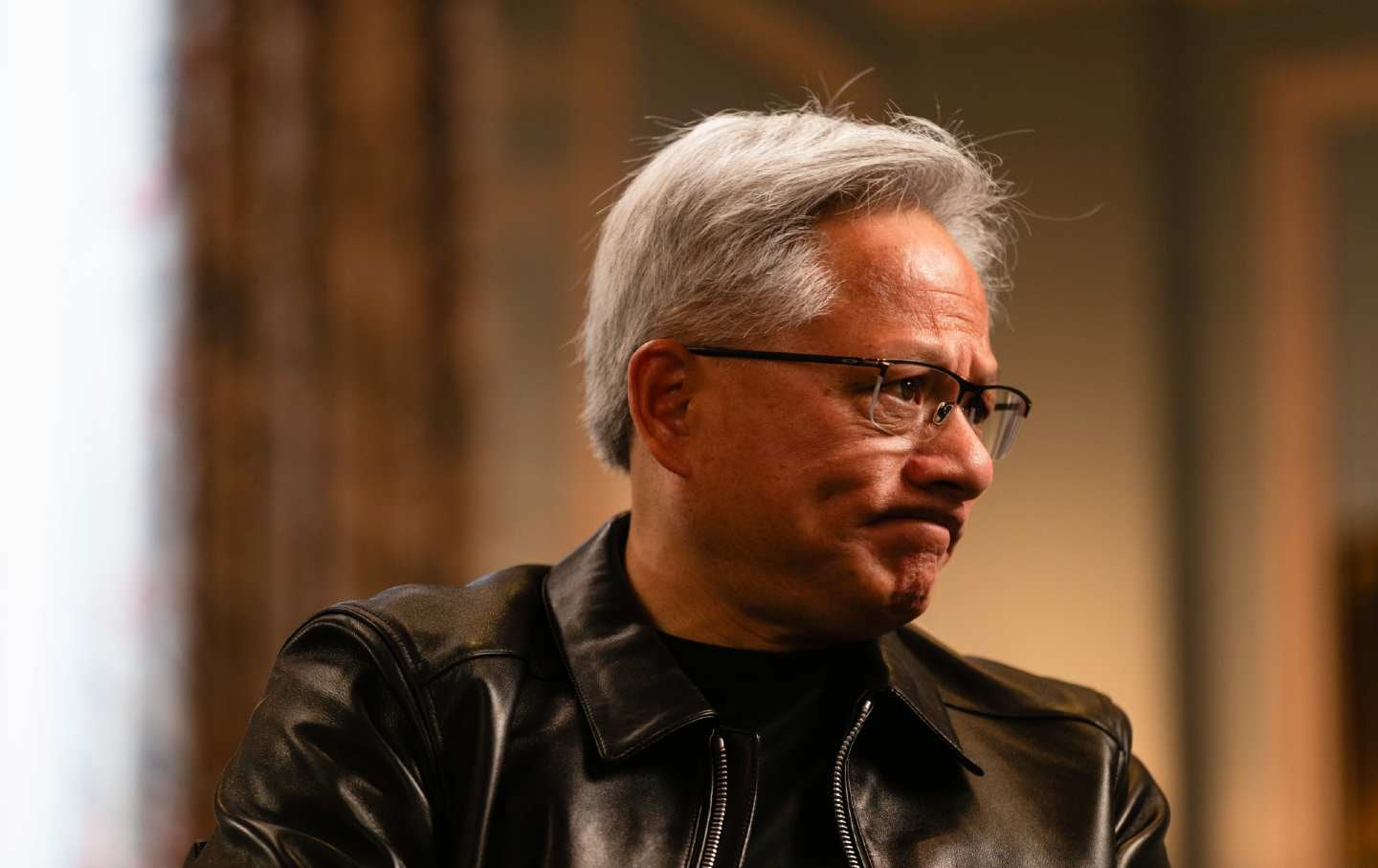
A tech titan’s dopey affair with a suspected Chinese agent could upend the economy.
Nvidia CEO Jensen Huang during a Bloomberg TV interview in London last month.
(Jose Sarmento Matos / Bloomberg via Getty Images)
Will the AI boom that currently powers the stock market—and pretty much the whole economy—be brought low by one tech exec’s inability to keep it in his pants? Nervous investors sent Nvidia’s stock skittering downward after hours Wednesday in the wake of reports that the already scandal-infected company CEO Jensen Huang had a relationship with an executive who reports to him—and that Nvidia’s board was about to send him packing. Huang wound up sparing them the trouble by announcing his resignation Thursday.
This was all, of course, on top of his recent admission that he’d had an affair with a Chinese executive at the tech firm Megaspeed with the same last name who the US government says is a Chinese spy. Many observers thought that Huang would somehow survive the revelation of the Chinese spy affair, but evidently two affairs is one too many to overlook.
A CEO having a fling with a subordinate is an egregious HR nightmare, to be sure, but it was the affair with apparent Chinese Ministry of State Security employee Alice Huang that raised actual geopolitical concerns. Had the Nvidia CEO (knowingly or unknowingly) passed along information to her or lobbied for an easing of restrictions on plans to export chips to China at least in part on her behalf? Was he so gullible that he didn’t realize she was a spy? Or could he have known, and thus committed some light (or possibly heavy) treason?
But the whole Huang fiasco looks like it could be far more than a sex scandal with a side of espionage. Some company critics are suggesting that Nvidia’s “China problem” goes well beyond Huang’s bad spy romance. We know that Nvidia sold some $4.6 billion worth of chips to a Megaspeed subsidiary, ostensibly intended for a Malaysian data center. But Culper Research, a small short-selling shop that produced an explosive report on Nvidia back in May, says that this is just the tip of the iceberg: Culper estimated that at least 20 percent of the company’s compute revenue in the 2026 fiscal year may have come from illicit sales of its most advanced chips to a network of sketchy companies in Southeast Asia that have in some instances diverted the chips to China, contravening the US export ban.
According to Culper, “Numerous experts told us that Nvidia has long possessed the means to detect diversions”—including post-sale technical tests of server IP addresses and latency time, which could prove that the chips were physically in China. The implication is clear: Either Nvidia knew about the diversions and did nothing, or it didn’t even bother to check, almost certainly because company leaders didn’t want to know. (Culper Research acknowledged in its report that it was shorting Nvidia stock, which means that it benefits if it goes down.)
Current Issue
Ed Zitron, a tech muckraker and AI-boom skeptic contends, based on Culper’s research and his own, that “Nvidia is an untrustworthy company inflating its revenues with deals that range from dodgy to outright illegal.”
Culper’s broad-ranging accusations haven’t exactly been at the center of the media coverage of the scandal. A Wednesday New York Times profile of the man behind Culper mentioned them only glancingly, but you can rest assured that reporters at the Times and elsewhere are hard at work trying to corroborate the Culper research—and so are congressional investigators. In other words, as big as the Nvidia scandal is now, it could get a lot bigger.
And of course there’s the not-inconsiderable political angle. President Donald Trump was first informed of Huang’s affair with a spy about a year ago, and was reminded again by Marco Rubio just prior to a trip Trump took to Beijing back in May. Trump was evidently so unbothered by the fact that the CEO running the firm that provides the essential infrastructure for the AI boom, whose most powerful chips are so cutting-edge that it is forbidden to sell them to China, might be compromised by Chinese intelligence that he went ahead and invited Huang on his trip. As the Times put it, in its deadpan prose, “Mr. Trump has been wary of disrupting Nvidia’s chip sales, which are helping to drive the economy and the stock market.” (Trump also harbors his own conflict of interest, having brokered a deal for the United States to share between 15 and 25 percent of Nvidia’s revenues derived from China sales.)
Trump continues to insist that he knew nothing of any of this until “not too long ago.” As far as he’s concerned, Huang is “an amazing guy” who, as far as Trump knows, hasn’t “done anything wrong.” He went on to offer the perplexing explanation that Huang “dealt with somebody, but you know, so does everybody else.” On Sunday, after Huang had publicly confessed to having an affair, Trump assured reporters that the CEO was “an honorable guy. I think he probably has an excuse for it.”
It’s unlikely that Huang has even one convincing explanation for his actions. But what Huang did have was a crisis PR firm—run by Risa Heller, who famously also represented former (and greatly disgraced) Democratic Representative Anthony Weiner, and which he hired around the time the Times first raised questions about his association with Alice Huang in an article more than a year ago. Presumably, Huang (Jensen, that is) thought that he was about to be enveloped in a scandal of his own making. The Times article, titled “A Mystery C.E.O. and Billions in Sales: Is China Buying Banned Nvidia Chips?,”not only featured several photos of Huang and Huang, er, networking in Taipei; it also made a pretty convincing case, if an implicit one, that Nvidia should have known that Megaspeed was not exactly on the up-and-up. The article closed with a memorable vignette, noting that when a Times reporter visited the headquarters of Megaspeed’s subsidiary Speedmatrix in a Malaysian mall, “three employees inside did not answer despite repeated knocks. A woman eventually emerged for lunch and identified herself as an administrator. She said she had no contact with her bosses. When asked what the company did, she said, ‘It’s not clear.’ ”
You might have thought that this report, which sketched out many of the basic elements of the scandal that now saturates the financial media, would have been a huge deal at the time. But the world only really stood up and took notice when we learned last week that Huang was literally fucking someone who seems to be a Chinese spy.
But the scandal’s salacious aspects aren’t the key issue here, largely because of who Jensen Huang is. He wasn’t just any CEO, just as Nvidia isn’t just any company. Huang was the de facto “key man” of the second-biggest company in the world by market cap, after Apple. Many tech industry observers regarded him as an indispensable figure in the rolling AI boom, and he apparently concurred, having made no effort to groom a successor. Oops.
Popular
“swipe left below to view more authors”Swipe →
As for the $4.2 trillion company he cofounded, it isn’t just a supplier of the chips that make the AI boom possible; it’s widely considered the “central bank of AI.” Its outsize market valuation has left it deeply entangled in a web of circular finance with companies ranging from tech giants like Meta and OpenAI to smaller companies like the cloud-computing rentier CoreWeave. Nvidia will often invest billions of dollars in companies that in turn buy billions of dollars worth of chips from it. It’s all a bit reminiscent of writer Brandy Jensen’s definition of “modern friendship [as] just sending the same $20 back and forth via venmo, forever.” The Economist, noting that Nvidia pledged more than $70 billion in investments in start-ups over three years and offered $300 billion in financial support to customers, warns that “the more of this boom they finance, the more of any bust they will have to bear.”
And the more of this boom they finance, the more likely that a scandal like the one they now face could trigger an AI market crash that could quickly spread to other stocks and take down the economy itself. As Charlie Warzel of The Atlantic notes, “Nvidia has much of the financial system in a hostage situation. Huang is too big to fail.” And now he has.
But Nvidia isn’t the only company that is, as Warzel and Matteo Wong put it in an Atlantic essay last year, “load-bearing” for the economy. So are the other giant firms at the top of America’s corporate heap, many of which have become monstrously large in recent years. Concentration of economic power has increased dramatically. At the end of 2015, the top 10 firms in the S&P 500 represented roughly 19 percent of the market cap of the total index, according to RBC Wealth Management; by the end of last year the top 10 represented nearly 41 percent, a record. (My own back-of- the-envelope calculations suggest the number is a few percentage points higher today.)
Meanwhile, the diversity of these top firms has decreased as the AI boom has inflated the top tech firms and pushed older stalwarts like GE and Johnson and Johnson off the list. Currently, after Apple and Nvidia, the next five-largest US companies by market cap are all tech firms, with most of them, including Alphabet (the parent company of Google), Microsoft and Meta, heavily invested in AI—and all are large customers of Nvidia. If Nvidia falls, so will they, and we’ll all suffer the collateral damage. Hey ChatGPT, are we all screwed?
More from The Nation

In their new book, economists Arjun Jayadev and J.W. Mason examine the peculiar role money plays in shaping human life.
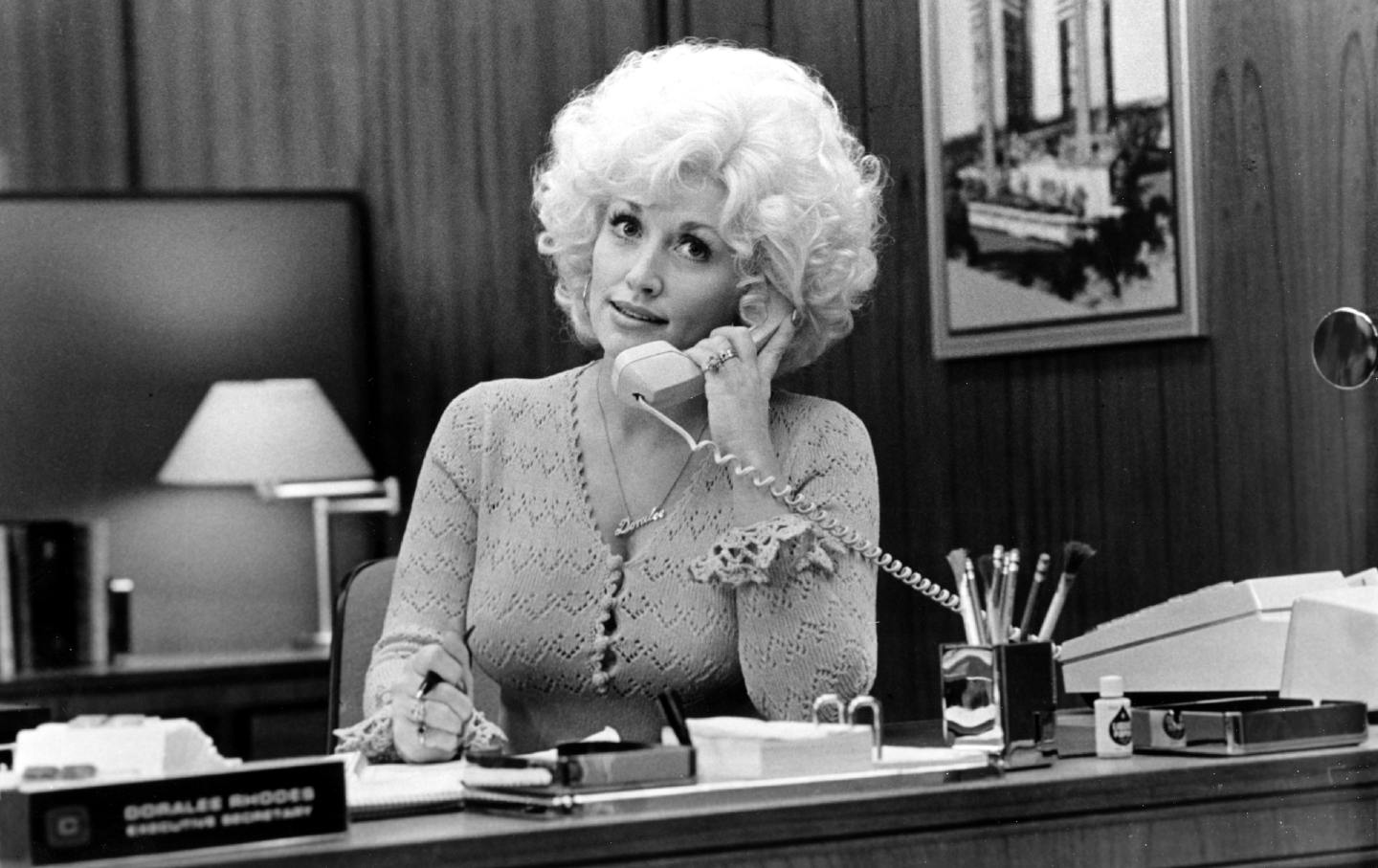
Organized labor is celebrating the life and legacy of an artist who championed working women and carried a union card for almost 60 years.
By force of preset agendas, conservatives and liberals react to debt headlines like Pavlov’s dogs.

As the Biden-era SAVE plan ends, borrowers are facing unaffordable bills, lost payment records, and errors that have falsely put some into default.