
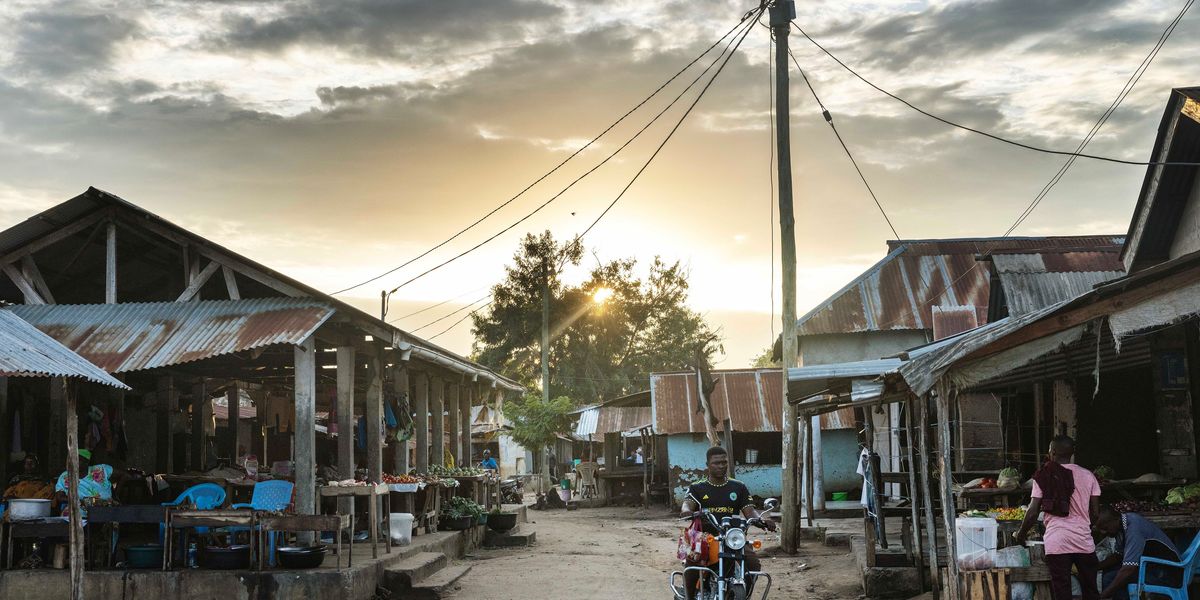
I dined recently with Joe, a Nigerian who manages a 400-hectare rice farm in the north of his country. Nigeria imports about 2.4 million metric tons of rice annually, according to the U.S. Department of Agriculture. Farmers like Joe are helping to move his country of 237 million people toward self-sufficiency in rice.
But farmer Joe has a handicap. “For me, the power grid is a fiction,” he says. “I don’t get any electricity from the grid, and I never will.”
Five years ago, Joe installed solar panels to power his farm’s irrigation system, which draws water from a nearby river. His milling and bagging machines, meanwhile, still run on diesel generators. When Nigeria ended its fuel subsidy in 2023, Joe’s fuel costs soared, reducing the money he can invest in more land and other improvements.
What is holding back Africa’s electrification?
Joe’s predicament is not unique. In sub-Saharan Africa, 600 million people—about 53 percent—still have no access to electricity. Even this grim statistic understates the problem, because “access” can mean just enough wattage to illuminate a few LED lightbulbs some of the time. It’s not what Western Europeans or North Americans would consider electricity.
And traditional power grids in sub-Saharan Africa are hampered by poor reliability and frequent outages. Even when offered electricity, many customers can’t afford to pay, and so theft of service is endemic. Where grids do exist, “they are outdated, unstable, and lack customer connections,” the United Nations Conference on Trade and Development (UNCTAD) reported in 2023.
“I’m a bit tired of imprecise measures of access if that access doesn’t translate into the potential for substantial improvements and increases in consumption,” says Christopher D. Gore, a professor of politics and public administration at Toronto Metropolitan University, who studies electricity usage in the region. “Our latest research shows that [sub-Saharan] households are happy to have any electric light but remain dissatisfied with the minimal supply, the price, and the quality of both grid and solar power.”
The electricity deficit may well be worsening. In a 2024 report on universal energy access in Africa, researchers from the Center for Strategic & International Studies, in Washington, D.C., concluded that “demand is significantly outstripping supply, and the energy crisis is deepening.”
To address this dire shortage, the World Bank and the African Development Bank announced an initiative last year called Mission 300, to bring electricity to 300 million people in sub-Saharan Africa—about half the number who lack access now—by 2030. Such a rapid expansion means bringing electricity to an additional 4.2 million people every month on average.
While plausible, the expansion faces headwinds, most notably from the sub-Saharan’s net population gain of about 2.5 million people per month. If that population growth continues for all six years of the initiative, there will be an additional 180 million people requiring electricity access.
“The challenge is large. Africa’s population is projected to double by 2050,” says Barry MacColl, a senior regional manager at the Electric Power Research Institute (EPRI), who covers Africa from Johannesburg. “Expanding national grids can be expensive and slow, especially in rural and remote areas, where most of the unelectrified people live.” For example, South Africa’s main utility, Eskom Holdings, estimates it will need to spend 390 billion rand (US $22 billion) over the next decade to expand and upgrade its aging power grid and prevent future blackouts.
Large differences in electricity access persist among and within African countries. According to a 2020 report from Germany’s Federal Ministry for Economic Cooperation and Development, in the East, West, and Southern African regions, about half the people have access to electricity, but the percentage falls to a mere 30 percent in Central Africa, where nearly 100 million folks have no electricity access. And according to the World Bank, about 82 percent of urban residents had electricity access in 2023, but only 33 percent in rural areas. (The North African countries aren’t part of the sub-Saharan region, and, except for Libya, have electrification rates of 100 percent.)
Off-grid solar’s untapped potential in Africa
Fossil fuels still play a big role in Africa’s power generation. Natural gas is the single largest source of electricity generation, while coal is significant only in South Africa. Together, they account for roughly two-thirds of the continent’s electricity production, according to BloombergNEF. While new gas-fired plants continue to be built, the trend is shifting toward renewable energy sources.
 An electronics shop in Kenya sells solar panels. Off-grid solar has been a big part of the country’s successful push to increase electricity access.James Wakibia/SOPA Images/LightRocket/Getty Images
Small-scale off-grid technologies, especially solar power, are widely viewed as the strongest path to expanding electricity access to rural communities and underserved urban areas. UNCTAD estimates that Africa has 60 percent of the world’s best global solar resources. That translates to a solar potential of over 10 terawatts. “Off-grid solar and storage is taking off in a big way,” says Sonia Dunlop, CEO of the Global Solar Council in London. “There are already about 600 million people, almost all in sub-Saharan Africa, who use off-grid solar and storage at least once a week.” Dunlop expects to see a 40 percent increase in solar installations next year in the region.
Off-grid solar power lends itself to bottom-up bootstrapping in rural areas by communities, small farms, businesses, and residential customers. To make the technology more affordable, the expansion of microfinancing will be key, as Mwoya Byaro and Nanzia Florent Mmbaga point out in a 2022 study in Scientific African.
I know firsthand the difference off-grid solar can make. My Nigerian-born wife and I own a walled compound of three homes in southern Nigeria, where members of her family live. We recently installed solar lights atop 5-meter-tall poles. They now illuminate communal areas that were formerly dark at night. The compound and the neighborhood aren’t connected to the grid, though, so for indoor electricity, our relatives still rely on diesel generators.
The future of hydropower in sub-Saharan Africa
While off-grid solar could bring electricity to millions of people, hydropower is “Africa’s renewable-electricity powerhouse, largely thanks to excellent resources in the East and Central regions of the continent,” BloombergNEF reported in 2024. Six countries, led by Ethiopia, get most of their electricity from hydropower.
 Engineers monitor the Kariba Dam, on the Zambia-Zimbabwe border. Hydropower could play a big role in expanding electricity access in sub-Saharan Africa, but construction is expensive and changing rainfall patterns are making hydropower output unpredictable. The Washington Post/Getty Images
“The hydro space is a huge growth area target,” says MacColl of EPRI. As with solar, Africa uses only a small fraction of its hydropower potential. Mini hydropower dams from 100 kilowatts to 1 megawatt are important for remote and small communities of around 50 to 500 homes, MacColl says. Large dams are under construction or have been recently completed in Angola, Ethiopia, Nigeria, and Zambia.
But constructing hydropower dams is costly and carries the risk of corruption and mismanagement that comes with big projects, as well as the cost of connecting a new power source to the power grid. For instance, Nigeria’s $5.8 billion, 3,050-MW Mambilla dam, which will become the largest source of electricity in the country, has been in the planning stage for over 40 years, and completion isn’t expected before 2030. Climate change’s impact on rainfall and temperature is also upending estimates of how much electricity hydropower dams across the region can produce.
Could nuclear power help electrify Africa?
Even nuclear power may play a role in closing Africa’s electricity gap. The African Energy Chamber, an industry group based in Johannesburg, notes in its 2025 Outlook Report that “a significant number of countries in Africa are considering embarking on nuclear power programmes.”
Today, only South Africa has nuclear power. But Ghana, which runs a research reactor, is planning its first nuclear power plant with assistance from China, Japan, and the United States. Uganda has chosen a site for its first reactors, as has Kenya. And the Nigerian Nuclear Regulatory Authority says it has signed technical agreements on nuclear power with France, India, Russia, and South Korea. But in all these cases, generating electricity from nuclear power is at least a decade away, according to the World Nuclear Association.
Kenya’s electrification success story
Ultimately, increased access to electricity in sub-Saharan Africa will come from a variety of sources. One success story is Kenya, where off-grid electricity, primarily from solar, is complementing expanded grid access. The government’s Last Mile Connectivity Project aims to extend the grid to an additional 280,000 residences, 30,000 businesses, and health centers and schools in all 47 counties, according to the African Development Bank, which helped fund the effort. Previously, the national utility, Kenya Power, succeeded in increasing the number of grid-connected households in the poorest urban areas from 3,000 to 150,000. Kenya also has the largest wind farm in Africa, the Lake Turkana Wind Power Project. The 310-MW plant’s 365 turbines account for about 15 percent of Kenya’s installed electricity capacity.
These sustained efforts doubled Kenya’s electrification access rate between 2013 and 2023 to 79 percent. Kenya Power now aims to achieve universal electricity access by 2030.
Meanwhile, in Nigeria, the most populous sub-Saharan country, the outlook for electricity access is cloudier. Joe, the Nigerian rice farmer, is considering installing more solar on his farm, to expand his mill. With more electricity, he says, “we can grow more rice, and mill and bag more for our people.” If the power grid won’t—or can’t—come to him, at least he has the means to generate his own electricity to meet his own needs.
From Your Site Articles
Related Articles Around the Web