
Technology Reporter

 374Water
“There’s a lot of destruction that needs to be done,” sums up Parker Bovée of Cleantech Group, a research and consulting firm.
He is referring to PFAS (Perfluoroalkyl and Polyfluoroalkyl Substances), also known as “forever chemicals”.
These man-made chemicals can be found in items such as waterproof clothing, non-stick pans, lipsticks and food packaging.
They are used for their grease and water repellence, but do not degrade quickly and have been linked to health issues such as higher risks of certain cancers and reproductive problems.
The extraordinarily strong carbon-fluorine bonds they contain gives them the ability to persist for decades or even centuries in nature.
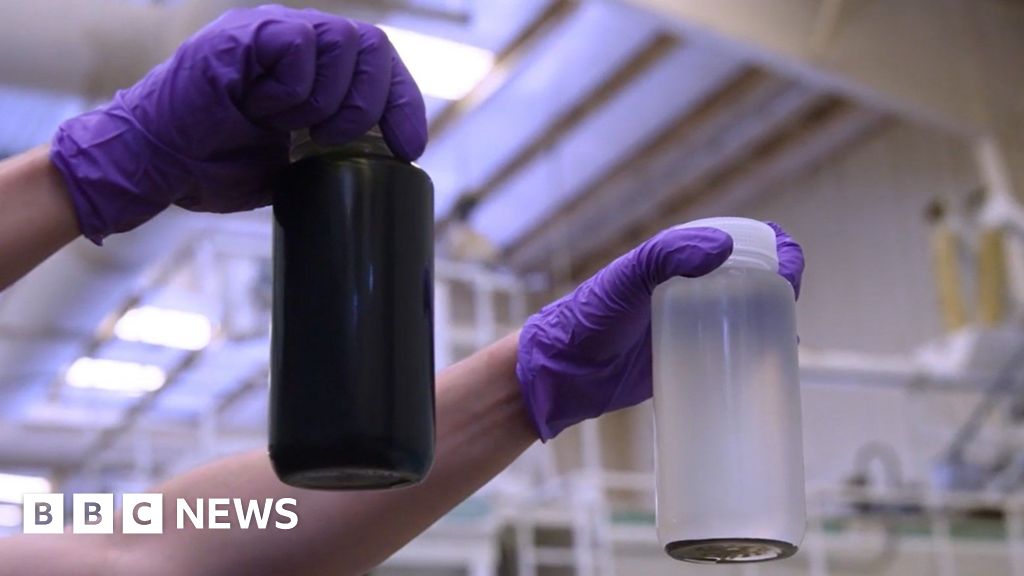
PFAS can be detected and removed from water and soil and then concentrated into smaller volumes of high strength waste.
But what to do with that waste?
Currently, concentrated PFAS waste is either put in long-term storage which is expensive, or incinerated (often incompletely, leading to toxic emissions), or sent to landfills for hazardous waste.
But now clean-tech companies are bringing techniques to market that can destroy them.
These are being tested in small-scale pilot projects with potential customers including some industrial manufacturers, municipal wastewater treatment plants and even the US military.
There’s a “large and growing” market opportunity for PFAS destruction companies notes Mr Bovée.
While it is mostly currently centred in the US, others are dipping their toes, he says.
In the UK, funding for water companies to look into PFAS destruction has been provided by water regulator Ofwat, with Severn Trent Water leading a project to examine the potential technologies and suppliers.
One factor driving the market forward in the US is legal risk. Thousands of lawsuits claiming PFAS-related contamination and harm have been filed with some large chemical manufacturers, notably 3M, having already paid out billions in class-action settlements.
Regulation is also beginning to tighten worldwide.
Legal limits for two PFAS in drinking water are now scheduled to take effect in the US in 2031.
PFAS remains a bipartisan issue, says Mr Bovée, and many expect that future US regulation will expand beyond drinking water to cover industrial discharge and other sources.
The EU also has legal limits for PFAS in drinking water, which member states must begin enforcing from next year.
 Axine Water Technologies
There are a variety of technologies for destroying PFAS – each with their own advantages and limitations.
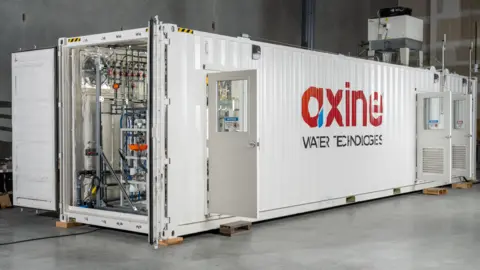
According to Mr Bovée, one technology that is almost commercially ready is electrochemical oxidation (EO) technology.
Electrodes are placed in water contaminated by PFAS and a current is passed through, resulting in the chemicals’ breakdown.
While energy intensive, it doesn’t require high temperature or pressure, and is easy to operate and integrate into existing treatment systems for concentrating PFAS, says Mark Ralph, CEO of Canadian-based start-up Axine Water Technologies.
Last year, following a successful pilot project, it sold its first commercial-scale unit to a Michigan-based producer of automotive components. It is now up and running and the customer is planning to purchase additional systems for other sites.
 374Water
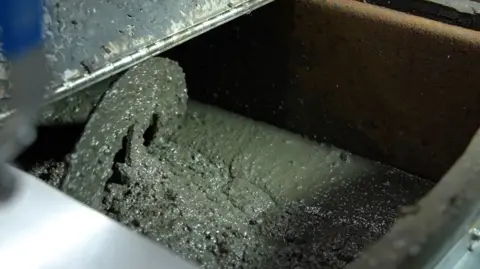
Another technology not far behind is Supercritical Water Oxidation (SCWO).
It relies on heating and pressurising water to such a high degree that it enters a new state of matter: a so-called supercritical state. When the PFAS waste stream is introduced, it breaks the carbon-fluorine bonds.
One advantage is that it can process both solid and liquid PFAS waste, says Chris Gannon, CEO of North Carolina-based 374Water.
He says his technology can even destroy PFAS in plastics if they are ground up.
It can be expensive to buy and maintain – the process is so intense it requires a complex reactor and regular cleaning. But it can be more cost effective if the PFAS is first concentrated before it enters the process.
Currently the City of Orlando in Florida is testing 374Water’s technology at its largest wastewater treatment plant.
The City is trying to get ahead of the curve, explains Alan Oyler, its special projects manager for public works.
Levels of PFAS in sewage sludge aren’t currently regulated, but he expects them to be in the future.
So far, Mr Oyler is pleased with the destruction capability he has seen, but is also waiting to see how reliable the system is.
The scale of 374Water’s current technology is small: it can handle just a fraction of the tonnes of wet sludge the facility produces daily.
But the company is in the process of scaling up, and Mr Oyler imagines in a few years it will be able to handle all the facility’s material “ready for when the regulations require”.
Other technologies on their way to being commercially ready include hydrothermal alkaline treatment (HALT), which uses high temperature, high pressure, and an alkaline chemical to destroy PFAS; and plasma-based technology, which involves making an ionized gas (called a plasma) to attack and degrade the PFAS molecules.
 Aquagga
Yet there is one potential issue with the technologies now coming through, says Jay Meegoda, a professor of civil and environmental engineering at the New Jersey Institute of Technology: nasty PFAS degradation byproducts.
For example, in the case of EO, highly corrosive hydrogen fluoride vapor. Each needs a “complete study” accounting for all their inputs and outputs, he says.
The companies have claimed they either don’t produce PFAS degradation products or deal with them adequately.
One important partner for many of the PFAS destruction companies in testing their technologies in the real world has been the US Department of Defence (DOD).
PFAS contamination at US military sites is a big, below-the-radar problem. It stems particularly from the use of older formulations of firefighting foam, used for example during training exercises or emergencies, but other routes too such as the cleaning of military equipment.
More than 700 sites are known or suspected to be contaminated, posing a threat to surrounding communities. A judge recently cleared the way for PFAS contamination and harm lawsuits against the military to proceed.
Clean up efforts are where the destruction companies could come in, and projects have been undertaken or are under way at various sites to assess the performance and cost effectiveness of many of their solutions.
One start-up, Aquagga, which specialises in HALT technology, recently completed a demonstration project for the DOD which involved destroying a firefighting foam mixture amongst other concentrated PFAS-containing liquids.
Immense volumes of the foam are currently stockpiled in all sorts of places, not just at military sites.
Like others, Aquagga sees a big opportunity over the next few years for both destroying the foam and remediating the environmental damage associated with its use.
And outside the military, there’s a tantalizing new PFAS waste stream on the horizon. The US is actively expanding domestic computer chip manufacturing – a process that uses PFAS in massive amounts. “We can destroy that,” says Mr Gannon, of 374Water.