
A film about the space shuttle ends with a majestic launch and rocket exhaust filling the screen. Suddenly, real-life fog envelops the theater, before the walls part and the haze dissipates to reveal a gasp-inducing 200-foot Space Shuttle Endeavour, nose up, facing skyward.
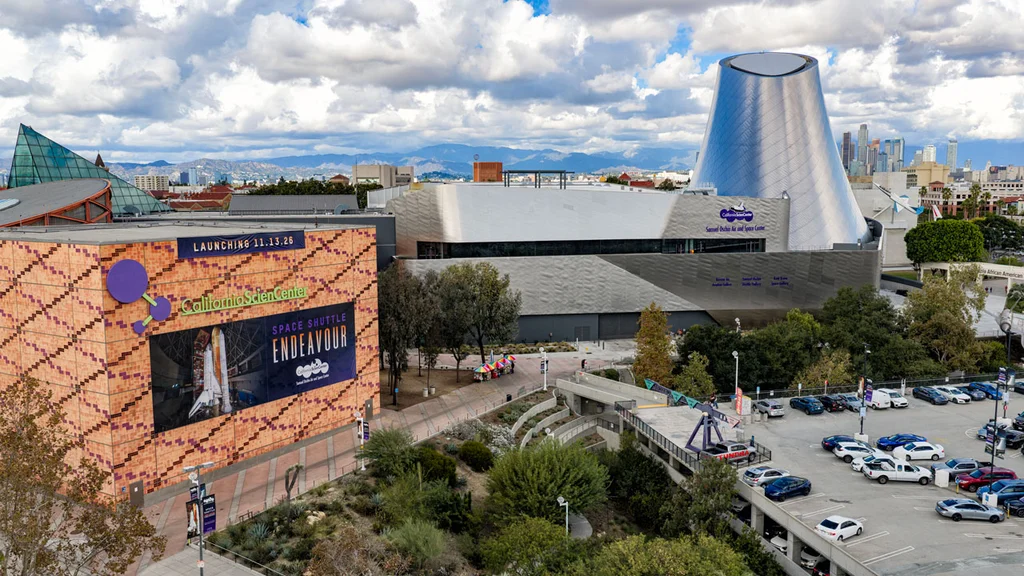
This Hollywood finish—Endeavour is the only authentic space shuttle presented with fuel tank and solid rocket boosters stacked for launch—is the centerpiece of the California Science Center’s new $450 million Samuel Oschin Air and Space Center, which opens November 13 after more than three decades in the making.
More than 200 aerospace artifacts and interactive exhibits fill three airy, multilevel galleries that illustrate the history and physics of flight, space exploration, and autonomous craft. But it’s the spectacle of Endeavour that symbolizes the CSC’s mission as Southern California’s gateway drug to science. The air and space wing comes at a time when the state’s $366 billion space technology sector is desperate for more STEM talent in a region often regarded as the epicenter of the space startup economy.
“We want to be a feeder into all kinds of science, engineering, and STEM careers,” Jeffrey Rudolph, the CSC president and CEO, tells Fast Company. “Getting particularly young people, who may not have thought of themselves as belonging in science and engineering, interested and involved. Even if they don’t want to go into science, we think it’s good to have a basic understanding of it.”
“There’s a war on science going on in our country right now,” the California governor, Gavin Newsom, said during a press preview last month. “That has implications not just for air and space, but for healthcare, all kinds of decisions. We want to help change that. This is a physical manifestation of what California values.”
The CSC’s mandate includes reducing initial barriers to science and guiding STEM career aspirants to their next steps. Beyond free admission, CSC offers a summer science camp, professional development for science educators, and high school internships that expose students to local aerospace companies and institutions.
The study of flight
The Oschin wing’s impact on science advocacy was in evidence even before its opening. In July, Astronauts for America used the shuttle as a backdrop to kick off its American college tour encouraging students to vote. Kenneth Phillips, the physicist who is CSC’s curator for aerospace science, designed the Oschin exhibits around a freshman course he teaches at the University of Southern California, even enlisting students to prototype several interactive exhibits. The opening expects some 30 astronauts, including Endeavour’s final mission crew, led by Mark Kelly, now a U.S. senator from Arizona.
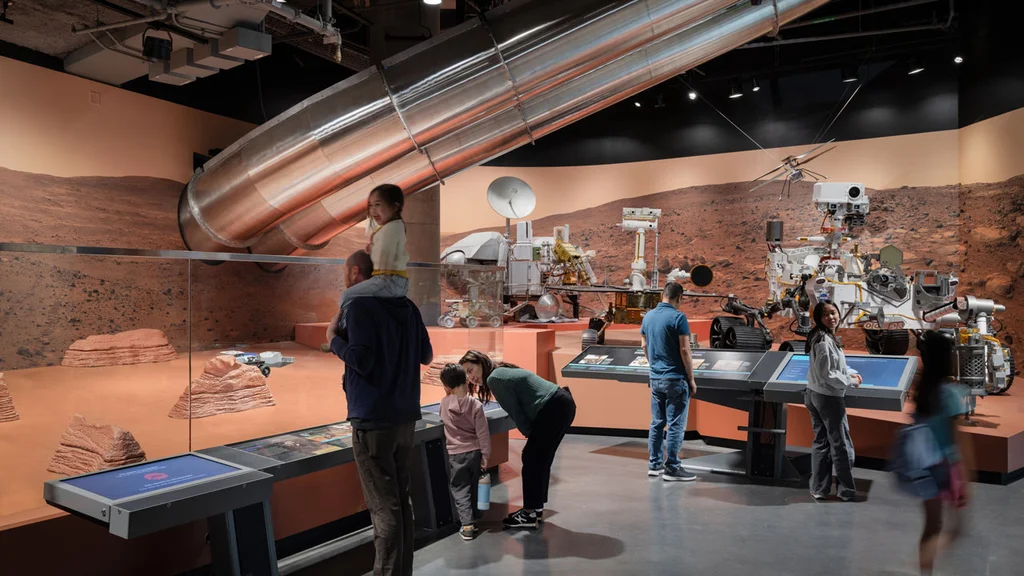
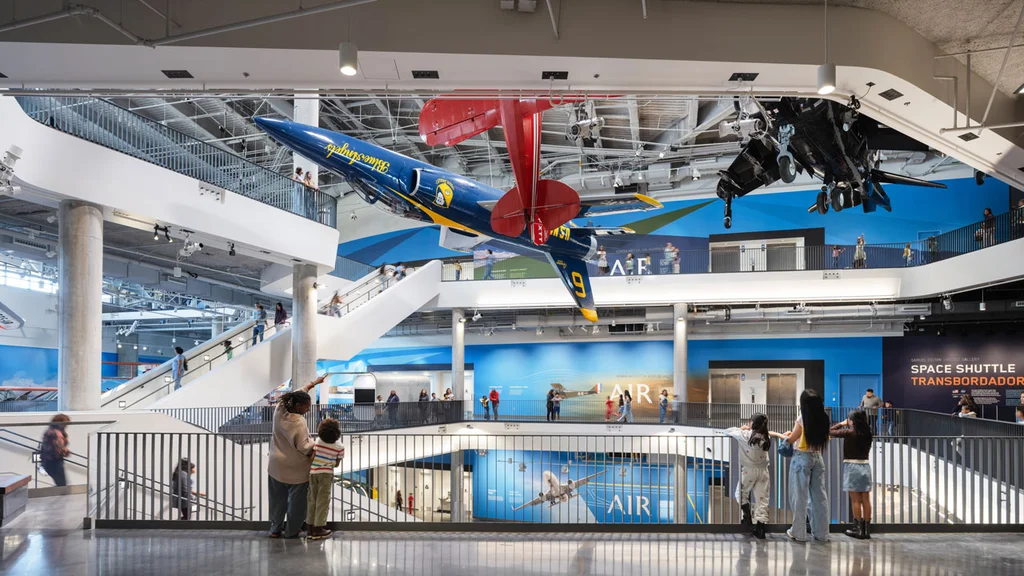
The 200,000-square-foot expansion (as big as three and a half football fields) roughly doubles the Los Angeles science center’s exhibit space, boasting a dizzying array of air and spacecraft that hang from the ceiling and jet up from lower floors. There are authentic Gemini 11 and SpaceX Dragon cargo capsules, a 3D-printed 60-foot Electron rocket from Rocket Lab, Joby eVTOL (electric vertical takeoff and landing aircraft), a drone display, and immersive experiences like an International Space Station fly-through simulation and a flight to Seoul inside a Korean Air Boeing 747-400 cockpit. A collaboration with NASA’s Jet Propulsion Laboratory and the California Institute of Technology describes their planetary exploration and Earth observation work through replicas of lunar and Martian probes, snakelike exploration robots, and the opportunity to program a Mars rover mission.
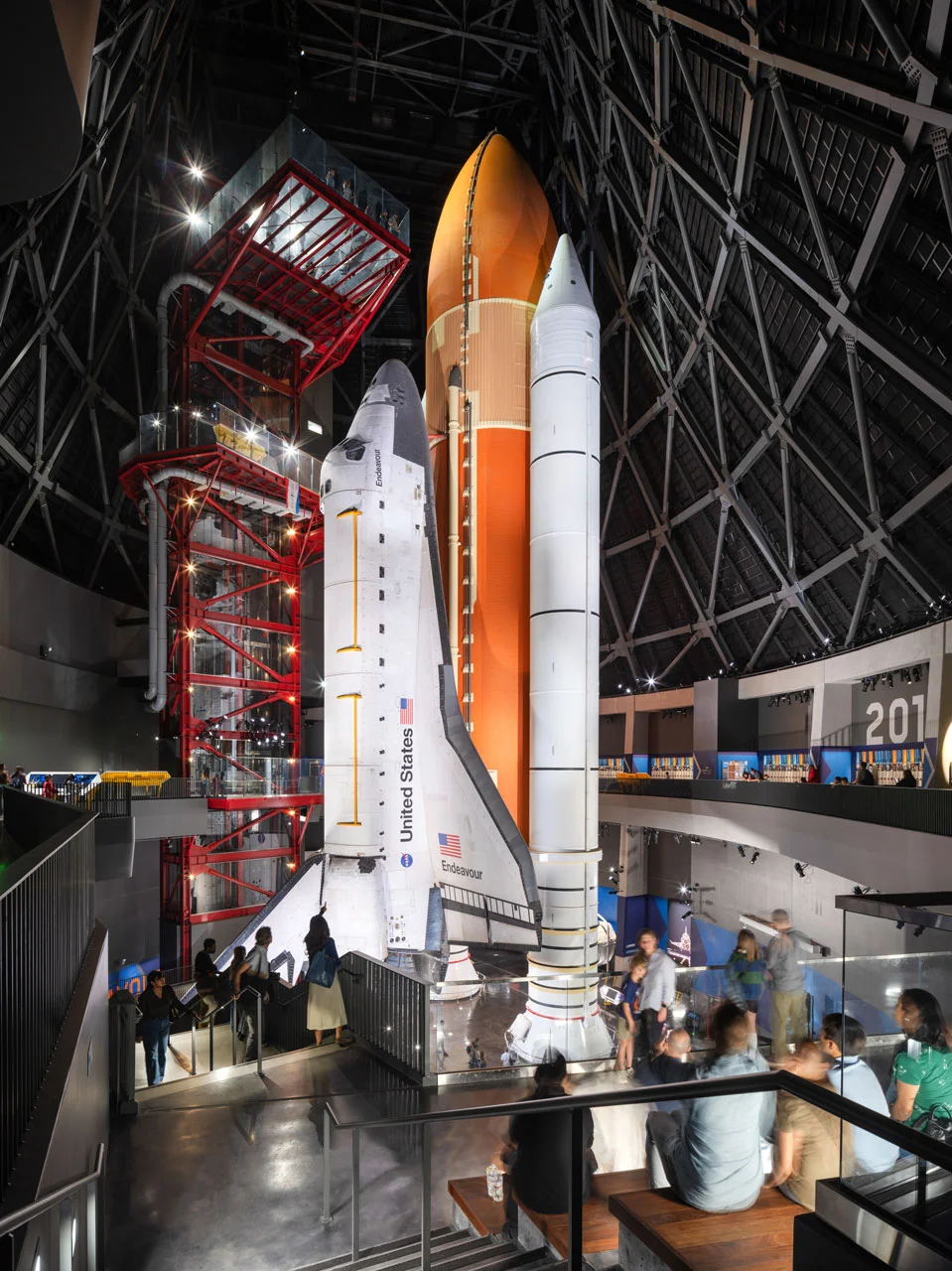
The 20-story Endeavour, alongside its orange propellant container and two solid rocket boosters, holds court in the cavernous shuttle gallery. Its base lies 25 feet below, accessible in part by a dark 45-foot tunnel slide with turns that replicate the shuttle’s reentry path, an idea borrowed from Kennedy Space Center’s Atlantis shuttle showcase. (“We saw that and said, ‘That’s good, but we can make it bigger and better,’” Rudolph laughs.) Several levels offer close-up views into the cockpit and mid-deck, and a payload bay stocked with supplies; above, there’s a glass platform from which visitors can look down on the entire shuttle.
“We wanted to show the whole system in launch position to explain the science and engineering behind it and give a better understanding of the enormous amount of energy it takes to get off the surface of Earth and into orbit,” says Rudolph. “And it is the most majestic way to see it.”
These views, once reserved only for NASA engineers, astronauts, and their families, “we now get to share with the rest of the world,” says the retired NASA astronaut John “Danny” Olivas, who flew two shuttle missions and advised on the Oschin Center. “The visual experience does a much better job of capturing the enormity of it.”
We got the space shuttle. Now what?
Getting hold of a retired shuttle to display in launch position was always part of CSC’s master plan, adopted in 1993, and the center won Endeavour from NASA in 2011 in a competition among museums. (The other three shuttles—Atlantis, Enterprise, and Discovery—reside on the East Coast.) Aside from the state’s long history with the aerospace industry, the shuttles were designed, built, and often landed in California.
“So, we got it,” says Rudolph. “And then we’re like, ‘Now what?’”
CSC brass set about raising money, figuring out transportation logistics, locating or fabricating missing shuttle pieces, and designing the first building to house a vertical shuttle outside of a NASA or Air Force facility, feats requiring the guidance of NASA engineers. Funding came from its namesake, Samuel Oschin, the Los Angeles entrepreneur who died in 2003; the state of California; state-backed bonds; and private donations, which are still being raised. (Also, some exhibit elements come from commercial and institutional partnerships.) Meanwhile, they had to get Endeavour to Los Angeles, and to the center.
“We had no idea how complex it was. We probably wouldn’t have done it if we did,” says Rudolph. “A lot of the folks at NASA didn’t think we could pull off getting it from LAX to the science center, because you can’t take it apart like an airplane. We’d never be able to put it back together again.”
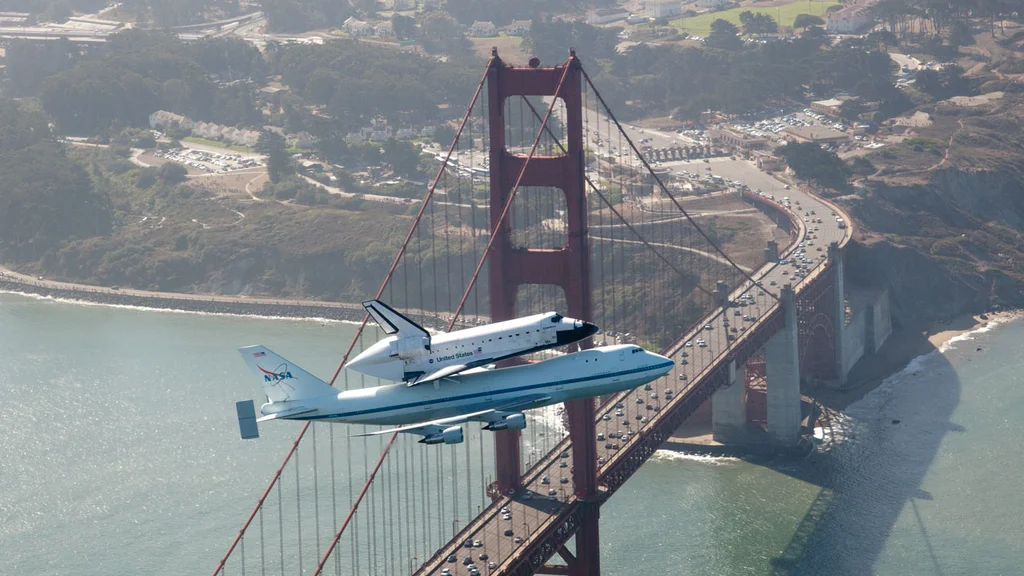
In 2012, the shuttle—ferried atop a modified Boeing 747 shuttle carrier aircraft—famously flew around California, over NASA facilities and iconic landmarks, before landing at Los Angeles International Airport. Then it was transported, on a specialized rolling steel platform, slowly through a 12-mile nonlinear street route that had to be more than 78 feet wide with no overhangs below 60 feet high, passing 1.5 million cheering onlookers. The tank came by barge through the Panama Canal, up the West Coast to Marina Del Rey, before moving through the streets. “Almost half a million people showed up—for a fuel tank,” says Rudolph.
After more than a decade in a horizontal stance in a CSC atrium, Endeavour was ready for its final liftoff. In early 2024, a massive 450-foot crane hoisted the shuttle by sling, turned it upright, and slowly lowered it—with an inch to spare on either side—onto an isolated concrete seismic slab on ball bearings to move with earthquakes. Given the beating it had to take from launch and reentry, “we figured that the shuttle as a design can withstand the worst earthquake anyone’s predicting for L.A.,” says Dennis Jenkins, the Oschin Center project director, who spent three decades as a NASA contractor working on the shuttles.
The Oschin Air and Space Center’s long journey to realization ends with a first step for a new generation of explorers, enthusiasts, and even creatives seeking inspiration from new frontiers. Eventually, the air and space center hopes to collaborate with the nearby Lucas Museum of Narrative Art, Natural History Museum of L.A. County, and California African American Museum.
“The country really needs science and engineering more than ever now, but it’s more than just STEM,” says Rudolph. “Space inspires across the entire spectrum of human expression.”