
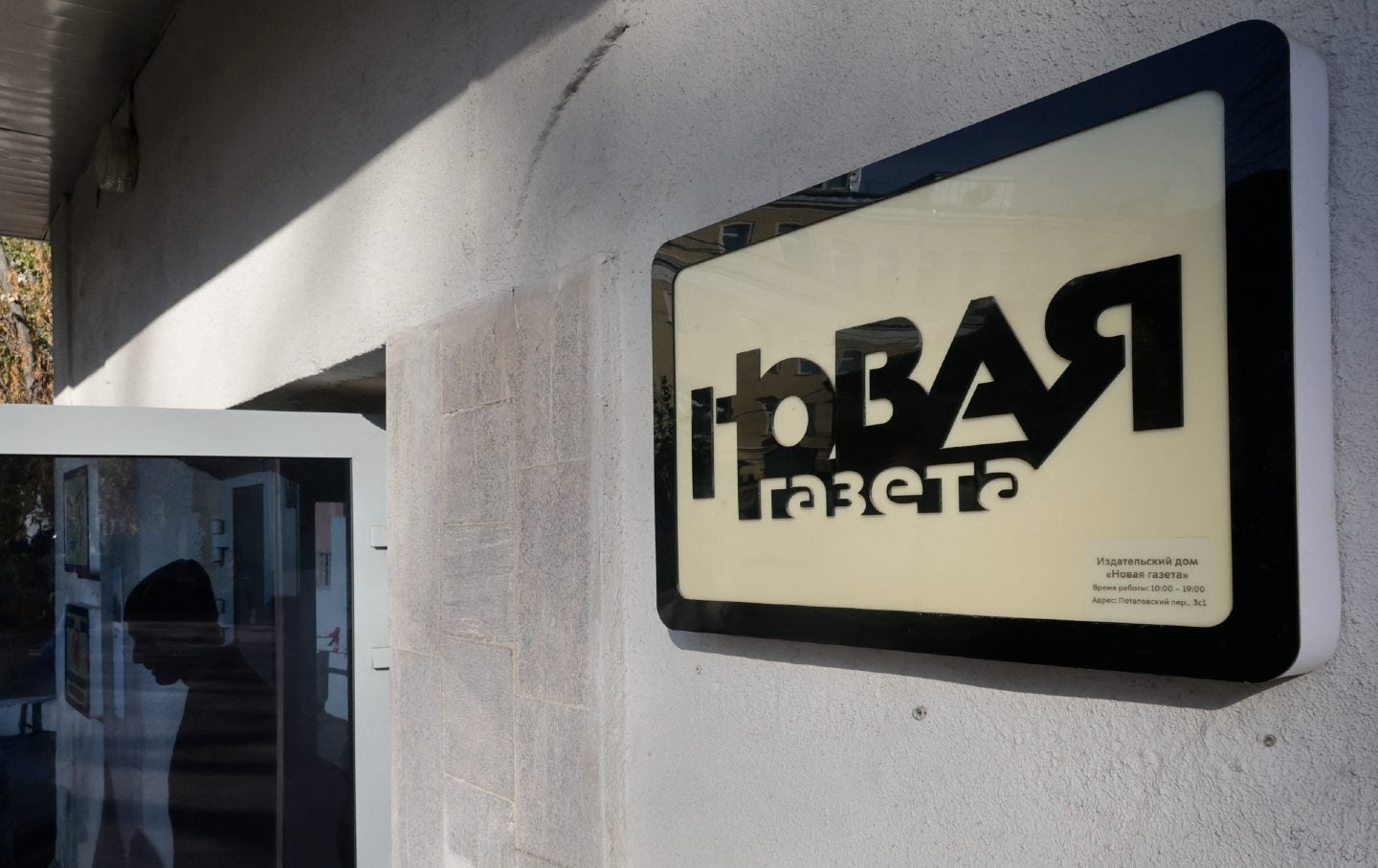
Novaya Gazeta’s closing marks the end of what little press freedom remained in Putin’s Russia.
The closing of “Novaya Gazeta” marks the end of what little press freedom remained in Putin’s Russia.
Novaya Gazeta—one of Russia’s last bastions of independent journalism—will publish a final issue and shut down next week.
The paper has faced mounting institutional pressures: It was evicted from its office space and labeled a foreign agent by the Kremlin, and banks have refused Novaya their services. Its reader-supported funding platform was also shut down.
The fact that the publication survived for this long is a testament to its reporters’ extraordinary bravery. Since its founding in 1993, Novaya has earned international acclaim for reporting in areas including human rights violations during the second Chechen War, the persecution of Chechnya’s LGBT community, and abuse inside Russian prisons. Over its years of courageous muckraking, six Novaya journalists were killed, including the crusading reporter Anna Politkovskaya.
After Russia’s 2022 invasion of Ukraine and the free-speech crackdown that followed, much of the paper’s staff fled to Latvia, where they launched Novaya Gazeta Europe. This outlet is expected to continue operations—but its website is blocked in Russia.
However, while the original paper will soon cease publication, readers and historians can still access its work. Kronika, a project from PEN America and Bard College dedicated to preserving journalism at risk of suppression, is digitizing the newspaper’s entire archive. In doing so, the project is keeping Novaya’s ideals and principles alive.
Novaya cofounder and former editor in chief Dmitrii Muratov told Columbia Journalism Review that, if not for the archive, decades of Russia’s historical memory could vanish. And if such a public record were lost, he said, “we would not know how dictatorships take shape.”
Current Issue

To mark the legacy of this singular newspaper, The Nation is republishing the piece below, which I originally wrote when Muratov and the Filipino American journalist Maria Ressa were jointly awarded the Nobel Peace Prize in 2021.
In the Nobel lecture he delivered later that year, Muratov saluted his colleagues, who risked their lives to hold those in power to account and promote the public interest.
“We are the prerequisite for progress,” he said. “We are the antidote against tyranny.”
The following was originally published in The Nation, October 8, 2021.
A Courageous Voice for Press Freedom and Independence in Russia
As the Nobel Prize committee recognized with today’s award to Dmitrii Muratov, independent journalism and media freedom in Russia confront growing threats.
katrina vanden heuvel
I and my late husband, Stephen Cohen, first met Dmitrii Muratov in 1993. He and a few other colleagues had gathered in the basement cafeteria of Moscow News—then a bold newspaper of the glasnost era—to plan the launch of Novaya Gazeta. Survival was on their minds at that time; they were beginning the paper with two computers, one printer, two rooms—and no money for salaries. A few months later, an initial boost of support came from President Mikhail Gorbachev, who contributed part of his 1990 Nobel Peace Prize money to buy the newspaper its first computers.
Nearly 30 years later, the newspaper has another Nobel in its history. On October 8, Muratov was jointly awarded the Nobel Peace Prize with Filipina journalist Maria Ressa “for their efforts to safeguard freedom of expression, which is a precondition for democracy and lasting peace.”
I knew in 1993 that “Dima” was a bold and creative editor. What I did not foresee was that he would become such a vital defender and advocate of press freedom in Russia. The newspaper, which continues to publish against great odds, has paid a heavy price for its crusading investigations into Putin’s and other high-level officials’ corruption, human rights violations, the persecution of the LGBT community in Chechnya, right-wing nationalist extremism, and abuses of power. The paper has also spent decades carefully tracing Stalin’s crimes in newly opened archives.
Six of its courageous reporters—among them Anna Politkovskaya, who was killed exactly 15 years ago—have been murdered for their unflinching investigations. (Fewer than half the killings have been solved.) “When Anya was killed, I called an emergency editorial meeting and wanted to close down the paper,” Muratov told me once. “I told my staff no story is worth dying for. But they wouldn’t let me do it.… I knew we had to go on.”
Muratov is not afraid to publish dissenting, oppositionist views on Crimea, Donbas, Syria, and growing poverty and the abuse of civil liberties in Russia. He handles at least 10 lawsuits a month—filed by official organs. It is remarkable that amid the escalating crackdown on press freedom, he has managed to preserve a sense of humor and visibly enjoy mentoring a new generation of investigative journalists—and readers. Elena Milashina, who started at Novaya in her late 20s, is one of those journalists; since the publication of her article in March documenting the murders of LGBT people and reporting on the cold-blooded murders instigated by Chechnya’s leader Ramzan Kadyrov, she has faced physical threats and death threats.
Indeed, most of the journalists working at the paper are like Milashina: the same age as, or a few years older than, the publication itself. Younger generations may not read the print edition, but Novaya’s print circulation as of October 2021 is 90,000, social-media traffic is 30 million a month, and its website receives 8 million to 11 million monthly page views.
Popular
“swipe left below to view more authors”Swipe →
The paper’s founding independence was boosted by the fact that, until 2006, Novaya journalists owned 100 percent of its stock. In 2006, to secure a capital infusion, Muratov persuaded his staff to sell 49 percent of their stock to Gorbachev (10 percent) and a partner, mini-oligarch Aleksandr Lebedev (39 percent). Lebedev invested nearly $4 million to raise staff salaries, upgrade the paper’s offices, and turn Novaya into a paper with national reach. (In 2015, Lebedev stopped funding Novaya, revealing in a Guardian interview that he had ceased because of the expense and also the strain.)
Fifteen years after Politkovskaya’s murder, nearly 30 years after Novaya was founded, independent journalism and media freedom in Russia confront growing threats. An array of media regulations and laws, the labeling of independent media outlets as “foreign agents,” and increasingly restrictive regulation of the Internet are all deeply troubling. Some Russian media analysts and journalists believe that many of these new restrictions are fueled by the West’s anti-Russian sanctions, increasing political tensions, and a deepening and dangerous cold war. In such times, the already narrow space for diversity of views and freedom of speech shrinks. Many analysts also see the culture of impunity—the ongoing failure to hold accountable those who threaten, attack, or kill journalists—as posing a grave threat to media freedom and democracy itself.
How Dmitrii Muratov has navigated for decades the dangerous waters of Russian politics—he has friends across all levels of Russian society, including top politicians—often irritates members of Russia’s more hard-core opposition and some Western observers, who think he has sold out to the Kremlin. As I ventured onto Twitter this morning to post a congratulatory note, a cat lover named Svetlana posted: “With tremendous respect to Dmitry—in Russia there is a saying, ‘If he’s still alive, he’s working for them.’ I admire his courage. And so did Peskov [Putin’s press secretary]. Where does it leave us? Thank you.”
Muratov has used his influence and connections not for his personal ambitions, nor to enrich himself, but to keep alive one of the last havens of investigative journalism inside Russia. The Nobel Prize will likely give Novaya and Muratov domestic protection, but may well also earn Muratov more enemies among the Putin elite, who will allege that he has betrayed the country for awards and foreign funds. What matters, as Muratov said on learning of Oslo’s call, are “Igor Domnikov, Yuri Shchekochikhin, Anna Politkovskaya, Stas Markelov, Nastya Baburova—these are the people who won the Nobel Prize today.”
Today’s prize will be wind at the back for all Russian investigative journalists.
More from The Nation
The potential Democratic hopeful for president is not a socialist. But he has a folksy demeanor and moral compass.

The country singer was an enthusiastic supporter of the Democrats who won every major statewide race in Texas.
In this week’s Elie v. US, our justice correspondent demands subpoenas, subpoenas, subpoenas of Trump and his cronies. Plus: Elon Musk gets hoisted by his own petard.
Voters across the country have given the keys to Democrats. But can the party get in gear?