
In her new book Side Effects, the Politico reporter shows that the impact of abortion bans goes far beyond reproductive health care.
In her new book “Side Effects,” the “Politico” reporter shows that the impact of abortion bans goes far beyond reproductive health care.
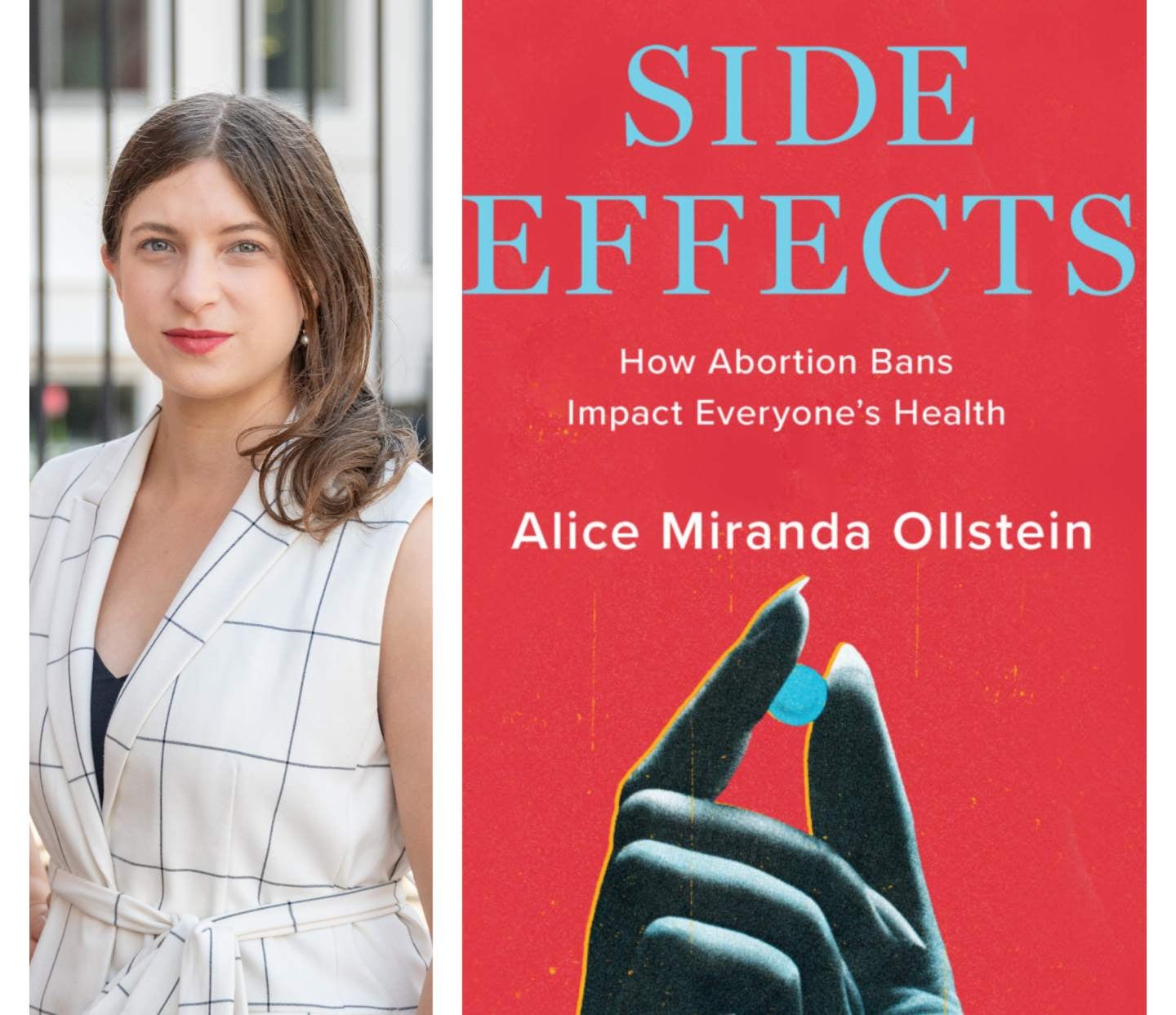
Alice Miranda Ollstein covers the politics of abortion as a reporter for Politico. But as she traveled the country reporting on the fallout from the Supreme Court’s decision to overturn Roe v. Wade in 2022, Ollstein began to hear another drumbeat in the background. “[O]ver the course of writing hundreds of articles, as I interviewed patients, doctors, pharmacists, researchers, and others impacted by the new restrictions, I saw how such laws were also eroding the quality and availability of health care—and not just reproductive health care,” Ollstein writes in her new book, Side Effects: How Abortion Bans Impact Everyone’s Health (published by The New Press this October).
In her book, Ollstein uncovers how the harmful consequences of abortion bans stretch well beyond miscarriage management, maternity care, and contraception, as well as, of course, delaying or outright denying care to those seeking abortions. Everyone from veterans suffering the effects of war to chronically ill patients seeking care for debilitating pain are affected by these laws. The Supreme Court’s Dobbs decision has sent ripple effects across the healthcare landscape, shaping where clinicians live, how they train, what drugs they prescribe, and how they conduct medical research. “No part of the healthcare system went untouched by Dobbs,” Ollstein told me. I interviewed her recently about the findings in her book, and as the midterms approach, I also took the opportunity to ask her about how abortion will affect the elections in November.
I’ve edited our conversation for clarity and length.
—Amy Littlefield
Amy Littlefield: Let’s start with an area of medicine impacted by Dobbs that is fully related to reproductive health care—contraception. How did banning abortion affect access to contraception?
Alice Miranda Ollstein: There are so many contradictory trends in the contraception space right now. You have, on the one hand, more demand than ever for contraception, including permanent contraception, because people are more afraid of an unintended pregnancy that they would not be able to terminate. On the other hand, there is reduced access. Some of that is due to the blurring of the line between what is an abortifacient and what is a contraceptive. There’s been a lot of misinformation about that, from official state government entities and circulating online. That has led to certain forms of contraception being excluded from government programs [and] government coverage. In some cases, universities that are state-run stopped providing certain forms of contraception because they were unsure if it would violate their new state abortion ban. A lot of it was in the immediate aftermath of Dobbs, but some of it still continues to this day.
AL: Let’s talk about some areas of healthcare that are less intuitively connected to abortion. How do abortion bans impede medical research, including into conditions totally unrelated to abortion?
AMO: One example is that the abortion pill mifepristone has a lot of potential, being studied in the United States and around the world, for treating certain cancers and all kinds of other conditions. I met a researcher in Florida who found that this medication had a miraculous impact on older veterans who had debilitating mental and physical impacts from Gulf War Syndrome, which is caused by being exposed to toxic chemicals in Operation Desert Storm. This medication that right now is only authorized for abortions made a huge difference for them, but because of state bans, that research got delayed and there were all these hurdles, and so veterans still cannot access this medication that could really help them. I met another researcher who was trying to study mifepristone’s impact on breast cancer, and she ended up abandoning the study altogether because she was based in a state with a near-total abortion ban and was afraid of losing access to the medication midway through the study.
Current Issue

AL: In the book you tell the story of Tara Rule, a New York woman who had debilitating cluster headaches, whose doctor balked at prescribing medication that could have alleviated her symptoms because the drug could cause birth defects. Can you talk about this trend?
AMO: I was really struck by the trend of people with chronic illnesses who were not pregnant, were not planning on being pregnant, in some cases physically could not get pregnant, and they were still being denied medication they really depend on because either that medication was a potential abortifacient or that medication could cause birth defects if you become pregnant while you’re taking it. What was wild to learn about is that this was happening [all] around the country right after Dobbs. It was happening in states with bans and in states with abortion protections. It was happening to people with lupus, Crohn’s, rheumatoid arthritis, Ehlers-Danlos. Sometimes it was the doctor who refused to prescribe it; sometimes it was a pharmacist who refused to fill it, and sometimes it was the insurer who refused to cover it. When Tara Rule was posting on social media about this, which went viral at the time, she started hearing from so many other people saying, ‘Hey, this happened to me, too.’
AL: Some stories of women dying while suffering miscarriages when providers delayed giving care have gotten lots of media attention. But there are other fatalities we have heard less about —like that of an Indiana woman who died when her ectopic pregnancy ruptured and she had to travel further for care because her local hospital’s labor unit had recently shut down. What does her death show about how hard it is to document deaths from abortion bans?
AMO: You’re seeing labor and delivery units around the country close, and a lot of that is economic, but in some instances the hospital themselves publicly say that the state abortion ban is a factor in losing doctors and not being able to maintain access. Doctors are also just more fearful and hesitant to treat pregnant women who are going through literally anything. Even if somebody comes in from a car accident, there’s just so much fear of accidentally seeming like you maybe caused an abortion, or you didn’t document it right. These delays can be deadly in some circumstances. It’s hard to prove causality, and I think that it’s especially challenging because the state entities that are supposed to make those determinations, these mortality maternal mortality review committees, their work has been made a lot harder by bans, and in certain states they have been censored. They’ve been fired and replaced. The reports have been delayed. I’m thinking in particular of Georgia, Texas, and Idaho. All had major disruptions of their maternal mortality review committees, and those are the committees that are supposed to go through every death during pregnancy, birth, and the postpartum period, and determine what caused it. That’s information that could save lives in the future.
AL: Another story from your book that has stayed with me is that of Samantha Casiano, who learned during her 20-week anatomy scan that her fetus had a lethal birth defect called anenchephaly. But she lived in Texas and couldn’t afford to leave her four kids to travel out of state for an abortion. Talk about her story and what it shows about the overall message of your book.
Even though the whole thesis of my book is that everyone is impacted in some way by abortion bans, some people are clearly more impacted than others, and low-income women of color are, in a lot of circumstances, being impacted the most. I reported on women in Texas who received diagnoses later in pregnancy that their fetus had a medical condition that was incompatible with life. The upper-middle-class white women I met had the financial resources, the job flexibility, the family support to leave the state and get an abortion in another state and come back. I’m not saying that they had it easy. It was very, very difficult emotionally and physically. But you compare that with what happened to Samantha Casiano, who did not have the financial resources to be able to leave the state, and she ended up carrying to term her fetus that had anencephaly, and it died in her arms four hours after birth, gasping for breath, turning purple. It was so traumatic for Samantha that when she testified in court about it as part of a lawsuit by the Center for Reproductive Rights, she actually vomited on the witness stand, just reliving that trauma. I really think about her and what differences class and other divisions can cause.
AL: One of the most compelling parts of the book is your reporting on how the Dobbs decision has politicized doctors in new ways. Can you talk about that?
Popular
“swipe left below to view more authors”Swipe →
AMO: A lot of abortion providers were already very politically active. They were part of lawsuits. They were outspoken. Often, they felt like they had to be. But what I saw happen after Dobbs is that all of these other doctors who never performed an abortion themselves—many of them didn’t even treat women of reproductive age—they saw the spillover effects on their own work and thought, “I really need to get involved.” I talked to neurologists, rheumatologists, oncologists, pediatricians, ER doctors, just across the medical system, and you had this happening at the individual level, where individuals were speaking out more, participating in some of these political campaigns, running for office themselves in some cases, joining lawsuits. But they also lobbied their medical societies, either state or national, to take stronger stands on access to abortion than those groups ever had in the past.
AL: How do you see abortion shaping the way that people vote this year?
AMO: There are four states where abortion is going to be directly on the ballot. That obviously brings it more top of mind in Idaho, Missouri, Nevada, and Virginia. But it’s been coming up in the Maine Senate race, where the Democratic challenger has been hammering Susan Collins over her vote to confirm the Supreme Court justices who overturned Roe, and that has become one of her bigger liabilities. There is polling [showing] that people do care about abortion as an issue, and they want candidates to talk about it, and they say they’re more likely to support a candidate who supports abortion access. But when people are asked to rank issues, it does not rank in the very top, along with things like being able to afford groceries, for instance. There are glimmers of signs that it is still a potent issue. I was interested to hear James Talarico in Texas give a pretty full-throated support for abortion rights, and that is in a tough race in a very conservative state. I don’t think he would have said that if he didn’t think it was a message that resonated with a lot of people.
More from The Nation

Northern Virginia is laden with structures that house data for Fortune 500 companies. I went inside just one of those monstrosities that bothers its neighbors.

Carlson has broken with Trump largely over the war in Iran. But on Ukraine and immigration, the two speak very much the same language.

Haredi rabbis and the secular left agree: This technology is a threat to the entire social fabric.