
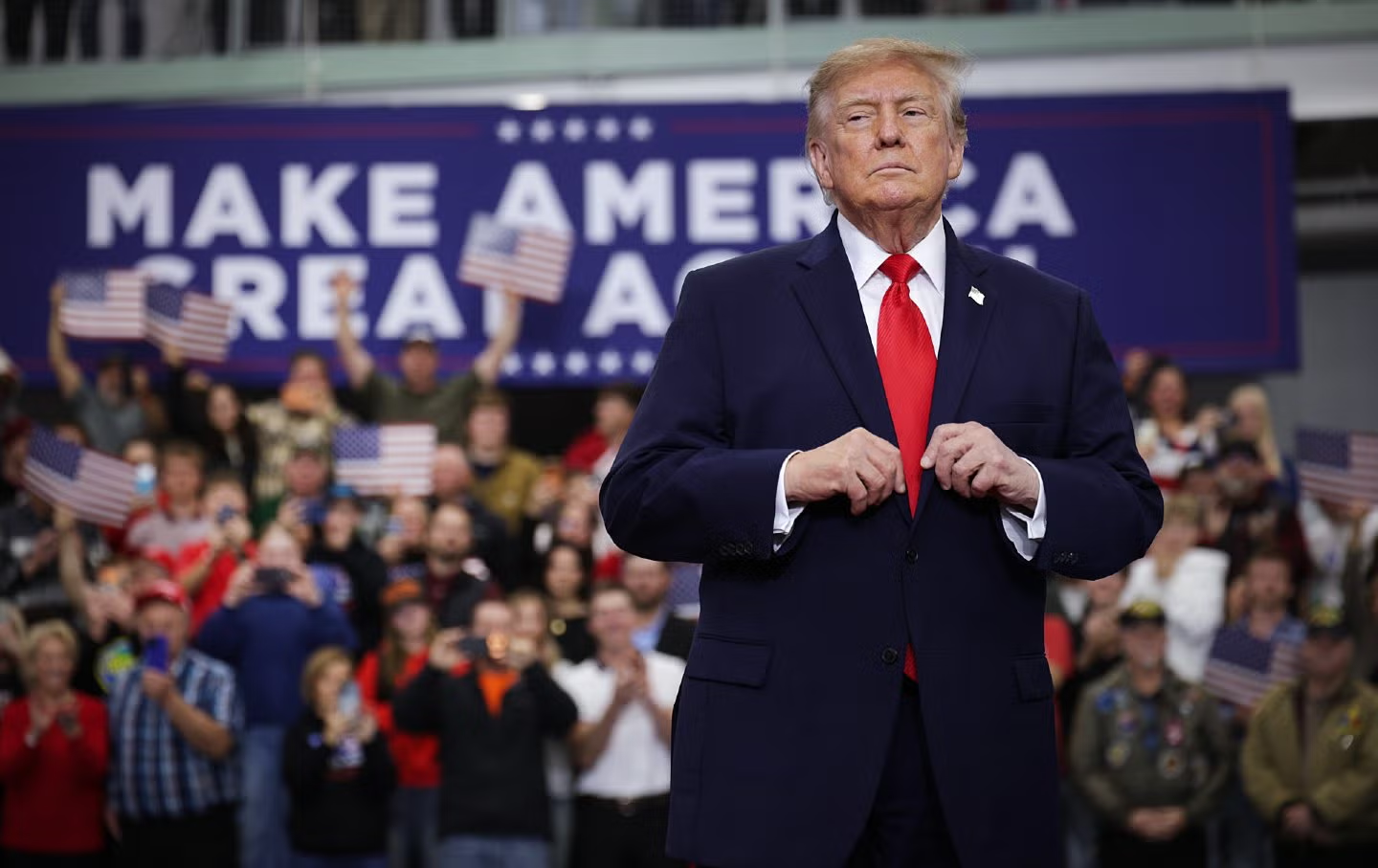
The Alaska case is a red flag that Trump has no intention of accepting the results of an election that Republicans lose.
Donald Trump speaks at a rally for GOP candidates in Wasilla, Alaska.
(Alex Wong / Getty Images)
The Democrats have a legitimate chance to retake the Senate next week. The Cook Political Report rates 13 of the open Senate seats as favoring Democrats, giving them a possible total of 47 seats. It rates seven additional races as “toss-ups.” If Democrats win four of those races, they’ll control the chamber.
I don’t actually believe any polls, anywhere, anymore, because repeated polling failures during the Trump era have left me scarred for life. But for the sake of preelection argument, we have to pretend that these pollsters have professional skills and aren’t engaged in a terroristic plot to weaponize hope.
One of the toss-up states is Alaska, where Republican incumbent Dan S. Sullivan is facing a fierce challenge from former Democratic representative Mary Peltola. The race could be definitive in determining control of the Senate. The seven states rated as toss-ups are: Alaska, Iowa, Kansas, Maine, Michigan, Ohio, and Texas. Let’s say Democrats win in Michigan and Ohio. Let’s say they split Maine and Texas—Susan Collins hangs on but James Talarico pulls through, or vice versa. Alaska could easily be the fourth seat Democrats need to take control of the Senate. It’s that important. (If you tell me Democrat Adam Hamilton is going to beat incumbent Republican Roger Marshall in Kansas, then I’m going to tell you Democrats are gonna run the entire table and Trump will need nukes to maintain control.)
I don’t need the pollster-industrial complex to tell me that Alaska is close, because Republicans are doing what they always do when elections get close: They’re trying to steal it. Last week, the Department of Justice, at the personal order of Donald Trump, filed a lawsuit to try to prevent Alaska from certifying the result of the Senate election, but only if the Republican loses.
Trump and the Republican Party have engaged in numerous forms of electoral skulduggery, including trying to gerrymander their way to one-party rule, trying to purge the voter rolls of eligible citizens, and threatening to unleash an army of election thugs wearing ICE clothing to intimidate voters at the polls. In such a corrupted world, it’s tempting to think of this Alaska lawsuit as more of the same, just another attack on democracy from an administration willing to burn the whole system down to be king of the ashes.
But the Alaska lawsuit is different from everything that’s come before, and a dangerous harbinger of what is to come. That’s because everything Trump has done up to this point has been aimed at preventing or suppressing the vote. He’s been trying to stop people from voting in the first place. This Alaska thing is trying to prevent votes that have already been cast and tabulated from counting. The lawsuit contemplates the Republican’s losing—it literally takes effect only if the GOP candidate loses—and then making that loss not matter. That is a dangerous escalation that should alert people that the Trump administration has no intention of accepting the results of an election in which the Republicans lose.
Current Issue

If it weren’t so obviously antidemocratic, this case would present an interesting legal issue. Alaska has ranked-choice voting, so there are actually four people running for Senate in Alaska: Sullivan, Peltola, a Republican named Gerald Heikes, and a candidate with no party affiliation named Daniel J. Sullivan Jr. Yeah, there are two men with the same name running for the same office. That’s not a coincidence. Moreover, it’s probably a dirty trick. Daniel J. Sullivan is a retired schoolteacher who recently registered as a Republican and then, even more recently, switched his affiliation to “undeclared.” He has given money to Mary Peltola in the past. Even if most people know the difference between the incumbent Dan S. and the schoolteacher Daniel J., if there are even some people who rank Daniel J. over or instead of Dan S.—people are allowed to rank a total of four candidates—it could matter.
Daniel J. claims that his candidacy is not a plant or a trick inspired by Democrats. But just because he says it, doesn’t mean I have to believe it. I was born at night, but not last night.
After Daniel J. won enough votes during the primary to get on the November ballot, Republicans moved to have him kicked off. That case was litigated all the way up to the Supreme Court of Alaska, which ruled in favor of Daniel J. The lawsuit launched by the DOJ last week challenges that ruling.
The most important thing to know about that state Supreme Court case is that it happened in June. If the Trump administration had a problem with the ruling, it could have filed its appeal over the summer and had this all worked out by now. But it didn’t. It filed its appeal in October, days before the election, to make sure to cause maximum confusion and uncertainty in the election. Attorney General Todd Blanche claims that there was nothing nefarious about the timing of the administration’s appeal, but, again, I wasn’t born last night. Everybody can or should be able to see that the DOJ is trying to interfere with the election.
The other reason the DOJ’s delayed timing matters has to do with the remedy it’s requesting. Pending its appeal (which now cannot be resolved before the election), the DOJ is asking the court to force Alaska to delay certification of the results should Daniel J. Sullivan secure enough votes to influence the outcome of the election. This is the most dangerous part of what Blanche and Trump are doing. They’re effectively asking the court to rule that all votes cast for Daniel J. are suspect, based entirely on the theory that anybody who votes for Daniel J. meant to vote for the incumbent, Dan S.
We know that logic is wrong. There will be some people who honestly want to vote for Daniel J., especially as their second choice. He is, after all, probably a secret Democrat. If I were an Alaska voter, I would rank Peltola as my first choice and Daniel J. as my second, not because I am confused and not because I am trying to participate in a scam; I would legitimately want a retired probably-Democrat schoolteacher to represent me in the Senate over a Trumper like Dan S. Casting my vote aside, or awarding it to a guy I never intended to vote for, because the Republican Party thinks it knows what I meant to do is ludicrously antidemocratic. It can’t be allowed.
Popular
“swipe left below to view more authors”Swipe →
Indeed, I know that courts do not allow this kind of remedy, because I am old enough to remember the 2000 election in Florida. I remember the infamous “butterfly ballot” in Palm Beach county. For those lucky enough not to remember one of the dumbest episodes in the history of American civics: The presidential ballot design in Palm Beach county (pictured here) likely caused confusion for people who wanted to vote for Democrat Al Gore against Republican George W. Bush. An analysis of the election results showed that over 2,000 registered Democrats voted for Republican bigot Pat Buchanan (running as a third-party candidate) instead of Al Gore. Those 2,000 votes were more than Bush’s margin of victory over Gore in Florida; if people who probably tried to vote for Gore had successfully voted for Gore, Gore would have won Florida and the White House, and (most likely) the entire freaking world would be different.
You know what the courts said to Democrats who complained? Tough nooggies. They said there was nothing they could do. They couldn’t just give Gore all of Buchanan’s votes in Palm Beach. They couldn’t just assume that the voters who mistakenly voted for Buchanan actually made a mistake. For all the litigation that erupted after the 2000 election, the butterfly ballot was not part of Bush v. Gore. You can argue about whether election officials correctly counted votes that were cast, but you can’t argue that voters cast a ballot in error so those votes should be awarded to another candidate.
That said, the current Supreme Court is even more nakedly partisan than the one that decided Bush v. Gore. I don’t think this Supreme Court will give all of Daniel J.’s votes to Dan S. I don’t think this Supreme Court will allow Republicans to engineer a new election in Alaska if the current one doesn’t go the way Republicans would like. But I can’t be sure. Justices Clarence Thomas and Samuel Alito seem to be so deep in the cult of the Republican Party that they will vote for whatever the administration wants. If the Alaska race turns out to be the deciding seat, who knows what the rest of the Republicans on the Supreme Court will do?
Still, my biggest worry isn’t what the Supreme Court will do in Alaska. My real worry is what this means the Trump administration is prepared to do across all states. It’s trying to stop certification of results in an election the Republicans haven’t even lost yet, so what the hell do you think the administration will do when Republicans actually start losing some of these races? Every loss will be litigated on the thinnest theory of Republican supremacy, and that opens the door to Supreme Court shenanigans every day from the close of the polls to the induction of the new Senate, which JD Vance might not even be willing to oversee properly. And during every one of these legal fights, the potential for Trump to take extralegal means to assure power, including the destruction of physical ballots he doesn’t like, increases significantly.
The Alaska lawsuit proves that Trump will contest ballots that are validly and legally cast, and Todd Blanche will do whatever Trump tells him to do. I don’t think anybody is truly prepared for how dirty Trump is going to play.
More from The Nation

Peaceful demonstrations were overshadowed by violence and destruction in the streets of Paris and Limoges.

The attempt to strip Omar of her citizenship is part of a much bigger push for the mass denaturalization of American immigrants.
The president’s flailing midterms campaign underscores a truth we should be acknowledging more often: He kind of sucks at this.

Unlike other establishment figures, the former president isn’t scared to associate with the party’s left flank.
The world’s richest man—saying he’s “wised up” to the fiction of self-government—is leveraging his wealth to sway elections, threaten Congress, and alter the global balance of pow…