
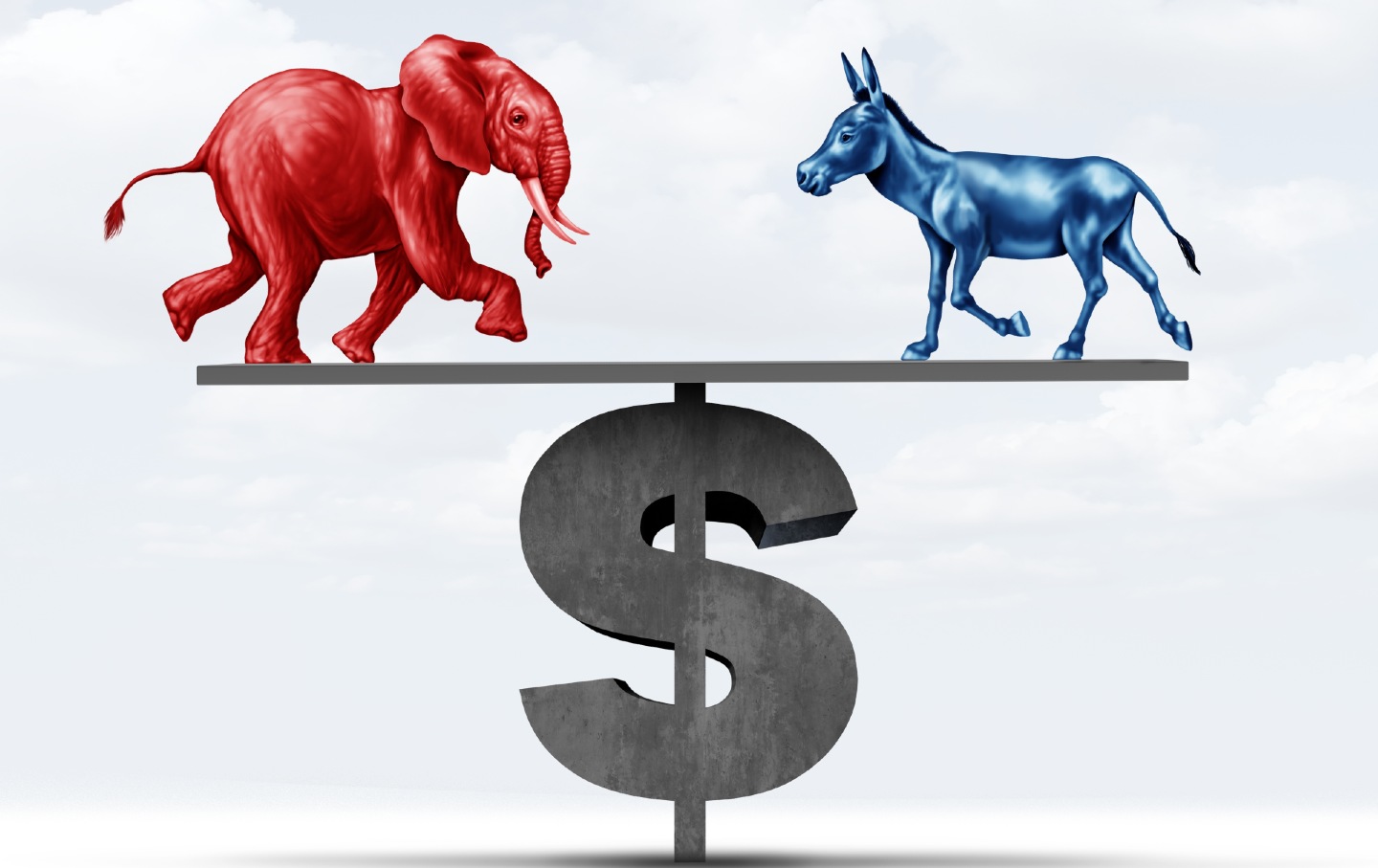
Nonprofits that don’t disclose their donors have funneled at least $642 million to PACs so far in the midterms.
At least $642 million in secret money has flowed into PACs so far this election cycle through nonprofits that do not disclose their donors, a Sludge analysis of federal campaign-finance records found.
The money has financed some of the country’s largest political spending groups while leaving voters unable to know which individuals or companies originally supplied it.
Known as “gray money,” the practice has exploded over the past decade. A New York Times analysis published earlier this year found that organizations that do not disclose their donors supplied nearly one in five dollars contributed to super PACs in the 2024 election, up from roughly one in 100 in 2012.
Sludge’s analysis shows that the surge has carried into the 2026 midterms. Through late August, more than 130 nonprofits that do not disclose their donors have given at least $642 million to super PACs and hybrid PACs, which both make independent expenditures and donate directly to candidates. The total represents 14 percent of the $4.6 billion in itemized contributions of at least $5,000 examined by Sludge and is almost certainly an undercount.
Some of the biggest sums are financing the battle for control of Congress. One Nation, the dark-money nonprofit aligned with Senate Republican leadership, has given $70.7 million to its affiliate Senate Leadership Fund, the main super PAC backing Republican Senate candidates, as of data available from the FEC website on August 27, 2026. Majority Forward, its Democratic counterpart, has given $61 million to its super PAC affiliate, Senate Majority PAC. On the House side, American Action Network, the nonprofit tied to Speaker Mike Johnson’s Congressional Leadership Fund, has given that hybrid PAC $44.3 million, and House Majority Forward, aligned with House Majority PAC, has given it $21.7 million.
Combined, the four party-leadership-aligned nonprofits have funneled $197 million through their affiliated dark-money nonprofits this cycle, more than one dollar in every four the PACs raised in itemized contributions of $5,000 or more.
Current Issue

Michael Beckel, research director at the campaign-finance watchdog Issue One, described the trend as a bipartisan “fundraising arms race fueled by anonymous donors.”
Beckel said, “Voters across the political spectrum lose.”
Gray money gives secret donors a way to tap into the machinery of super PACs without publicly identifying themselves. Rather than having a nonprofit build its own political operation and spend directly on elections, it can transfer millions of dollars to a super PAC whose strategists can pool the money with other contributions and deploy it across races.
The rise of gray money has undercut the disclosure system that the Supreme Court left in place in its 2010 Citizens United decision. While the court struck down restrictions on independent political spending by corporations and unions, it upheld federal disclosure requirements, describing disclosure as a “less restrictive alternative to more comprehensive regulations of speech” that could help voters “give proper weight to different speakers and messages” and determine whether elected officials were “in the pocket of so-called moneyed interests.”
Democrats in Congress attempted to strengthen political-disclosure requirements later that year with the DISCLOSE Act. The measure passed the House but stalled in the Senate, where supporters fell one vote short of the 60 votes needed to overcome a filibuster in September 2010. Democrats have since repeatedly introduced versions of the legislation, but it has never become law.
“The US Supreme Court’s majority opinion in Citizens United envisioned a world in which disclosure rules enabled citizens to make informed decisions about the political ads they see and the messengers behind those ads,” Beckel told Sludge. “But the reality of political spending today makes a mockery of the Supreme Court’s logic.”
Popular
“swipe left below to view more authors”Swipe →
The gray money flowing into the 2026 elections extends far beyond the major party-aligned groups.
The American Israel Public Affairs Committee has given $30 million this cycle to United Democracy Project, its super PAC, which has spent heavily in Democratic congressional races and is the top outside spender so far in the midterms. AIPAC is a 501(c)(4) “social welfare” nonprofit and does not publicly disclose the donors behind the money it transfers to the super PAC.
American Prosperity Alliance, a Republican dark-money group with ties to former House Speaker Kevin McCarthy, has given more than $36 million to super PACs this cycle, including $35.5 million to Conservative Americans PAC. That super PAC has in turn financed groups including Lead Left PAC and Real Change PAC that intervened in Democratic primaries to boost candidates whom Republicans viewed as easier to defeat in the general election.
The New York Times reported that two people briefed on American Prosperity Alliance’s finances, speaking anonymously, said the group is funded heavily by corporate interests, including the pharmaceutical industry. The Times totaled dark money in the 2026 midterms to have topped $1 billion, including both gray money contributions and nonprofit spending on ads, the latter of which is not covered by this analysis.
Trump’s political operation also has a gray-money arm. Securing American Greatness, a nonprofit founded by Trump adviser Taylor Budowich and led, according to a May 2025 FCC document, by White House communications official Kaelen Dorr, does not disclose its donors and has given $24.8 million to three PACs this cycle: MAGA Inc., Accountability Project Inc., and American Leadership PAC.
Some of the nonprofits identified by Sludge are far more obscure and appear to do little besides move money into political committees.
Three Virginia nonprofits—Condorcet Initiative Corp, Ardleigh Impact Corp, and Leon Rachel Corp—were formed within two months of one another in late 2023 and share a treasurer, longtime Republican operative Staci Goede, according to OpenSecrets. The three have combined to give $11.2 million to 10 different super PACs this cycle. Nearly half of the money went to Texans for a Conservative Majority, the main super PAC backing Senator John Cornyn in his Republican primary against Ken Paxton. The nonprofits also gave $1 million apiece to the Eighteen Fifty-Four Fund and Sentinel Action Fund, a pair of Republican super PACs. The same three groups gave a combined $1 million to Pine Tree Results PAC, which ran ads attacking Democratic Senate candidate Graham Platner in Maine.
This article has assembled the most complete known list of dark-money groups that have contributed to PACs in the 2026 midterms.
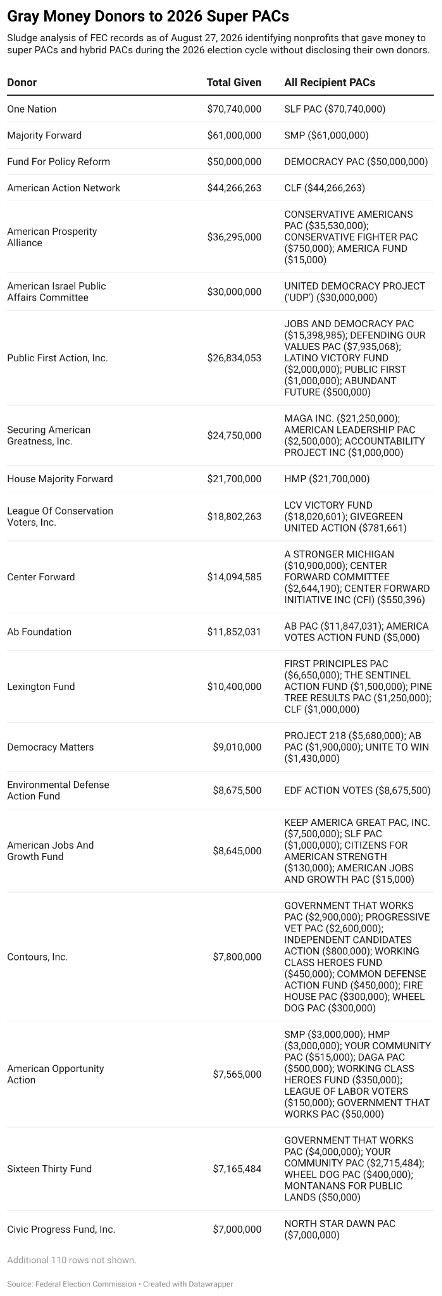
Contours Inc., a nonprofit created in 2025 that does not disclose its donors, has given $2.9 million directly to Government That Works, a political committee funded primarily by nonprofits that keep their donors secret, including Responsive Government Action ($7 million) and the Sixteen Thirty Fund ($4 million). Government That Works, in turn, gave $3.75 million to Lone Star Rising PAC, the main super PAC backing James Talarico in his successful Democratic Senate primary in Texas, making it the super PAC’s largest donor.
Sludge’s $642 million tally does not capture all of the secret money flowing into super PACs and hybrid PACs. Another roughly $75 million donated to super PACs and hybrid PACs came from dozens of entities with names suggesting they may be nonprofits, but that Sludge could not confirm for this analysis and did not include in the total. A separate roughly $140 million came from LLCs and investment vehicles whose FEC paperwork discloses only a company name; some, like George Soros’s Geosor Corporation and Andreessen Horowitz’s a16z Capital Management, have a publicly identifiable owner and are not counted as gray money here. The figure also doesn’t capture “dark money” in the traditional sense of nonprofits that purchase election advertising directly without routing the money through a PAC. The analysis covers itemized contributions of at least $5,000 to super PACs and hybrid PACs, and includes only nonprofits that Sludge could identify by cross-referencing IRS records, state corporate and campaign finance registries, and previous reporting.
More from The Nation
David Morales’s campaign for mayor of Providence, Rhode Island, is providing a model for how a progressive candidate can oust an incumbent.
He’s the most vulnerable incumbent in the Senate race, and his state is ground zero for the new Jim Crow attacks on voting rights.
The union’s endorsements of insurgent candidates led to big wins this summer. It’s all part of a strategy to remake American politics for the working class.
How Homeland Security has adopted the COINTELPRO playbook.