
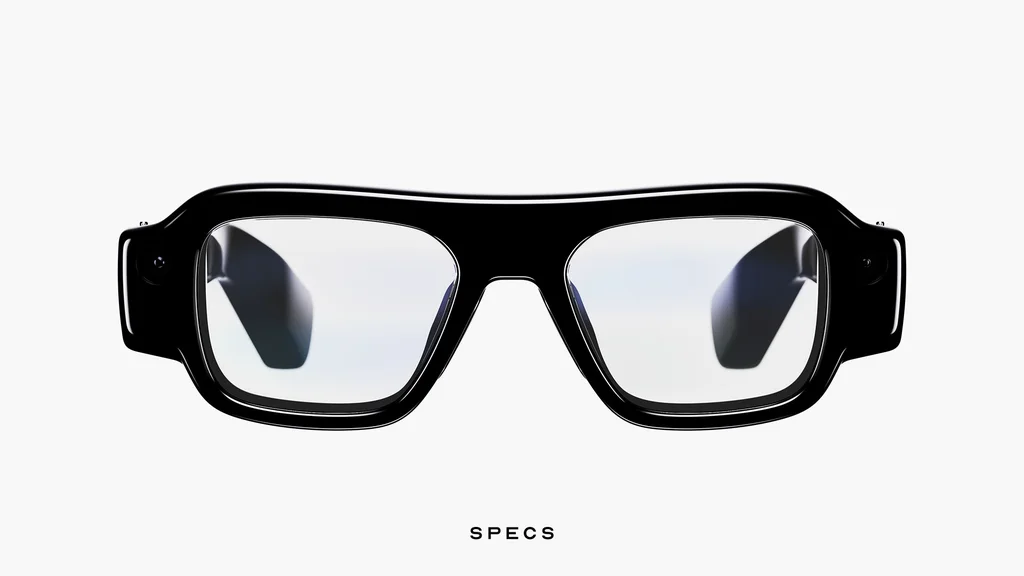
Snap’s cofounder and CEO, Evan Spiegel, gave this morning’s keynote at AWE, the augmented reality industry’s big annual conference. He came with news: Snap, best known for its Snapchat ephemeral messaging app, is releasing a pair of AR-enabled glasses called Specs. It intends to ship them this fall for $2,195, and is taking preorders.
Though Specs are new, Snap’s investment in smart glasses as a computing and communications platform is anything but. Depending on how you figure, it all began nearly a decade ago, when the company shipped its first product in the category, which, like four subsequent versions, was known as Spectacles. Or back in 2014, when it acquired a tiny startup called Vergence Labs that had already crowdfunded and shipped a product called Epiphany Eyewear.
Spiegel pinpoints an even earlier origin story. As a Stanford student, he told me this week, “I had seen prototypes of AR headsets that really looked like giant helmets, essentially. The promise of being able to actually use computing through a see-through lens rather than a screen was really exciting and interesting to me.”
His enduring interest in AR has kept the glasses project going through some turbulent years at Snap, whose stock is down more than 90% from its peak. The company announced major rounds of layoffs in August 2022, February 2024, and last April. Along the way, it shed several noncore activities, including ones involving original short shows, social mapping, music creation, a selfie drone, and enterprise services.
Why has Snap stuck with glasses for so long, rather than finding them a distraction from its primary business of keeping nearly a billion Snapchatters happy and monetizing their attention through advertising? Spiegel argues that they’ve never been a mere side project.
“If you look at the history of the company, we’ve been laser focused on trying to make computing more human,” he says. “Some of the early innovations were things like ephemeral messaging that make conversation more like face-to-face, and stories that put content in chronological order. These are the sorts of things that we think have helped make your smartphone feel more human. But fundamentally, we believe that until we get computing off a screen and into the world where humans live, it’s really hard to fully realize that vision.”

Earlier this year, in preparation for Specs’ launch, Snap spun the business into a subsidiary called Specs Inc. It said the move’s benefits ranged from operational focus to more distinct branding to the possibility of outside investment. Yet the glasses’ kinship with Snapchat remains strong on multiple fronts, from the philosophical to the technical.
First, there’s the fact that Snapchat has long been one of the world’s most popular augmented reality products. Some 450,000-plus developers have created more than 5 million AR experiences for the platform, called Lenses. Mostly, they offer whimsical little hits of entertainment, such as the opportunity to turn yourself into a cat or a lizard, remove your hair, put yourself on a virtual jet ski, or twist your face like Silly Putty. But they sure do speak to the app’s users, who engage with Lenses 9 billion times a day.
Lenses’ popularity is no doubt boosted by the fact that Snapchat shows you what your camera sees the moment you launch the app, putting any of a seemingly endless quantity of AR effects a tap away. “That’s one of the things that’s always been unique about Snapchat, that we’ve opened the app into your own experience of the world and invited you to use Lenses,” says Spiegel. “Some of those original founding ideas are mirrored with glasses. When you put on glasses, you’re seeing the world through your perspective, not entering a feed of content.”
By putting AR before your very glasses-wearing eyes, Specs offer a richer canvas for AR than a smartphone-sized app like Snapchat can. That enables more ambitious applications, including a virtual floating web browser complete with video streaming, immersive mapping, car repair tutorials, floating recipes you can consult as you cook, and much more. Snap calls the device a “computer,” which seems reasonable given the breadth of its aspirations.
But the Specs platform also builds directly on tools Snap originally devised for Snapchat, including the Lens Studio development platform and Commerce Kit monetization engine. According to Spiegel, Snap’s years of labor getting AR to operate smoothly on whatever phones its users happened to own have also helped it bring the technology to the computing resources it could cram into a pair of glasses.
“It’s really battle-hardened the overall platform, because our rendering engine is running on lots of smartphones all over the world, including low-end smartphones with very limited compute,” he says.
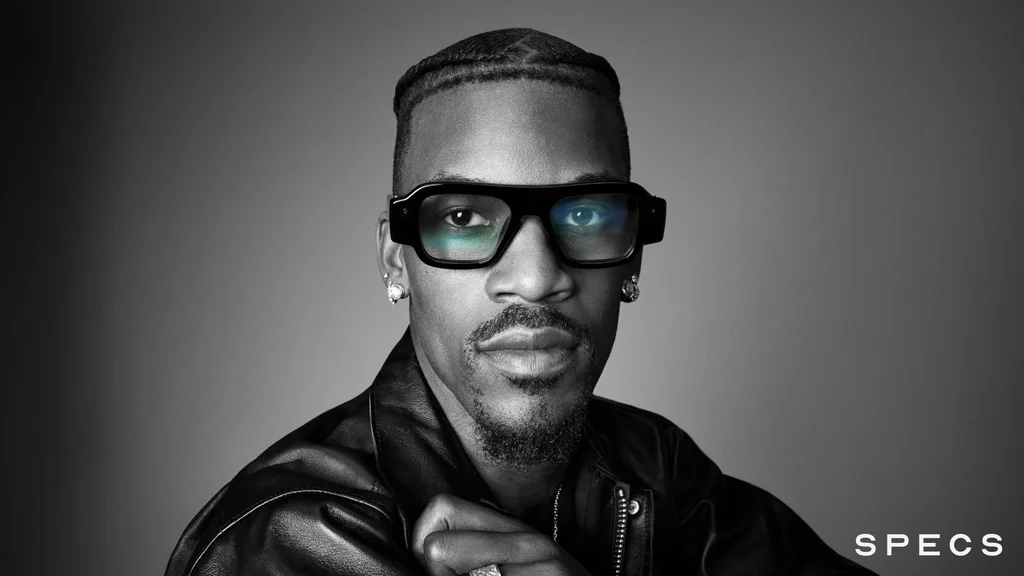
One step at a time
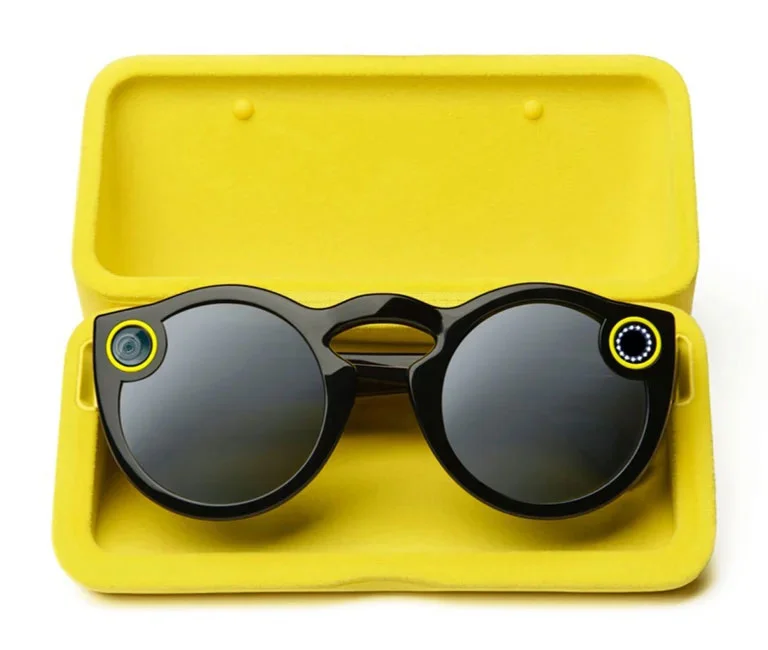
Even in Spectacles’ formative years, Spiegel was thinking ahead to the moment when Snap could create something resembling Specs, he says: “I actually thought it would take longer.” But the current version of the idea is just barely recognizable as a descendant of the original 2016 Spectacles.
That version was not an AR platform—just a colorful pair of sunglasses with a built-in camera and the ability to record 10-second video clips. At $130, they were a quirky impulse item, and were even sold in vending machines. Not as many people had the impulse as expected, though: Snap ended up taking a $40 million write-off on unsold units and unused components. Undaunted, it went on to release upgraded versions in 2018 and 2019.
Spectacles’ biggest single leap came in 2021, with the first version that included displays and AR technology. That allowed the glasses to overlay digital imagery on the real world and let users interact via hand gestures. Instead of selling this version, Snap gave it for free to hundreds of creators. They provided feedback to the Spectacles product team, which continued to noodle on the concept.
The company followed up in 2024 with an even more ambitious version of Spectacles that offered an AI voice assistant as well as AR features. Still in experimentation mode, it made this iteration available only to developers, who paid a subscription fee to get access. I demoed several of its entertainment, educational, and social experiences at the time, and found them to be intriguing good fun.
I have not yet had any face time with Specs, which offer another generation of technological advancement on those 2024 Spectacles. The new version is 40% lighter, has more than five times the claimed battery life, offers a wider field of view, and, though still decidedly chunky, no longer vaguely resembles a Cybertruck affixed to your face. Unlike many products in the broad category of AR/VR/spatial computing eyewear, it’s self-contained, with no external battery pack, input device other than your hands, or dependency on a smartphone for computing brains.
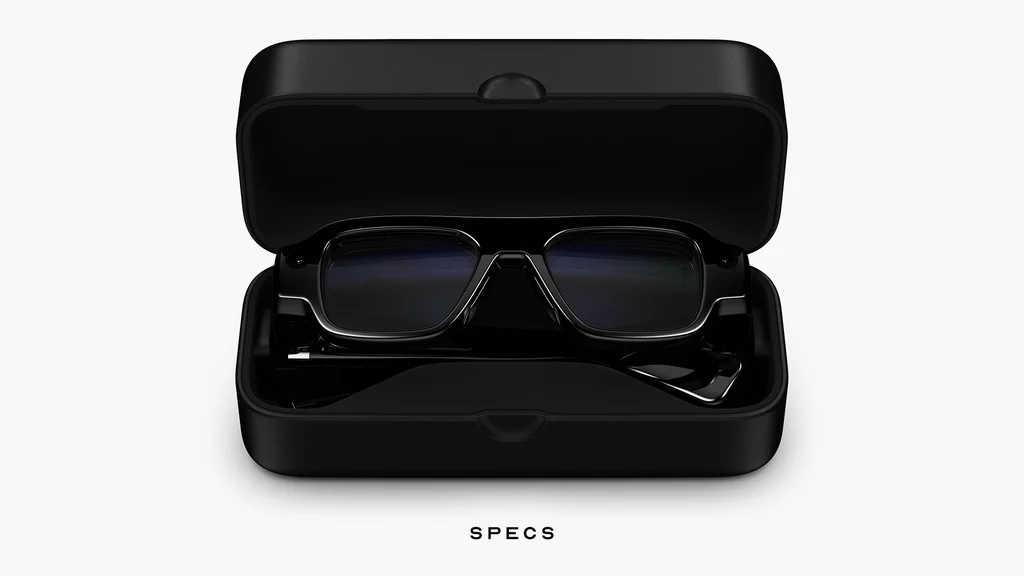
The new glasses will be available with prescription lenses and in two sizes: 47mm and 52mm (1.85/2.05 inches), weighing 132 grams and 136 grams (4.66/4.80 ounces), respectively. Both are around twice as heavy as Meta’s Ray-Ban Display Glasses (69-70 grams) but vastly lighter than Apple Vision Pro (750-800 grams, not counting the 353-gram tethered battery pack). Snap says Specs offers up to four hours of life on a charge; the included battery case can charge the glasses four times, for 20 total hours of on-the-go use.
Not a smartphone killer
During the tech industry’s blip of metaverse mania a few years ago, it wasn’t hard to find people—Mark Zuckerberg, for instance—who contended that smart glasses were destined to replace smartphones. Spiegel is not making that case for Specs. “At this point, we see it as more of a complement to your existing devices, just like the smartphone didn’t replace the laptop or the desktop,” he says.
So if Specs aren’t trying to beat any existing gadget at its own game, what are they good for? Asked how he uses the glasses, Spiegel calls out two scenarios. When traveling, he says, he misses his desktop monitor and uses Specs as an immersive display to stay productive. The father of four sons, he also finds it “a blast to run around outside and use a computer in that way, whether [he and his kids] are learning about dinosaurs or [playing] a version of laser tag on Specs.”
Ultimately, though, Specs’ killer apps will probably come from third-party developers whose imaginations will be sparked by the glasses once they’re available. “When the iPhone came out, Apple hadn’t imagined Uber or Snapchat or anything like that,” says Spiegel. “For me, what’s so fun about Specs is seeing all of these amazing creative experiences that I never would have thought of myself.”
Of course, most developers will be attracted to Specs only if they have a critical mass of users. That, inevitably, brings us to the device’s $2,195 price tag.
Considering the amount of sophisticated technology the glasses pack, Spiegel says their price is “a real engineering milestone and something we put a lot of effort into.” He points out that Apple Vision Pro costs $3,500 (and also that Apple’s original 1984 Macintosh sold for the inflation-adjusted equivalent of $8,000).
Still, as long as Specs cost more than most laptops, it’s tough to see them racking up double-digit market share among smart glasses. The research firm IDC says the category is dominated by Meta, whose AI-infused Ray-Bans and Oakleys make up 69% of units shipped, with no other player managing more than 3.4%. It forecasts that “optical see-through glasses,” the subcategory Specs fall into, will grow from 3 million units shipped this year to 12.2 million in 2030. But it also expects the average selling price to be in the range of $516 to $547, making Specs an outlier.
For now, preordering Snap’s glasses requires both a refundable $200 deposit and a leap of faith on a pricey, sight-unseen product. Stay tuned, though. In the future, Spiegel promises, “We’ll be very focused on helping as many people as possible try Specs.”
Despite Spiegel’s gamely arguing that Specs offer impressive bang for their 2,195 bucks, he doesn’t contend that they’ve hit a magic price point yet. “In future generations, we’d like to be able to either come up with different versions of Specs or to be able to develop other ways to reduce the cost of the device, so that more people can enjoy it,” he says.
What that magic price point might be will be contingent on how useful Specs turn out to be. That’s dependent on the apps it gets. But consider this: Forty-two years after Apple’s original Macintosh, you no longer need an inflation-adjusted $8,000 to buy a Mac—for $595, you can get a MacBook Neo. Even a decade after the original Spectacles, it may be early days for the big idea that Specs represent.