
The baton has been passed.
Nearly two weeks after the catastrophic explosion of Blue Origin’s New Glenn rocket, NASA is moving full force into the next phase of its race to the moon, announcing the Artemis III crew and outlining mission goals.
Next year, NASA astronauts Randy Bresnik, Andre Douglas, and Frank Rubio, and the European Space Agency’s Luca Parmitano, will spend two weeks in orbit testing maneuverability and compatibility between the space capsule and two landers to help ready Artemis IV, the first crewed mission to the Lunar South Pole in 2028.
“Artemis III will be unlike anything we’ve ever undertaken,” NASA Administrator Jared Isaacman posted on X. “A multi-launch campaign bringing together the most powerful rockets in the world to test rendezvous, docking, and interoperability across multiple systems close to Earth before we return astronauts to the lunar surface.”
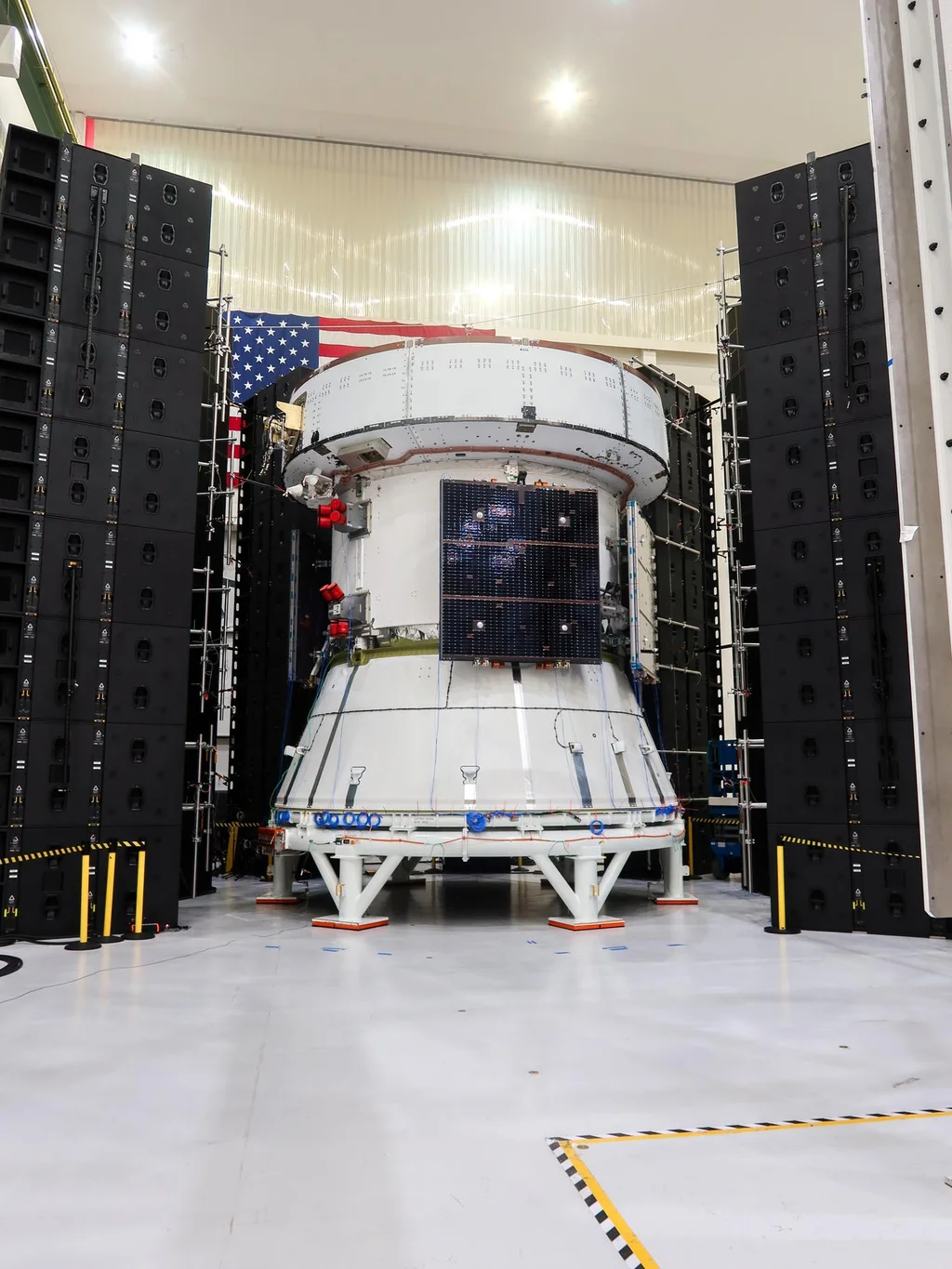
NASA’s Space Launch System (SLS) rocket will launch the Orion spacecraft from Kennedy Space Center to low Earth orbit. There, its crew will practice rendezvous and docking maneuvers with the Blue Origin Blue Moon and SpaceX Starship lander test models vying to carry humans from lunar orbit to the surface and back during Artemis IV. Orion will dock for several days with each lander, so the crew can conduct in-space trials assessing life support, hatch operations, communications, propulsion systems, and Axiom Space’s new spacesuits, as well as help guide development of the landers. After Artemis III, both Blue Origin and SpaceX will stage several uncrewed demonstrations to the lunar surface in 2028, in advance of Artemis IV.
“As the first crewed Artemis mission with commercial spacecraft, this test flight will enable us to prove we can carry out highly choreographed operations with our partners” across systems and launch pads, says Artemis program manager Jeremy Parsons during a Tuesday press conference. “We want to do this in Earth’s orbit before we return to the moon and establish an enduring presence there.”
Passing the torch
During the event, exuberant Artemis II crew members ceremoniously passed a baton they’d carried on their successful lunar flyby to the Artemis III team.
This mission marks the third spaceflight for both Artemis III commander Resnik and pilot Parmitano, whose helmet famously filled with water during a 2013 spacewalk. Parmitano is the first ESA astronaut assigned to an Artemis mission. Mission specialist Rubio, a physician and record-holder for the longest single-duration spaceflight by an American astronaut, will make his second trip to space. But it will be the first spaceflight for fellow mission specialist Douglas, an Artemis II backup astronaut. NASA astronaut Bob Hines, who’s logged 170 days in space, will serve as the backup crew member.
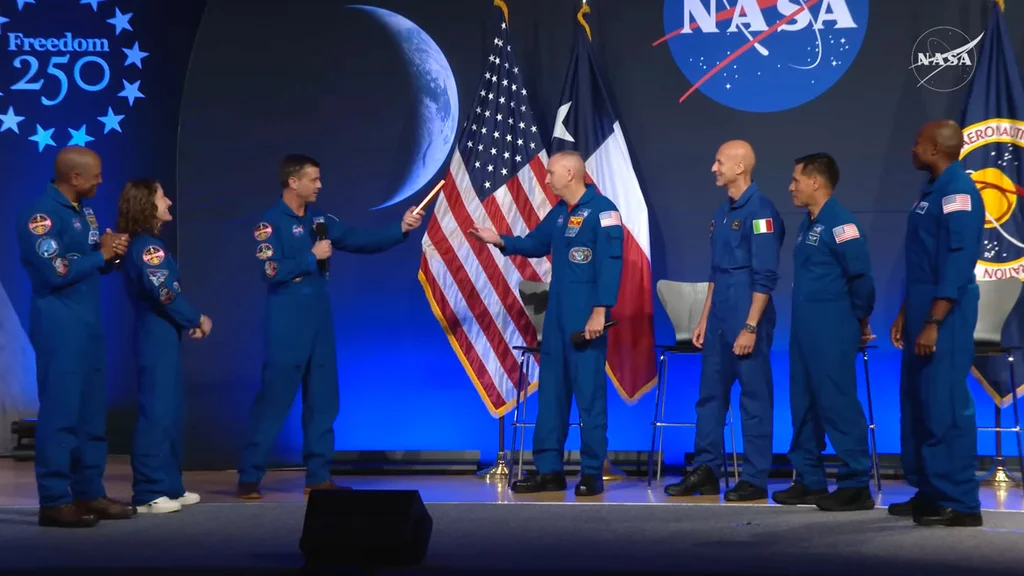
“We’ve been carrying this baton around for way too long,” said Artemis II commander Reid Wiseman. “So, with that, the Artemis II crew hands you the baton. You got the controls.”
“We’re honored to be able to carry this torch forward,” Bresnik responded. “To be able to execute our mission, to make that flame burn brighter, and pass it on to the next crew.”
Despite the excitement, enough frustration with an all-male crew prompted Isaacman’s next-day response, explaining that astronauts are chosen for specific skill sets. “The Astronaut Office assigns the crew that gives the mission the best chance of meeting its objectives, taking into account many factors, including the background and expertise of the astronauts, such as test pilot experience, development work on specific programs, and availability.”
Mission goals for the moon and beyond
Artemis III will also set a rhythm of multi-launch campaigns to build a lunar economy and Moon Base, commercial space stations, and more deep-space explorations that search for threatening asteroids, investigate dark matter and exoplanets, probe Mars and Saturn’s moon, Titan, and assemble the first nuclear-powered interplanetary spacecraft.
“Think about how many spacecraft, all of which will eventually carry human beings, will be in orbit at the same time,” said Isaacman. “This seems like the beginning of the future that we imagined as children.”
Since Artemis III is a technical mission, the science team will study how space weather affects Earth’s atmosphere to better understand how to protect and monitor spacecraft and crew health. That data could inform new kinds of instruments measuring increased radiation beyond Earth’s magnetosphere, orbital decay caused by solar flares, or contaminants that compromise lunar samples and crew wellness.
“Think of it [as] if you’re going on a road trip, you need to prepare a game plan, not just for your destination, but for driving through all of the states in between,” said Nicki Fox, the associate administrator for NASA’s Science Mission Directorate.
The New Glenn aftermath
The event’s momentum signaled a regroup from the May 28 Blue Origin New Glenn rocket explosion that threatened to delay the Artemis moon landing schedule, which is just slightly ahead of China’s 2030 target.
The heavy-lift rocket erupted in a fireball during a static test fire at Cape Canaveral that severely damaged the company’s only working launch pad. Later this year, the rocket was slated to launch Blue Origin’s Blue Moon Mark 1 lander and NASA payloads to the Lunar South Pole, as part of the first phase in establishing a Moon Base.
With the cause under investigation, Blue Origin plans to rebuild the launch pad. But how fast they’ll be able to resume flights is a matter of speculation. On June 1, Blue Origin CEO Dave Limp posted that the company will accomplish this before the end of this year, while others suggest 2027 or later.
“While we recognize there are questions about how Blue Origin’s recent anomaly impacts our plans, setbacks are a learning opportunity,” said NASA’s Parsons. “We are confident that New Glenn will be ready for Artemis III together with Blue Origin.”
However, Kathleen Curlee, a space economy research analyst at Georgetown University’s Center for Security and Emerging Technology, suggests that path—determining what went wrong, recertifying the rocket for flight, and rebuilding the launchpad, which requires new permits—might require a longer timeline.
“That’s pretty ambitious and unrealistic given all the factors that go into this,” she says in response to Limp’s comment. “I think it’s a year and a half to two years that they’ll be grounded. Unless someone else lets them use their launchpad, I don’t think they’ll launch by the end of the year. A more viable path would be for Blue Origin to rebuild, but this is a significant financial investment and a lengthy process, with a lot of permitting.”
Changing launchpads is unlikely, given the dearth of available pods capable of handling heavy-lift rockets and the difficulty of adapting them to a new rocket. Although Blue Origin is concurrently building a second pad at Vandenberg Air Force Base in California, it’s still wending its way through regulatory hurdles.
Another potential option is flying the Blue Moon on a SpaceX Falcon Heavy or ULA Vulcan Centaur rocket. With the Vulcan still grounded, the Falcon Heavy is the more likely backup. But it would require modifying both the rockets’ payload fairings and the lander propulsion system.
“We’re spoiled with the idea that a launch is sort of easy and not a big deal anymore because we’re launching rockets every other week,” says Curlee. “But it is a very difficult technical challenge to get a rocket into space. Seeing other launch providers struggle reemphasizes how much work is needed to come up with a reliable competitor.”