
Close Menu
    Facebook X (Twitter) Instagram
    TRENDING :
    • AI can help governments see around corners
    • Liquid Death founder Mike Cessario shares his playbook for breaking through
    • Scotland’s Tartan Army just inspired a perfect example of reactive advertising
    • Can we trust scientific images in the era of AI?
    • The personal brand trap: Why humans shouldn’t think of themselves as brands
    • Why the founder of David protein bars says controversy can be good for business
    • Women could solve the AI trust gap, but they aren’t in the room
    • US Strikes Deal For Kenya’s Rare Earth Minerals
    Populist Bulletin
    • Home
    • US Politics
    • World Politics
    • Economy
    • Business
    • Headline News
    Populist Bulletin
    Home»Business»Redwire and the power that’ll fuel NASA’s Gateway Lunar Space Station
    Business 2 Mins Read

    Redwire and the power that’ll fuel NASA’s Gateway Lunar Space Station

    Business 2 Mins Read
    Share Facebook Twitter Pinterest LinkedIn Tumblr Telegram Email Copy Link
    Follow Us
    Google News Flipboard
    Share
    Facebook Twitter LinkedIn Pinterest Email

    In two years, there could be a space station orbiting the moon. NASA’s Gateway Lunar Space Station, set to launch as early as 2027, will support the Artemis IV and V moon missions and, eventually, be a jumping-off point for missions to Mars. And maybe, one day, a colony.

    But before any of that can happen, the Gateway will need a power source—a powerful one, at that. The challenge is getting that energy supply into orbit the way anything reaches space: in the nose cone of a rocket.

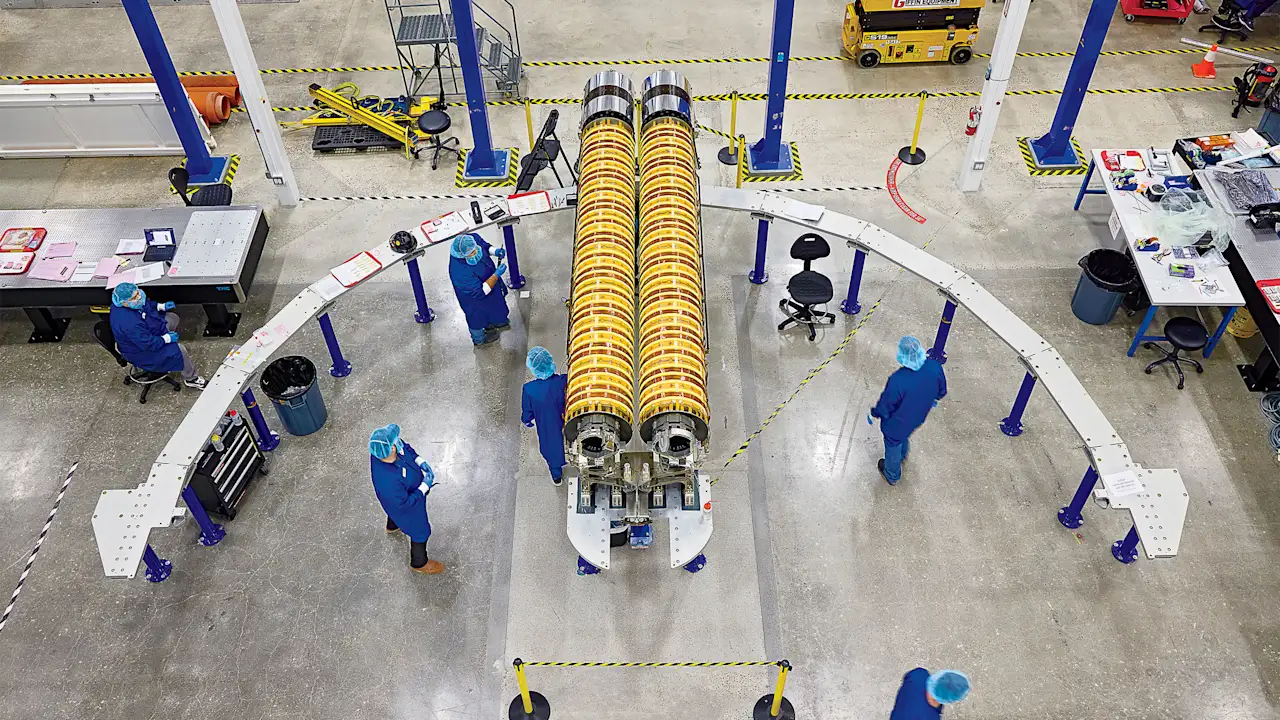
    Gateway’s power will come from a pair of blankets of photovoltaic cells, known as Roll-Out Solar Arrays (ROSAs). Each is roughly the size of a football end zone, and together they’ll provide 60 kilowatts for 24 hours a day—enough energy to power roughly 50 American homes. But to minimize their profile on the trip out of Earth’s atmosphere, the arrays will be launched in a rolled-up state, a pair of sci-fi rugs bound for lunar orbit. The Gateway’s ROSAs are built by space company Redwire, using tech initially developed by its subsidiary Deployable Space Solutions.

    “When the arrays get to the Gateway, they’ll be attached [to the station] and then roll out,” says Mike Gold, a NASA veteran and Redwire’s president of civil and international space business. The unrolling process doesn’t require an electric motor: A flexible boom simply guides the arrays as they unspool. After successfully testing the panels’ roll-out capabilities in July, Redwire is handing them off for prelaunch testing to space tech company Lanteris (formerly Maxar), which is building the Gateway’s power and propulsion element.

    Though the arrays for the Gateway are the largest and most powerful ROSAs that Redwire has built, the company’s tech is all over space. Six smaller ROSAs have already deployed on the International Space Station, with two more set to be launched and installed in 2026. Smaller versions of Redwire’s arrays will power the new Space Inspire telecom satellites from aerospace company Thales Alenia Space (launching in 2026). Redwire is also working on two ROSA wings for Axiom Space’s planned module for the International Space Station, slated to launch in late 2027.

    “We like to say we are second only to the sun when it comes to providing power in space,” Gold says.


    Source link

    Share. Facebook Twitter Pinterest LinkedIn Tumblr Email

    Related Posts

    AI can help governments see around corners

    June 24, 2026

    Liquid Death founder Mike Cessario shares his playbook for breaking through

    June 24, 2026

    Scotland’s Tartan Army just inspired a perfect example of reactive advertising

    June 24, 2026
    Top News
    Business 10 Mins Read

    The case for saying no to new gadgets

    Business 10 Mins Read

    This article is republished with permission from Wonder Tools, a newsletter that helps you discover…

    10 Essential Tips for Effective Gestion Leads Prospection

    January 18, 2026

    We Built a 7-Figure Business Without a Single Investor — Here’s Why Saying No to VC Was Our Smartest Move

    September 8, 2025

    What Is Employment Compliance and Why It Matters?

    March 1, 2026
    Top Trending
    Business 4 Mins Read

    AI can help governments see around corners

    Business 4 Mins Read

    Government agencies at all levels are searching for the answer to one…

    Business 4 Mins Read

    Liquid Death founder Mike Cessario shares his playbook for breaking through

    Business 4 Mins Read

    Hello and welcome to Modern CEO! I’m Stephanie Mehta, CEO and chief content officer of Mansueto…

    Business 5 Mins Read

    Scotland’s Tartan Army just inspired a perfect example of reactive advertising

    Business 5 Mins Read

    Since the World Cup began on June 11, thousands of international fans…

    Categories
    • Business
    • Economy
    • Headline News
    • Top News
    • US Politics
    • World Politics
    About us

    The Populist Bulletin was founded with a fervent commitment to inform, inspire, empower and spark meaningful conversations about the economy, business, politics, government accountability, globalization, and the preservation of American cultural heritage.

    We are devoted to delivering straightforward, unfiltered, compelling, relatable stories that resonate with the majority of the American public, while boldly challenging false mainstream narratives that seem to only serve entrenched elitists, and foreign interests.

    Top Picks

    AI can help governments see around corners

    June 24, 2026

    Liquid Death founder Mike Cessario shares his playbook for breaking through

    June 24, 2026

    Scotland’s Tartan Army just inspired a perfect example of reactive advertising

    June 24, 2026
    Categories
    • Business
    • Economy
    • Headline News
    • Top News
    • US Politics
    • World Politics
    Copyright © 2025 Populist Bulletin. All Rights Reserved.

    Type above and press Enter to search. Press Esc to cancel.