
Artificial intelligence is coming to Mozilla Firefox—but only for users who want it.
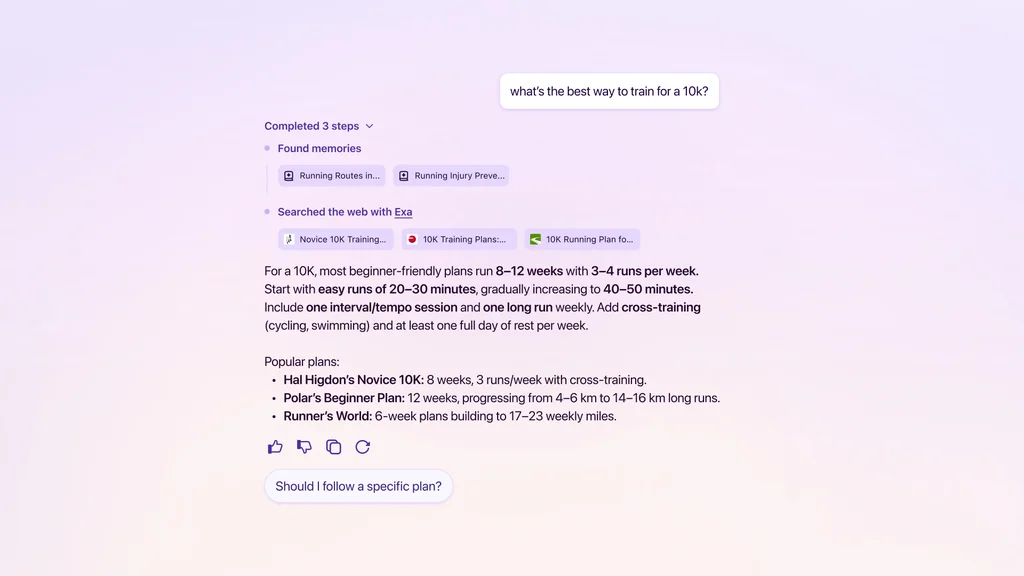
Through a deal with AI search provider Exa, Mozilla announced on Tuesday what it calls Smart Window, browser windows and tabs augmented with AI chat interfaces that can answer questions and help users with content on open tabs and material from the broader internet.
Perhaps most critically for many users, and in line with Mozilla’s ongoing approach to AI, the feature will only be shown to those who opt in, and users will be able to opt out at any time or temporarily toggle the feature off. Though that likely won’t satisfy all of Mozilla’s critics, some of whom are ardently opposed to generative AI and others who discourage Mozilla from investing in anything but core browser technology, the Firefox maker appears intent on catering to both AI aficionados and those who want nothing to do with large-language models.
“With Firefox, we are really focused on building the best browser,” says Ajit Varma, head of Firefox at Mozilla. “Some people definitely want AI, some people don’t, and so, what we’re looking at is really choice.”
The feature is currently rolling out to users who opt in in the U.S. and Canada. For those who do opt in, Smart Window can answer questions similar to those people might ask other AI chat tools like ChatGPT or Claude. The interactions take place within a panel that sits alongside ordinary browser content. But unlike third-party chatbots, the Smart Window AI can answer questions specifically about open tabs and based on “memories” derived from users’ browsing histories.
Questions relying on internet content are powered by Exa’s search engine, which the company says uses custom AI models and databases, along with ongoing crawls of more than 500 billion web addresses, to deliver relevant material. When a user asks a question that calls for information from the web, the AI model generates a search query and sends it to Exa through its API, then uses Exa’s response to formulate an answer, similar to the tool-calling approach used by other AI systems. Mozilla and Exa say neither retains the information sent as part of those searches.
Exa, which announced in May it had raised a $250 million funding round led by Andreessen Horowitz at a $2.2 billion valuation, also powers search for software companies including Cursor, Cognition, and HubSpot. “We train everything in house. We crawl everything in house,” says Exa cofounder and CEO Will Bryk. “And then a query comes in, and we rapidly search over all those documents that provide the highest quality.”
Mozilla emphasizes that Exa doesn’t retain user data, and Mozilla also doesn’t retain chat transcripts or use interactions to train models unless users opt in to specific programs. Memories accumulated over time can also be deleted from the browser’s settings menu, where users can toggle Smart Window off or disable AI features entirely.
“We won’t actually upsell a user to ever use it again,” says Varma.
Many longtime internet users know Firefox as the open-source browser that helped break Microsoft’s de facto Internet Explorer monopoly in the 2000s, and many still prefer it as an open and heavily customizable alternative to browsers from tech giants Google, Apple, and Microsoft. Part of Mozilla’s goal is still to make sure there’s no single dominant player controlling users’ access to the internet, Varma says, whether they prefer a traditional browsing interface or one accompanied by AI chat.
To that end, users can also configure which AI model they want to use with Smart Window, choosing from three available by default or plugging in connection information for a third-party model. That could be one hosted on another provider’s cloud system or running on the user’s own computer. In the future, the AI may itself be able to help configure Firefox, since Varma says Mozilla is testing features that could let it tweak browser settings or even vibe code embeddable widgets and extensions to augment the browser.
“We joke a lot about the fun use cases where you can just change certain words to whatever word you want,” Varma says. “But there’s a lot of creativity that we think will come up.”
Mozilla isn’t the first to aim to build a more AI-centric browser: OpenAI last year launched a browser called ChatGPT Atlas, though the product was since discontinued in favor of web access capabilities within ChatGPT itself, and other startups continue to try their hands at rolling out post-LLM versions of the ubiquitous web access software.
But, Varma suggests, part of the reason none of those has yet taken off is that it’s simply hard to build a browser. Mozilla, of course, has decades of experience doing just that, and Varma emphasizes that Firefox continues to see non-AI-related upgrades, with the latest version of Firefox featuring improvements in everything from bookmark search to video playback.
Still, much of Mozilla’s revenue has long come from payments from Google to serve as Firefox’s default search engine. Smart Window won’t immediately help diversify the company’s revenue stream, since Mozilla is, in fact, paying Exa for its AI services. But AI also won’t necessarily eliminate traditional Google searches. Varma points to broader search-industry statistics showing that the overall volume of searches on platforms like Google has continued to rise even since the emergence of generative AI. So far, he says, searches per person have gone up rather than down. The company also has other revenue sources, including ads on the “New Tab” page and subscription-based products like Mozilla’s VPN.
And, Varma says, the company’s approach to AI and how it gets paid for could change over time as the industry continues to evolve.
“There are a spectrum of monetization options that we have, but right now, I think it’s too early for us to make a call,” says Varma. “We are looking at creating value for users, and then we believe if we create enough value, there’ll be more than enough monetization opportunities down the road.”