Close Menu
    Facebook X (Twitter) Instagram
    TRENDING :
    • The future of AI in schools isn’t personalized learning
    • How new perspectives come from moonwalking
    • Snap layoffs today: 16% of jobs cut as CEO Evan Spiegel is the latest to tout AI advances
    • With 7 short words, the CEO of United Airlines just taught a brilliant lesson in leadership
    • Disney begins laying off 1,000 employees. Here’s who will be affected
    • Quantum computing stocks are back on the rise. Here’s why IONQ, QBTS, RGTI, and QUBT are up
    • Hungary 3rd Time A Charm?
    • The padel app turning matches into meet-cutes
    Populist Bulletin
    • Home
    • US Politics
    • World Politics
    • Economy
    • Business
    • Headline News
    Populist Bulletin
    Home»Headline News»What are semiconductors and why is Trump planning 100% tariffs?
    Headline News 4 Mins Read

    What are semiconductors and why is Trump planning 100% tariffs?

    Headline News 4 Mins Read
    Share Facebook Twitter Pinterest LinkedIn Tumblr Telegram Email Copy Link
    Follow Us
    Google News Flipboard
    Share
    Facebook Twitter LinkedIn Pinterest Email


    Liv McMahon & Shiona McCallum

    Technology reporters

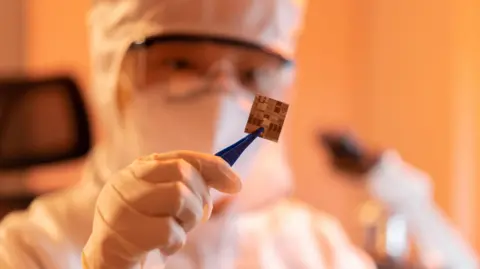
    Getty Images A female engineer wearing white protective clothing and a pair of goggles in a laboratory holds a silicon semiconductor wafer in a pair of blue tweezers in front of her.Getty Images

    The manufacture of the tiny tech that powers billions of devices is under a microscope.

    US President Donald Trump has said he plans to introduce 100% tariffs on semiconductor imports.

    The tiny chips power a range of different devices and are integral to modern technology and the global economy.

    While some semiconductor producers could be spared from the taxes, they may still impact the tech industry and could push up the price of some products.

    What is a semiconductor and how are they used?

    Semiconductors have enabled a slew of modern devices – from smartphones and laptops to video game consoles, pacemakers and solar panels.

    Sometimes referred to as microchips or integrated circuits, they are made from tiny fragments of raw materials, such as silicon.

    Semiconductors, as the name suggests, can partially conduct electricity – alternating between doing so and acting as an insulator.

    This allows them to be used as electronic switches, speaking the binary language of 0s and 1s that underpins computing.
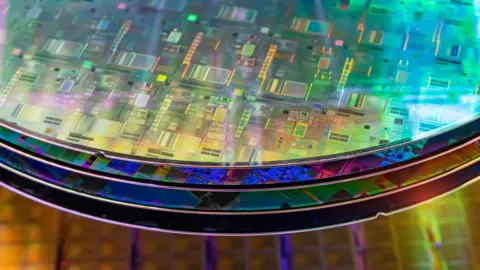
    Getty Images A close-up of gold and multicoloured silicon wafers.Getty Images

    Thin slices of silicon that resemble large disks, known as wafers, are used as the base for semiconductors.

    Who makes semiconductors?

    The UK, US, Europe and China rely heavily on Taiwan for semiconductors.

    Taiwan Semiconductor Manufacturing Company (TSMC) provides over half of the world’s supply.

    Founded in 1987 as the world’s first foundry – dedicated to producing semiconductors for device manufacturers – TSMC now makes them for tech giants like Nvidia, Apple and Microsoft.

    It has also been caught up in so-called “chip wars” between the US and China. Each country has tried to slow or cut off the other’s access to essential components, materials and parts of supply chains as they race to develop the best tech.

    Samsung Electronics in South Korea is the next biggest supplier.

    Together with SK Hynix, it has established the country as one of the world’s biggest semiconductor hubs – particularly for the supply of memory chips.

    Why does Trump want 100% tariffs on semiconductors?

    One of the main aims of President Trump’s “reciprocal” tariffs during his second term has been to encourage firms to manufacture more products in the US.

    In April, the White House exempted smartphones, computers and some other electronic devices from tariffs, including 125% levies imposed on Chinese imports. The tech industry breathed a sigh of relief.

    But in early August, Trump reiterated plans to impose tariffs on foreign semiconductors – saying he would introduce a 100% tax on chips from abroad.

    He did not offer more details on the tariffs, but said companies could avoid them by investing in the US.

    The country is already home to some companies that design, manufacture and sell processing chips, such as Intel and Texas Instruments.

    But it wants to be home to more manufacturers, particularly those making the most advanced and in-demand products – many of which are based in Asia.

    The President and members of his administration have also cited national security concerns about microchips being produced or sourced from elsewhere.
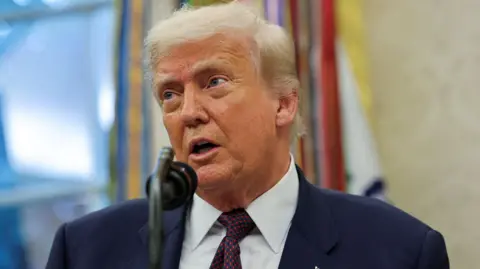
    Reuters President Donald Trump, wearing a navy blue suit and red spotted tie, speaks into a microphone in the Oval Office on 6 August.Reuters

    Trump has said previously he would not allow the US to be “held hostage” by countries such as China when it comes to tech.

    What impact could the tariffs have?

    In theory, Trump’s threat to impose 100% tariffs on foreign-made chip imports would impact a wide range of chipmakers and the tech companies who depend on them for semiconductors – given most are based outside the US.

    The effect of this could be seen in the form of delays, as companies rush to shift manufacturing to the US, or price rises for some electronics – if manufacturers look to pass the cost of tariffs on to consumers.

    But Trump’s caveat that companies committing to manufacturing in the US would not face the levy means the largest semiconductor firms may avoid Trump’s tariffs.

    The president said Apple, which sources its semiconductors from TSMC, will evade the 100% tariffs following its further $100bn investment in US manufacturing.

    This prompted a 5% rise in TSMC’s share price on Thursday.

    Meanwhile South Korean officials have said Samsung and SK Hynix will not face 100% tariffs due to their investment in new US chip fabrication plants.

    How could the US make more semiconductors?

    The US has spent colossal sums of money in recent years to try and boost domestic technology manufacturing.

    Some semiconductor companies, such as TSMC, have already boosted their US presence in response to legislation under the previous administration.

    The US Chips Act incentivised firms to move chips manufacturing in the US in return for funding awards.

    The US government committed $6.6bn (£5bn) in awards to TSMC after it built a factory in Arizona.
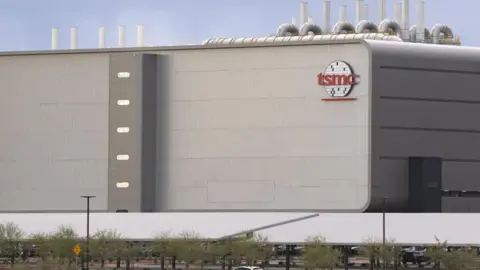
    Bloomberg via Getty Images TSMC plant in ArizonaBloomberg via Getty Images

    More companies are following in TSMC’s footsteps with plans for American manufacturing hubs.

    But production at the site has previously faced delays due to a shortage of skilled workers – something that may present a wider challenge to increasing US-based semiconductor manufacturing.

    TSMC reportedly only resolved its staff shortage by bringing thousands of workers over from Taiwan.


    Source link

    Share. Facebook Twitter Pinterest LinkedIn Tumblr Email

    Related Posts

    STEM Education in Africa: Engineering Student’s Story

    August 20, 2025

    Microsoft boss troubled by rise in reports of ‘AI psychosis’

    August 20, 2025

    Africa Engineering Hardware: Transforming Education

    August 20, 2025
    Top News
    Business 4 Mins Read

    Why did Apple kill ICE tracking apps? Activists are determined to find out 

    Business 4 Mins Read

    The controversy over Apple removing ICE tracking apps from its App Store isn’t over. The…

    NBCU Says Return to the Office or Leave: Severance Offer

    September 11, 2025

    HUGE: “Careful Pritzker” – Deputy AG Fires off Preservation Letter, Threatens to Arrest Politicians Fueling Violence and Threatening Prosecution Against ICE Agents (VIDEO) | The Gateway Pundit

    October 24, 2025

    David Axelrod Tries to Advise Illinois Governor Pritzker Not to Play Politics With Crime, Work With Trump (VIDEO) | The Gateway Pundit

    September 5, 2025
    Top Trending
    Business 6 Mins Read

    The future of AI in schools isn’t personalized learning

    Business 6 Mins Read

    At first blush, it sounds too good to be true: a learning…

    Business 5 Mins Read

    How new perspectives come from moonwalking

    Business 5 Mins Read

    I had a student visit my office hours recently looking for career…

    Business 2 Mins Read

    Snap layoffs today: 16% of jobs cut as CEO Evan Spiegel is the latest to tout AI advances

    Business 2 Mins Read

    On Wednesday, April 15, Snap CEO Evan Spiegel announced in a letter…

    Categories
    • Business
    • Economy
    • Headline News
    • Top News
    • US Politics
    • World Politics
    About us

    The Populist Bulletin was founded with a fervent commitment to inform, inspire, empower and spark meaningful conversations about the economy, business, politics, government accountability, globalization, and the preservation of American cultural heritage.

    We are devoted to delivering straightforward, unfiltered, compelling, relatable stories that resonate with the majority of the American public, while boldly challenging false mainstream narratives that seem to only serve entrenched elitists, and foreign interests.

    Top Picks

    The future of AI in schools isn’t personalized learning

    April 15, 2026

    How new perspectives come from moonwalking

    April 15, 2026

    Snap layoffs today: 16% of jobs cut as CEO Evan Spiegel is the latest to tout AI advances

    April 15, 2026
    Categories
    • Business
    • Economy
    • Headline News
    • Top News
    • US Politics
    • World Politics
    Copyright © 2025 Populist Bulletin. All Rights Reserved.

    Type above and press Enter to search. Press Esc to cancel.