

Ten years ago, I ended a meeting at WeWork with an offer to grab a free beer on tap. Last week, I ended it with a similar offer, except this time the beverage on offer was kombucha. The seemingly innocuous shift is symbolic of a bigger evolution underway at the coworking giant: less coolness, more functionality.
WeWork is growing up, and its newest location in downtown Manhattan is the most visible proof yet: 250 Broadway, which opened in January, is WeWork’s first outpost in the city since 2019—the year WeWork abandoned its initial public offering and ousted cofounder Adam Neumann as CEO. The space adds 60,000 square feet to the company’s New York portfolio, which already exceeds 3 million square feet. And it’s yet another outpost in a global network that now spans 600 locations worldwide.
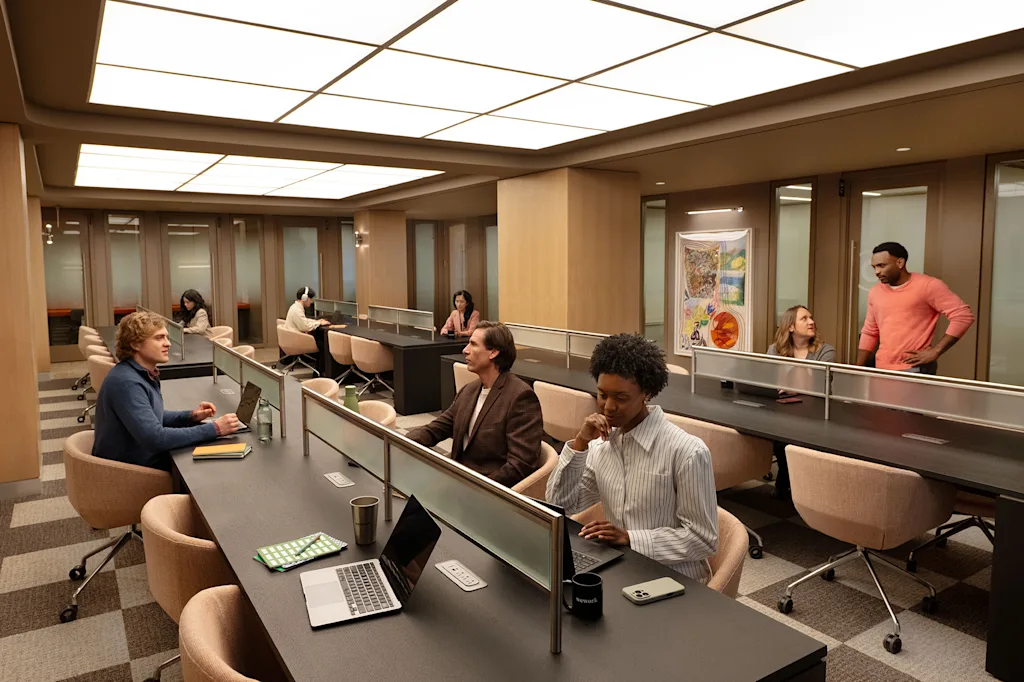
Except this isn’t WeWork as you might remember it: There are no neon signs, no beer o’clock, and no ping-pong tables. Instead, the walls are hung with paintings sourced through ArtLifting, an art consultancy that works with artists living with homelessness or disabilities. The bar is stocked with kombucha and espresso machines. And the once-labyrinthine corridors you could navigate only by asking for directions are now marked with pristine wayfinding signs.
This is WeWork 2.0, and it’s already a hit: 250 Broadway is 94% occupied across five floors—including one that won’t open until spring.
The rise and fall (and rise again) of WeWork
WeWork’s story is by now a familiar parable of Silicon Valley excess. Founded in 2010 by Neumann and Miguel McKelvey, the company spent a decade expanding on billions from SoftBank’s Vision Fund—a Saudi-backed mega-fund that poured tens of billions into high-growth tech startups like WeWork—along with a cultish faith in Neumann’s vision of community as business model. Then came the botched IPO in 2019, a belated stock market debut that failed to turn the tide, and, in November 2023, a Chapter 11 bankruptcy filing.
By the time WeWork reemerged in June 2024, it had shed roughly $4 billion in debt, closed hundreds of locations, and installed global commercial real estate firm Cushman & Wakefield veteran John Santora as its new CEO.
WeWork 2.0: From cool to functional
The seeds for WeWork 2.0 were sown in 2019, but according to its chief design officer, Ebbie Wisecarver, the company hadn’t reset its design values until last year. Today the goal is for WeWork locations to feel familiar and engaging. But where previous locations stuck to a recognizable WeWork brand (think: industrial loft meets Brooklyn coffee shop), new locations are designed to feel timeless rather than trendy.
“WeWork’s culture and what it stands for has evolved,” Wisecarver told me during a tour of 250 Broadway. “I don’t think it’s diminished this idea of community and connection, I just think we’ve adapted in a lot of ways to providing more spaces that are more suitable for what people are doing there.”
Before 2019, every location had to conform to a prescribed aesthetic, “and I think that actually restricted some locations from really being what they could be,” she said. Now the design team isn’t afraid to go slightly off-brand if the building calls for it.
At 250 Broadway, the team drew from the history of Lower Manhattan itself. The iconic Woolworth Building—visible from nearly every office window—is echoed in the space’s stone tile floors and its art deco-style reeded glass dividers. The sconces lighting up the lounge area were sourced from Brooklyn-based lighting design studio In Common With, while much of the furniture was made by New Jersey millwork firm Bestmark.
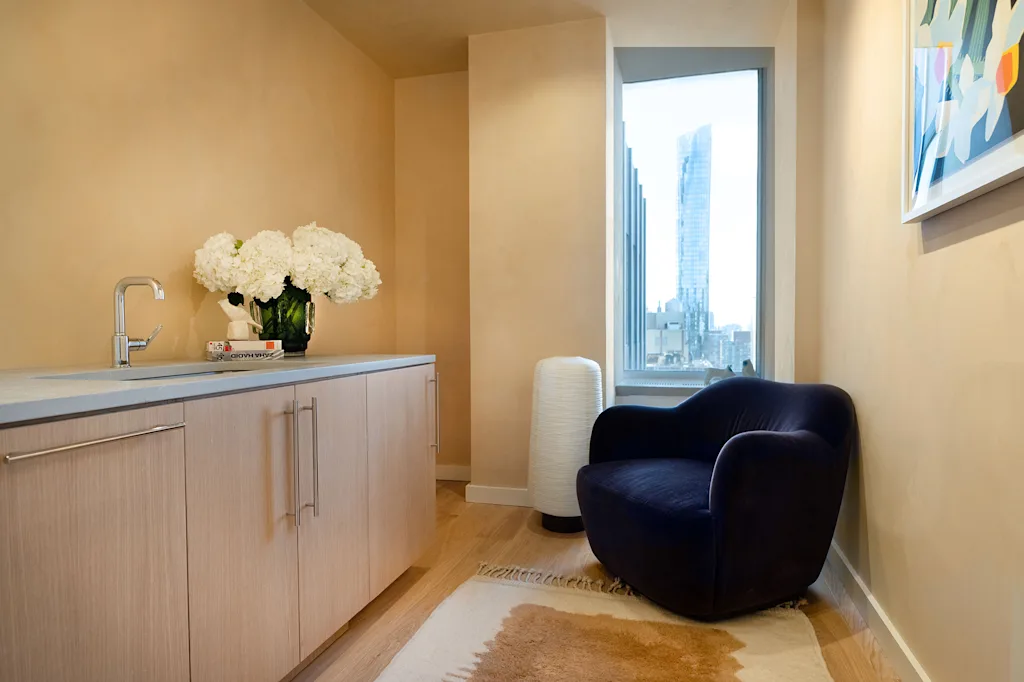
The upgrades, however, go deeper than aesthetics. Private offices, once outfitted with wooden floors that members complained amplified noise, are now carpeted. The mothers’ room—historically a corporate afterthought—has been given a window with a view of Manhattan. Even the phone booths, supplied by office design company Room, have been rethought and positioned in clusters near lounge areas rather than scattered across the floor. According to Wisecarver, that was a direct response to members asking for quiet spaces adjacent to communal ones.
A flexible workspace for the post-COVID era
The 250 Broadway location came about in part by necessity: WeWork’s lease next door, at 222 Broadway, was expiring as the building converted to residential. But the timing of what WeWork has built there speaks to something bigger than a single office move.
Since the pandemic, the way we work has fundamentally changed—perhaps permanently. The old WeWork, with its beer taps and open-plan optimism, was a result of working styles before COVID-19. Now hybrid schedules have made flexibility a baseline expectation rather than a perk. Workers want spaces that are quiet when they need focus and communal when they need connection—sometimes within the same hour. WeWork’s new design strategy is a response to that shift.
Today WeWork’s numbers suggest the office isn’t as dead as some proclaimed it would be. Across New York City, WeWork’s occupancy sits at 82%, with Midtown running at 90%. Globally, the company has climbed from 70% to 77% occupancy and is targeting 80% this year. Several markets are already well past that threshold: Dublin’s One Central Plaza is at 100%, Barcelona and Milan are both north of 90%, and Toronto has jumped from 73% to 85%. (San Francisco sits at 76%, up from 64%).
The problem is, while WeWork once revolutionized coworking, competition has never been stiffer. Industrious, acquired by CBRE for $400 million in early 2025, has built a premium alternative that competes directly for enterprise clients. IWG, the parent company of Regus and Spaces, has long been profitable where WeWork was not. And in WeWork’s own backyard in New York City’s financial district, WSA has bet that blending coworking with arts programming and cultural events is the next frontier of flexible work.
Which may be exactly why 250 Broadway feels more like a thesis statement. This summer, WeWork is opening a new location at 245 Fifth Avenue in Manhattan’s NoMad neighborhood. A new floor is being added to its 1 University Avenue location in Toronto. Upgraded offices are also coming to 1201 Wilson in Washington, D.C. Underpinning all of it is a commitment to reinvest roughly $80 million annually in modernizing its portfolio—a figure the company spent in 2025 and is repeating again in 2026.
Only time will tell if the thesis will prove out across these future locations.