
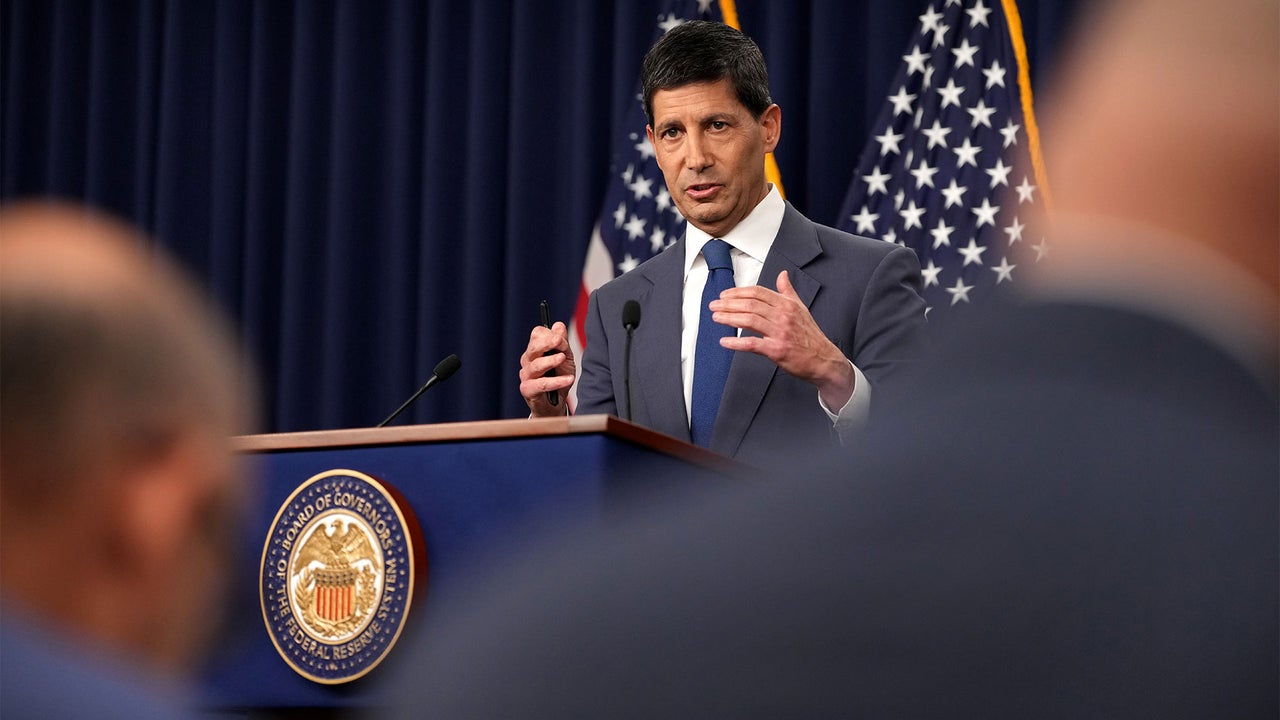
The new chair of the Federal Reserve, Kevin Warsh, has brought sharp change in how the central bank communicates by saying much less than his predecessors about the economy and inflation.
But so far, many economists and Wall Street investors haven’t been thrilled with that approach.
On Friday, Warsh has a high-stakes opportunity to address those concerns and underscore his inflation-fighting bona fides when he gives his speech in Jackson Hole, Wyoming, during the Fed’s annual economic symposium.
What many economists and Wall Street analysts are hoping for is a clear signal on how he thinks the Fed should handle the stubbornly elevated inflation that has caused pervasive gloom among many consumers. At his last press conference, he sowed confusion by ducking repeated questions on whether the Fed would hike its benchmark interest rate if inflation stays high.
Warsh has said he doesn’t want to provide what analysts call “forward guidance” about whether the Fed will hike or cut rates or stay on hold at upcoming meetings. He argues that it limits the Fed’s flexibility by committing it to a specific policy. He also thinks financial markets have become too dependent on such guidance.
Yet some economists argue that he could say more about his views on Fed policy without tipping his hand about future moves.
“What he needs to do is to clarify the conceptual framework he’ll bring to directing monetary policy,” David Wilcox, a senior fellow at the Peterson Institute for International Economics, said. “He’s refused to provide even that amount of illumination.”
Whether Warsh will deliver that clarification Friday is an open question. Last month, he said he wanted his speech to focus on the “big questions” such as AI and productivity, demographic changes, and the global economy’s response to shocks from the Iran war.
Looking for clues
How Warsh and the Fed will handle elevated prices is not just an issue for Wall Street. Even as inflation has cooled after spiking in May and June from higher gas prices, it remains above the central bank’s 2% target. Surveys show most Americans still see the affordability of necessities such as gas, groceries, and housing as a top economic issue heading into the midterm elections.
Notably, interest rates rose when Warsh last spoke publicly at a press conference July 29, pushing up mortgage borrowing costs after the Fed decided to keep its benchmark rate unchanged.
“Warsh effectively lost markets when he was speaking,” said Gennadiy Goldberg, head of U.S. rates strategy at TD Securities. “He kept talking more about bringing inflation down,” yet when reporters asked what he would do to achieve that, “he didn’t really have an answer.”
Warsh did tell reporters that “any central banker . . . is more inclined” to raise rates “when he or she sees underlying inflation moving higher,” which some economists said was in the ballpark of the broader outlook they were looking for.
But Warsh hasn’t said whether he in fact thinks “underlying inflation” is worsening, or how exactly he is measuring that. When asked what gauge he would use to determine if inflation is at the 2% target, he cited the Fed’s current preferred measure—the personal consumption expenditures price index—but he then suggested that could change next year, after the task forces he has appointed to look at things like data sources and inflation make recommendations.
And when asked whether he would support higher rates to combat stubborn inflation, he said they “could well be part of that solution,” but then added, “I wouldn’t say it’s in isolation.” Some Fed watchers took that to mean he would consider other measures, such as reducing the Fed’s vast holdings of Treasury bonds. Dumping those bonds could push up longer-term borrowing costs, but over a longer time frame.
Navigating politics
Questions swirling around Warsh have also been intensified by President Donald Trump’s continued calls for lower interest rates. While Trump has continued to defend Warsh, whom he appointed and who took office May 22, the president has criticized other Fed officials for supporting higher rates.
Trump has also renewed his efforts to remove Lisa Cook, a Fed governor who was appointed by former President Joe Biden. Replacing Cook would enable Trump appoint a majority of the seven-member board. Trump tried to fire her last year but was temporarily blocked by the Supreme Court.
“Politics are adding to the Fed’s credibility problems,” Diane Swonk, chief economist at KPMG, wrote in a recent commentary. “That is why his speech . . . later this month matters so much. It is an opportunity for Warsh to demonstrate his and the Fed’s independence from political interference.”
Providing a cleaner read on how he would lead the Fed wouldn’t take much, economists said—just a clearer statement of how the Fed might react if inflation stays high.
“None of this is radical stuff,” said Wilcox, who is also director of research at Bloomberg Economics. “The problem is he hasn’t said any of it. And people are beginning to be unnerved that he won’t utter some seemingly simple thoughts.”
If Warsh does assuage some of these concerns, longer-term interest rates could decline slightly. Those rates have steadily risen in recent weeks because of a range of factors, including burgeoning U.S. government deficits and outsize borrowing by tech firms building AI infrastructure.
The rate on the 30-year Treasury bond reached the highest level in 19 years last week, prompting an unusual effort by Treasury Secretary Scott Bessent to buy back bonds and push the yields lower.
When Warsh speaks Friday, “I think just yields not rising would be a victory,” said Derek Tang, an economist at Monetary Policy Analytics, a consulting firm.
—Christopher Rugaber, AP Economics Writer