
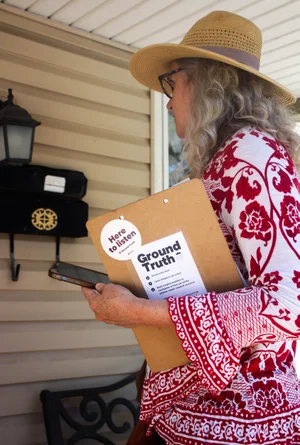
The student who answers the door looks a little hungover, and she may well be. It’s late August at East Stroudsburg University, a midsize public college in northeast Pennsylvania, and students are soaking in the final days of summer.
But Kim Allen is undeterred by the girl’s half-opened eyes. A 64-year-old middle school Spanish teacher from New York City, Allen is particularly immune to the sullen stares of youth.
“Hi, my name is Kim,” she says cheerily. “I’m a volunteer with Ground Truth, and we’re here to find out how people are feeling about how things are going in the country. Would you say we’re on the wrong track or the right track?”
The student shrugs a disinterested “I dunno,” but Allen presses on. She asks about her concerns, how likely she is to vote on a scale of 1 to 10, and whether it would be for Republicans or Democrats. On voting, the student ranks herself a 7. On Republicans, an 8.
Ordinarily, that would be Allen’s cue to leave. She’d traveled to East Stroudsburg that Saturday, as she had about a dozen Saturdays before, to help Democrats reclaim a crucial House seat they lost in 2024. For most Democratic groups and campaigns, talking to a Republican voter would seem a waste of time.
But Allen is part of a novel outreach effort attempting to do things differently. Her mission, according to the script on her clipboard, is to help Democrats “do a better job of listening to everyone, whether we always agree or not.”
And so, Allen listens as the student talks about, among other things, her concerns regarding immigration. Allen shares her own perspective and discusses the candidates in the district: Scranton’s Democratic mayor, Paige Cognetti, and the Republican incumbent, Rob Bresnahan. But over eight minutes, she never gives the hard sell. As the sticker on her phone reads, Allen is only “here to listen.”
Allen is one of more than 3,000 volunteers dispatched to more than 50 House districts across 23 states since January as part of the Ground Truth project. Launched late last year by the progressive grassroots group Swing Left, Ground Truth aims to knock on every door and engage voters of all political leanings in open conversations.
This approach, known as “deep canvassing,” isn’t entirely new; it has existed primarily in small pilot programs since at least 2008. What’s new is the scale it set out to achieve, and the technology Ground Truth is using to make sense of the conversations.
If one of Ground Truth’s goals is to rehabilitate Democrats’ image as the party of out-of-touch elites, the other is to turn those conversations into actionable data about the people on whose doors Democrats wouldn’t usually knock. That requires technology that can extract meaning from many thousands of open-ended conversations that can stretch 10, 15, even 30 meandering minutes. Making sense of all of that is something traditional Democratic infrastructure was not designed to do.
But large language models can, and Swing Left is leaning heavily on them to undergird its listening tour. Canvassers like Allen use an AI-powered app, where they can record voice-to-text recaps of their conversations with potential voters. Those conversations get stored in a central database where Swing Left organizers can query the records in plain English (“What were voters talking about in Pennsylvania’s 8th district this weekend?”) and distill them into useful or surprising findings for campaigns.
That may mean helping a campaign find the repeat Trump voters in their district who are open to voting for a Democrat or unearthing hyperlocal concerns that haven’t yet crossed a candidate’s desk. In one community, this system unearthed widespread worries about a rusting water tower in the district—an issue the Democratic candidate wasn’t aware of and that certainly wouldn’t have been on any traditional canvassing questionnaire.
Swing Left feeds those nuggets directly to candidates and funnels all of the information it collects into the Democratic Party’s central data warehouses so campaigns and third party groups can dig through it on their own—now and in the future. “Democrats have a real trust problem,” says Yasmin Radjy, executive director of Swing Left. “Our perspective is that the way that you build trust has to start by listening.”
Ground Truth is far from the only effort to modernize campaigning with artificial intelligence. According to a survey in March from the American Association of Political Consultants, more than 80% of consultants from both parties report using AI weekly. It’s being used to match campaigns with online content creators who can amplify their message and to craft campaign ads and talking points. For its part, the Democratic National Committee has undertaken its own phone-banking listening effort called Local Listeners, which set out with much the same aim as Ground Truth.
Pulling off this technological shift has been no easy task. For one thing, it carries political risk. One survey found that most voters disapprove of the use of AI for many campaign related activities—including uses as simple as drafting fundraising emails.
Pervasive fundraising hurdles on the left and the slow pace of change within politics more broadly have also made it difficult to reach the kind of scale Swing Left hoped to achieve. The group initially set out to talk to 500,000 potential voters before Election Day. By the end of September, it had talked to just over 40,000.
Even so, Radjy sees Ground Truth as a “proof of concept” for the 2028 election and beyond. It’s a test of whether AI—despite being an unpopular technology among most voters—can become a potent tool for understanding them. The hope is that with this information in hand, people won’t just feel like some stranger was willing to listen, but that they might actually be heard.
‘It is too transactional’
The United States is facing a crisis of political disillusionment. According to Pew Research, more than 80% of Americans say politicians don’t care what people like them think. That’s a level of political cynicism that is among the highest of dozens of countries Pew surveyed and is shared across just about every demographic. During the 2024 election, working class voters in particular viewed Democrats as being more “out of touch” than Republicans.
The Ground Truth project emerged out of the rubble of that election, in hopes of upending the extractive nature of voter outreach, where every two years, the same voters get pummeled by text messages, emails and door knocks asking them for things—a vote or a dollar—but rarely, if ever, get asked whether and how they’re getting by.
That was Allen’s experience knocking on doors for Kamala Harris in the outskirts of Philadelphia the Sunday before the 2024 election. Tasked with turning out reliable Democrats, she found that, “apart from Black women,” people simply weren’t interested in voting. Racing from house to house, she learned little about the people she met or why they’d become so cynical about democracy. The process felt transactional and demoralizing—“one of the most depressing experiences in my life,” she recalls. Allen went home convinced that “something has to be different.”
She was hardly the only one feeling that way. For decades, Democrats have dominated the so-called political “ground game,” compared with Republicans. With rare exception, they open more field offices and engage more volunteers than Republicans, who have begun to embrace canvassing, but tend to do it through paid campaigns. “Most of our canvassing efforts are focused on ‘paid doors’ where you hire one of these firms and you knock as many doors as possible, as cheaply as possible,” says Eric Wilson, a Republican strategist and executive director of the Center for Campaign Innovation.
During the 2024 cycle, Democrats went particularly big, mounting an historically huge voter outreach effort that included 1.9 billion voter contact attempts, including some 270 million door knocks, according to one analysis. And yet, the number of actual conversations volunteers were having with voters was simultaneously collapsing, as fewer people answered their phones and doorbells.
That mismatch led to a crisis of faith among the party’s volunteers and field organizers. “Every campaign operative believes that organizing is dead and or dying,” says Radjy, the Swing Left executive director. “It is too late. It is too transactional, and the scripts we use are highly robotic.”
It was clear to Radjy after Harris lost that Democrats didn’t have a quantity problem, but a quality problem. Deep canvassing emerged as a possible solution. Over the years, researchers have found that canvassing efforts focused on more extensive, empathic conversations about anything from abortion to trans rights can have their own persuasive effects. But one reason this style of canvassing hasn’t taken off is that it’s difficult to track and scale.
Listening, it turns out, is not just a human challenge, but a technical one. It’s one thing to sift through a few hundred unstructured conversations about people’s political views. It’s another to do that across many thousands of them.
Instead, Democrats try to maximize efficiency by focusing on a campaign’s likeliest supporters, or at least the ones that the data suggests could be persuaded. Canvassing scripts include quick and dirty questions—do you plan to vote and for whom?—that can be easily collated into what are known as support scores. Those scores drive decisions about which people campaigns and PACs will spend their money trying to convince. And the cycle continues.
The problem is that support scores are blunt instruments. They’re often wrong and even when they’re right, they obscure the reasons underpinning people’s political beliefs. Even worse, Radjy says, there are plenty of people for whom Democrats have no robust data, so they wind up being overlooked.
But the proliferation of large language models changed things, Radjy argues. Suddenly, there was a tool that could crawl through endless sprawling conversations and find the common themes and surprising insights within them in minutes. With a tool like that, Swing Left believed deep canvassing could work at a much greater scale.
“They’re the only ones who have really scaled deep canvassing that have a national volunteer team that has the ability to have boots on the ground in every single state,” says Ella Barrett, one of the organizers who helped develop deep canvassing in the late 2000s and now trains other groups, including Swing Left, through the organization she cofounded, New Conversation Consulting.
The timing of this technological revolution was fortuitous. In 2024, the Federal Election Commission lifted a ban that had prohibited canvassing groups like Ground Truth from sharing their doorstep data with campaigns, state parties, and outside groups. Under the ruling, Swing Left would be able to funnel all of the data it collects through a central repository called the Democratic Data Exchange, ensuring important findings got disseminated throughout the party. “The purpose here is to be able to move this data about these conversations back to the party so the campaigns can improve their targeting and build their messaging,” says Amanda Coulombe, CEO of the exchange.
For its canvassing technology, Swing Left worked with an outside group, Everybody Techworks, which had built its own app, called People. Rather than relying on the Democratic party’s longstanding canvassing app, miniVAN, Ground Truth organizers use People to knock doors, collect data like names and phone numbers, and record voice-to-text notes recapping the conversations they’re having. Volunteers can attach these records to a person who’s already in the voter file, or they can add new entries, based on whoever they bump into along their routes.
All that data gets fed into the central database Swing Left uses to sift through these records and pull out findings. The system can be buggy: During one demo Swing Left showed Fast Company, it stalled out while crawling data from Pennsylvania’s 10th district. But it has delivered some valuable discoveries, says Brooke Butler, national political director for the Democratic Congressional Campaign Committee (DCCC), which works to elect Democrats to the House.
In the first half of this year, about one in three people canvassers talked to weren’t listed as likely Democrats in the voter file. But in person, about half of them identified themselves as either toss-ups or leaning toward Democrats. One in five identified as strong Democrats. That means Ground Truth is finding voters that traditional canvassing, focused on support scores, would have skipped. The DCCC is now adding all of the voters Ground Truth has identified as undecided or mildly supportive to its list of targets. “We didn’t have access to this kind of rich voter data at scale before,” says Butler.
But pulling off a national deep canvassing campaign didn’t just require new technology. It also required training volunteers in a new way of speaking to voters. To develop a script, Swing Left volunteers and organizers spent six months working with New Conversation Consulting, painstakingly planning the best way to approach voters, how and when to disclose their own political leanings and plotting out decision-tree style follow up questions. If a voter says they’re feeling hopeless about the political process, the August script read, “Validate what is hard,” and share your side, but don’t focus “solely on Trump.”
Volunteers for Ground Truth get a brief training in how to listen deeply. On the East Stroudsburg trip, this training happens on the Swing Left bus, which shuttles dozens of volunteers from New York. “The point is not to persuade people to the Democratic side, but to listen to people’s concerns and figure out how Democrats can best serve the people in this district,” says one of the trainers that day, gripping the back of a bus seat. “A lot of the reason why we’re in this mess is that we were not listening.”
Last November, Swing Left piloted the program with a small group of volunteers before launching the nationwide effort in January. Violet Kopp, Swing Left’s East Coast organizing program manager, admits she was doubtful it would work. “We were like, there’s no way people are going to answer,” she says, let alone engage in long, soul-searching conversations.
But it turned out the opposite was true. Over the last year, Swing Left says one out of every three door knocks have resulted in a conversation, and two-thirds of those conversations were what the group considers “substantive” ones, often lasting 10 minutes or more.
These conversations validate Swing Left’s instinct, Kopp says, that “there’s this hunger to be heard.”
‘I hit the jackpot’
As Allen walks the streets of East Stroudsburg, dressed in a purple paisley dress and matching sneakers, she encounters voters of every persuasion. There’s the reluctant voter from a family of loyal Democrats, whom Allen encourages to call his mother; the woman who had voted Republican in the past but swears she never would again; and the college guy sitting on the porch with his buddies, who calls Democrats “corrupt as shit,” even as he acknowledges some of Cognetti’s mayoral accomplishments in nearby Scranton.
In a few weeks, all Ground Truth scripts will shift toward more targeted persuasion, but for now, in the final days of August, Allen mostly listens. The guys appreciate the approach. “A lot of people our age, you can’t have a conversation,” one says afterward.
Her most promising encounter comes with a young woman I’ll call “Amy,” who says she rarely votes because she doesn’t know enough about the candidates, but who worries about disappearing abortion rights and wildfires. When Allen shows her photos of Bresnahan and Cognetti, a departure from Ground Truth’s script, Amy perks up. She likes the idea of voting for a young woman, she says, and she tells Allen she is now more inclined to vote for Cognetti. This exchange isn’t entirely unusual. In one small September sample collected by Swing Left—albeit after volunteers shifted to more persuasion-focused outreach—about a third of the people volunteers spoke with moved toward Democrats by the end of their conversations.
Allen shares her phone number with Amy, in hopes of convincing her to volunteer. “I hit the jackpot,” Allen says later.
Still, the day’s canvassing also reveals the limitations of Ground Truth’s approach. Some volunteers struggle with the technology, while others veer off script. One repeatedly—and erroneously—introduces herself as a representative of the Democratic Party. And not everyone was receptive to conversation. There are people who don’t want to talk, people who talk a lot but say little, and at least one person who quickly reveals extremist views that make him an unlikely recruit to the coalition. One risk of knocking on every door is the possibility of wasting limited volunteers’ time or turning out the other side.
Another question hanging over the entire project is whether and how campaigns will actually use this data. A select few have become early adopters. In Oregon’s 5th district, for instance, Congresswoman Janelle Bynum’s reelection campaign has used Ground Truth’s data to find Republican voters who are open to new candidates. “Ground Truth’s initial efforts showed us the evidence we needed to broaden our outreach beyond traditional narrow voter targeting,” says Quinton Berkompas, Bynum’s campaign manager.
In Arizona, where Dr. Amish Shah edged out the establishment candidate in a hard-fought primary, Ground Truth’s early canvassing “built a strong foundation and helped us hit the ground running in the general election,” says Eve Zhurbinskiy, a campaign operative.
Yet this kind of embrace is far from universal. According to Swing Left’s most recent data, only about 29% of the campaigns Ground Truth targeted are fully utilizing and acting on the data volunteers are collecting. About 40% say they lack the capacity to fully implement the program, and 5% declined outright to work with Ground Truth. The rest are somewhere in the middle. The Cognetti campaign in Pennsylvania didn’t respond to multiple requests for comment, so it is unclear how extensively it’s using the data.
Ground Truth is asking campaigns to fundamentally change the way they operate, including by talking to people the voter file suggests they shouldn’t and looking beyond support scores. But in a system as fragmented as political campaigning, Radjy says, that change is admittedly slow moving. “We have a set of traditions that have become baked in as habits for the ways we campaign,” she says. She noted that one campaign cited its canvassing packet printing schedule as a barrier to working with Ground Truth.
And Swing Left is not immune to the other forces afflicting the Democratic party, including a pervasive fundraising shortfall that made it difficult for the group to hire organizers and achieve its 500,000 conversation goal. Still, Radjy says she remains optimistic about what Ground Truth was able to prove this cycle, even given the limitations. “Building something this new and complex took longer than we planned,” she admits. “While we’re not on pace to reach it this cycle, our goal galvanized our community and the ecosystem to establish crucial infrastructure and prove what is possible.”
For now, the most immediate effect of this work may be on volunteers like Allen, who, after 2024, were beginning to wonder whether all of this work—the sweaty sneakers, the tired legs—was even worth it. Now, Allen says she’s planning to retire at the end of the school year and devote herself full time to Ground Truth volunteering, not just because she wants Democrats to win in 2028, but because of how the whole process makes her feel. “This feels different,” she says. “This feels like rebuilding something that’s been broken.”