
The student press is facing a growing wave of censorship and institutional obstruction
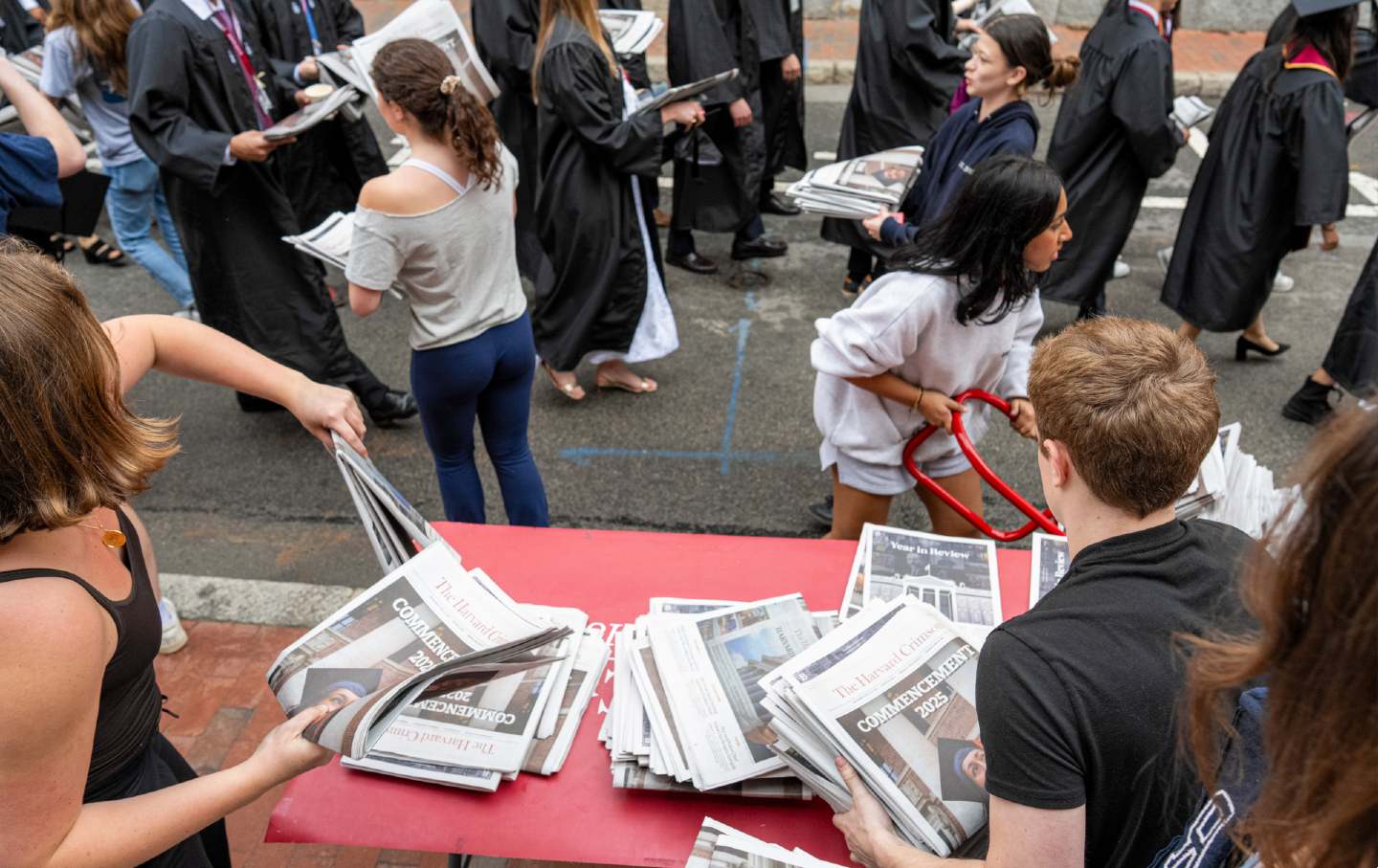
College newspapers like The Harvard Crimson have broken stories of national import. But increasingly, the student press is being stifled.
(Mel Musto / Bloomberg via Getty Images)
In 2022, student journalist Elizabeth Wilson filed multiple public records requests, seeking access to records related to sexual assaults, alleged labor violations, and alleged administrator misconduct on Cal Poly San Luis Obispo’s campus. After multiple spurned attempts to meet with employees of the public records office and a letter to the university from the First Amendment Coalition on her behalf, Wilson says, she was still empty-handed.
In April 2024, Wilson, then a reporter with the student newspaper Mustang News, sued Cal Poly San Luis Obispo, alleging that the campus violated the California Public Records Act (CPRA), which gives every member of the public the right to access public records unless records are exempt from disclosure by law. Wilson’s lawsuit prompted an immediate release of the records and ended in a settlement.
Countless campuses across the country list press freedoms and information access among their core values. But when universities are called on to answer for their own actions, these values waver. In an increasingly repressive national landscape for journalists of all stripes, Wilson is one of many journalists who have had to fight for greater transparency and communication from universities that have increasingly stifled the student press.
This is a nationwide trend on college campuses. According to reporting from Poynter, calls to the Student Press Law Center’s legal hotline rose 42 percent from the 2022–23 academic year to the 2023–24 academic year. The number-one culprit? Censorship.
Some student papers were forced to create new independent publications when their universities would no longer pay printing fees or advisors. Other universities exerted power editorially, putting pressure on editors to change content. At student papers that are entirely independent, with no advisors or funding from the university, administrators stifle reporting by forcing journalists to only go through spokespeople for information or denying students access to records.
Student journalists do vital work. They are often the first or only outlets to report on their universities. At UC Berkeley, The Daily Californian broke the story that the university had shared the names of 160 faculty, staff, and students with the Trump administration as part of a federal antisemitism probe. UC Berkeley is not alone. The Harvard Crimson was the first to investigate Harvard faculty’s ties to Jeffrey Epstein. During 2024’s pro-Palestine encampments, reporters at UCLA’s Daily Bruin, Columbia University’s Daily Spectator, UT Austin’s Daily Texan and countless others were correspondents on the ground as their universities cracked down on protestors.
Current Issue

Meanwhile, as local news struggles to survive across the country, student papers are sometimes the last remaining outlets reporting on the neighborhoods and towns surrounding their universities. But rather than aiding this crucial work, many students have found universities increasingly impede it.
In 2025, UCLA’s Daily Bruin published an editorial claiming that reporters at the paper had made more than 70 requests through the university’s public records office that had gone unfilled for over six months. The CPRA requires that public documents be disclosed within fourteen days.
“Repeated failures to comply with CPRA—from suppressing footage to stonewalling advocacy groups—are not isolated missteps or oversights,” the editorial reads. “They reflect a much deeper institutional parasite that is failing to be accountable.”
The editorial alleges that these delays in releasing public records are antithetical to the university’s stated values, including open access to information and dissemination of knowledge. Because the university withheld public records from the Daily Bruin, important questions about the annual budget, security, and police presence during the 2024 pro-Palestine encampment went unanswered.
In 2025, the College Heights Herald, Western Kentucky University’s student paper, was honored by the Student Press Law Center for a series of accountability stories. Reporters covered budget discrepancies, dropping enrollment, and a structural inspection that led to the surprise shutdown of three dorms. Since this coverage, Herald editor in chief Anthony Clauson says the university’s treatment of student reporters has changed.
Reporters before Clauson’s time had the university president’s personal phone number. The previous president regularly sat down for in-person meetings with the paper. Now, Clauson says, the university president holds press conferences for all local media outlets, declining to meet with the student paper individually. According to a statement from a university spokesperson, these press conferences are an effort to increase transparency and ensure equitable access to the university president for all local news outlets.
Last year’s editor in chief, Jake McMahon, said there are not many other outlets in Bowling Green, Kentucky, the small city where the campus is located, that cover the university like student reporters do. He and his colleagues see the College Heights Herald as a watchdog for the university. But when the paper reported on falling enrollment numbers and shuttered dorms, McMahon says administrators got “defensive.”
From any other source, this might be an expected part of reporting negative news. From the university, an entity with an outsized amount of power to help or hurt student journalism, restricting lines of communication can enter repressive territory.
“There was not really any attempt on their side to have a cordial relationship with us and understand that we were just trying to report the news,” McMahon said. “If we reported something negative on the university, it was always, ‘the Herald only reports negative stuff; they’re making news out of nothing.’”
In Clauson’s reporting on three dorms that suddenly closed, he found that students did not know why their dorms were closing. He spoke to some who speculated that a sinkhole had opened up under one building, which was not true. Clauson’s deep dives into public records uncovered the structural inspection that closed one of the buildings in 2024. He says the university still has not released a statement on the building closures.
According to a statement from a university spokesperson, a separate entity, the Student Life Foundation, owned the residence halls; therefore, the university was not authorized to speak about the cause of the closures. When student reporters asked, the spokesperson said they were redirected to the Student Life Foundation’s spokesperson instead.
“After some of this reporting came out, is when we saw a lot of the restrictions on being able to talk really tighten,” Clauson said. “It was kind of a culmination of, from their perspective, bad press.”
Popular
“swipe left below to view more authors”Swipe →
At The Daily Californian, UC Berkeley’s engagement with reporters follows a tight script: students send their questions to university spokespeople, and they respond with an email statement within 48 hours. But if journalists attempt to contact a campus administrator directly, they typically receive a “slap on the wrist,” as recent UC Berkeley graduate and former Daily Cal university news editor Alexa Vazquez put it.
Though these reprimands don’t carry formal disciplinary weight, students take them seriously enough that new reporters are warned about the rules in the paper’s training.
Vazquez said that while some enterprising student reporters have gone directly to university employees in person to seek comment, many of these visits have been futile: even some student employees have told the reporters that they were instructed not to speak to them.
Vazquez sees these rigid rules of engagement as a way for spokespeople to maintain Berkeley’s public image and appeal to prospective students.
“Berkeley really cares about its reputation…the image of Berkeley as this revolutionary place for academics, for its history, for its politics,” Vazquez said. “The spokespeople here at Berkeley…their primary job is to uphold the reputation of the university.”
In some ways, the university’s highly structured relationship with the student paper works in the Daily Cal’s favor. UC Berkeley campus spokesperson Janet Gilmore said her office works closely with the publication, processing two or three requests from reporters per day. The office meets with editors semesterly, and collects information from across departments and relevant experts to respond to reporter questions.
But at other universities, information is less restricted. Sophia Dasser, editor in chief of The Cornell Daily Sun, said that, unlike the Daily Cal, her paper’s editing team is in constant communication with administrators, and regularly conducts direct interviews with them. Reporters attend Cornell’s faculty senate meetings to speak to administrators there.
In Dasser’s view, university administrators depend on the student paper, not the other way around.
“We’re going to publish this piece either way, and so if it shines a negative light on [administrators], then they should want to make their point of view clear,” Dasser said. “People read the Sun. People don’t often read [university] statements.”
According to Vazquez, dealing with a university that restricts students’ access to people and information doesn’t make for bad journalism training.
“There are definitely times when it’s really important, especially with closures or cuts to departments and centers, that we talk to the people at the source, and sometimes, campus spokespeople will be a bit of a hurdle to overcome,” Vazquez said. “I’m kind of glad that I had these maybe slightly unsavory interactions with [spokespeople],” he continued, “Now I’m not going to crumble if I have a spat with a spokesperson and it’s not entirely professional. I can hold my ground.”
When Wilson filed her lawsuit against Cal Poly San Luis Obispo, she was the editor of the Mustang News investigations team. Without reliable access to public records, her team learned to uncover information and data in creative ways. To find university data from previous years no longer on active sites, Wilson used the Wayback Machine. When the school didn’t respond to her public records requests, she directed her queries to campus spokespeople instead.
“We figured out how to deepen our reporting since we weren’t getting the information [from the university]… or there were delays,” Wilson said. “It’s kind of interesting, balancing that frustration that was very much real, but also the agency of: we got to figure it out; we got to publish the story.”
Dealing with hardline, uncooperative universities can be hugely detrimental to important coverage. By the time her lawsuit against Cal Poly wrapped up, Wilson was in her senior year. She was looking forward to life after college and a journalism career beyond Mustang News. Even though Wilson ultimately received the records she was seeking, she did not write the stories she had planned to because of the delay.
Clauson, at Western Kentucky University, sees the university’s adversarial posture toward student journalists as part of a national wave of distrust in the media that, in the long term, can only hurt the industry and the communities it serves.
“You can’t have a thriving democracy if you don’t have a free flow of information through credible sources like newspapers,” Clauson said. “This trend to just have a tight hold on everything is ultimately not beneficial for anybody.”
More from The Nation

The pontiff just excommunicated a reactionary splinter group committed to undermining the church. Democratic leaders could learn something.

The Italian American establishment’s hysterical response to Mayor Mamdani’s map of immigrant enclaves reveals a cynical politics of victimhood.
Many students arrive at college with dreams of creating social change, but the corporate pipeline diverts them. A democracy in need of their talent is poorer because of it.
Until we, as a society, reject the camp and its logic, it will remain a threat—and the linchpin in the entire immigration enforcement regime.

Of course fans roundly booed the president at the World Cup final: Damaging the integrity of anything he touches is true to the Trump brand.
Manosphere celebrities—including alleged sexual predators like Tate—are a symptom of a politically resurgent misogyny.