
Apparently, getting into orbit is far less mysterious than the female body. In 1983, as Sally Ride prepared to become the first American woman to head to space, an all-male cadre of engineers helping her prep famously asked her if 100 tampons would cover a six-day shuttle mission.
Some 40 years on, NASA is considerably more hip to women, but little has progressed in menstrual studies in space.
The physicist and astronautical engineer Manju Bangalore, 28, is hoping to change that next year, when she and Priya Abiram, 22, an aerospace engineer, board a Virgin Galactic flight to conduct the first formal research study of menstrual fluid dynamics in microgravity. Along the way, they’ll become the youngest South Asian women in space.
With most information so far coming from anecdotal astronaut observations, the two engineers are seeking actual measurements. “Right now, the data says that menstruation is generally safe to do in space, but it’s limited data, and it’s all qualitative,” says Bangalore. “So, we are pursuing the first quantitative study of menstruation in space.”
Using a fluid that mimics the properties of menstrual blood, they plan to track both flow behavior and the absorption performance of feminine products. They hope their findings will pave the way for more research on longer orbital flights. Such datasets are needed for astronaut health and product allocation on longer-duration missions to the planned Moon Base and possibly Mars, while helping to improve commercially available products on Earth.
The study extends the mandate of Bangalore’s 11-year-old nonprofit, Operation Period, which delivers feminine products to marginalized communities, educates about menstrual health, and conducts menstrual research. Bangalore, a NASA engineer-turned-science-communicator, oversees the nonprofit as founder and executive producer alongside a group of Gen Z volunteers, with support from grassroots donors and institutional funders. They’re trying to raise $1.2 million for the spaceflight, which they hope to chronicle with a minidocumentary of the mission.
“The culture’s very much shifting right now in that people are willing to invest in menstrual health nonprofits,” says Bangalore.
Historically, astronauts have used oral contraceptives and hormonal IUDs, which can cause side effects that might worsen in space. For example, Bangalore notes, oral contraceptives can produce a higher risk of cardiovascular complications; existing limited data suggests a potential higher risk in space.
Research for earthbound users wasn’t much better. For decades, a dearth of standard definitions in menstrual health eluded clinical settings and research publications, while feminine care manufacturers used saline to test product absorbency. In 2023, an Oregon Health and Science University study showed much greater accuracy when using blood to diagnose heavy menstrual bleeding.
“You don’t need to be a physicist to know that saline and menstrual blood do not have the same viscosity or other kind of properties,” says Bangalore. “The implications were that doctors were underdiagnosing heavy menstrual bleeding, which affects 20% of people in America who bleed, and can be an indicator of other diseases or chronic conditions.”
A show of empathy
Operation Period’s Virgin Galactic mission has roots in Bangalore’s childhood dreams of spaceflight and awareness of social inequity. She grew up in rural Oregon to parents who immigrated from India and worked in agricultural crop science. By comparison, her maternal grandmother grew up in a 25%-literate village in India and was married at 12 and a mother at 14. That insight led to an epiphany Bangalore had at 17, during a period so painful she remembers the date.
“It was February 2015,” she says. “It hit me in one moment that my pain was not good, but I had a roof over my head, menstrual products, a heating pad, my doll—things that were luxuries to people just five miles away who were unhoused. Later that week, I was buying more [sanitary] pads, and the woman in front of me was buying hers when her card declined. So, I ended up buying both of ours together. It reminded me that this is not a distant issue—it’s literally happening in a grocery store near you. So, I ended up starting Operation Period.”
The nonprofit began by distributing feminine products to marginalized communities and slowly expanded to international outreach in countries like Bangladesh and India. To date, it’s distributed more than 300,000 menstrual products and is producing a documentary short on the challenges of menstruating in prison.
Now it’s expanding efforts to address the root causes of these issues, a concept Bangalore calls “menstrual freedom.” According to the World Bank, 500 million people worldwide lack access to menstrual products, education, sanitation, and cultural support, which present life-and-death consequences.
Over the last three years, Operation Period has launched the Youth Institute for Menstrual Freedom fellowship to train, mentor, and fund young people who want to lead similar projects in their communities. It established chapters in New York, Los Angeles, and Jackson, Mississippi, run by Gareema Dhiman, a Yale PhD candidate in planetary science, and launched Redshift Lab, a research arm directed by Abiram, a life support engineer with Vast Space, to help close gaps in menstrual and reproductive health.
Redshift Lab devised precursor microgravity experiments for a ZeroG flight, whose parabolic loops enable roughly 20 seconds of weightlessness apiece. Bangalore and Abiram are revising the experiment design for Virgin Galactic’s three-and-a-half minutes of microgravity in one suborbital loop that crests just above the NASA demarcation of space, at 52 miles.
“I posted about [the ZeroG flight] online as part of my platform to destigmatize periods. What better way to do that than in zero gravity?” says Bangalore. She and Abiram knew they’d touched a nerve when it got 25 million views and connected them with Virgin Galactic. They ultimately plan to publish their findings in peer-reviewed journals.
Furthering the message
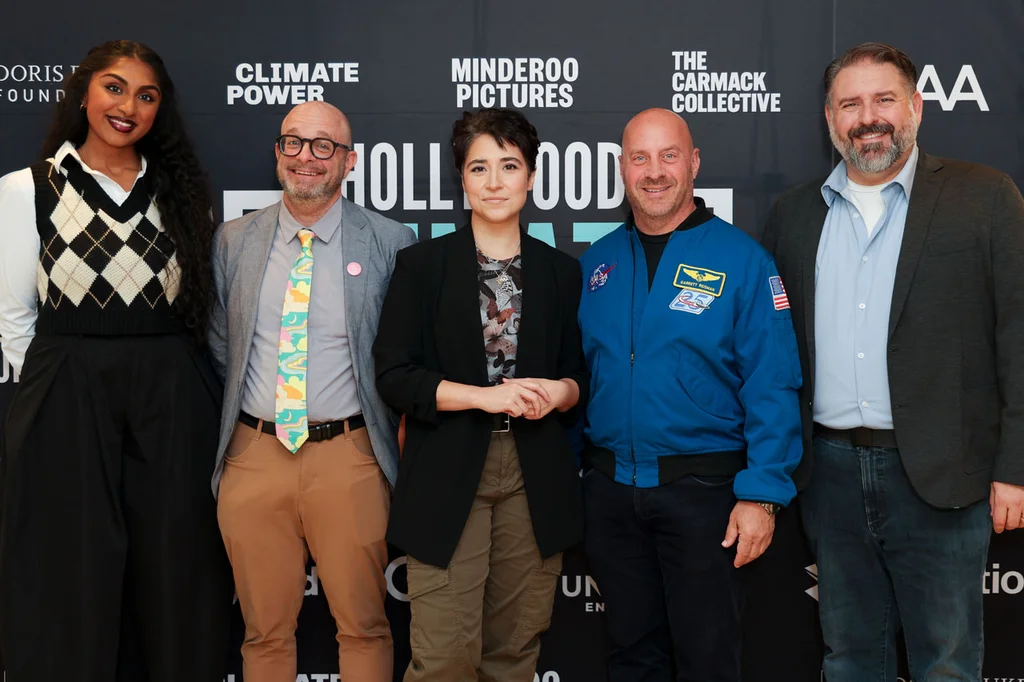
Operation Period is now collaborating with organizations addressing issues that impact menstrual health—such as climate change, mental health, economics, and social justice. Which is how Bangalore found herself sharing the stage at the Hollywood Climate Summit earlier this summer on a panel that included Star Trek creatives and the NASA astronaut Garrett Reisman.
“It was a `pinch me’ moment being at the summit, getting to talk about the overview effect as a research astronaut training for my nonprofit,” she says. “A lot of the astronauts that come back talk about how we’re all interconnected, there aren’t borders, there’s just Earth from space.”
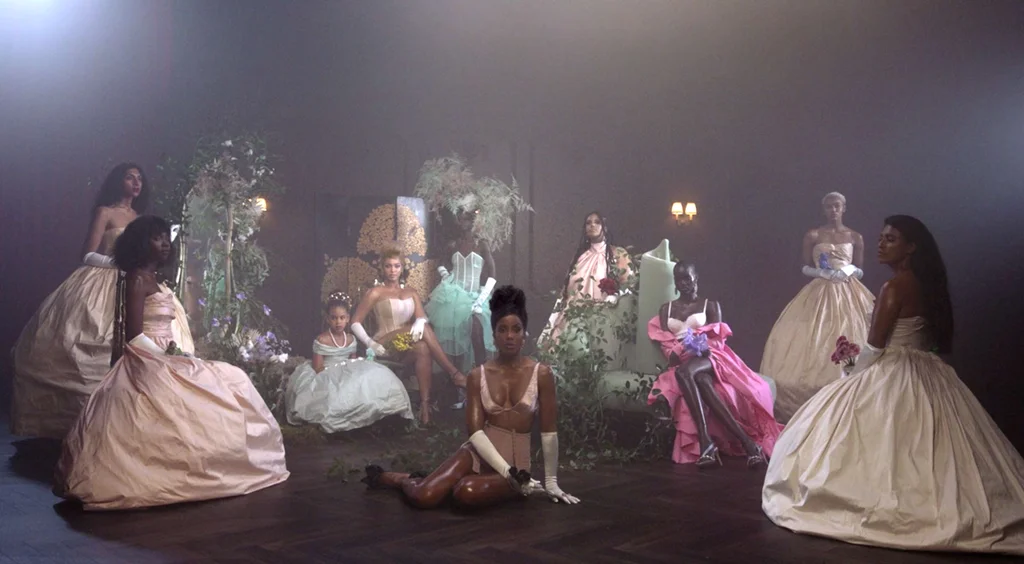
Bangalore’s public speaking springs from a concurrent performance sideline. A 2023 Miss Oregon USA and 2019 Miss World California, Bangalore has modeled for Sports Illustrated and appeared in General Hospital, Animal Kingdom, and Beyoncé’s Brown Skin Girl music video. That concurrent sideline honed her public speaking skills.
Bangalore is continuing her mission awareness campaign through the fall, with a TEDx talk in Tulsa, the Jasper Dark Sky Festival in Canada, and a keynote at the University of Oregon, her alma mater. Eventually, she’d like to develop an Operation Period conference in May, which is International Period Month.
“The whole concept of menstrual justice and menstrual freedom is providing opportunity where it hasn’t been provided in the past,” says Bangalore. She evokes her grandmother’s experience to drive her point home. “In two generations, I’m going to space, and I have a master’s degree. I use that example to say, `Look what’s possible when we have the right resources, support, and care.’ I don’t think I’m smarter than my grandma. So what would it have looked like to get her those opportunities, resources, support, and care? That’s our whole mission.”