
The president keeps suggesting that reporters have a party on his home turf. That’s a terrible idea.
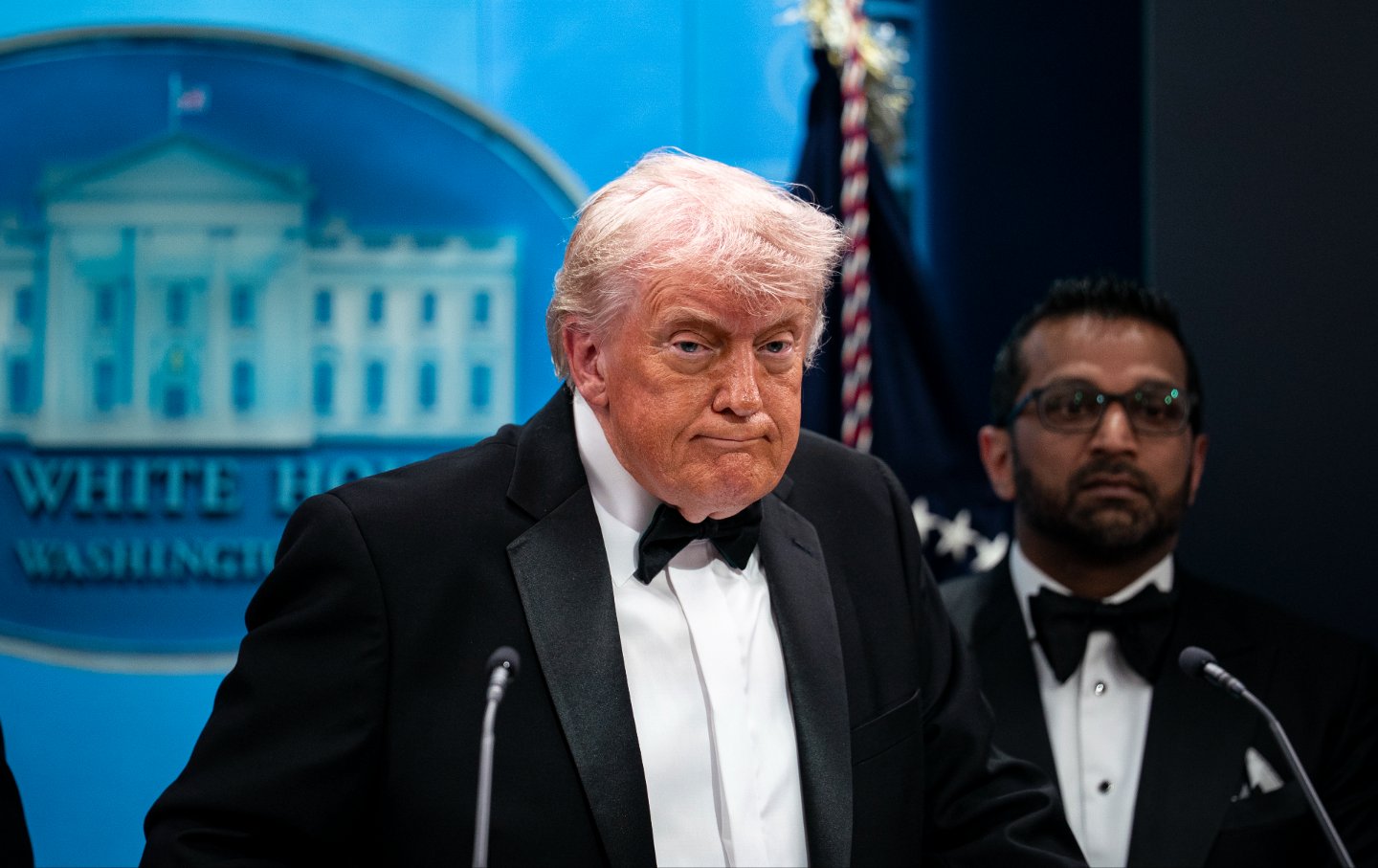
Donald Trump speaks during a press conference in the Brady Briefing Room of the White House on April 25, 2026.
(Al Drago / Getty Images)
In the wake of the assassination attempt on President Trump, DC outsiders might sense a veiled threat at the White House Correspondents’ Association’s long-standing insistence on having its annual gala at the Washington Hilton. After all, this is the hotel where, in 1981, John Hinckley Jr. tried to impress Jodie Foster by shooting Ronald Reagan—not an association you’d think Beltway bigwigs would want to embrace. In reality, the so-called “Hinckley Hilton” is one of the only spaces in Washington big enough to host a dinner of 2,000 people or more.
Not that any reporter covering any president wants violence; rather, the metaphor of who is actually welcome at the dinner should appeal to castle-doctrine-loving MAGA Republicans. When the president is invited to dinner by the press at the Hilton, they’re sending a message: You’re on our turf and at our pleasure; the invitation can be rescinded.
There is power in an invite, as the proprietor of Mar-a-Lago surely knows.
Now, after last weekend’s incident, Trump and his MAGA allies have been pushing for future White House Correspondents’ Association dinners to be held on his turf, at the still-mythical ballroom that the president tore down part of the White House to build. But this is a solution to a problem that does not exist.
For one thing, the security cordon at the Hilton did not fail. The would-be assassin was brought down at the very first barricade he met. It is not even clear he got off more than a single shot (it’s not even clear that he hit someone). The Secret Service determined how close to the president they’d allow someone with a gun to get. That’s where they put the magnetometers. That’s where Cole Allen was stopped. The system functioned exactly as it should.
But Trump has never met a functioning system that he didn’t try to break—and the real impetus for his suggestion to take the dinner in-house is not security, but control.
Current Issue

The metaphor of watchful hospitality should be on everyone’s mind every time Trump or his cronies bleat about moving the correspondents’ dinner to his metastasizing monstrosity, because the change of venue would reverse the current roles entirely: The press, nominally celebrating its independence, would be the guest of the president at the most well-guarded private residence in the country. If he decides someone should go, there are plenty of guns to be trained on them when he demands that they leave.
The problem of who is inviting whom to the dinner is both logistical and ideological (as most logistical questions also are). Currently, the new ballroom is set to seat 1,000—or about half the number of guests the WHCA usually invites. Trump might already be scheming to use the WHCD as an excuse to expand his pet project further, but even if the gilt and plaster bloat to house 5,000, there would still be an issue. That’s because the number of guests doesn’t matter nearly as much as who decides who those guests will be.
Another niggling question: If the president is the host, who’s underwriting the whole affair? Traditional media organizations wall off their correspondents from accepting anything from the officials or candidates they cover. The White House charges reporters to fly on Air Force One; journalists even have to pay $50 for every meal they eat on the plane. A news organization covering the president on a foreign trip can wind up paying the White House travel office $100,000 or more for the (dubious) privilege, including the flight, temporary office space near venues, hotels, and even wifi. Will they have to pay to dine at the White House? Or will they make the ethically questionable decision to party on the president’s dime?
Don’t forget: The WHCD is presumably a fundraiser in addition to a festival of source-lubing, and already the margins are impossibly thin. One Columbia Journalism Review analysis back in 2018 found that the 2017 dinner cost over $500,000 to put on and brought in $800,000 (largely from selling tickets and tables). Some of that money (about $102,000) went to scholarships, but most of it paid for the costs of running the association, which exists mainly to coordinate coverage of the White House, sponsor programming like panels and lunches, and, not incidentally, put on the dinner itself. This year, the WHCA announced that it had awarded $156,000 in scholarships, “the highest amount since it started scholarships more than 3 decades ago.” But, adjusted for inflation, about the same as 10 years ago.
(CJR queried the head of the association about whether the event could really be described as a scholarship event, given that split, and was told that the website description as of that year was “out of date.” The current description states more clearly, “Our annual dinner is our main source of revenue to finance all of our work.”)
There is no compensation arrangement where the White House hosts the event that isn’t fraught with conflict. The idea that taxpayers should fund the dinner is outlandish. The president’s donating that amount of money (over a million dollars adjusted for inflation) to a press organization to fund his own coverage would be unseemly, to say the least. The White House’s getting to name its own price for providing the space, staff, equipment and meals invites grift. It’s tough to say which arrangement appeals to Trump more.
That Trump can imagine hosting the association shows again Trump’s savant-like cunning for cutting through the artifice of traditional Washington relationships. After boycotting the dinner for years, Trump’s visit that weekend ignited such an affection for the event that he has made perpetuating it a personal cause. As he told Norah O’Donnell on 60 Minutes the next Sunday, “I think they were happy to see me there, actually.… There was spirit in that room. I mean, it was like the whole country was together. It was pretty amazing. It made a big impression. It was very nice to see.”
Popular
“swipe left below to view more authors”Swipe →
Trump’s newly discovered passion for the press corps’s social engagement, and his insistence that the “show must go on,” has less to do with bravely “going on” and much more to do with “the show.” It’s not about the assassination at all, but rather his gleeful discovery of the truth of what the correspondents’ dinner is really for: flattery and pomp. After Barack Obama mocked his birther conspiracy enthusiasm in 2011, Trump could only bear going once more over the next 15 years. Now he’s ready for a permanent seat. A gentle roast gave him more PTSD than a gunman who stormed the event with the intent to kill.
The association itself has been unduly, respectfully quiet about the potential new arrangement; it’s difficult to believe that White House reporters are not acting out their newly enriched trauma bond. Perhaps they feel that a nod in any direction, accepting or rejecting, would be read as “political,” and they’re not wrong: It’s just that there’s only one answer that’s also correct. You do not eat where you shit, even if the White House press corps is doing far too little shit-stirring in the briefing room these days.
From illegal war on Iran to an inhumane fuel blockade of Cuba, from AI weapons to crypto corruption, this is a time of staggering chaos, cruelty, and violence.
Unlike other publications that parrot the views of authoritarians, billionaires, and corporations, The Nation publishes stories that hold the powerful to account and center the communities too often denied a voice in the national media—stories like the one you’ve just read.
Each day, our journalism cuts through lies and distortions, contextualizes the developments reshaping politics around the globe, and advances progressive ideas that oxygenate our movements and instigate change in the halls of power.
This independent journalism is only possible with the support of our readers. If you want to see more urgent coverage like this, please donate to The Nation today.
More from The Nation
The new consensus is that the American empire is in steep decline.
In this week’s Elie v. US, our justice correspondent explores the GOP’s glee over the Supreme Court’s Voting Rights decision. Plus: Elie’s take on Musk v. Altman.

DNC chair Ken Martin has turned himself into the shifty bad guy from Fargo.